
The Gallery Industry

Michael Marriott installing Wood Metal Plastic in the Unit.d space (image: courtesy of Unit.d).
Down a backstreet in east London, bordering Stonebridge Gardens at the rear of Haggerston Overground Station, a new design gallery is taking form – ready for its launch on 12 March. Except, “gallery” may not be the right term to describe it. “The wording is definitely tricky,” concedes Duncan Riches, the space’s founder. “I was very nearly not going to call it a gallery, but then realised that I didn’t have a better word for it.”
The wording for the space is, perhaps, tricky precisely because what it is trying to capture is itself unfamiliar: Riches’ venture, which he has christened Unit.d, is without clear precedent in the contemporary London design scene. The space is gallery-like inasmuch as it is a blank, white-walled space that will be periodically filled with different shows of contemporary design, serving as a display hub and social incubator for the city’s designers. So far, so gallery. “I want it to be somewhere where we can all get together,” explains Riches, a design writer and strategist who is widely known for his curation of the annual Shoreditch Design Triangle festival. “I think there is a need for spaces where [the design world] can get together and be a bit celebratory, because I feel like that's something which has slightly gone out of our London scene in recent years.”
Yet despite this gallery-like function, there are other ways in which Unit.d resists the tag. In place of luxury or editioned design, the space has been curated by Riches as a vehicle for industrial design made in batches or large production runs, with a focus on everyday, affordable objects. The space’s debut show is Wood Metal Plastic, a display of small objects designed by Michael Marriott, with an additional contribution by Jasper Morrison. “They're all new things, but they're all very little things, which is kind of fun,” Riches explains, with price tags for the objects on display kept low by the nature of the products: a key ring, a shelf bracket and a hook. The Omi keyring, Morrison’s contribution, is a neat ring of metal, shaped a little like a miniature spyglass, while Marriott’s curled wall-mounted Homer bottle opener is accompanied by his Monza shelf bracket, which makes use of steel’s “natural springiness” with its elegantly looped metal wire construction.

Marriott’s Homer bottle opener (image: courtesy of Unit.d).
Riches’ focus on smaller, accessible objects of this kind is informed by his own experience, which has seen him frequently collaborate with exhibition spaces and design stores through his work in Shoreditch. “I’m very supportive of that world, but I think my own interest has always been in more accessible design and everyday objects,” he says. Given that a large proportion of its contemporary design stores and galleries predominantly cater to the luxury or contract market, Riches acknowledges that an issue of access to contemporary design for wider demographics has grown up in London. “It can feel that we’re at a point where [spaces] aren’t selling objects that anyone under the age of 35 could realistically afford,” he says. With Unit.d, the traditional logic of the gallery as a space devoted to the appreciation and sale of exclusive, highly-crafted objects is subverted – instead, Unit.d has been conceived of as the gallery as a distribution model for everyday, industrial objects whose own innate value is perhaps less obvious until they arrive in a person’s hands.
In this regard, inspiration came from one of the space’s inaugural exhibitors, Marriott, whose online store Wood Metal Plastic (from which the Unit.d exhibition takes its name) is devoted to the sale of modest objects for the home (designed by both Marriott and others): a collection of tools, furniture, lighting and assorted gewgaws that resist the posturing and ego of much contemporary design, and instead focus on ingenuity and utility. Riches acknowledges the influence of Marriott’s store on his thinking, but also the Sori Yanagi Appreciation Society, an initiative that he and Marriott founded together in 2024 and which resulted in a book a year later: a collection of anecdotes sourced from contemporary designers about their favourite objects designed by Yanagi, an industrial designer of everyday tools and homeware, noted for his dictum that “true design lies in a realm counter to trends.”
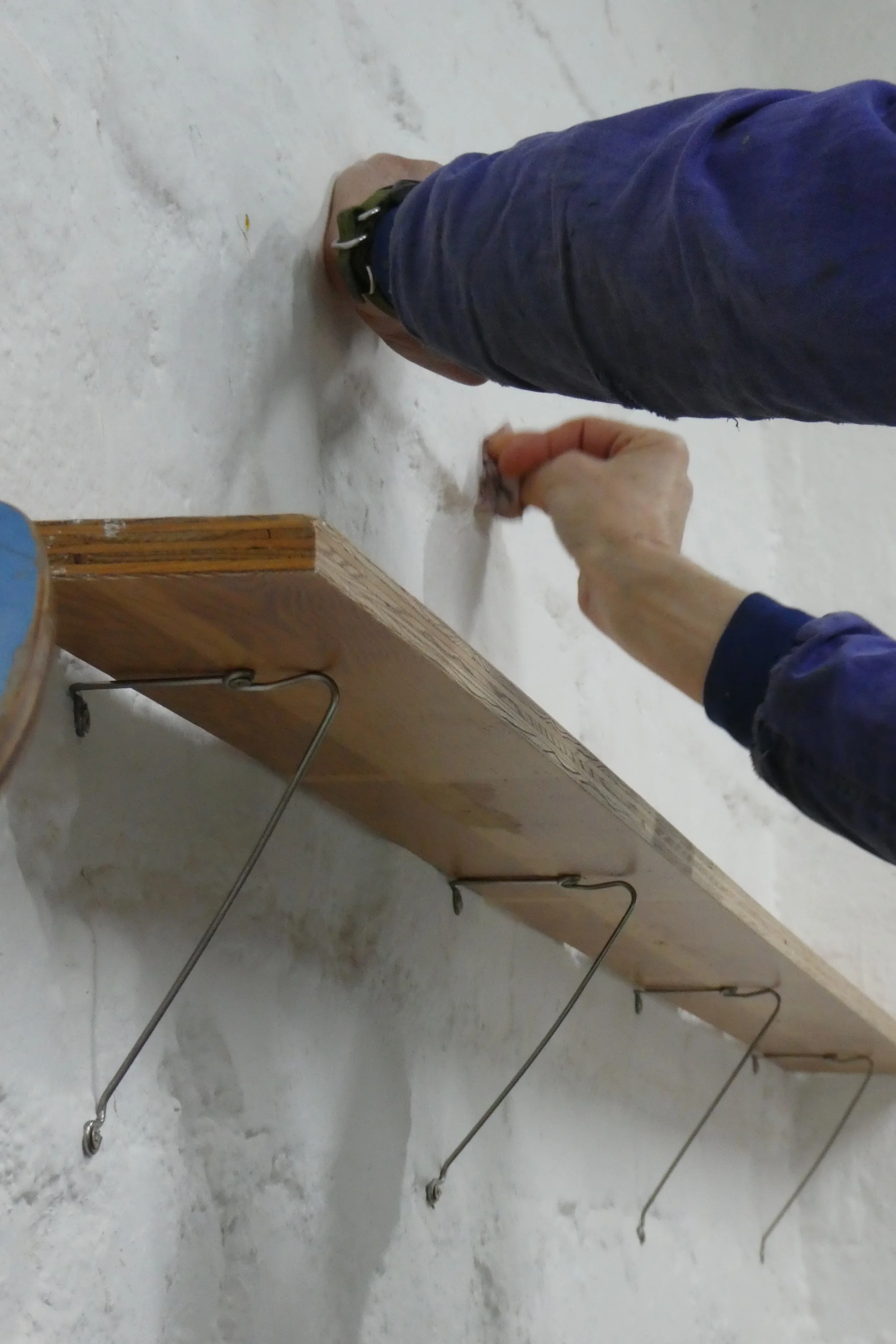
The Monza hook, designed by Marriott (image: courtesy of Unit.d).
“The thing that was incredible was the depth of emotion that people showed in their responses,” Riches explains, with contributors paying tribute to Yanagi’s cutlery, kitchen tongs, steel bowls and more. “The reality is that [Yanagi’s] products are available in every hardware shop in Japan – they’re not inaccessible objects; they’re objects that people use every day. But we were getting stories from people about how much they loved their kettle and how much he had touched people. That really left an impression on me in terms of saying that you need to get products like these into the hands of people, because once they have them every day in their lives, they take on another kind of quality.”
This emphasis on retail and access will be key to Unit.d. Each month, the space will be open as a selling gallery for one week, with the remaining three weeks in the month seeing the venue occupied by an art gallery called Terrace. Unit.d’s online store, however, will remain open year round, with a select number of pieces from each show added for permanent sale to the gallery’s online collection. “I'm very much aware that if we're going to do something which isn't expensive designer objects, we're going to have to sell a lot of them to make it make sense,” Riches says. “But I'm also hopeful that if we can create a platform where it works and people are interested, then we might get to a situation where we can say to a designer, ‘We'll sell X many of this piece, so you can now go to a producer and work out whether you can get that made or not.’”

Jasper Morrison’s Omi keyring (image: Marcia de Michele).
A connected impulse undercutting the entire project, Riches notes, is to offer designers the freedom to work with batch production while retaining creative control over their output – producing designs whose value they believe in, made viable through the economies of scale. “Michael has kind of pioneered that a bit with some of the products he's done with Wood Metal Plastic, and I think that there’s an appetite from other designers to try and work in that way as well,” Riches explains. While he acknowledges that the UK “doesn’t have the kind of manufacturing we did in the past,” he is optimistic about the potential for platforms that can encourage deeper interaction between designers and manufacturers around the country. “I think that we know we have some issues in terms of the connection between industry and design,” he says. “But it’s an area we should look at.”
In this spirit, Unit.d’s early programme is eclectic, with exhibitions planned with Travel Things Museum, Andu Masebo, Mentsen, Alexandra Gerber and Studio Mama, all scheduled to happen ahead of a planned month-long recess in August 2026. Riches intends for the space to be open to designers at different stages in their career, as well as welcoming practices that focus on different outputs within the sphere of industrial design. While Marriott and Morrison may represent established talent in London’s design scene, figures such as Masebo and Gerber are more recent arrivals whose perspectives on the discipline open up new possibility for the practice and, in turn, the space. “The most important thing for me,” Riches says, “Is trying to match people up with it who have an interest in making everyday objects.I feel like there is a really good new energy with some of the younger talent coming out now , which I haven't really felt for a while. We'll definitely be wanting to get some of them in and making them feel included, because I think that it’s important that there isn't a gap between [generations].”
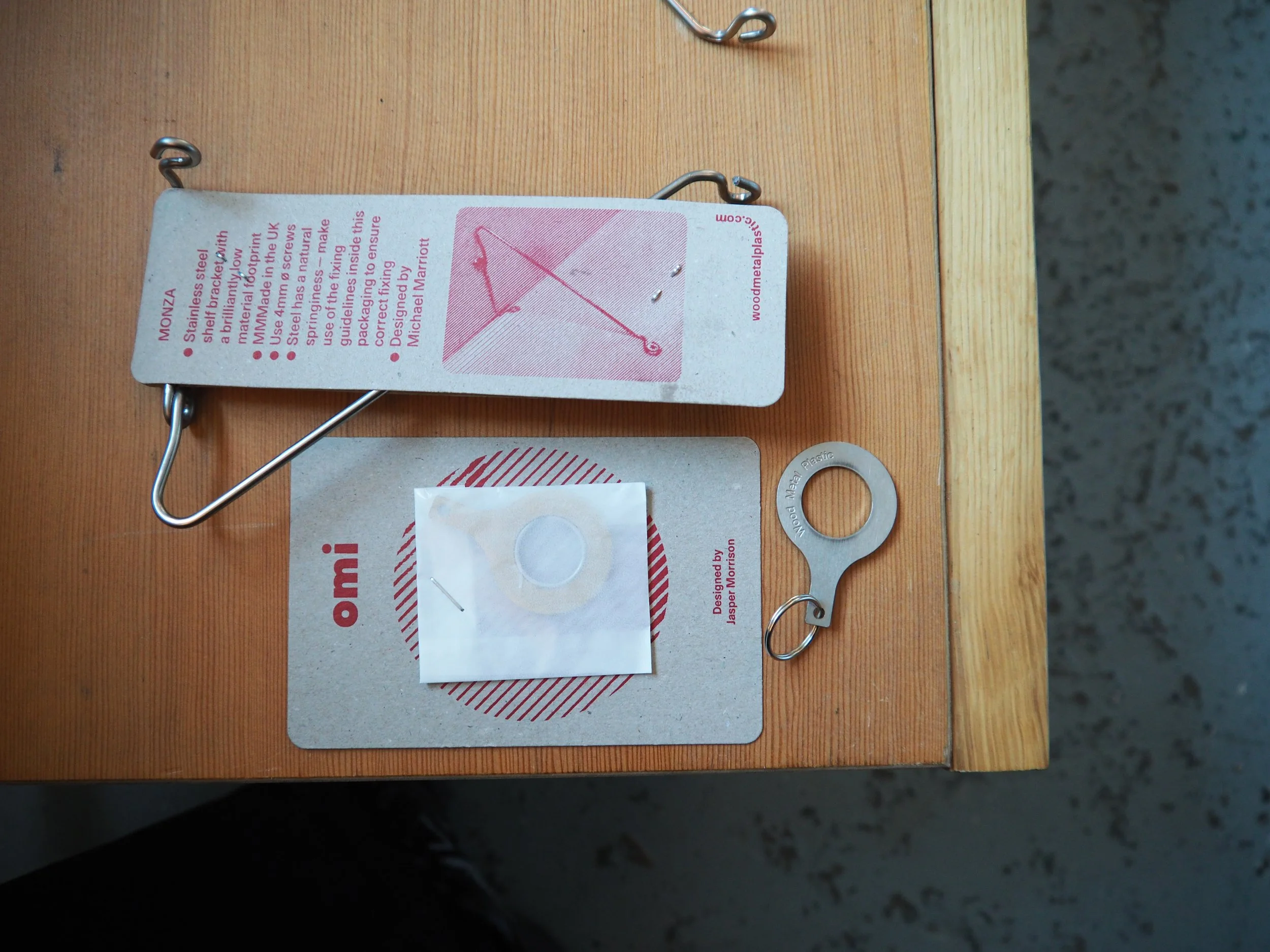
Packaging for the Wood Metal Plastic products (image: courtesy of Unit.d).
This emphasis on community is essential to Riches. While Unit.d is billed as a gallery, it carries none of the connotations of exclusivity or exclusion that often attend the form. Each new exhibition in the space will be accompanied by an in-person opening, with this social element essential to its operations. “There are so many wonderful people in the design industry, particularly in and around East London, that there seems to be a pressing need for a space to corral around, a place to celebrate work, each other, and share good ideas,” the gallery explains in its press release. In this respect, as with every other element of the project, the wording is important. The gallery’s name, derived from the fact that the building in which it is based is carved into units, offers both a nod to the historical Design Research Unit – the UK's first design consultancy, which was launched in 1943 with the ambition of “[carrying] out research into the needs of the consumer and the potentialities of industry, and to evolve from these researches types of design which in every case are functionally efficient and aesthetically pleasing” – as well as a gesture towards Riches’ social ambitions for the space. “It's a kind of unit for design, so I felt we could call it ‘Unit.d,” he explains, “but when I sent it to my partner Luciana [Britton Newell], who has done all of the graphic design for the space, she immediately sent it back to me saying, ‘That looks like ‘United’.’ And so I was like, ‘OK, we've got a name, because what I most want this to be is somewhere where the whole design community can get together.”
Unit.d opens on 12 March at 4 Frederick Terrace, E8 4EW.
Wood Metal Plastic will be open daily, from Thursday 12th to Sunday 15th March 2026.