
Spectrum
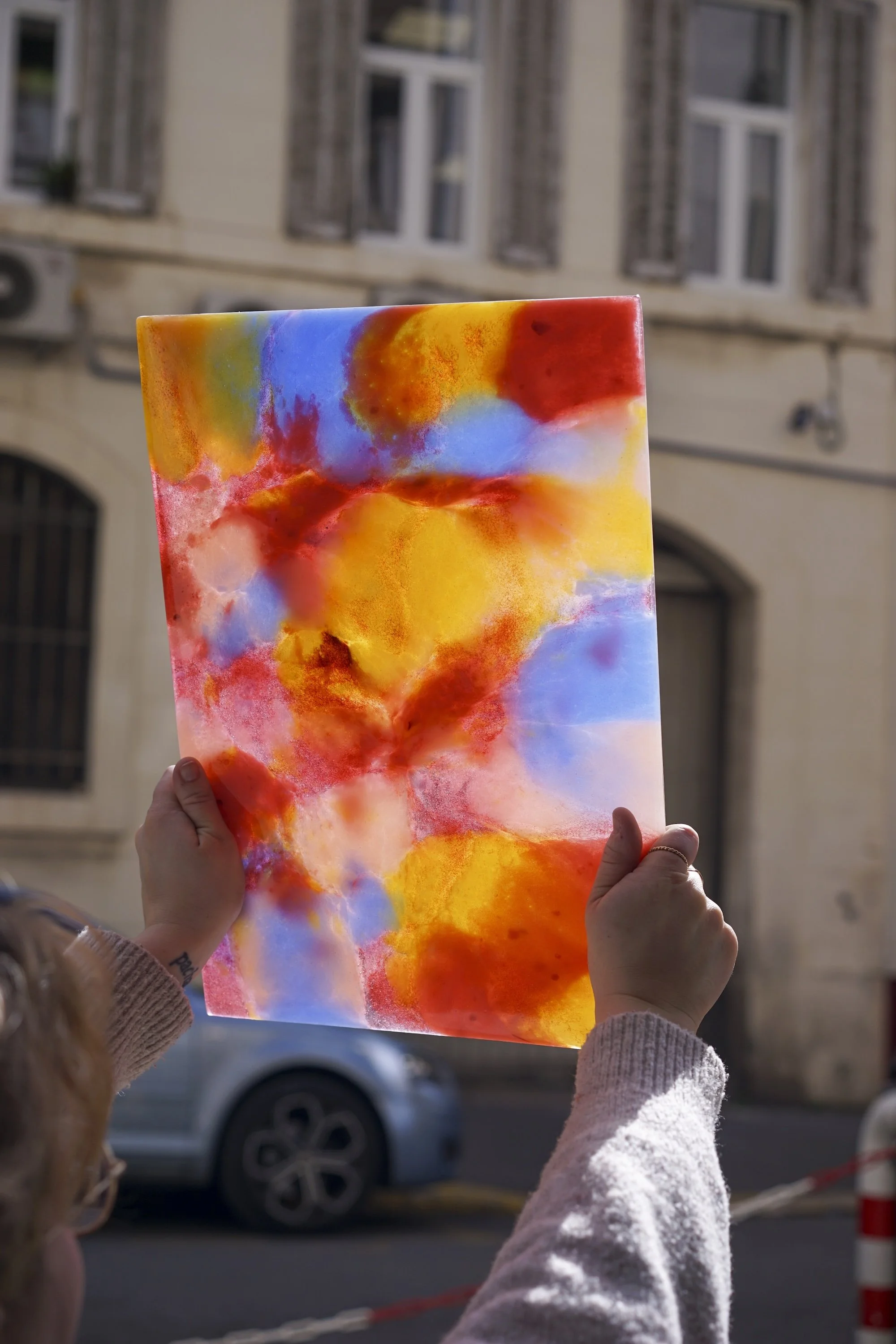
Studio Brynjar & Veronika’s pâte de verre windows are made using a glass technique that has been celebrated for its capacity to mimic natural stones (image: Studio Brynjar & Veronika).
Presenting through a Zoom window on my laptop screen, designers Brynjar Sigurðarson and Veronika Sedlmair are, curiously enough, showing me a presentation of windows.
Sedlmair clicks a button and my screen is filled with colour: a window of raspberry glass rippled with electric blueberry and honeyed amber. Another click, and this pane is replaced with a sheet swirled with glass nebulae of deep violet, into which fold seams of indigo and lime. “Right from the start, we knew this was about colours,” Sedlmair explains from their studio in Immenstadt, south Germany, as the next window appears, its blooms of candied peach growing around sprays of golden pear. “You enter the colour,” Sigurðarson adds. “You don’t look at it.”
Sedlmair and Sigurðarson’s windows, produced under their Studio Brynjar & Veronika banner, are the fruits of a longterm research project with Cirva, an international glass research centre in Marseille. “The biggest part of Cirva is glassblowing, but at the back there is a kind of room dedicated to glass casting,” says Sigurðarson, who began the project during a residency he undertook in 2011 – an award for winning the Grand Prix at the Design Parade 6 festival in Hyères, France. It was in Marseille that Sigurðarson discovered pâte de verre, one of the oldest surviving modes of working with glass and a technique that breaks with contemporary preconceptions as to what glass is or could be.
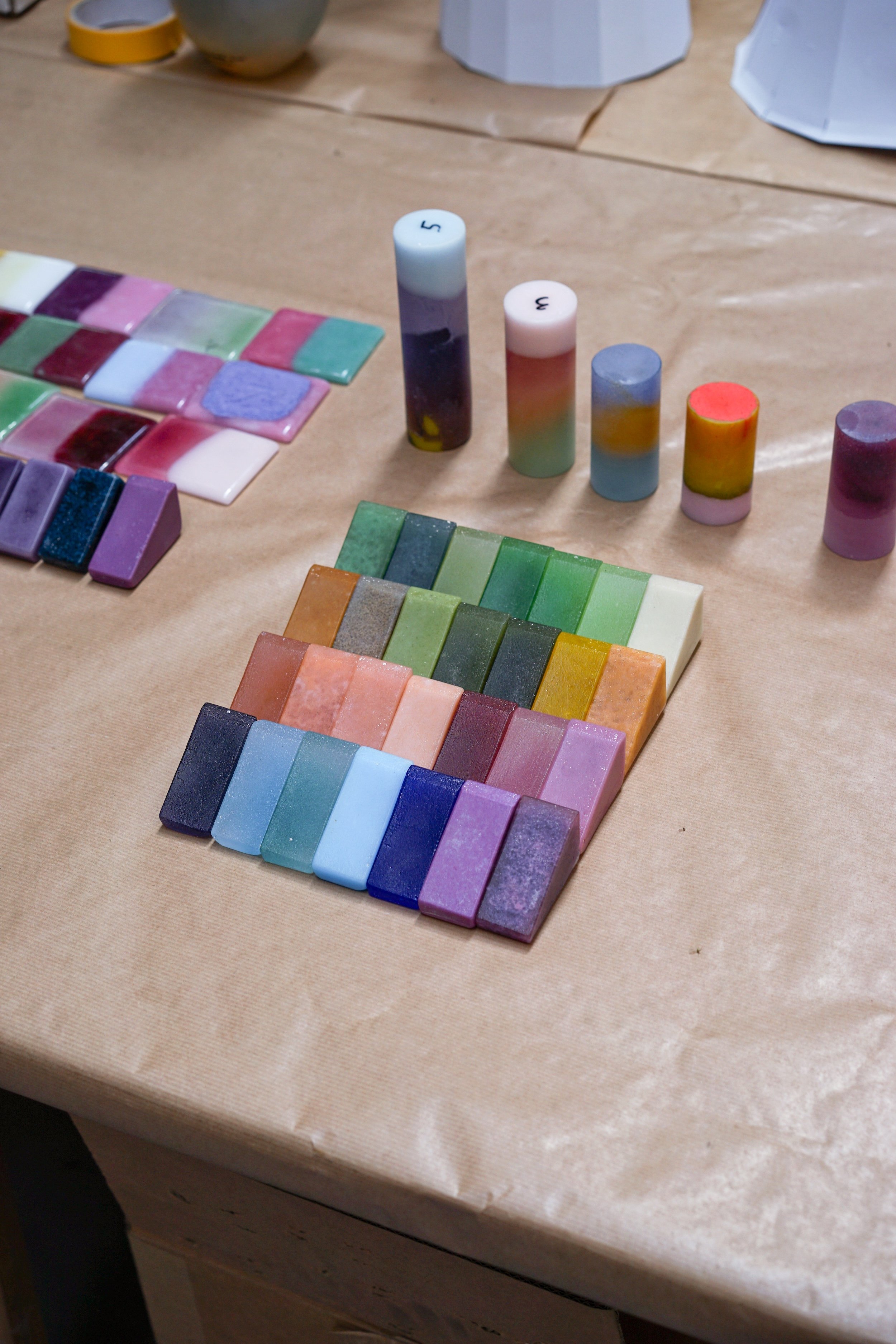
Glass colour samples, developed at Cirva in Marseille (image: Studio Brynjar & Veronika).
In contrast to the molten material used for blown glass, pâte de verre is produced from a paste made of crushed or powdered glass that is mixed with a binding agent. This paste is layered up in a mould and then fired to fuse the glass particles and create a material whose aesthetic runs contrary to the brilliance of contemporary glass. Rather than transparent and glinting, pâte de verre is opaque or lightly translucent, with a texture that seems igneous or sedimentary, its firing revealing colours that recall minerals dredged from the earth. “It’s an aesthetic that somehow looks not like glass,” Sedlmair notes, with the technique having been used widely throughout antiquity as a form of decoration, and exploited for its capacity to mimic the textures and colours of semiprecious stone and rock. “Emulation is always the first thought for making with all new materials,” note glass artists Max Stewart and Tone Ørvik in their 2022 book Pâte de Verre: The Material of Time, “and for the majority of its 5,000-year history, glass’s main purpose was as a simulation.” This, Sedlmair notes, is the appeal of this approach towards glassmaking. “The material can look like stone or have these more milky, mineral textures,” she explains. “In glassblowing this would be a defect, it’s seen as not ‘clean’. But in our case, we really like these effects.”
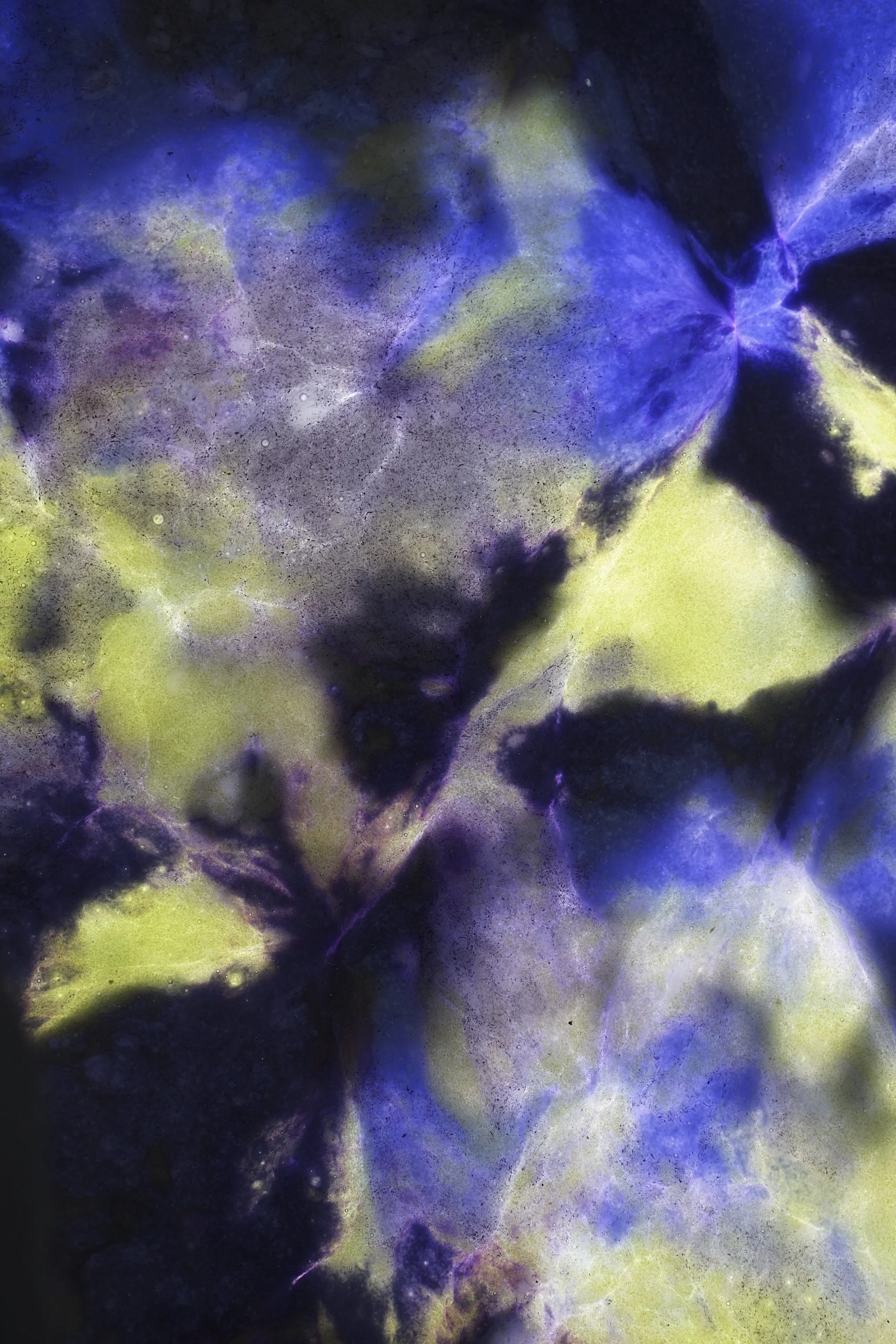
Pâte de verre’s colours and grainy textures fell out of favour after the development of transparent glass (image: Studio Brynjar & Veronika).
Sedlmair and Sigurðarson’s interest in using pâte de verre and associated techniques is comparatively unusual. With the advancement of glassblowing and the development of transparent glass during the Roman era, pâte de verre’s usage, as well as its perceived value, declined sharply. The ingenuity and artistry of earlier pâte de verre was gradually hollowed out, such that by the Middle Ages little was left beyond its capacity to cheaply imitate gemstones. “Instead of relishing the fact that glass was a man-made material, which could be made to rival the original,” write Stewart and Ørvik, “it was the disguise, the chameleon nature of the substance, and the act of deception that became the principal guiding factor; the mimicry made it appear vulgar and cheap.” Even with a resurgence in popularity during the late 19th century, when sculptor Henry Cros was credited with resurrecting the technique and giving it the name by which it is now known, pâte de verre has remained in the shadow of other glassmaking traditions. “There’s not so much knowledge in this area,” Sedlmair suggests, with pâte de verre’s aesthetic running counter to contemporary preconceptions around glass. “[We] are living in a curious age where glass’s primary characteristics are considered to be transparent, colorless, and shiny – or variants of those three things,” Stewart and Ørvik note. “[…] In the modern world the ‘glassiness’ of glass is considered its true value. Invisibility is everything. But throughout its own particular history, pâte de verre was not that.”
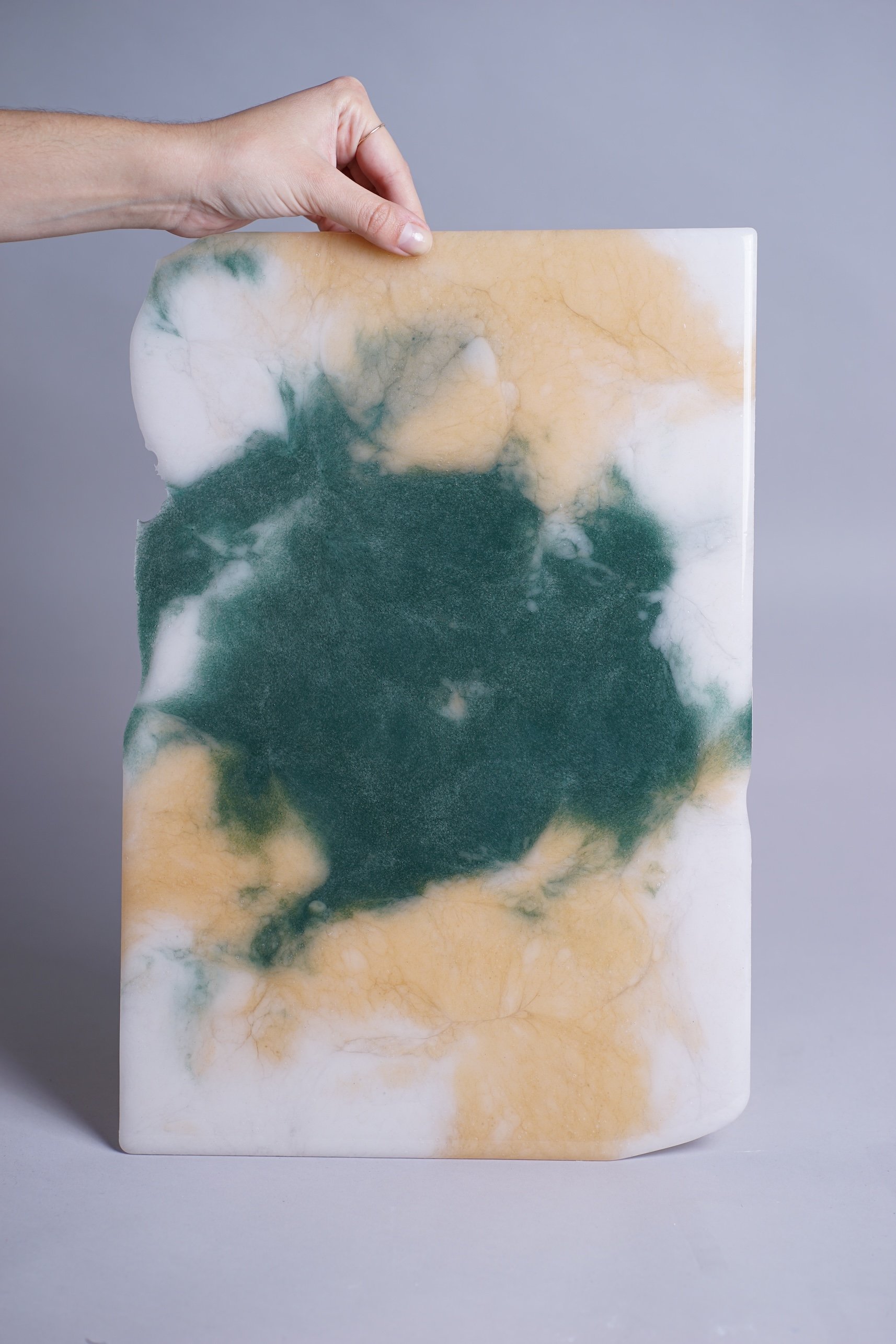
The studio created colour recipes inspired by natural phenomena, such as moss, clouds and dirty snow (image: Studio Brynjar & Veronika).
This contradiction in the nature of pâte de verre intrigued Sigurðarson during his time at Cirva, with initial experiments resulting in Spectrum (2012), a vase whose glass form sees forest green diffuse through smoked white. When Sedlmair joined the studio in 2014, the pair resolved to revisit this technique – something they achieved in the summer of 2019 when they began working with Valérie Olléon, a glassmaker at Cirva specialising in cast glass, as part of a new residency focused on the technique. In particular, the group were keen to explore the colour potential of this form of glassmaking. “It has some sort of a nature to it that you don’t really achieve in glassblowing,” Sigurðarson explains. “In the end, glass is made from minerals; it’s something that [ultimately] comes from a mountain. To close that circle, or to bring out a new nature in this material, we were quite intrigued by colours that are a bit ambiguous. Colours that are like minerals or which remind us of moss or clouds or dirty snow – things that you would not find in a classic colour catalogue.”
Over the course of their second residency, the designers worked with Olléon to develop colour recipes, gradually building an archive of close to 1,000 different glass swatches. Each tone is created using carefully determined ratios of coloured and transparent glass powders, which are then fired to produce the desired tone. “The glassblowing colours that you get are already a mix of different minerals and densities, so it’s just about how they react [to heat and time],” Sedlmair says, explaining how the team experimented with different firing conditions to achieve their goals. “Our research was in how you can get colour that is stable, both structurally and as a colour.” While bright, clear colours such as reds and yellows are challenging to create using the technique, it lends itself naturally to more mineral, complex tones. “We have a lot of greens, blues, purples, pinks, brown tones and grey – colours that are earthy,” Sigurðarson explains. “They have some sort of a nature to them that is unusual in glass.” The pair now intend for their colour library to be made available at Cirva for other practitioners, allowing for the survival of the technique in the future. “It reminds me of alchemy,” Sigurðarson adds. “This idea of making a recipe to create something beautiful.”
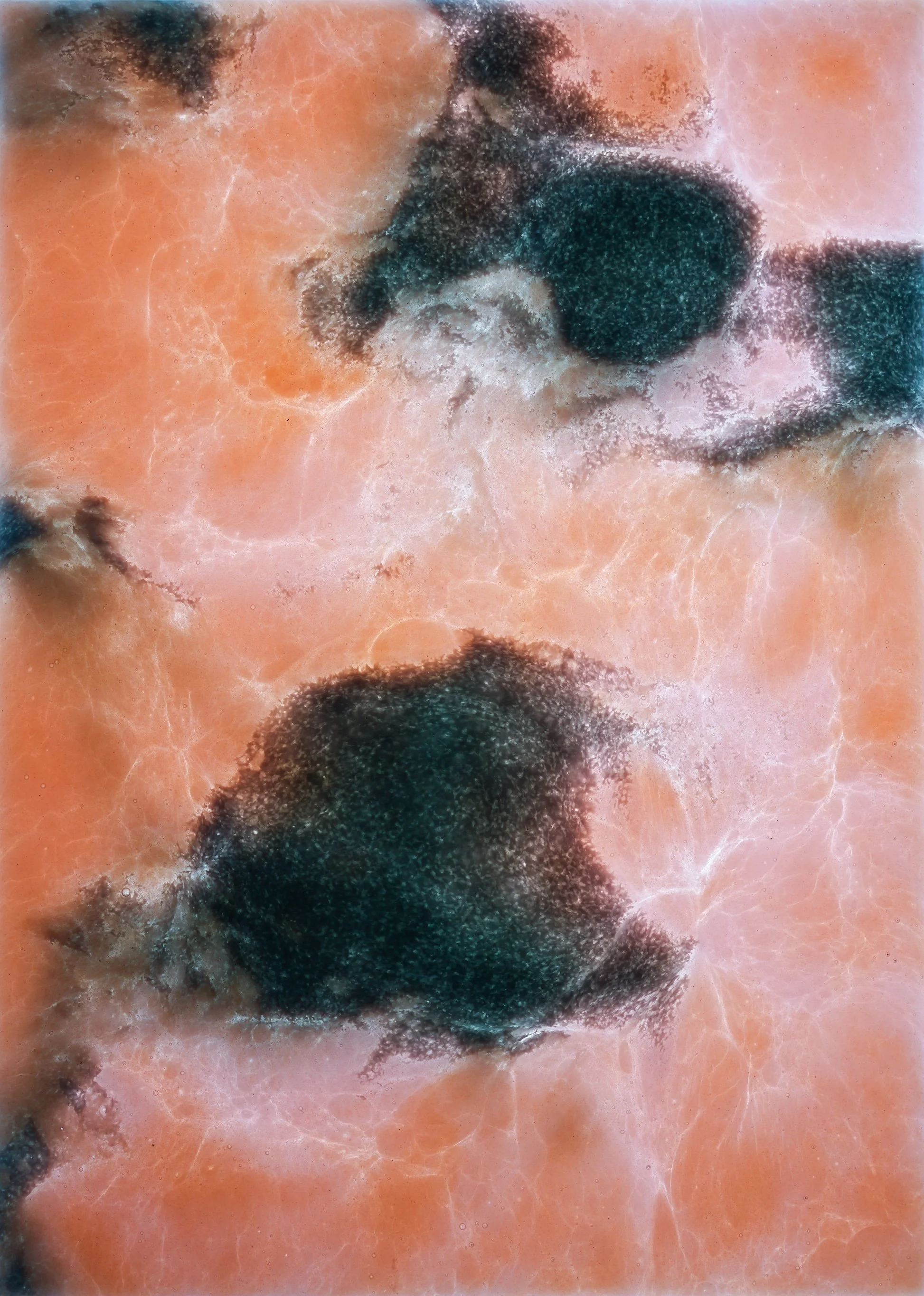
Image: Studio Brynjar & Veronika.
Having developed this colour archive, Sedlmair and Sigurðarson’s attentions have turned towards the practical application of windows. “A window is quite pure in its use of material,” Sedlmair says, explaining the studio’s motivation to create coloured glass panes that can show off their material’s aesthetic qualities. “We have this feeling that with a window, the colour can become the object,” Sigurðarson adds. As such, the pair have begun mixing different recipes for their glass powders and arranging them in patterns before firing, with the resulting colours bleeding around one another like watercolours. When unlit, the panes resemble sheets of rocky marble, but as light passes. through the material, these windows ignite, burning into candy-bright whorls of colour. The opportunity to install these windows within contemporary architecture, Sedlmair says, is their “ultimate dream” with the project. “At that scale,” she explains, “there can be that feeling of being overtaken by colour.”
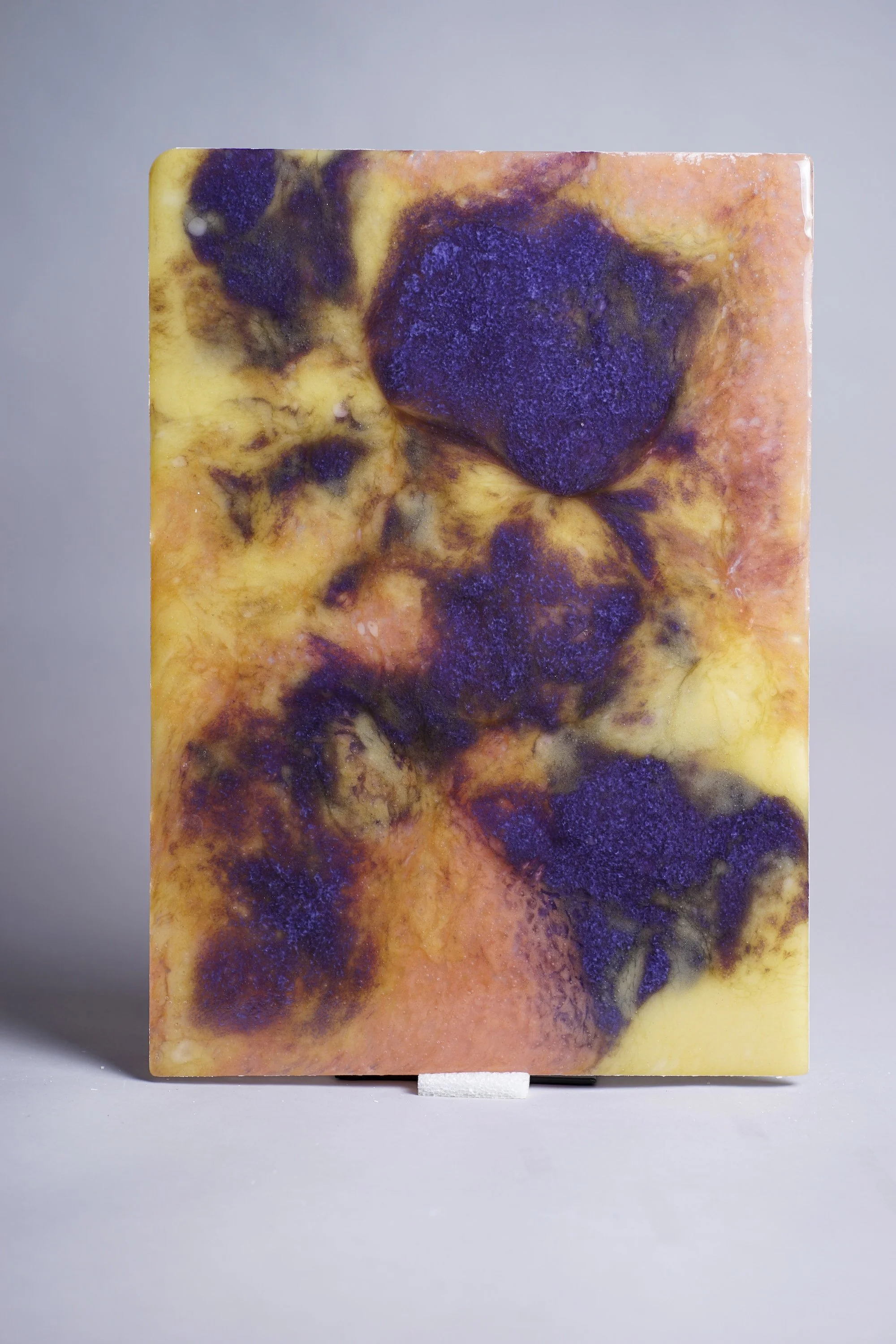
Image: Studio Brynjar & Veronika.
Sigurðarson and Sedlmair’s glass windows are not a traditional pâte de verre, inasmuch as they are not made from glass paste, but rather fire their powdered material directly. As such, the windows could, the designers acknowledge, be seen as a belonging to a different tradition of fused glass. “It’s an in-between thing,” Sedlmair notes. “They don’t fall into a clear category.”[1] Nevertheless, Sigurðarson and Sedlmair are also clear that their experiments owe a debt to pâte de verre’s aesthetic and processes – as well as itching at its perceived limitations. “[If] the dominant forms of glass are transparent and blown and liquid, pâte de verre is opaque and compressed and fine grained,” writes glass curator William Warmus in his essay in Pâte de Verre: The Material of Time. “These characteristics have in the past seemed like confounding flaws. You certainly cannot make a cellphone screen from foggy and murky glass paste, nor even a window.” And yet, seen through the window on my laptop screen, Sedlmair and Sigurðarson have done just that.
[1] It is worth noting, however, that the category of pâte de verre is not clear cut either. “[Any] definition and perception of ‘one true methodology’ [within pâte de verre] is nonsense,” write Stewart and Ørvik. Instead, over the course of the technique’s history, they argue, “the general processes of pâte de verre making would often disappear below the surface and the glassmaker’s consciousness for centuries before being rediscovered, reinvented, and renamed.” Even if Sedlmair and Sigurðarson’s windows are not a traditional pâte de verre, this is not to say that they do not have a place in the tradition itself.
Words Oli Stratford
Images Studio Brynjar & Veronika