
In Search of the Long-armed Chair
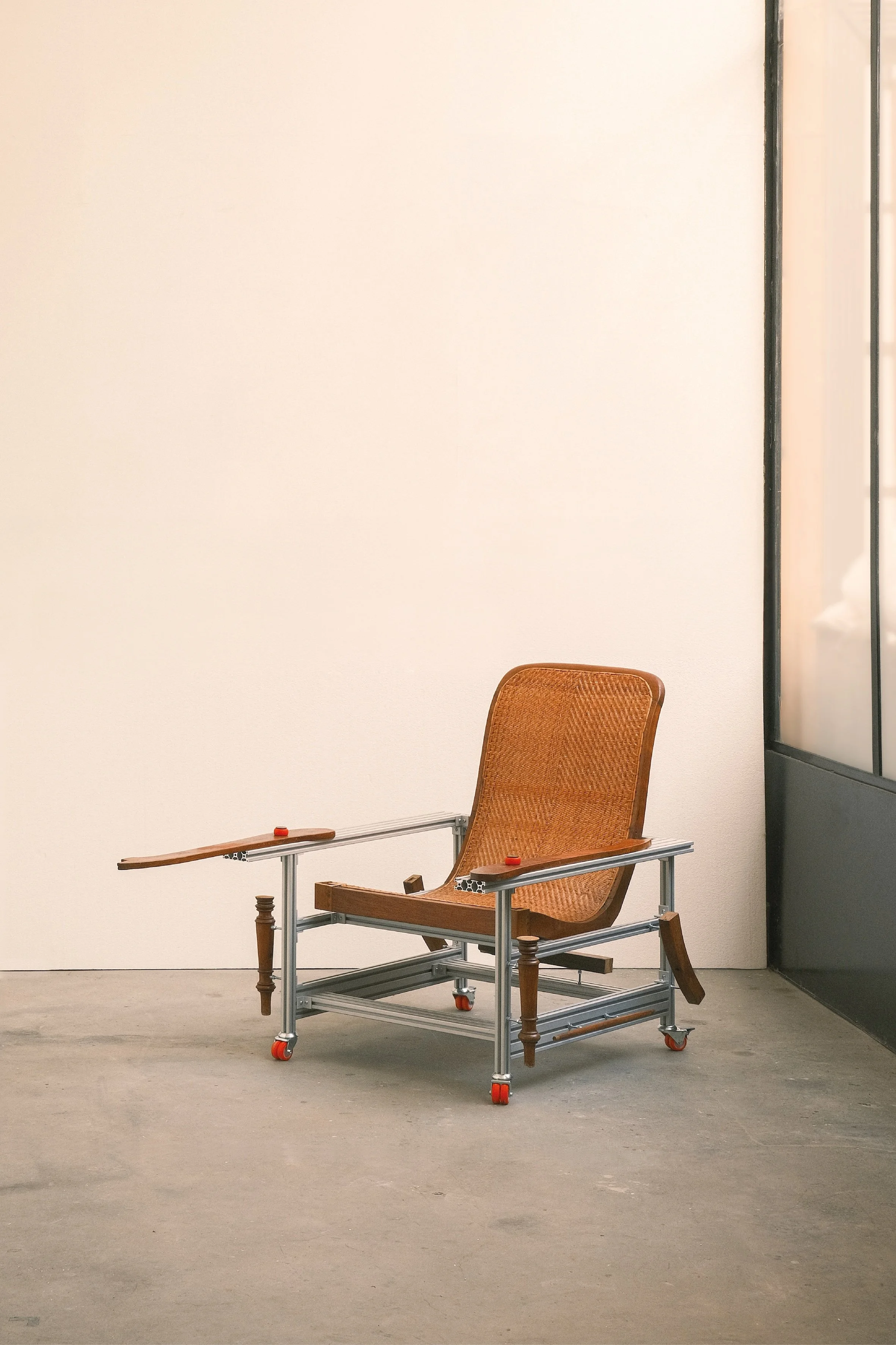
Yassine Ben Abdallah and Mileno Guillorel-Obregón’s Nieuwe Planter’s Chair deconstructs the traditional planter’s chair to critique the legacies of colonialism in modern design practices (image: Hugo Revollet).
Field Notes: January 2024
Location: Kolkata
Condition: Average
Age: 100+ years
Material: Teak wood
Distinguishing features: None
Place of use: NA
Construction: Continuous seat and back
Armrests: Swivel out
Legs: Straight square sections
Seat: Rewoven in plastic
Down the road from the Alipore Jail Museum in Kolkata, a row of cubicle-like stores displays an eclectic mix of furniture. Tables, chairs, cabinets, sideboards, mirrors and other items jostle with one another as they spill out onto the pavement. Some have been restored with new hardware fittings and shiny polish, others are awaiting restoration – dusty, broken, with missing parts. We enter one of the stores and notice a row of worn chairs hanging on the wall. “They look like they are awaiting an execution of sorts,” I muse, recalling vivid images of the jail museum.
Sidhartha, the shop manager, gestures towards the long-armed chair he recently acquired. He tells us that the chair is over a century old. He knows this because it is made of Burma teak, brought into India before the Partition. Using a sharp glass sheet, he scrapes off the dirt and discolouration from the armrest with a flourish, revealing the warm teak finish. Rachel notices the cleverly hidden swivel mechanism under the armrest; considering the chair must have been unused for quite some time, it pivoted out surprisingly smoothly. There are no decorative details on the head rail or armrest, the chair’s woven seat is missing, and its square legs make it glaringly basic and featureless. In its heyday, was it a sturdy and comfortable chair that was used on the verandah after a long day of work? It surely was not a “conversation piece” that could complement the decor of a high-end drawing room. Nevertheless, Sidhartha is confident that once he restores it, there will be takers for the chair in India and abroad.
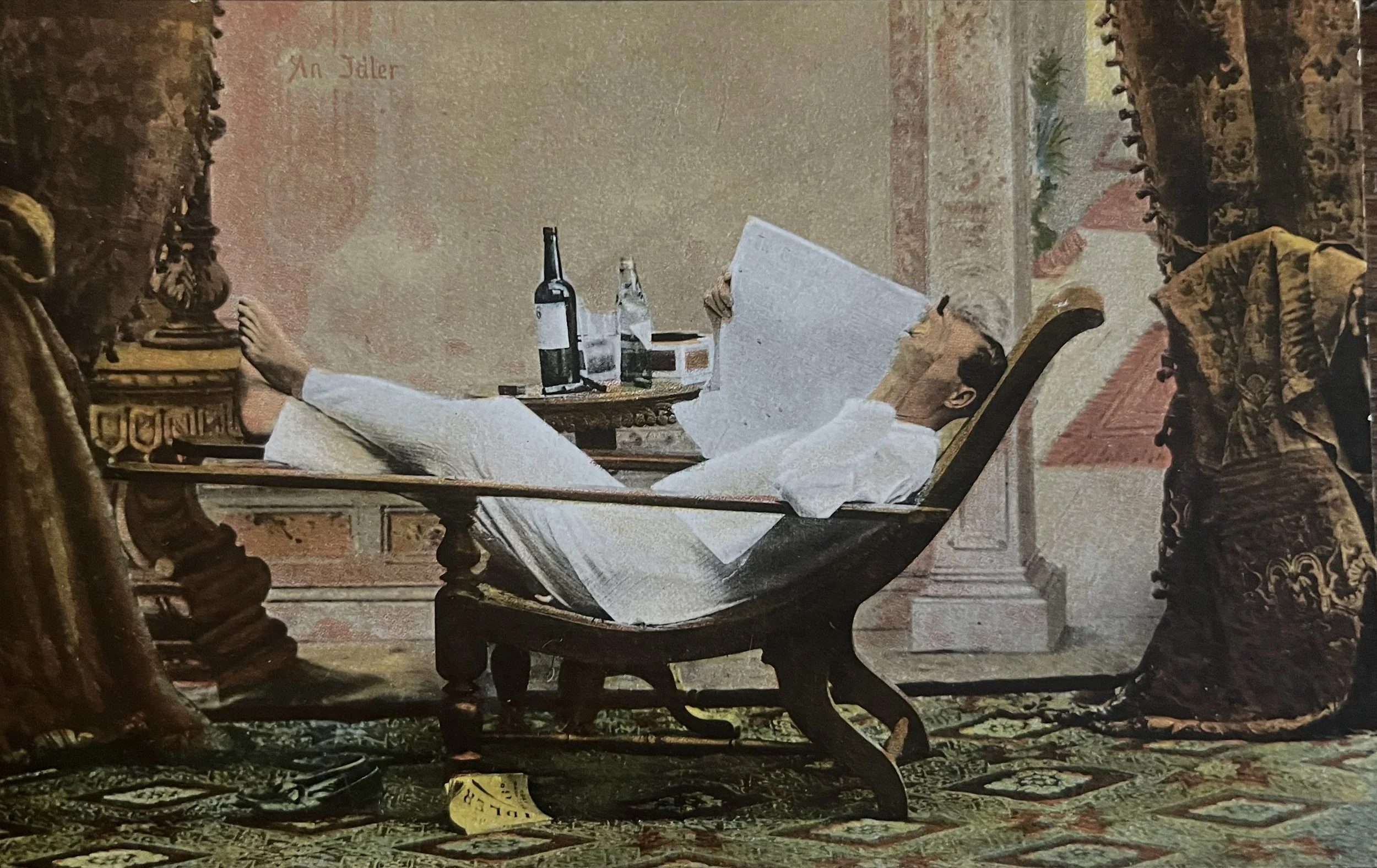
A historic postcard of the chair from the collection of Clare Arni.
Over the last two years we have travelled across the Indian subcontinent, chasing down an object with probable colonial origins, widely known as the “planter’s chair”. Alongside digging through the archives of various institutions across the world, we have collected numerous oral histories from people who own, make, or sell the chair, and photographed it in situ in India, Europe, and Sri Lanka. We found the chair in various locations – from plantation verandahs and social clubs to railway station waiting rooms and libraries. It turned up in colonial and contemporary popular culture – in satirical prints, humorous postcards, Bollywood (and other regional language) films, book covers, poetry, and paintings. Even while it was more character actor than leading star, it appears to have lent itself to a wide range of storytelling. As a conversation piece and symbol of power and privilege, the planter’s chair demands attention: beloved by patriarchs, its extendable armrests make it a champion of manspreading.
Early in our research, we set out to detail the chair’s tangible features. We found that a “classic” version is distinguished by long arms that reach out to provide leg rests, and a continuous sloping cane seat. As our research progressed, however, we expanded our definition to include the variations we discovered, such as chairs with fixed elongated armrests that do not retract, seats made of canvas, padded fabric, or leather upholstery, backs and seats made of separate frames, and chairs with staggered armrests and leg rests.
Despite its large, ungainly frame and spatial demands, how has this design classic survived nearly two centuries of transnational journeys? The chair was rarely embellished with rare or expensive materials, so what has led it to traverse vast geographies, and settle comfortably into the imaginations of diverse communities across the world? The answer seemed to lie beyond its concrete properties. As such, during our field work we also sought out the non-physical qualities or traits that a chair must possess in order to be considered an example of the planter’s chair.
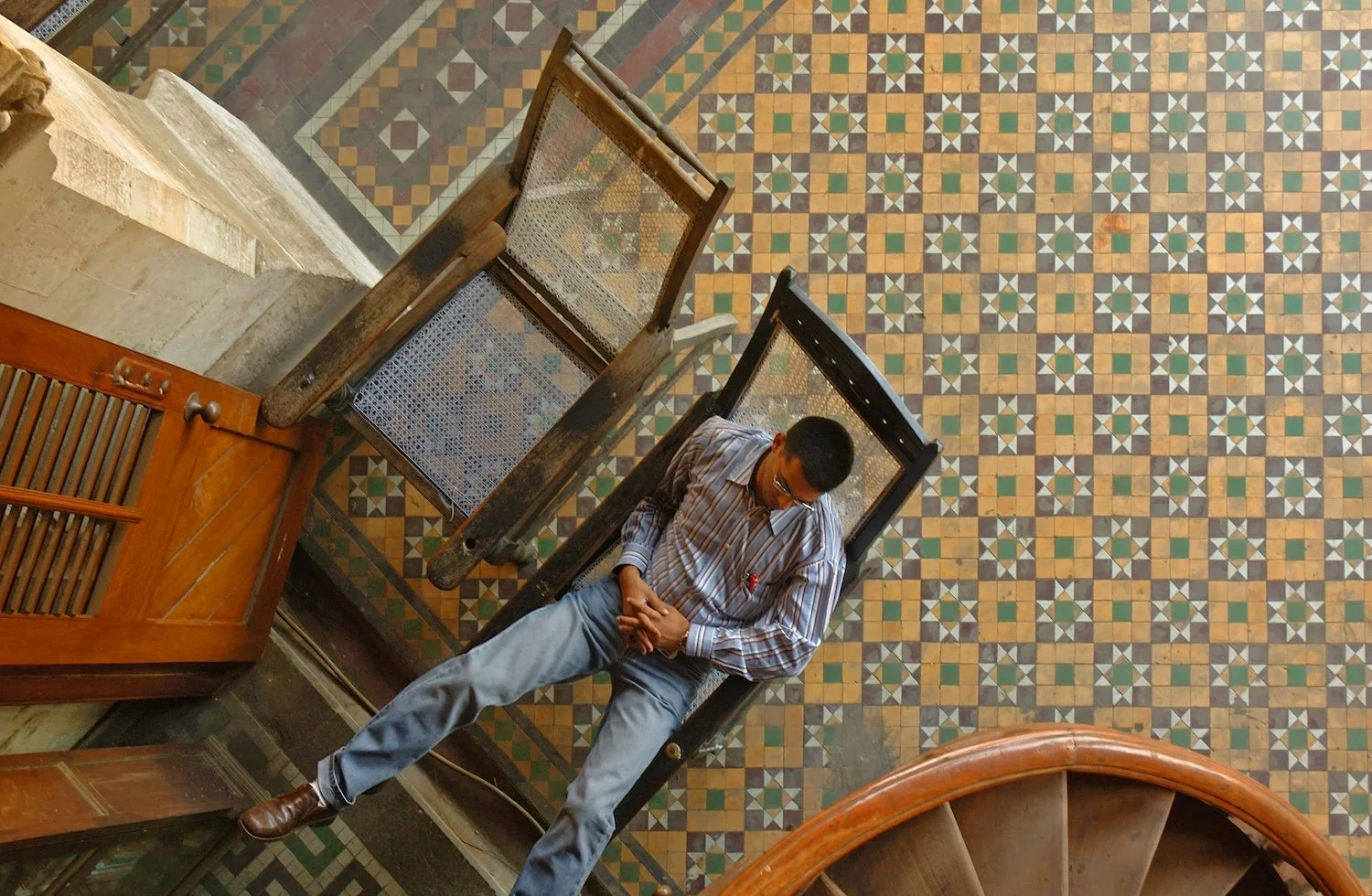
The chair in Mumbai’s David Sassoon Library and Reading Room (image: Rachel Lee and Sarita Sundar).
Originally from Scotland, Rachel first encountered the chair in central Mumbai at the David Sassoon Library and Reading Room, constructed in 1870.
Field notes: August 2021
Location: Mumbai
Condition: Very good
Age: 100+ years
Material: Teak wood
Distinguishing features: Varied
Place of use: Verandah of a library
Construction: Varied
Armrests: Swivel out with no ornamental pin, fixed
Legs: Straight square, spindle and tapered
Seat: Cane cross and diamond weave
On the hushed first-floor verandah of Mumbai’s David Sassoon Library and Reading Room, surrounded by neo-Gothic arches, a man is reading a newspaper. The chair in which he is sitting holds him at a relaxed recline and raises his stockinged feet off the ground. Rather than resting on a separate footstool, his feet are supported by armrests that extend significantly beyond the limits of the chair’s seat. As well as raising his feet, the long armrests also serve to separate them in a manner not dissimilar to a gynaecological examination chair. His posture is simultaneously relaxed and exposed. When I look down the verandah, I realise that all the chairs are variations on a theme. Some have permanently extended armrests, while others feature a pivot that allows the foot support to be tucked away when not in use. Before arriving in Mumbai, a friend from Kolkata had joked with me about such chairs: “Oh, you’re going to Bombay? You should look out for Bombay fornicators!” Confused rather than amused, I quickly googled “Bombay fornicator”, which turned out to be a popular local name for this peculiar chair. And now here I was, on day one of my Mumbai field trip, confronted with a battery of them.
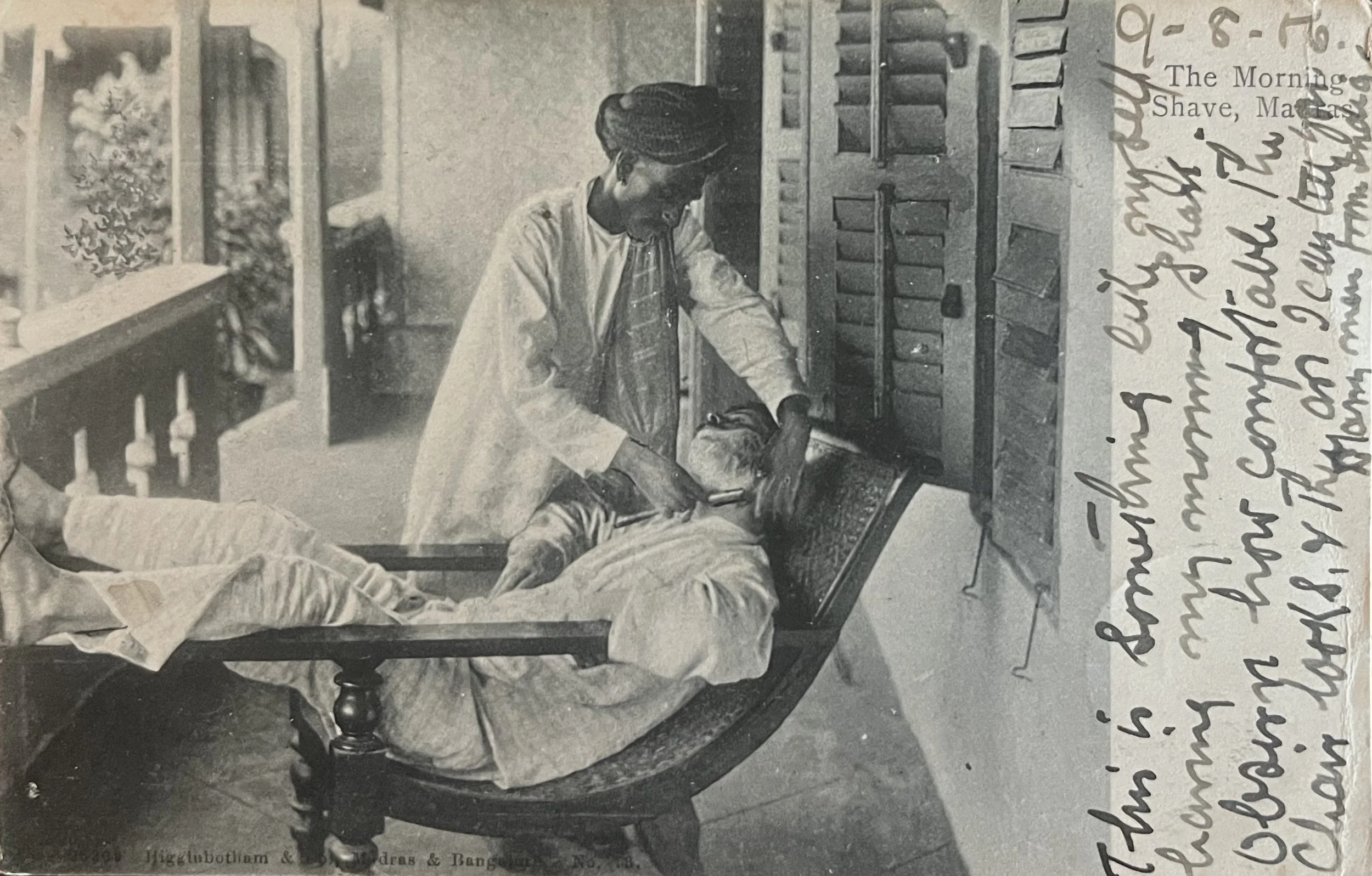
A historic postcard of the chair from the collection of Clare Arni.
For Sarita, her connection to the chair goes back to childhood. From Kerala, South India, she has lived most of her life elsewhere. As a child, visiting her ancestral village from Delhi in the north, she first encountered the chair through her grandfather’s interactions with it.
Field Notes: July 2019
Location: Aliparamba, Kerala
Condition: Average
Age: 100+ years
Material: Teak wood
Distinguishing features: None
Place of use: Verandah of an ancestral house
Construction: Folding
Armrests: Fixed
Legs: Straight, rectangular
Seat: Canvas and cotton
It was the dignity and loftiness with which my maternal grandfather assumed his seat that drew me – and most of the village – to his side repeatedly. The charukasera, or leaning chair, upon which he sat, upon which he spent most of his day, was a standard-issue teak and canvas model. Every morning, a fresh white muslin towel was laid out. Every morning, he would pick it up, shake it out, use it to swat the chair assiduously, stretch it as if to ensure symmetry, and lay it down with utmost precision before assuming his position on the verandah. It was a station of vantage and power, angled to afford prospect of any approaches to the house or of any emerging from within. His percipience and reputation for astute advice saw villagers seeking his darshan, or counsel, often. They were afforded positions, determined by their social standing, across from him on seats much like his: benches with backs; benches without backs; stools; or none at all; where the more confident found spots on the inner or outer steps, and the less stood diffidently in the compound.
I would watch this scene with curiosity when I visited my grandparents in Kerala – curiosity tinged with awe and discomfort. Awe at how my gentle grandfather and chair played a role in this very feudal tableau; discomfort at how my gentle grandfather and chair played a role in this very feudal tableau.[1]
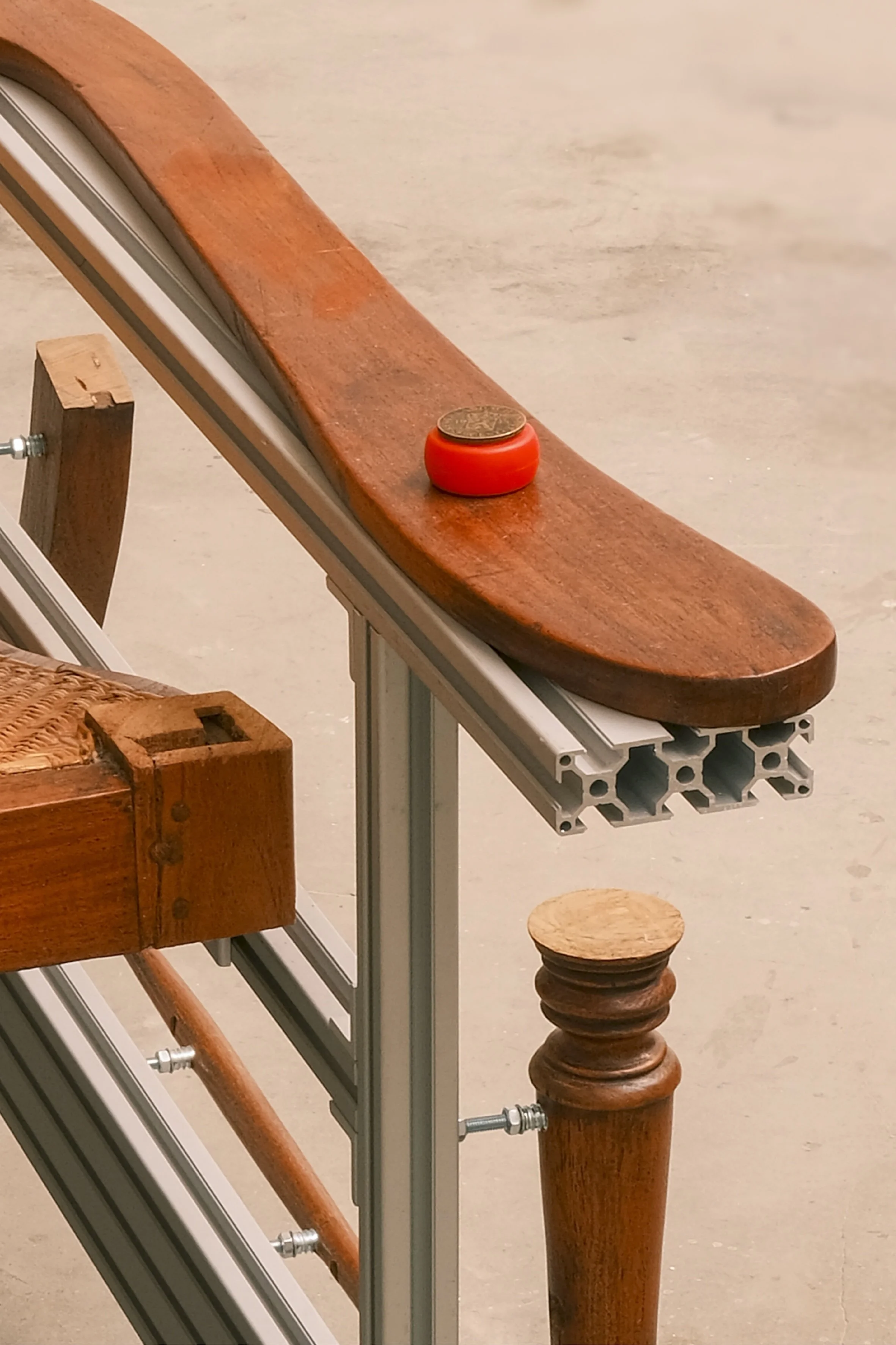
The extended armrest of the Nieuwe Planter’s Chair (image: Hugo Revollet).
Despite our best efforts, we have not been able to determine, precisely, the origins of the chair. Depictions of planter’s chairs in colonial literature and images from the era confirm its association with the British colonial military, leading us to conclude that the chair most likely originated in India during the British East India Company’s dominion in the 19th century. However, the chair’s popular name clearly links it to other spaces, such as the verandahs of bungalows in British-established plantations. Subsequently, the chair crossed colonial borders and planted itself in a variety of settings, such as the Dutch East Indies, where it was known as kursi/krossie gobang in Bahasa or luiaardsstoelen in Dutch.
Field Notes: November 2023
Location: Bangalore
Condition: Good
Age: 100+ years
Material: Teak wood
Distinguishing features: Spindle top rail
Place of use: Verandah of an apartment
Construction: Separate seat and back
Armrests: Slide out
Legs: Straight, rectangular
Seat: Cane
Clare Arni’s apartment in central Bangalore is a veritable treasure trove. In a text message, Clare had told me that her sister remembered having planter’s chairs in their childhood home in Madurai – and being bitten by mosquitoes through their cane bottoms. A British photographer living and working in India for over three decades, Clare’s work spans multiple genres. She also collects many forms of memorabilia. Leading us to her verandah, she points to a chair surrounded by tall palms and ferns. She tells us that this is her son’s chair, where he would sit through the day, reading and drinking copious amounts of tea.
The real treasure, however, is the box of postcards her father had collected. These pictorial portrayals of the colonial era were often self-deprecating and satirical in tone and showed the chair as a locus of white male power and privilege. Appearing in quite a few postcards, these chairs were clearly symbols of colonial repose, with the act of lounging in them a powerful statement. They exuded authority and leisure in equal measure, signifying a life where one was served by attendants. As it raised and separated the sitter’s legs, the deeply gendered chair was inappropriate for women to use.
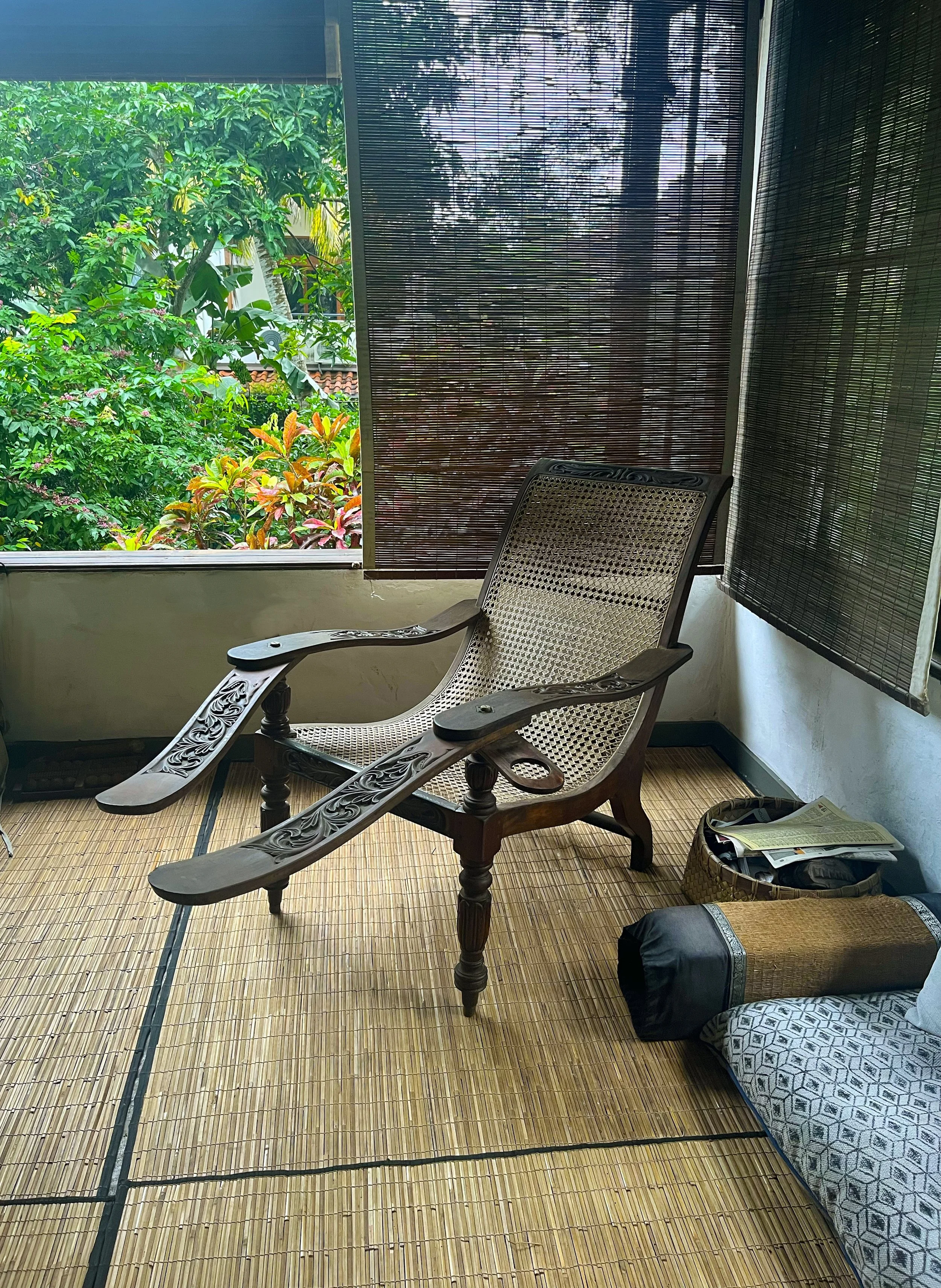
A planter’s chair in Colombo, Sri Lanka (image: Sarita Sundar).
As the examples at the David Sassoon Library and Sarita’s reminiscences show, the planter’s chair was not the exclusive domain of colonisers. The chair was embraced by local elites, as well as many others in the industrial and political classes. A surprise revelation was one used as a reading chair by Babasaheb B. R. Ambedkar, an anti-colonial Dalit activist, who drafted the Indian constitution post-Independence. Many communities adopted the chair, attaching community or vernacular names to it: the Charukassera in Kerala, the Parsi Chair in Mumbai, the Hansi Putuwa in Sri Lanka. The rich repository of audio, visual and textual material collected during our research has revealed that it goes by at least 20 different names in diverse parts of the world, attesting to its survival beyond just a colonial legacy.
Field Notes: November 2024
Location: Colombo
Condition: Very good
Age: 100+ years
Material: Nedun wood
Distinguishing features: Makara and floral motifs, circular slot as a drinks rest
Place of use: Verandah
Construction: Continuous seat and back
Armrests: Wavy, swivel out
Legs: Spindle tapered
Seat: Cane
After seeing a few hundred chairs, we thought we’d seen them all. We thought we wouldn’t come across any that would cause us to gasp. And yet, this one manages to do just that. Made of a local wood called nedun, it features crisply carved motifs of a makara – a mythical sea monster often depicted with a crocodile head and the body of a fish or a deer – spewing out a braid of acanthus leaves from its jaws. Its long wavy arms and top rail match in ornamentation. A round detail swivels out and can be used as a drinks rest. This is the most magnificent chair we have come across. Belonging to an architect-writer, it is well sat upon – with all the family members taking turns on it during the course of the day.
With the British colonisation of Sri Lanka in the 19th century, acres of jungle tracts were converted to coffee, and later cinnamon and tea plantations. And, along with other colonial practices, many cultural artefacts moved from the Indian subcontinent to Sri Lanka. And yet here, the Hansi Putuwa or “lying back chair” appears to have defied, and challenged, any role it might have played in difficult and dark histories. In the open verandah, cosily furnished with natural fibre floor coverings, low seats, and a view to a lush garden frequented by tropical birds, it seems to take on an altogether unique character, partaking in the warm conviviality of its surroundings.
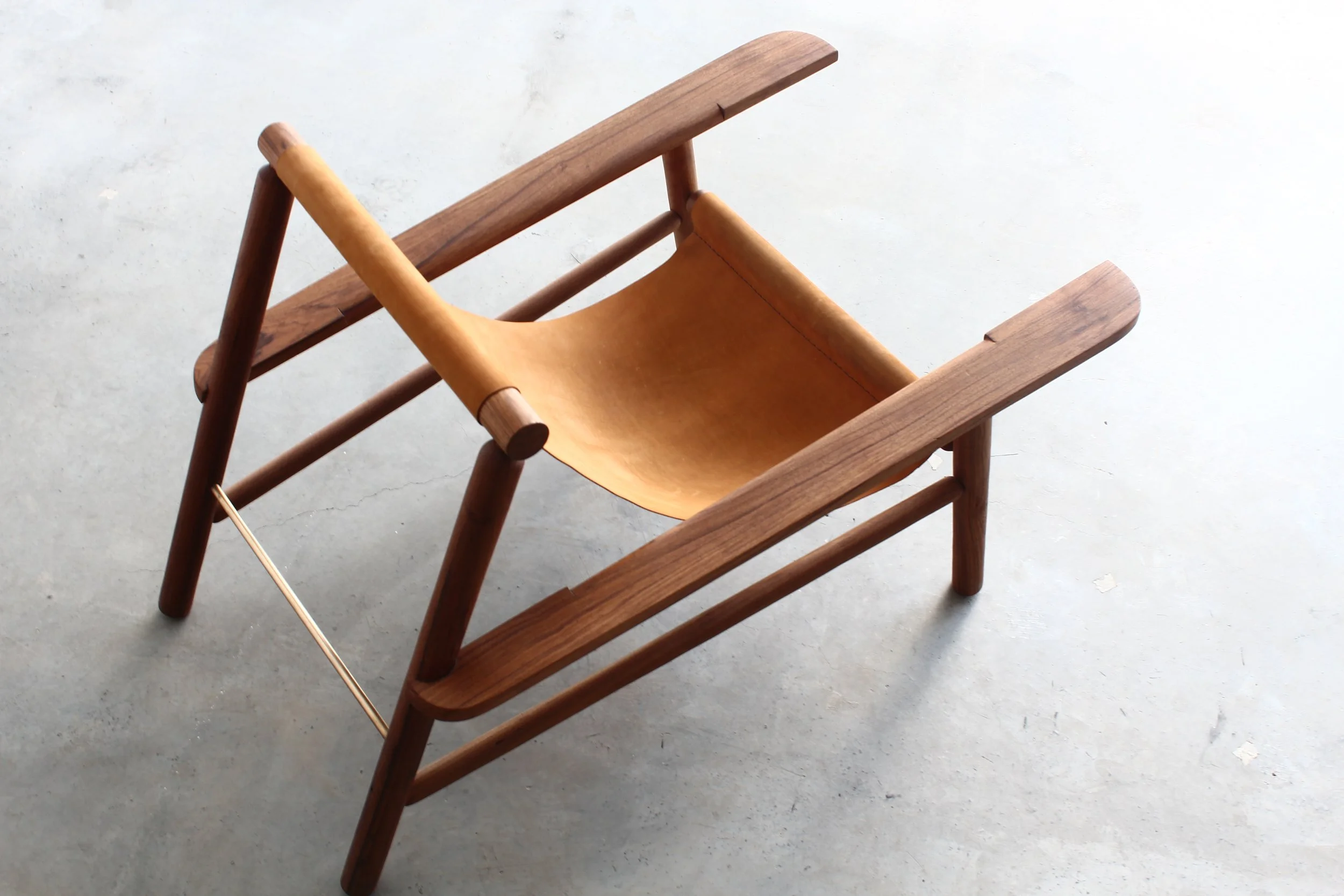
The Āyāma / Extend deck chair by Sār Studio (image: Sameer Belvalkar and Sār Studio).
A planter’s chair’s long armrests and relatively large size means it is often too cumbersome and ungainly for domestic interiors in most parts of the world. We did, however, come across a few owners who had carted the chair across continents. While many interviewees acknowledged the role that the chair played in colonial history, it was rare for someone to vociferously express the kind of discomfort that Naomi did.
Field notes: July 2024
Location: London (via Zoom)
Condition: Very good
Age: 60+ years
Material: Wood
Distinguishing Features: A circular raised dowel
Place of use: Study
Construction: Continuous seat with a break
Armrests: Swivel out
Legs: Spindle tapered
Seat: Cane
Naomi, an academic who grew up in a multiracial family in the UK, speaks fondly of winter holidays spent in tea garden bungalows with her extended family in Sylhet, Bangladesh. She remembers coming across the planter’s chair there. “We thought they were great. The kids would climb all over them,” she says. “Yeah, we thought it was fabulous. We’d never seen anything like it. What the hell is this weird thing with the bits out, what is it for? To put your cup of tea on or something? We couldn’t figure it out.”
She recalls being told that the chair was for colonial officials. “They would put their dirty boots up and their helpers would pull them off for them,” she says. “That’s what it was for.” Aware of the chair’s direct connection with the exploitative practices of plantations, she wonders at the lack of criticality in naming it “planter’s chair”. “Why would you call it that?” she asks. “People don’t know what happened on the plantations?” Yet, when she came across the chair in a shop in Brighton, she couldn’t resist buying it. “I was like, Oh, we used to have these when I was a kid! So, I had to have it.” She finds herself conflicted, struggling to part with it because “It’s been around the world a bit with us,” travelling with her family from Brighton to Indonesia and now to London. Eventually she concludes that, if she were to change the chair’s name, she would feel better about keeping it in her London flat.
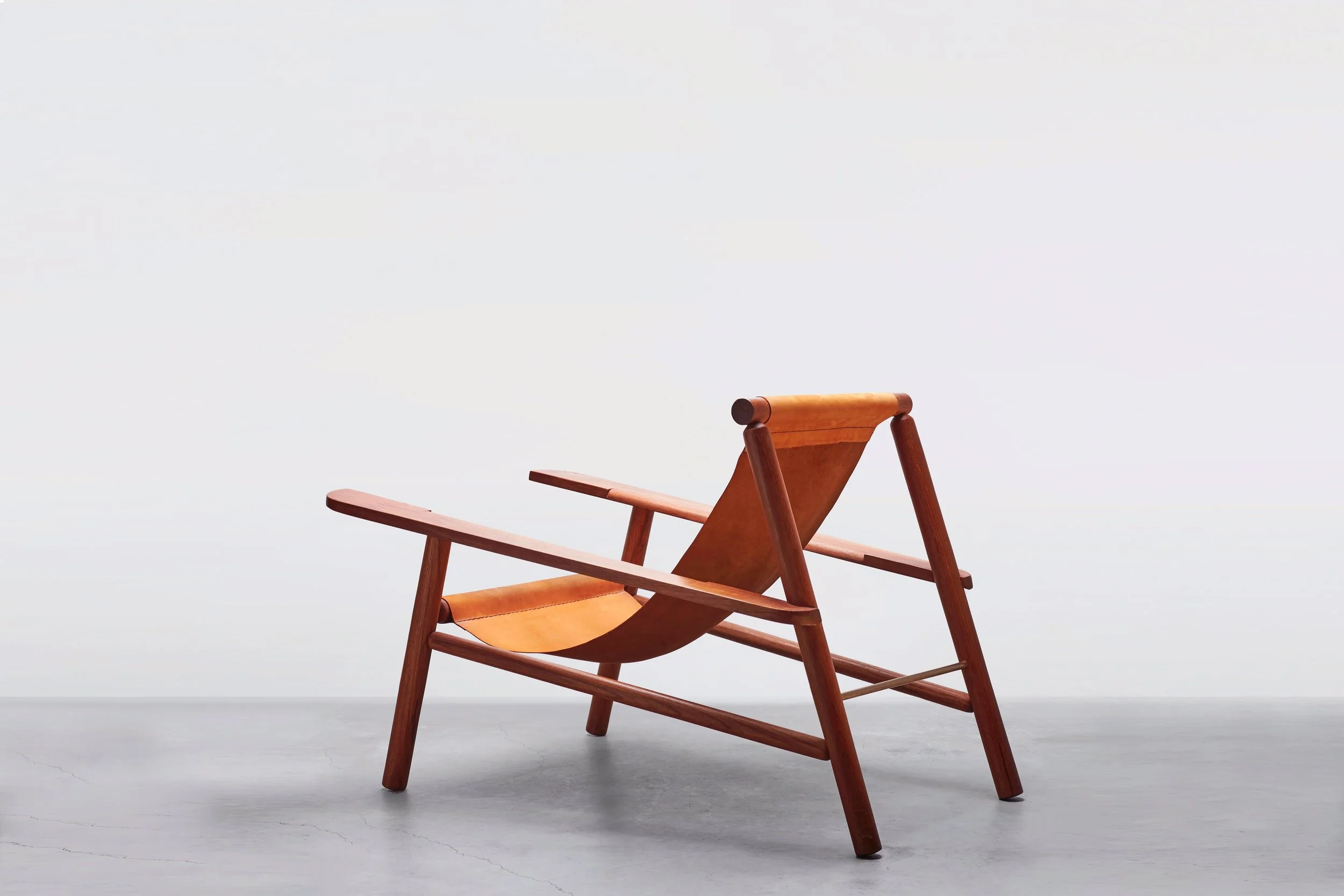
Image: Sameer Belvalkar and Sār Studio.
Today, while examples are sourced from antique shops across India and sought by auction houses, the chair continues to be crafted by artisans and reinterpreted by contemporary designers. Some contemporary designs reuse, alter, and retain traces from earlier expressions, appropriating and montaging elements from the past to add to the present.
Field notes: July 2021 and July 2024
Location: Pune (via Zoom) and Mumbai in discussion
Condition: New
Age: Five years
Material: Wood and leather
Distinguishing Features: Hand polished teak
Place of use: Varied
Construction: Knock down and folds flat
Armrests: Fixed
Legs: Round sections
Seat: Leather
The leather dips down leisurely before rising to meet the smoothly finished teak spindle-shaped top rail. There is a sense of unhurriedness in the form – calling out for a pause, to move slow. I sink into the seat and instantly feel enveloped in its warmth. Āyāma / Extend deck chair was created by German designer Pascal Hien and Indian designer Nikita Bhate of Sār Studio, who bring their differing cultural backgrounds together to create products that take inspiration from India’s craft traditions. The chair is part of their Reclaimed Stories series, and its frame is made from repurposed wood crafted using a combination of mass production and modern handmade techniques. The unique joinery detail is from the Sankheda, a traditional furniture style from West India. However, instead of the typical bright lacquer finish on the wooden sections, the teak is hand polished to create an almost golden glow. Nikita speaks of the design details: the chair packs flat for ease of transport, and the shortened armrests make it easier to fit into smaller homes. The chair seems to have many stories to tell, of nostalgia for leisure times, of a sensitivity to material usage, of craft legacies, and the beauty of well finished materials.
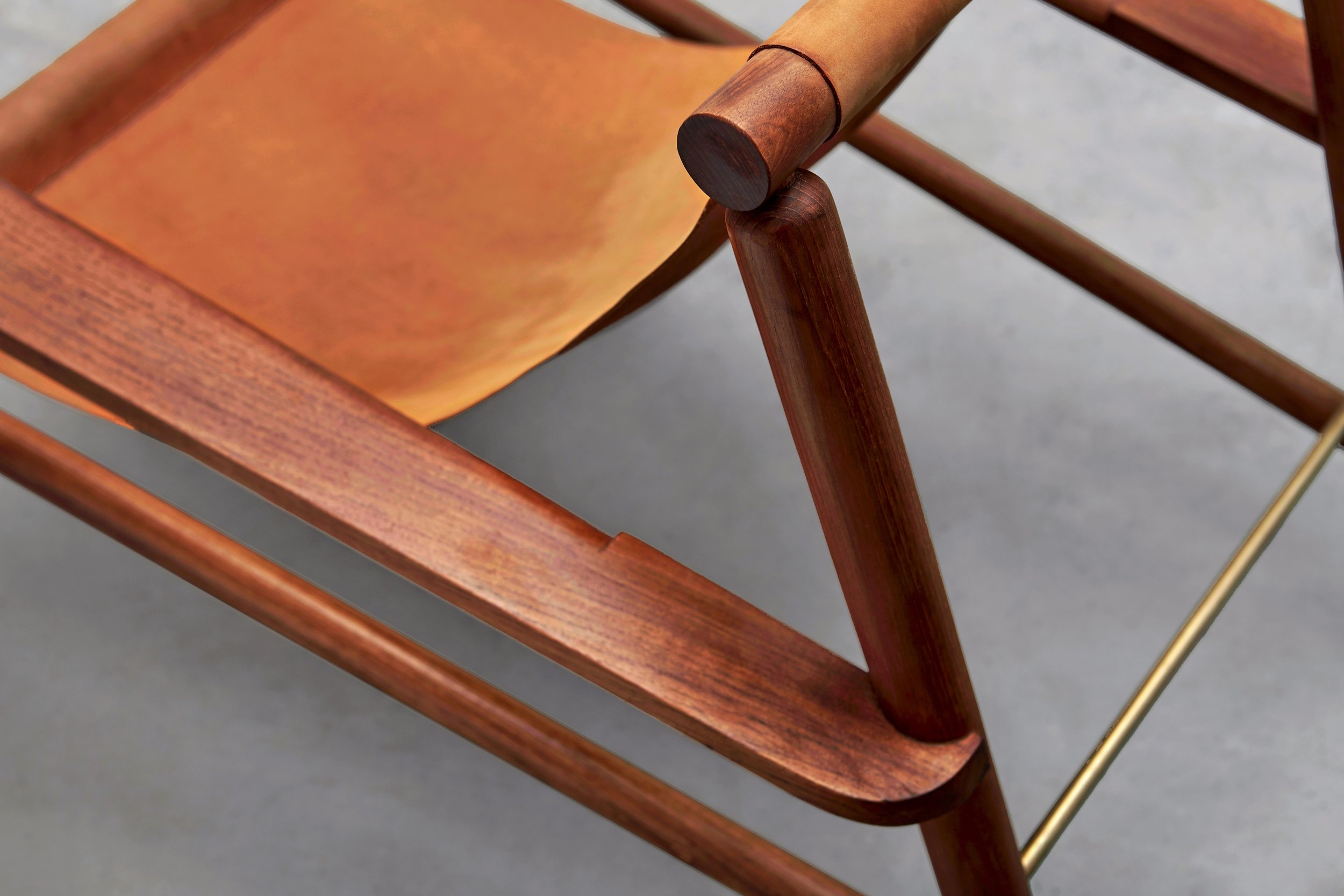
Image: Sameer Belvalkar and Sār Studio.
Artists are also drawn to the planter’s chair, and it often appears in works critiquing colonialism, such as the Nieuwe Planter’s Chair by Yassine Ben Abdallah and Mileno Guillorel-Obregón for Het Nieuwe Instituut in Rotterdam, two practitioners whose rendition of the chair seems to subvert colonial legacies, deconstructing (and decolonising?) a traditional planter’s chair.
Field notes: July 2024
Location: London (via Zoom)
Condition: New
Age: One year
Material: Aluminium and wood
Distinguishing Features: Aluminium profiles
Place of use: Not available
Construction: Continuous seat
Armrests: Swivel out
Legs: Spindle tapered
Seat: Cane
Abdallah and Guillorel-Obregón describe how they sourced a chair from Leboncoin, stripped it down, and recreated it using aluminium profiles. Their redesigned chair looks like an exploded view diagram, highlighting details such as its floating wooden components, the copper coin resting on a red dowel, and the armrests made of aluminium sections and wood. At first glance, the spindle-shaped wooden legs hidden behind the metal frames seemed out of place. We question if they had a structural purpose. Are they intended to be provocative or subversive? While we are aware that the legacy of teak wood is intrinsically linked to colonial expansion, racism and misappropriation, we didn’t know enough about the ethics of the extraction and supply of aluminium, a favoured material in this day and age. Through the forced juxtaposition of industrial aluminium, a material whose provenance and extraction is mired in social and environmental concerns, with traditional woven cane and carved wood, their piece attempts to “unseat” the ubiquitous legacies of colonialism in modern design practices, as well as the institutions that display them.
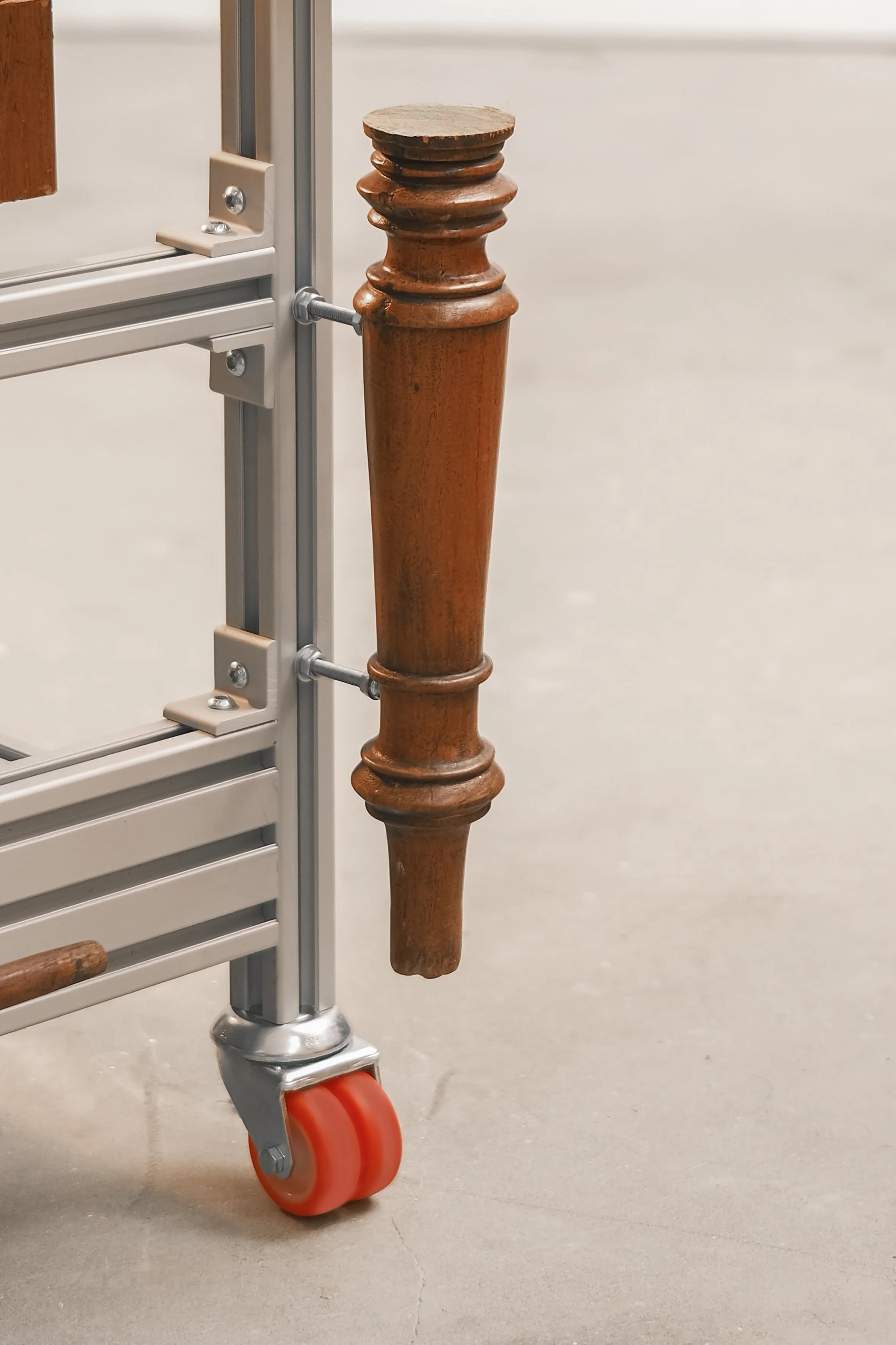
The leg detail of the the Nieuwe Planter’s Chair (image: Hugo Revollet).
The long-armed chair elicits conflicting feelings in many. Nevertheless, it has had an uncanny ability to adapt and survive. Through its post-colonial excursions, it has transformed, adopted new names, and absorbed layers of meaning, remaining an intriguing hybrid across contexts. This boundary-crossing object has not only persisted – but has seamlessly integrated local nuances, embedding itself comfortably in both domestic and commercial spaces.
We may never know whether its survival is due to its ability to: command respect and power through its monumentality; relate to things grandfatherly; recall “better” times when space and time were more generous; or evoke nostalgia for times spent in the warmth and conviviality of family. We have been discomfited by the chair’s colonial legacy, and its continued role in perpetuating colonial, and postcolonial, legacies. And yet, we have come to accept and appreciate its enduring presence as both a functional object and a cultural imaginary. Moving forward, we must ensure that it continues to encourage, inspire, and push us to investigate, confront, and transform its legacies.
[1] Adapted from Sarita Sundar’s From the Frugal to the Ornate: Stories of the Seat in India (2022).
Words Rachel Lee and Sarita Sundar
Images Hugo Revollet