
A Bedroom in a Box
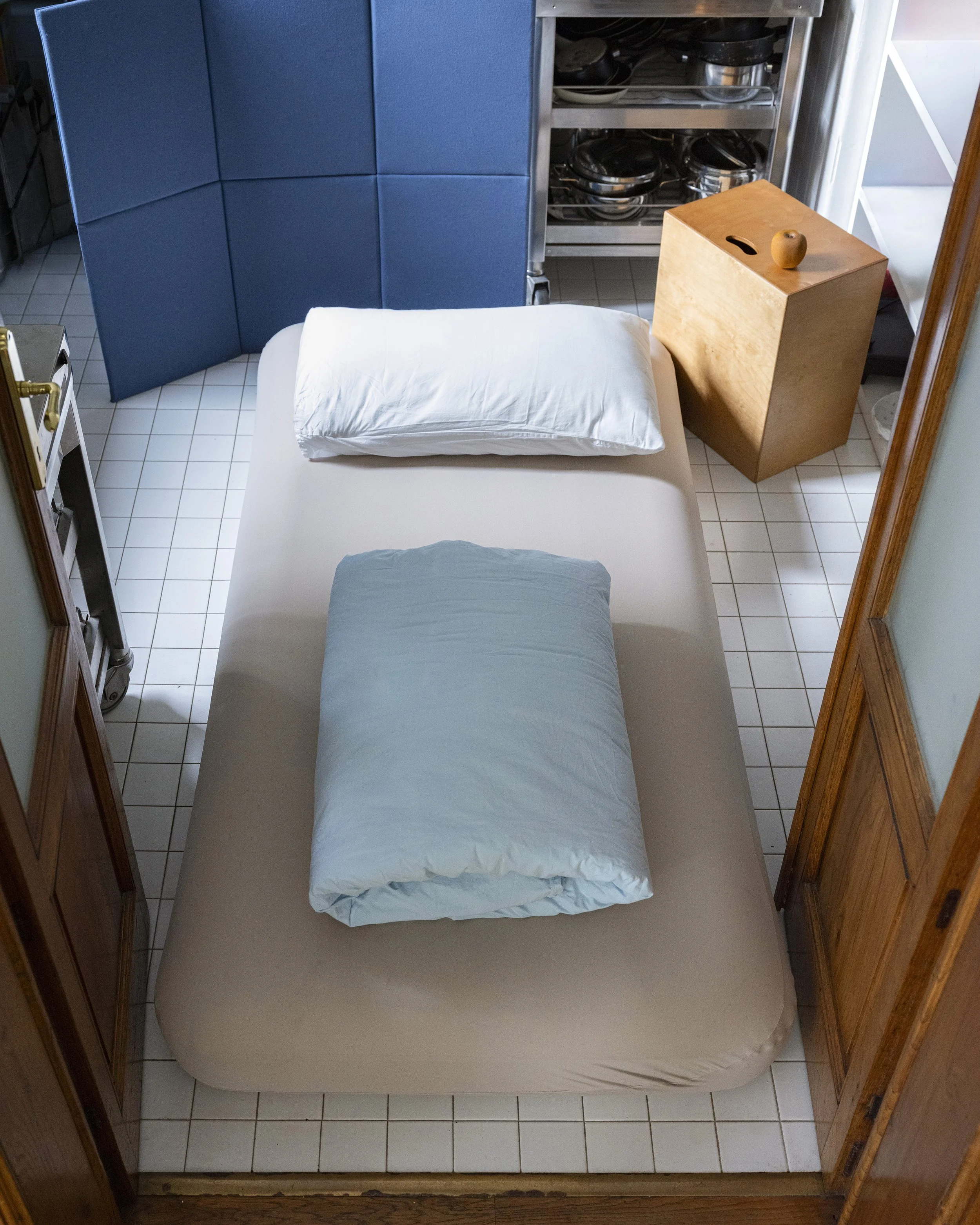
Bienvenue by Thélonious Goupil for Campeggi (image: Michele Foti).
“An amusing ottoman”. So begins the online description of Denis Santachiara’s Pisolò ottoman for Italian furniture brand Campeggi. Designed in 1997, Pisolò is a piece of casual furniture that becomes “an emergency bed by magic” when its cushion is removed to reveal that its hollow body conceals an airbed and pump, meaning that it is “ready to host [guests] in a minute”.
Given that Pisolò is no longer in active production, Santachiara’s mid-1990s design is not the most obvious starting point for a contemporary product. Nevertheless, updating the legacy of Santachiara’s ottoman-cum-airbed was the task that Campeggi set Paris-based designer Thélonious Goupil in 2025. “Pisolò had been a bestseller for them,” Goupil explains, “so the task was whether we could come up with a version that was more contemporary.” While the project may have centred around a small-scale object, it was nevertheless a prestigious commission. Campeggi was founded as a sofa-bed company in 1959, but burnished its design reputation in the mid-1990s through a series of radical, transformable furniture pieces created by celebrated Italian designer Vico Magistretti, followed by ongoing contemporary commissions for similarly adaptable furniture from the likes of Matali Crasset, Julie Richoz and Adrien Rovero. “So there’s quite a great history within the company,” Goupil explains. “They don’t only wonder about how to make a product that sells; it's about looking at how people live today.”
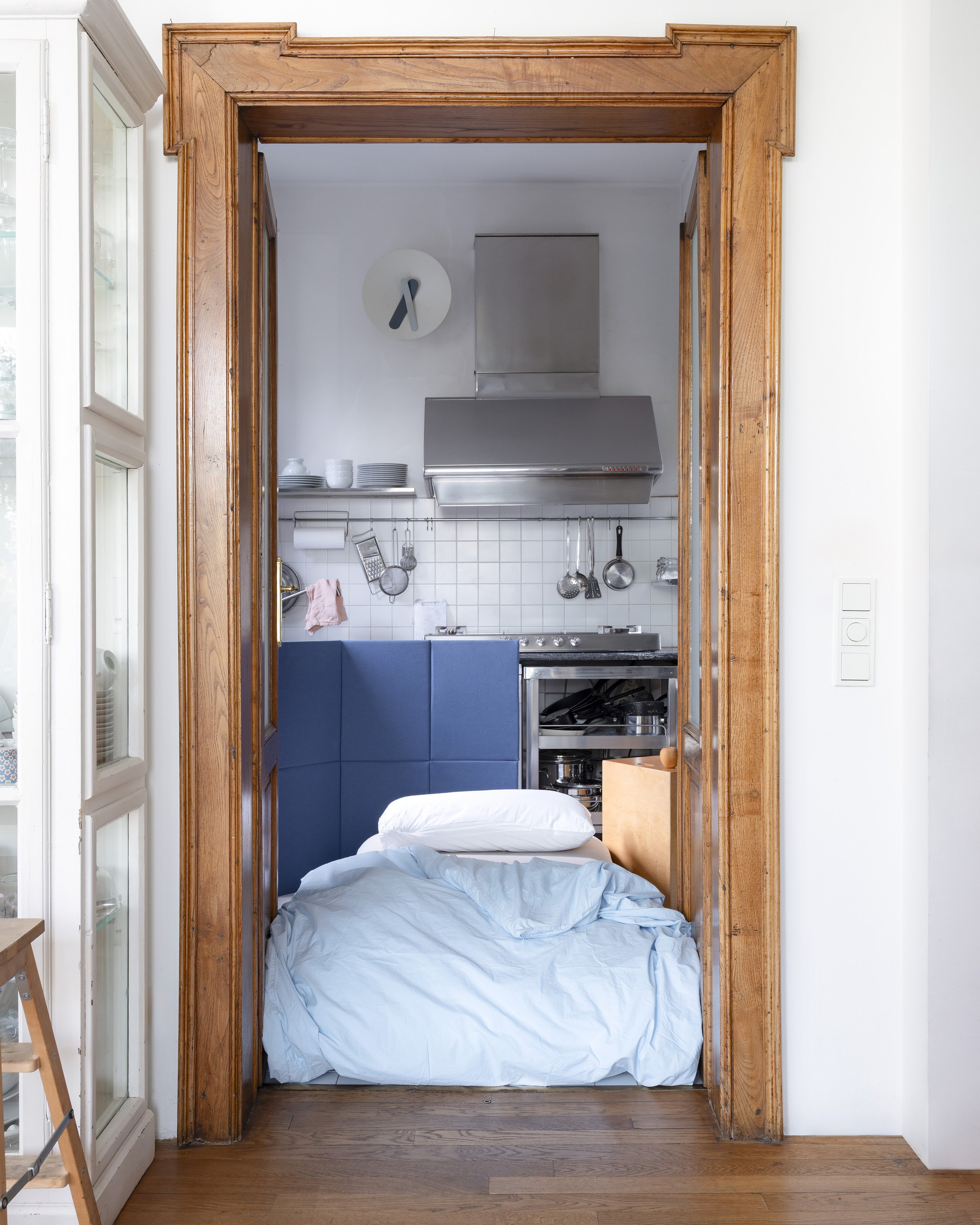
Image: Michele Foti.
The original Pisolò was smart in its configuration of storage, but also gleeful. The ottoman cleverly concealed its airbed, with its cushion doubling up as the pillow, and this sense of joyful improvisation carried through to the object’s overall aesthetic. The stool was executed in brightly coloured plastic in shades of sunshine yellow and firetruck red, while the base of the design features three holes that seem to describe a cartoon face – the two eyes providing holes through which the pump’s hose can be threaded to inflate the daybed, with the gawping mouth offering a slot such that the stool can be easily picked up and moved. Santachiara’s design was undoubtedly useful, but wore its utility lightly. Instead of focusing on pure functionality, it embraced the fun of an ad hoc sleeping arrangement for a temporary guest, seeming less like a design purposefully intended to fulfil a deep social need, and more akin to a handy solution to an off-the-cuff requirement, filtered through the chunky, playful plastics of late 1990s product design.
Goupil’s updated design, by contrast, is more sensitive in its response, and has been adapted to a less whimsical interpretation of the need for an airbed. “When thinking about having an air mattress around the house, I knew from my own experience that it's not that nice to have to just sleep in the middle of somebody’s living room,” he says. If Santachiara’s design tapped into the exuberance of a childhood sleepover, Goupil’s seeks to grapple with the reality that 21st-century urban living spaces are becoming increasingly constrained, with dedicated spare rooms for guests now being seen as a luxury to many. “I think design is about responding to need,” Goupil explains, “so it’s about considering how to fill an apartment with the right things, so that your life is easier. It’s about adapting to spaces that are always becoming smaller.” As such, the early stages of Goupil’s design focused on his own approach to guests staying in his home. In addition to a mattress, he explains, “I usually use a folding table that I put alongside [the bed] to create a sort of divider to the rest of the room and create a sense of a bedroom for them.”
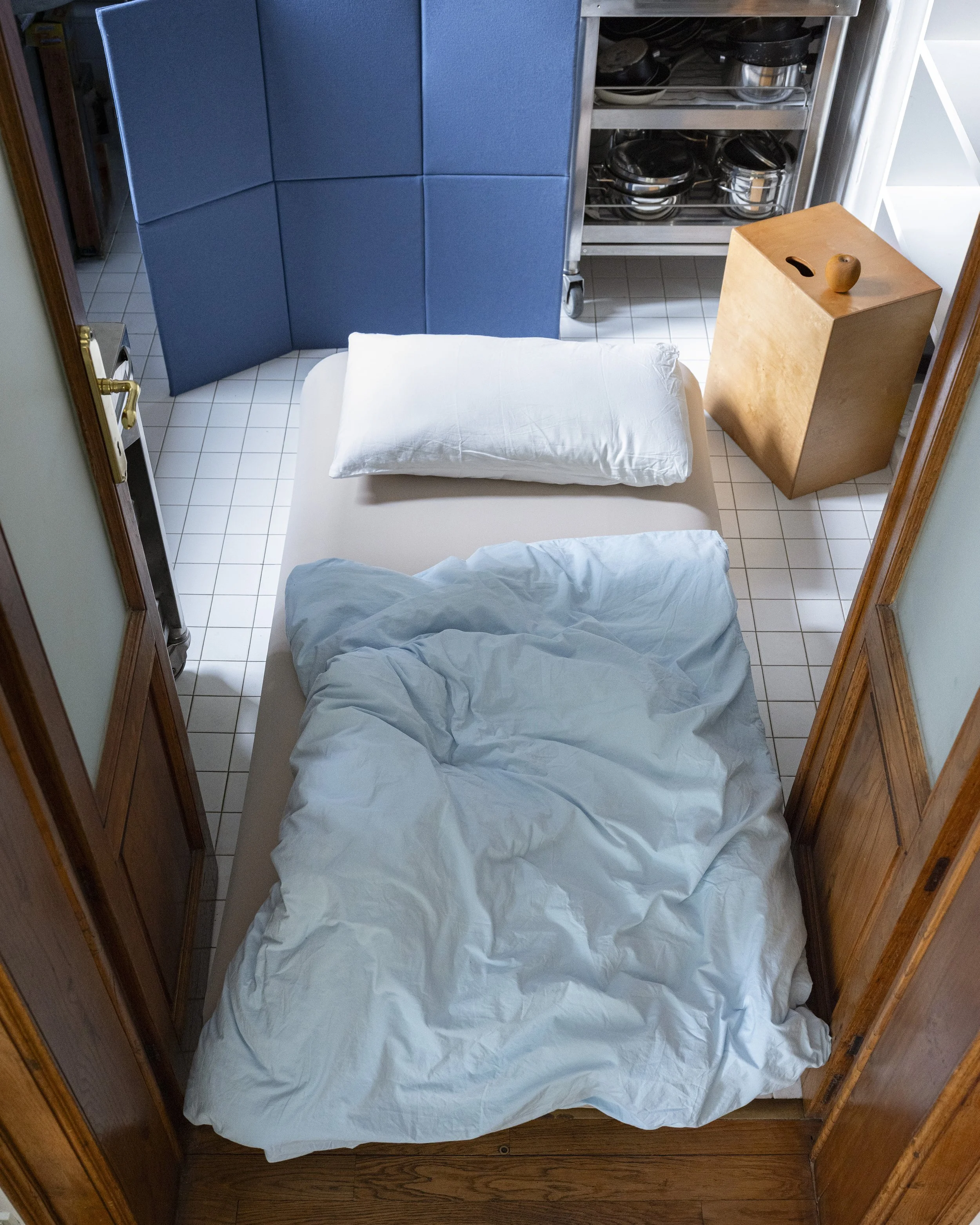
Image: Michele Foti.
A development of this original insight has now resulted in Bienvenue, a product first shown during Milan Design Week in April 2026. Exhibited as a prototype, Bienvenue is a “temporary micro-architecture,” Campeggi writes, “that defines an intimate space and turns hospitality into an act of care.” In place of Santachiara’s cheerful ottoman, Goupil has housed the elements of Bienvenue within a plain birch plywood box that has been treated with a brou de noix stain “that gives it this sort of vintage finish, as if it had already had a life before,” Goupil explains. Contained within the box are an air mattress and electric pump à la Pisolò, but also an upholstered six-panel poplar room divider, whose construction was influenced by research into the manner in which paper maps fold down. “I knew from the beginning that I wanted a divider inside the box, because that ritual of setting out things to host your friends feels so nice,” Goupil says. In Pisolò, this was limited to the bed itself, but Bienvenue extends this with its addition of the screen to demarcate private space, as well as the box itself becoming a bedside table for a lamp or a guest’s personal effects. It is, Campeggi suggests, a complete “bedroom in a box”.
Bienvenue, then, is a piece of product design, but a central acknowledgment of the project is that this product is chiefly relevant because of the absence of more permanent solutions within people’s living spaces. “What Campeggi perceives [the project as being] is that they are not selling a product,” Goupil explains. “They are selling an extra room.” In response to this, Goupil has sought to design the elements of Bienvenue with care and compassion. The box’s handle is cut out in the shape of a smile, perhaps nodding to the original face on Pisolò, but also offering a sense of personality within his own design. “That’s the difficulty when you design a box,” he acknowledges. “How do you make it personal? The handle is the only thing that remains [to be designed], so you try to put everything into that.”
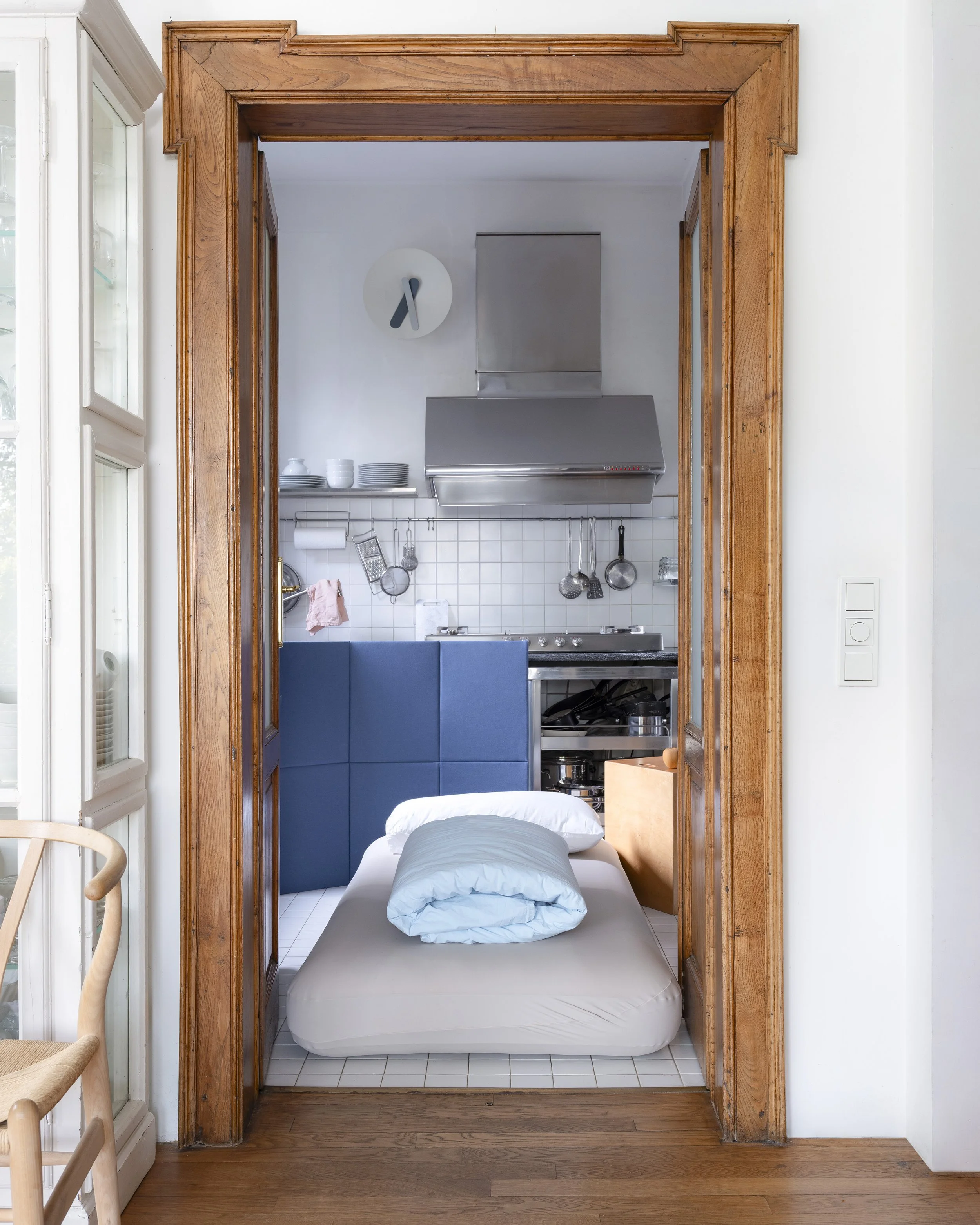
Image: Michele Foti.
Yet the other elements of Bienvenue are similarly considerate of their users – from the delicate folding mechanism of its fan-like divider, to the purposefully stained plywood that is suggestive of a carefully designed and valued element of a home, rather than a temporary solution. “A lot of [the design] is about the ritual of putting things out for your friends,” Goupil says. “Normally that ritual is very short – a bed sheet and a cushion – but if you start to put out more things, like a divider and a low table, then it becomes something else.” As with Pisolò and Campeggi’s wider furniture work, Goupil’s Bienvenue explores the transformation of otherwise static products, and the potential for this transformation to make an impact on people’s lives. “How do we bring solutions for living in small apartments,” Goupil asks, “and how can you make those well? I felt as if I was in the right place [with Bienvenue], because design should be about responding to real needs.”
Words Oli Stratford