
What’s In a Chair?
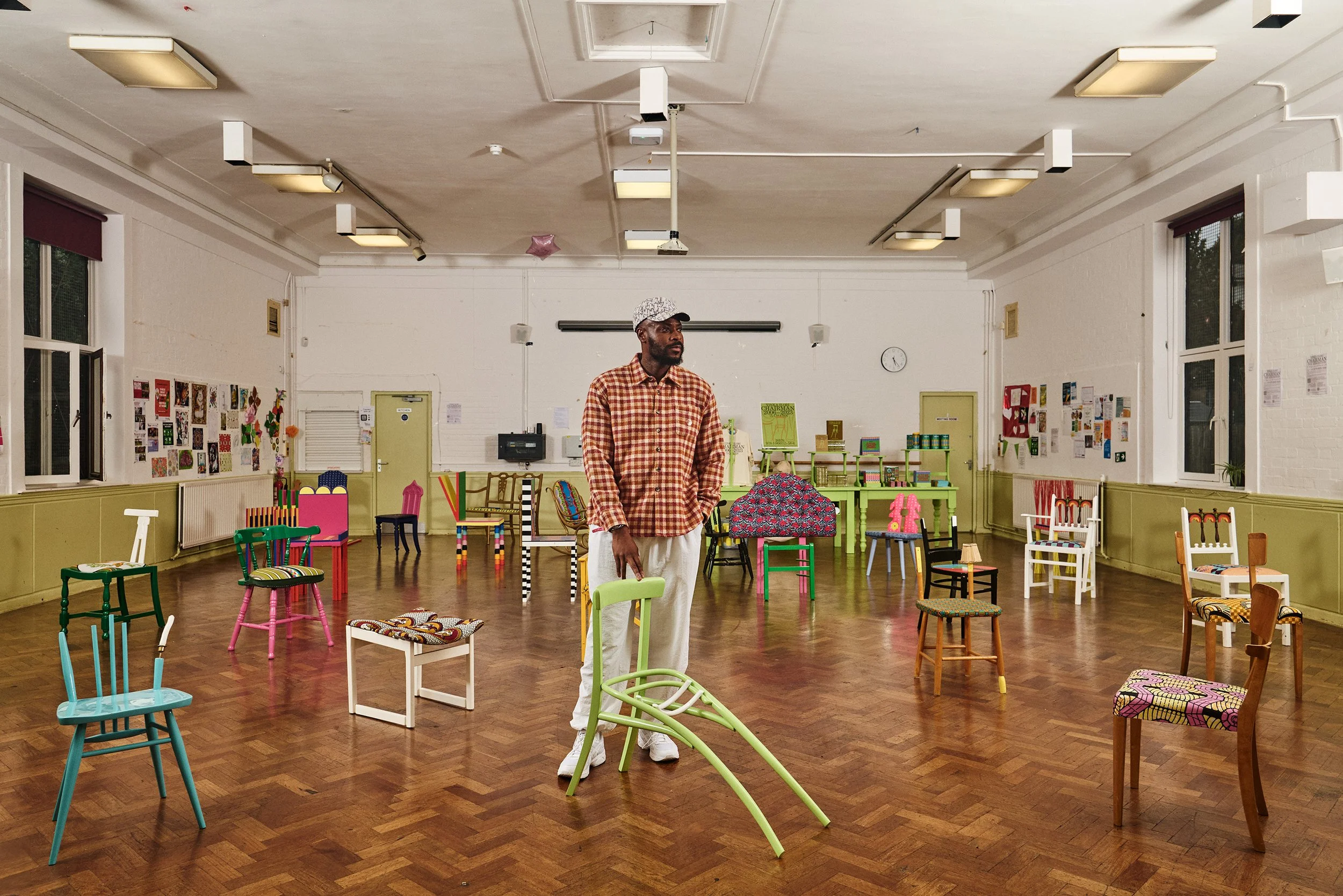
Yinka Ilori, photographed in Chairman (image: Kane Hulse).
When I first interviewed Yinka Ilori in 2016, it was for an article in Mr Porter, commissioned to explore a selection of five different London-based designers’ relationships with chairs and the enduring popularity of the typology within the field. Ilori was one of those chosen to speak, selected for his view of chairs as being essentially communicative, rather than just strictly functional in any traditional sense of the term. “Chairs reflect who we are as individuals and we form relationships with them without even knowing it,” Ilori told me, photographed sat in his Backbone chair (2015), its wooden frame gleaming in lush black paint.
“Most of the chairs I create are both functional and unfunctional,” Ilori explained to me, speaking at a time when his practice had just begun to gain widespread attention for an ongoing series of bricolage chair designs, formed by fusing together, or else hacking, used chairs that Ilori found discarded or in second-hand stores around London. Many of Ilori’s chairs drew upon parables from Nigeria, the country of his parents’ birth, but others focused on more local narratives. Backbone, for instance, was a 1950s café chair, adapted to tell the story of “somebody in my secondary school whose friends steered him down the wrong path, so he never reached his full potential. At times I just wanted to tell him to grow a backbone and say no to people, but it wasn’t my place.“ Ilori’s treatment of the original chair saw him detach its backrest and drop it lower down the frame until it sunk into a position at the small of the back – a form that some sitters found comfortable, but which others emphatically did not. “But the idea is to get people to speak about how they feel,” Ilori told me. “The important thing is that they provoke conversations that would have never been ignited without that chair as the starting point.“ Unsurprisingly, Mr Porter titled the article ‘The Chair Men’.
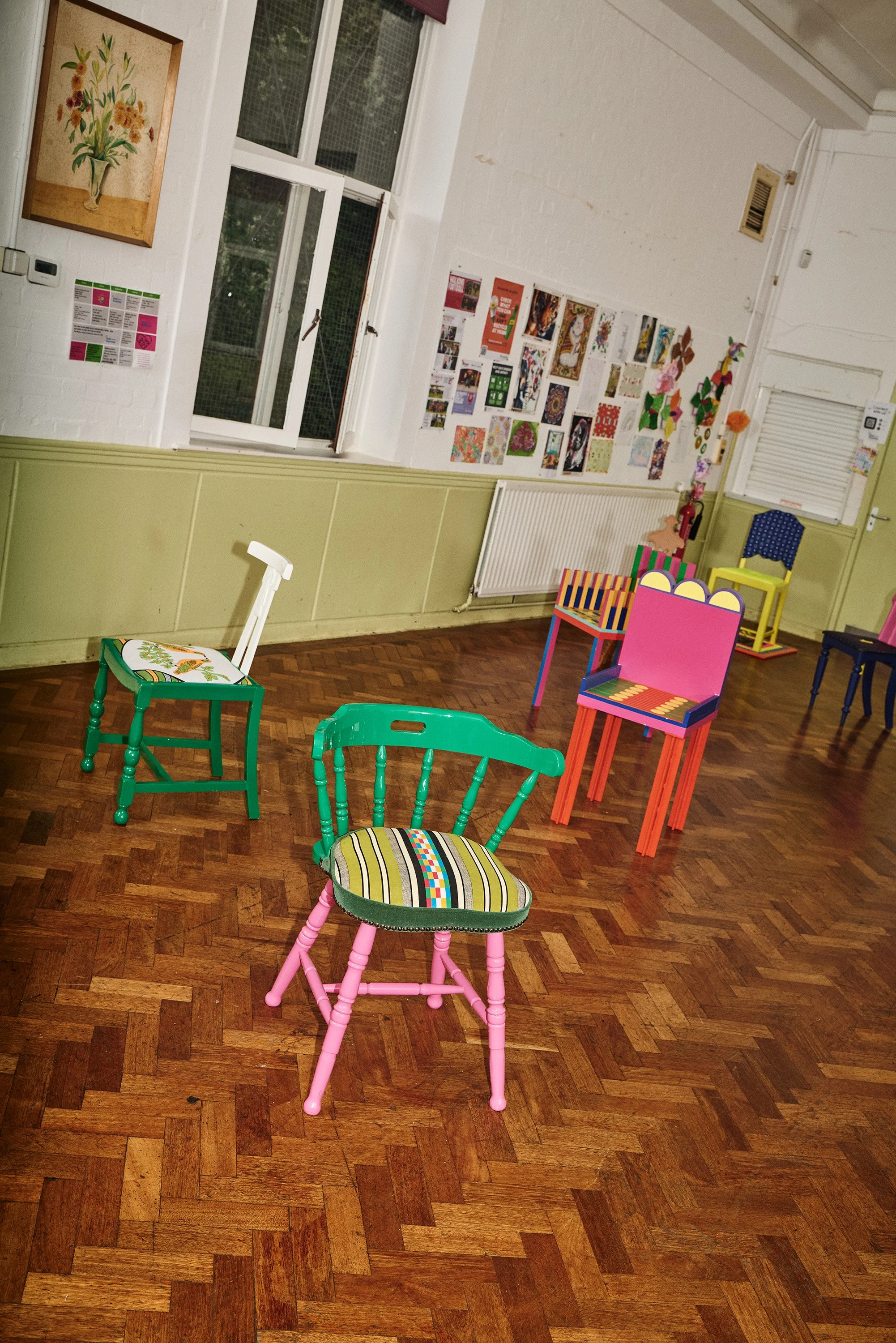
Image: Kane Hulse.
Ten years on and The Chair Men have become Chairman, the title of Ilori’s new monograph, as well as an exhibition of his chair designs from 2006 to 2023, hosted in the Walter Sickert Community Centre, a space within the Marquess Estate on which Ilori grew up in north London. The Water Sickert is no white cube, but the exhibition’s focus on community and its subject’s own roots is typical of Ilori, who has often spoken about the need for design to be shared widely throughout all sectors of society and called for greater, more inclusive, access points into the industry. “I want to give kids a point of connection and a point of reference,” he tells me, gesturing around the space and surrounding estate, “so that they can see the possibilities of what they can become.” In the Walter Sickert, every inch of wallspace is busily pinned with the happy clutter of children’s artwork and assorted community notices, with Ilori’s chairs assembled around the space in states of repose, their position mapped out in an accompanying handout that explains the story each design was created to communicate. Flowerbomb (2015), for instance, is a folding yellow chair with a succulent growing from its backrest, which was “inspired by a school friend who flourished after others overlooked their potential”. Transparency ‘Akoyawo’ (2023), whose breezy MCM leather upholstery in shades of baby blue and candy pink is bifurcated by a thick slab of transparent resin, serves to reflect “hidden pain and resilience in Ilori’s parents’ migration story”. The chairs can be enjoyed as standalone material objects – Ilori’s facility with and delight in colour, pattern and detailing is well known throughout the industry – yet each one is also the receptacle for a detailed story from Ilori’s own life. “A chair,” as the exhibition text opens, “is never just a chair.”
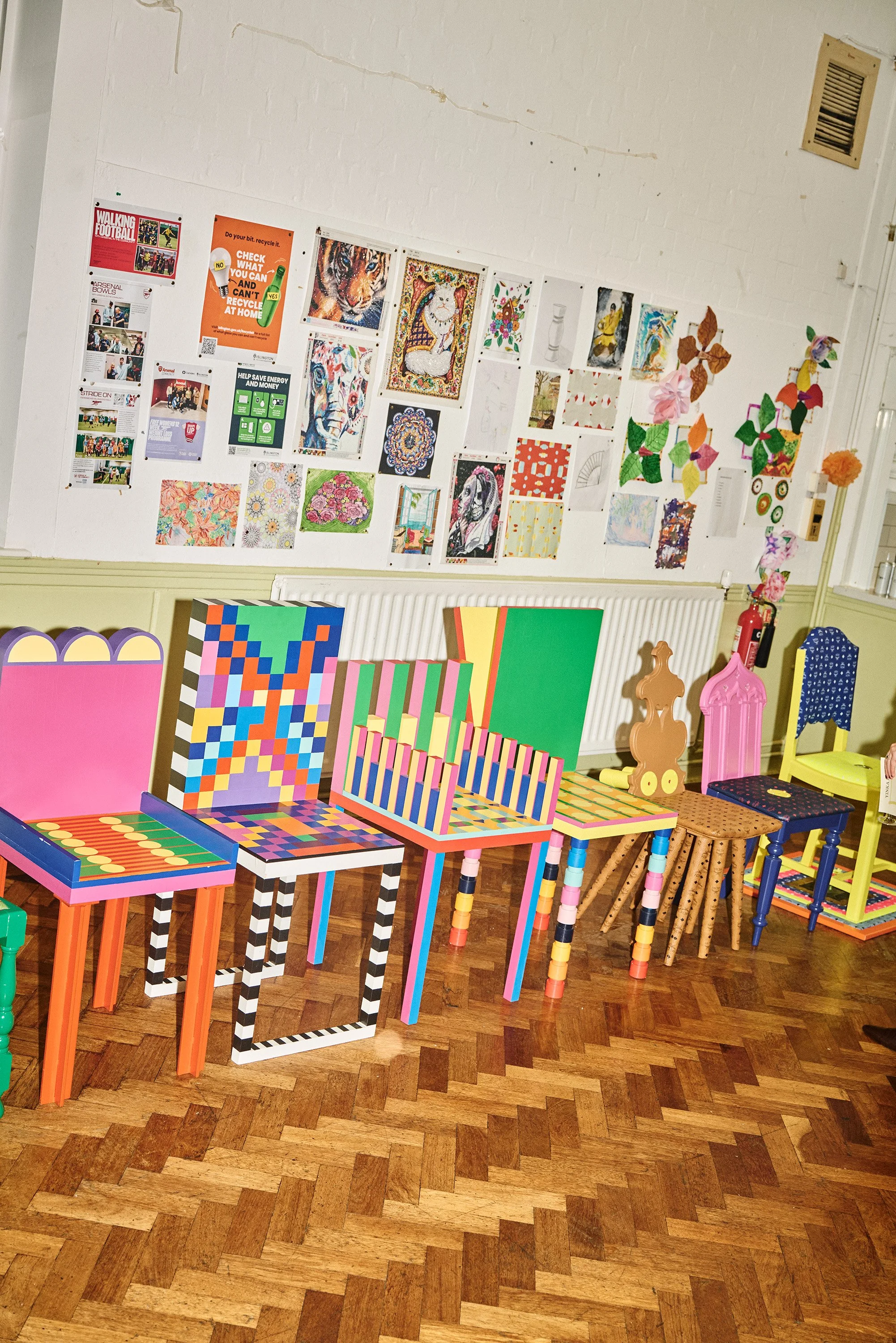
Image: Kane Hulse.
This complexity in the function of a chair (or the introduction of its “unfunction”), is fertile ground for Ilori and his interest in objects as representing, above all else, embodied stories. “It feels quite therapeutic going back to all these stories,” Ilori tells me as we tour the space, explaining how the chronology of the show begins with the first chair guests encounter upon entering the room, a recreation of Two Become One (2006). This was Ilori’s first chair, designed and made while he was still a student at London Metropolitan University, in which the bentwood backrest of a Thonet café chair becomes an extended, curvaceous seat, executed in shades of pistachio and white – a response to a brief set by educator Jane Atfield that “inspired this whole project,” Ilori summarises. While his practice is now commercially thriving, with Ilori and his colleagues regularly sought out for product, mural and installation collaborations with international brands including Absolut, Rapha, Beats by Dre and Lego, the chairs remain what he describes as the “foundation of my practice”, providing him with “my test of how to combine objects and stories” – the foundation that underpins the wider public art commissions for which the studio has become best known.
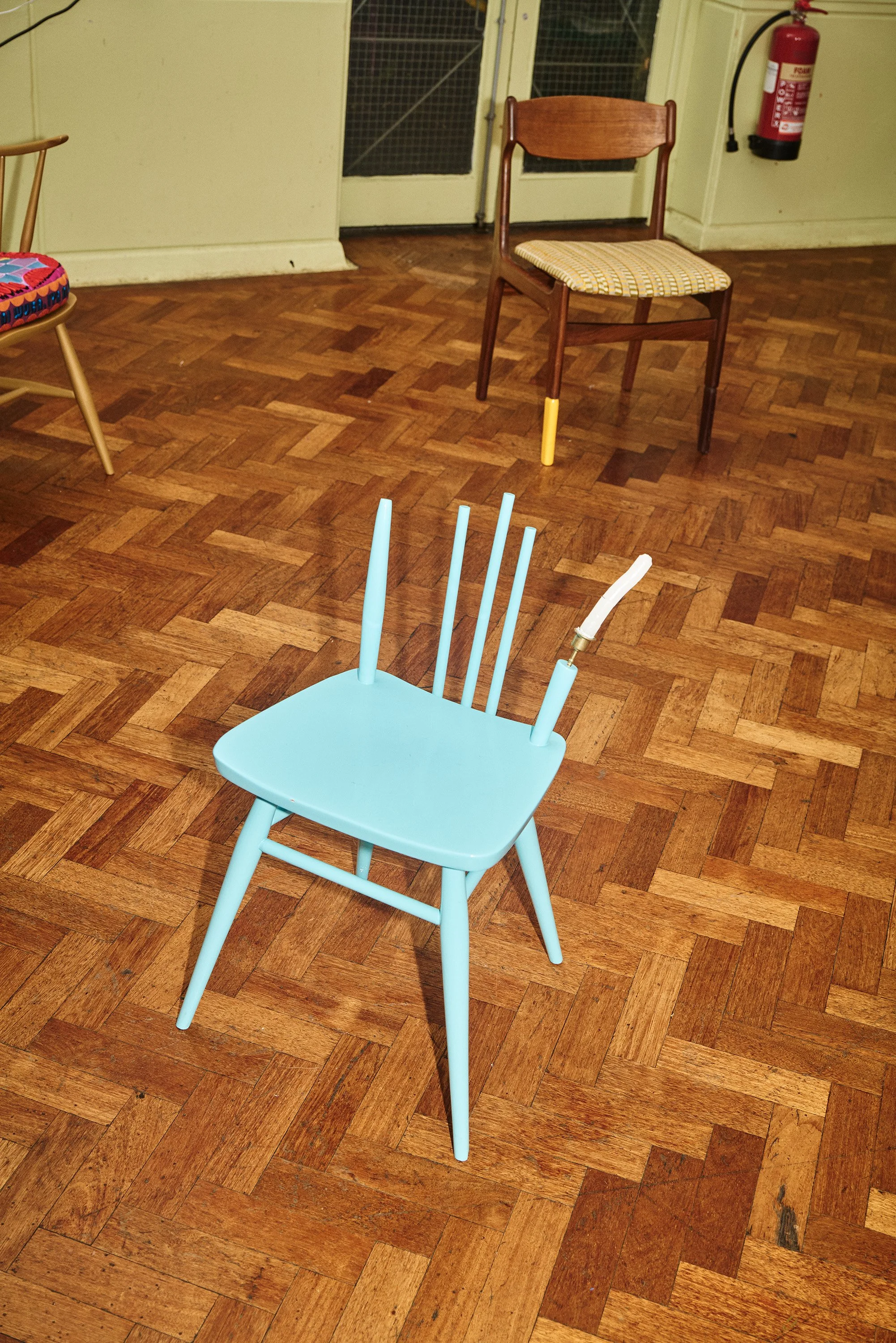
Image: Kane Hulse.
While the earlier chairs in the exhibition are more explicitly upcycled – Oba (2013) maintains its original dining chair structure, but introduces Aso Oke cloth and a restored yellow leg, while Let There Be Light (2013) is a blue Windsor chair in which one of its spindles has been replaced by a candle – the later works demonstrate the progression of Ilori’s work, introducing more complex transformations and the introduction of recurring elements within the designer’s aesthetic: yellow metal tubing introduces perforations in both Big Shoes to Fill ‘Bata Nla Lati Kun’ II (2023) and We Are Magic ‘Idan Ni Wa’ (2023), while Untitled V (2020) pairs the colour-based graphics for which Ilori is known with a dramatically split double back. In this vein, Chairman is presented as Ilori’s personal research, as well as a reflection of his wider development as a designer. While half of the chairs in the show date from the 2020s, a time when Ilori’s practice was well established, the remainder are from far earlier, originating in “a time in my life where I needed an outlet to release some of my emotions, thoughts and ideas,” he says. “Back then, I was really a shy designer and not confident in my interviews. The chair was kind of what I could do as a storyteller – put it in public space and then run away.”
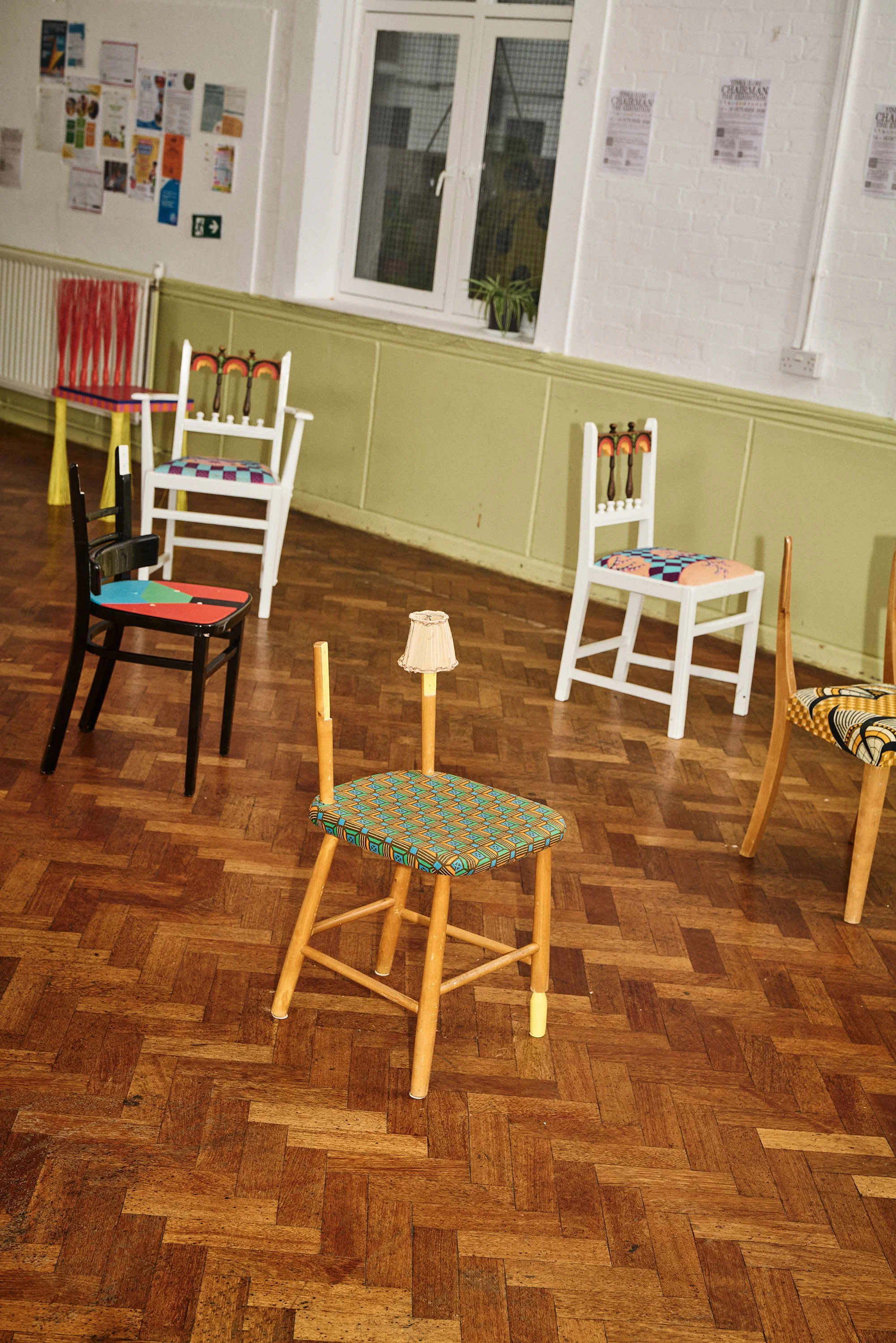
Image: Kane Hulse.
In this vein, as much as telling the stories of the chairs themselves, Chairman is Ilori's story: a summation of his attitude towards designed objects and a chronology of his work, hosted in a space that speaks of the community in which he grew up and which has explicitly shaped his design work. “I think it’s because I grew up in a very big community in North London, which is why the themes that run through my work are communities and people and storytelling,” Ilori told writer Georgina Johnson for an interview featured in Disegno #33. “[…]That’s where it started for me, and chairs are the thing I loved the most because they can tell stories. They’re sentimental objects.” Today, Ilori’s work has progressed to a point where Chairman, both a monograph and a retrospective of sorts, is possible, but chairs have still remained a point of personal reflection for him as much as a designed output. Ilori’s studio, for instance, contains multiple designers who work across projects with him, yet the chairs featured in Chairman remain a purely solo pursuit. ”We do a lot of work in public space, which the team collaborate on and develop, but not with the chairs,” Ilori explains. “These chairs are all fragile and delicate stories, and I can’t take someone’s personal story and make it a studio project.” Rather than objects, Ilori says, the chairs are something more intimate. “All these chairs, for me, are people,” he explains. “They’re individuals that you breathe life into, because they are all inspired by friends of mine, family, and people who I’ve met along the way, and are things I can always come back to.” Chairman is, then, a personal history, but also a career trajectory, “because I always knew that at some point, I wanted to a do a chair exhibition,” Ilori tells me as I prepare to leave. “I didn't know when it would happen, but everything that I’ve done has been building to this day.”
Words Oli Stratford