
Four Moons From Home
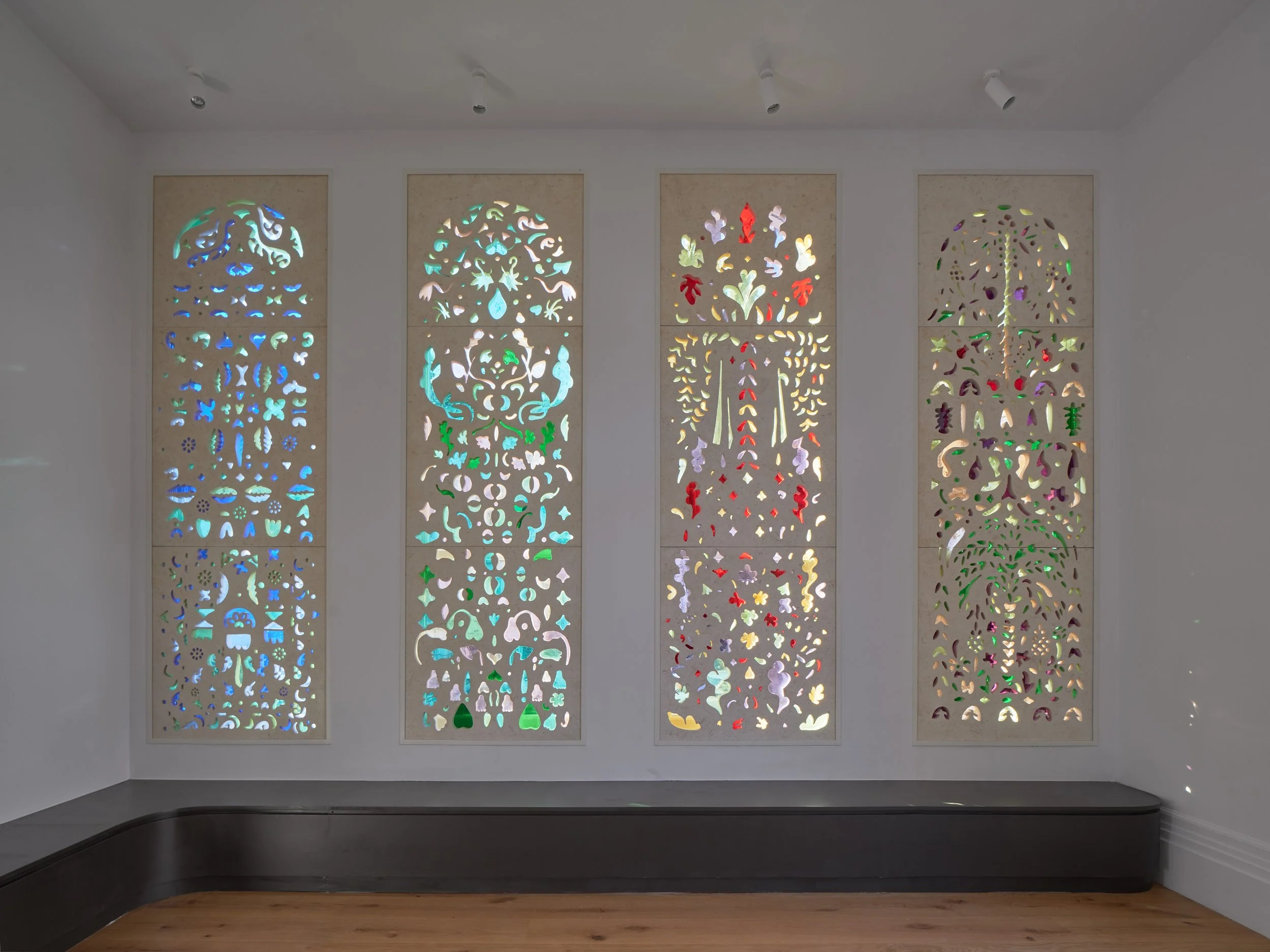
Architect and artist Dima Srouji created windows filled with Palestinian flora for the Mosaic Rooms (image: courtesy of the Mosaic Rooms).
In the entrance hall of the Mosaic Rooms gallery in London, four windows glow with poppies, irises, pomegranates, peas and more, each plant abstracted into wishbone-shaped pods, serpentine stems or cloud-like leaves. “So much of the work that gets made about Palestine right now is necessarily about destruction, about documenting what has been lost or taken,” says Dima Srouji, an architect and artist who created Four Moons from Home, a site-specific commission filled with Palestinian flora. “This work wanted to do something different. It wanted to insist on the living land, on colour and stone and light and the specific texture of a wildflower in spring.”
Each of the windows references a different season, with blues and greens transitioning into yellows, reds and purples as they pass from winter and spring through to summer and autumn. Made from stone inlaid with coloured glass, their construction references Qamariya windows – which were originally made using translucent sheets of marble or alabaster and eventually developed into designs made from plaster and glass – that can be seen embedded into historic architecture in Yemen, Egypt, Syria and Palestine. “The Mosaic Rooms already functions as a kind of home from afar, a space where all of our struggles meet with Palestine at their core,” Srouji says, with the organisation dedicated to supporting and amplifying contemporary culture from the Arab world. “The windows are the first thing you encounter, and I hope that encounter carries something physical and immediate […] that something in you recognises the land even if you have never been able to go there.” The piece evokes a longing for elsewhere while offering visitors the comfort and pleasure of architectural details that carry memory and cultural history. “It is a work made in London for a diaspora community many of whom cannot return, and the title [Four Moons From Home] keeps that fact present without being mournful about it,” Srouji says.
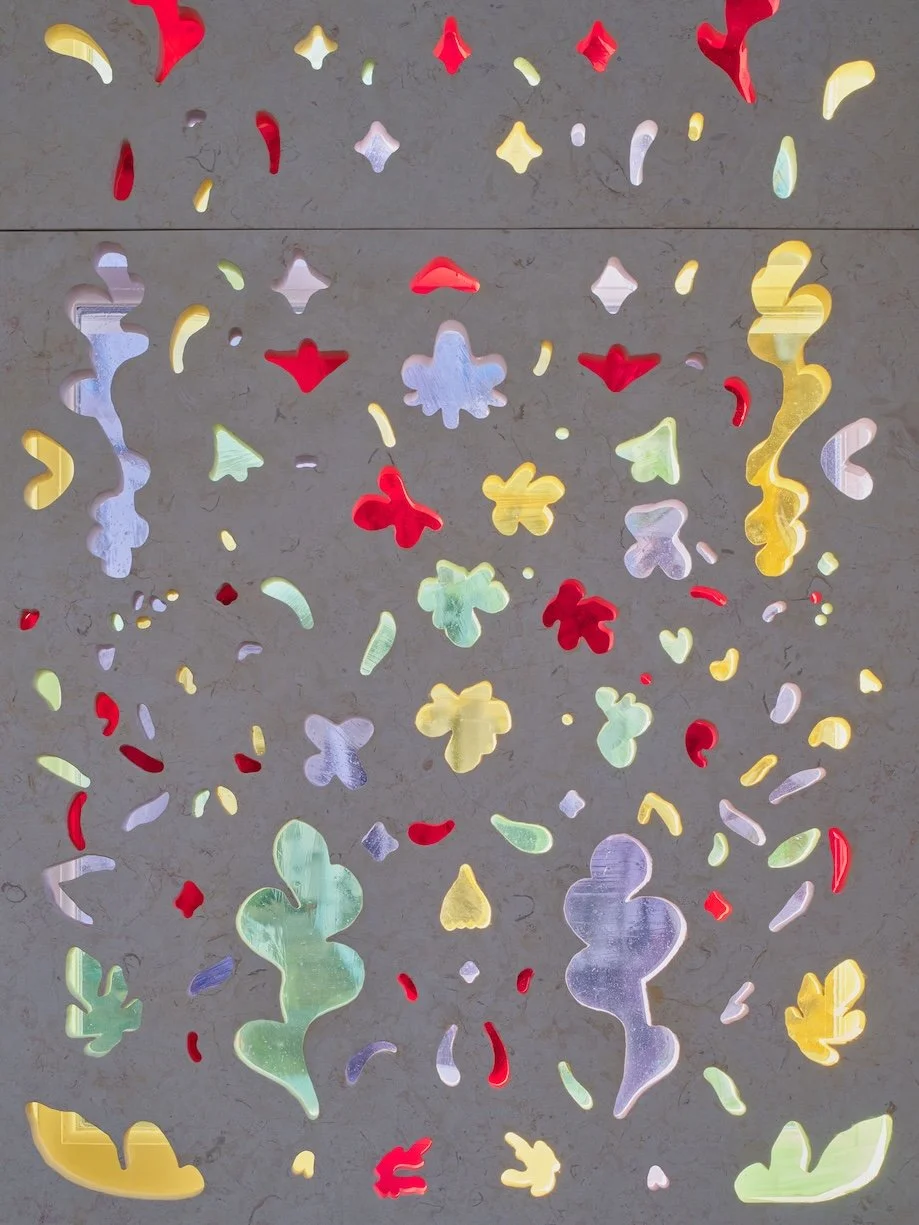
Inspired by the construction of Qamariya windows, Srouji created her pieces out of Jerusalem stone and coloured glass (image: courtesy of the Mosaic Rooms).
Srouji first started researching Qamariya windows as part of the Jameel Fellowship, a residency programme at the V&A that invites artists and designers from the Middle East to research and develop new lines of inquiry within the museum’s collections. “I wanted to understand how glass appears across the museum’s collections,” she says. “Coming from an architectural background, it was important to me to hold the history of glass alongside the history of architecture, not reduce it to the scale of vessel and object.” Following the fellowship Srouji created Maintaining the Sacred, a stone and coloured glass window whose jagged edges resemble a remnant of a building facade, for the Islamic Art Biennial in 2023. Designed as a reminder of the 30 windows in the Dome of the Rock and the Al-Aqsa Mosque that had been destroyed by Israeli forces the previous year, the piece was propped up by a wooden frame, its construction suggesting both a window awaiting installation and a fragment being carefully maintained. “The technique is a dying craft with a few practitioners in Yemen, one in Cairo, and another in Jerusalem,” Srouji writes on her website. “The reconstruction of the windows is currently blocked by the Israeli authorities, but it would take 15 years to repair all of them.”
The following year Srouji used stone and coloured glass to imagine future archeological monuments in Palestine, with the forms of each window in her Late Monuments series taking inspiration from the remains of Hisham’s Palace, an 8th-century early Islamic archaeological site near Jericho. The pieces resemble aerial views of the site, with channels cut into the stone like paths and pieces of glass acting as buildings. “[Late Monuments] drew from the land and its remains, from what has survived and what has been excavated,” Srouji explains. “Four Moons From Home moves away from that register of the ruin. It is less about what remains and more about the land itself, its living flora, its seasonal rhythms.” This emphasis on the living landscape also reflects the Mosaic Rooms’ desire to be a space of refuge and resilience for its visitors. “After genocide, I think we all want to see the light at the end of the tunnel and hold onto the beauty of home,” she says. “We are tired of ruination.”
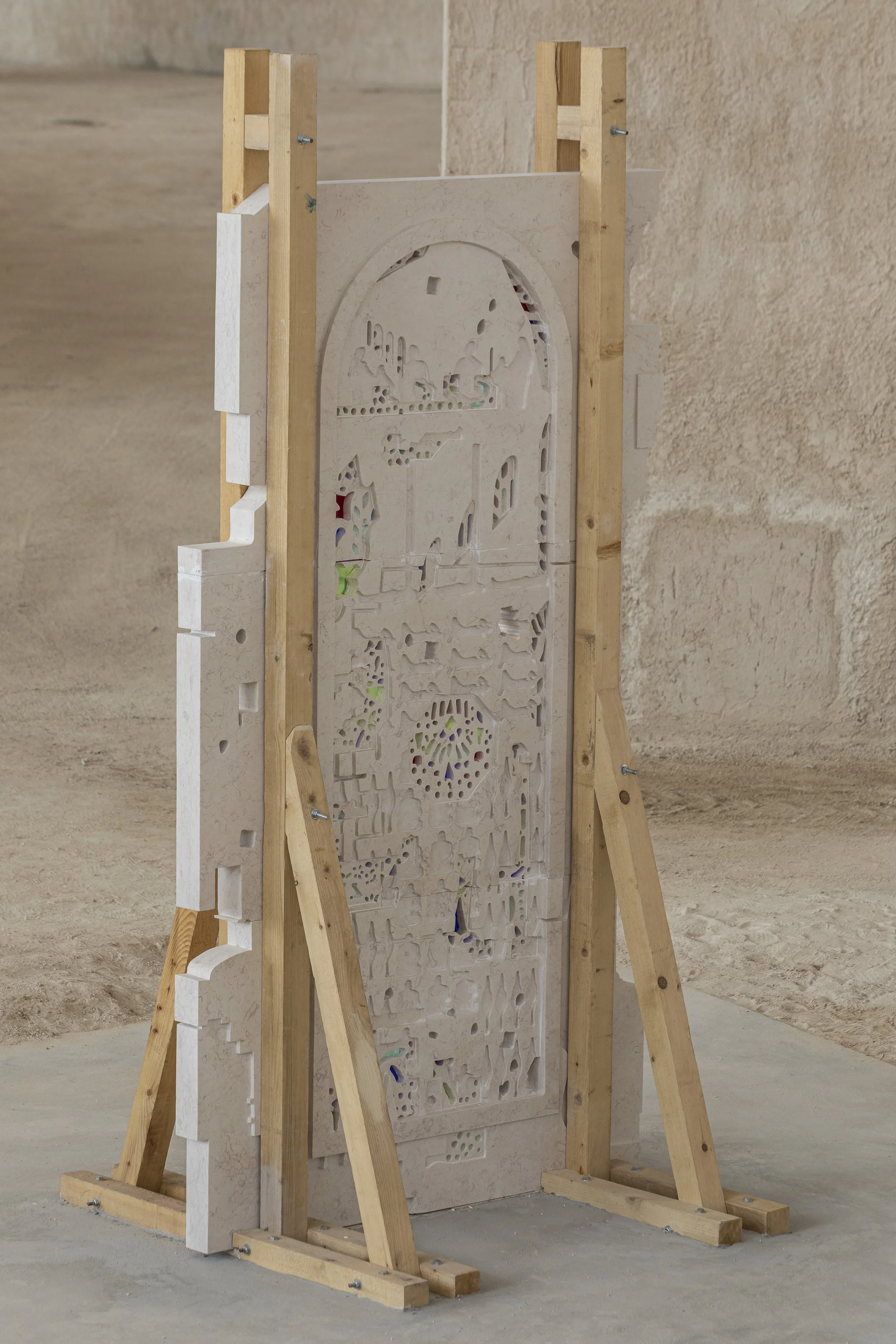
Maintaining the Sacred was designed as a reminder of the 30 windows in the Dome of the Rock and the Al-Aqsa Mosque that were destroyed by Israeli forces in 2022 (image: Dima Srouji).
In order to bring each season to life, Srouji spent months taking photographs of plants during walks across Palestine, as well as studying wildflower books that were sold to pilgrims as souvenirs in the early 20th century. Many of the plants featured, such as mulukhiya and akkoub, are foraged or cultivated for Palestinian dishes. “I wanted the designs to carry something immediate and living, not the abstraction of heritage but the specific quality of a plant in a particular season in a particular place,” she says. The motifs that accompany these plants were drawn from the Qamariya windows Srouji studied at the V&A and during trips to Cairo, as well as books on the architectural history of Yemen, where the first Qamariya windows appeared as alabaster carvings. “I wanted the designs to hold the larger region, with a particular interest in Yemen as a source of architectural thinking,” she explains. The designs are grounded in the physical landscape not only through their imagery, but also through their materiality, with each window made from Jerusalem stone transported to London. “Jerusalem stone is not just a material, it is a carrier of place, of memory, of geology specific to that land,” Srouji says. The stone used for the piece is called Nujasa, which translates to “pear” in Arabic, owing to the red and blue veins running through it that resemble a ripening fruit. “For a work that is asking the diaspora to feel a connection to home, a simulation would have felt like a betrayal of the premise,” she says. “The stone needed to come from there.”
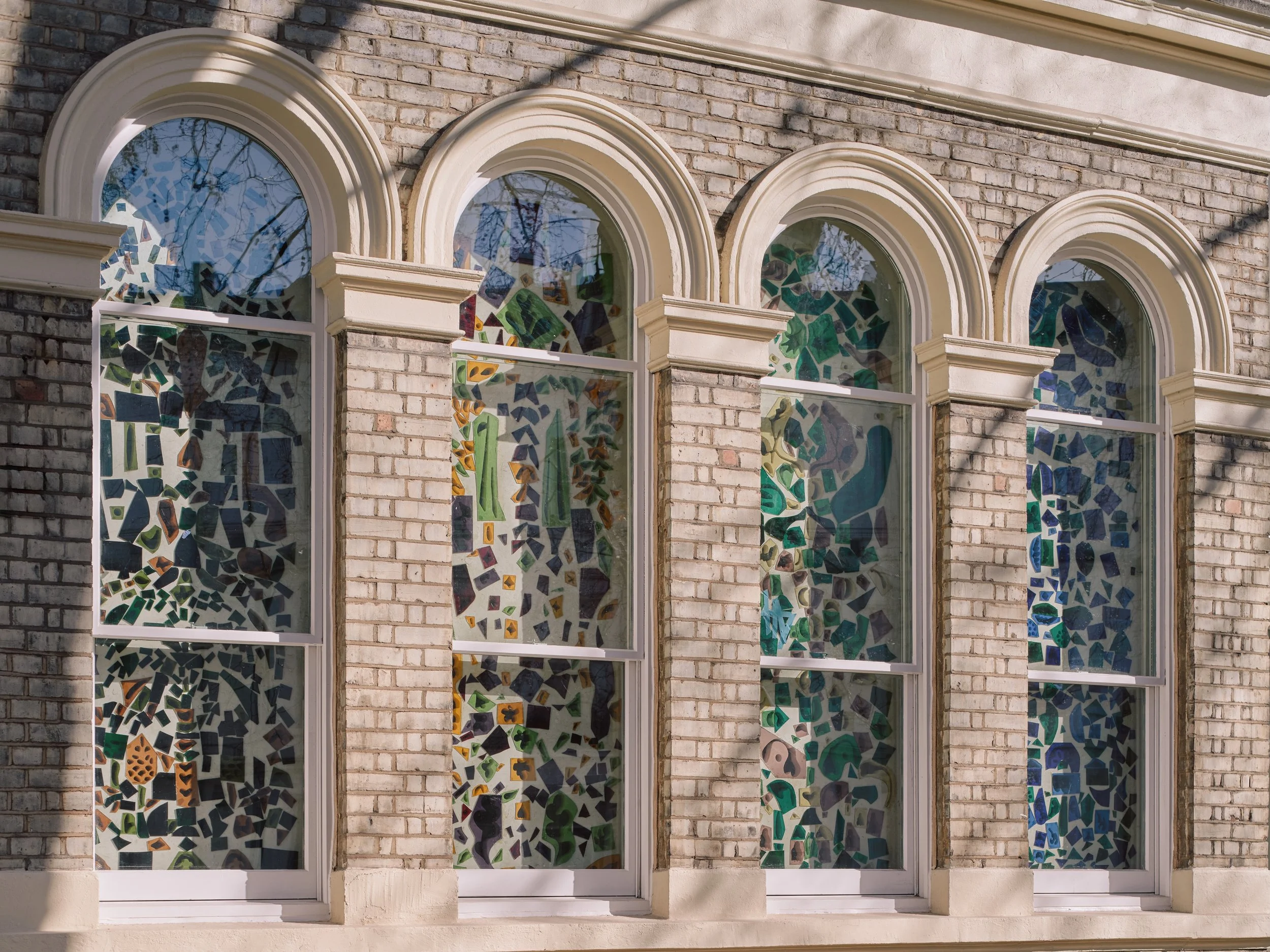
The side of the windows that faces the street shows the visible labour behind their construction (image: courtesy of the Mosaic Rooms).
Each flower and motif was carved by Munir Nasser, a stone artisan in Bethlehem, leaving gaps that were covered in glass sheets cut by Srouji in London. “The logistics were complicated, as they always are when working across borders that are actively hostile to Palestinian movement and Palestinian goods,” Srouji says. “But Munir Nasser navigated that with the expertise that comes from years of working under those conditions.” Srouji often collaborates with artisans in her work, such as the Twam family of glassblowers in Jaba’, Palestine, with whom she set up Hollow Forms, an initiative that seeks to sustain and reimagine local glassmaking traditions. One of its most notable collections, Ghosts (2019), recreated archeological vessels from Syria, Palestine and Lebanon that are now held in Western museum collections, rendering each one in transparent glass. By working with craftspeople who continue to possess the skills used to make ancient vessels and architecture, Srouji highlights the Palestinian people’s enduring connection to their land and heritage. “Qamariyas are always double-sided,” Srouji explains. “The front [of the window] presents a pristine illustration of form, while the back reveals the visible labour, fragments of glass attached in an almost abstract way, like the reverse of a weave.” In Four Moons From Home, Srouji reverses this practice: the side of the windows that faces the street is covered in squares and rectangles of glass that colour outside the lines of the delicate floral shapes, revealing the workmanship to passersby while saving the immaculate forms for those who enter.
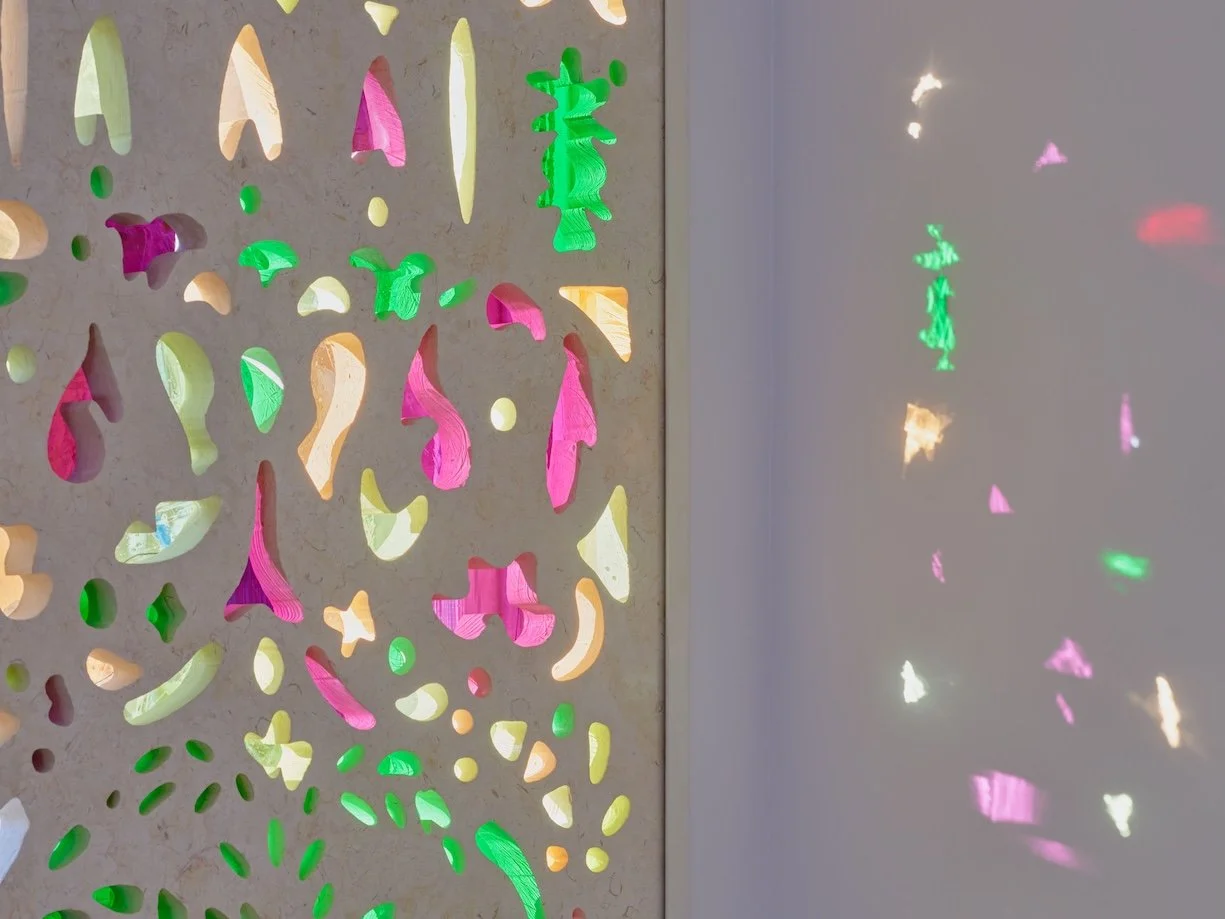
Image: courtesy of the Mosaic Rooms.
While Srouji’s work often references objects and architecture that have been displaced, destroyed or excavated, it always insists on wholeness: phantom vessels stand in for missing artefacts; an intact window speaks to shattered ones; and archaeological sites are reimagined as new monuments. “My practice has always been interested in the relationship to Palestine as a whole, not its fragments, and in finding the moments when the whole becomes briefly visible,” Srouji says. “The windows operate in that space. They are not about loss or partition. They are about continuity, about a land that has seasons, flora, light. When you stand in front of them I want the totality of Palestine to be present, not its wounds.” Each window shines rectangles of light on the floor that extend towards visitors like a pathway, offering what Srouji hopes they will see as portals to a free Palestine. Depending on the time of day, the flora glow onto the walls of the space like gemstones, casting colourful reflections people can reach out and touch. “The portal is not nostalgic,” Srouji says. “It opens onto something still possible.”
Words Helen Gonzalez Brown