
The 21st-Century Highway and the City
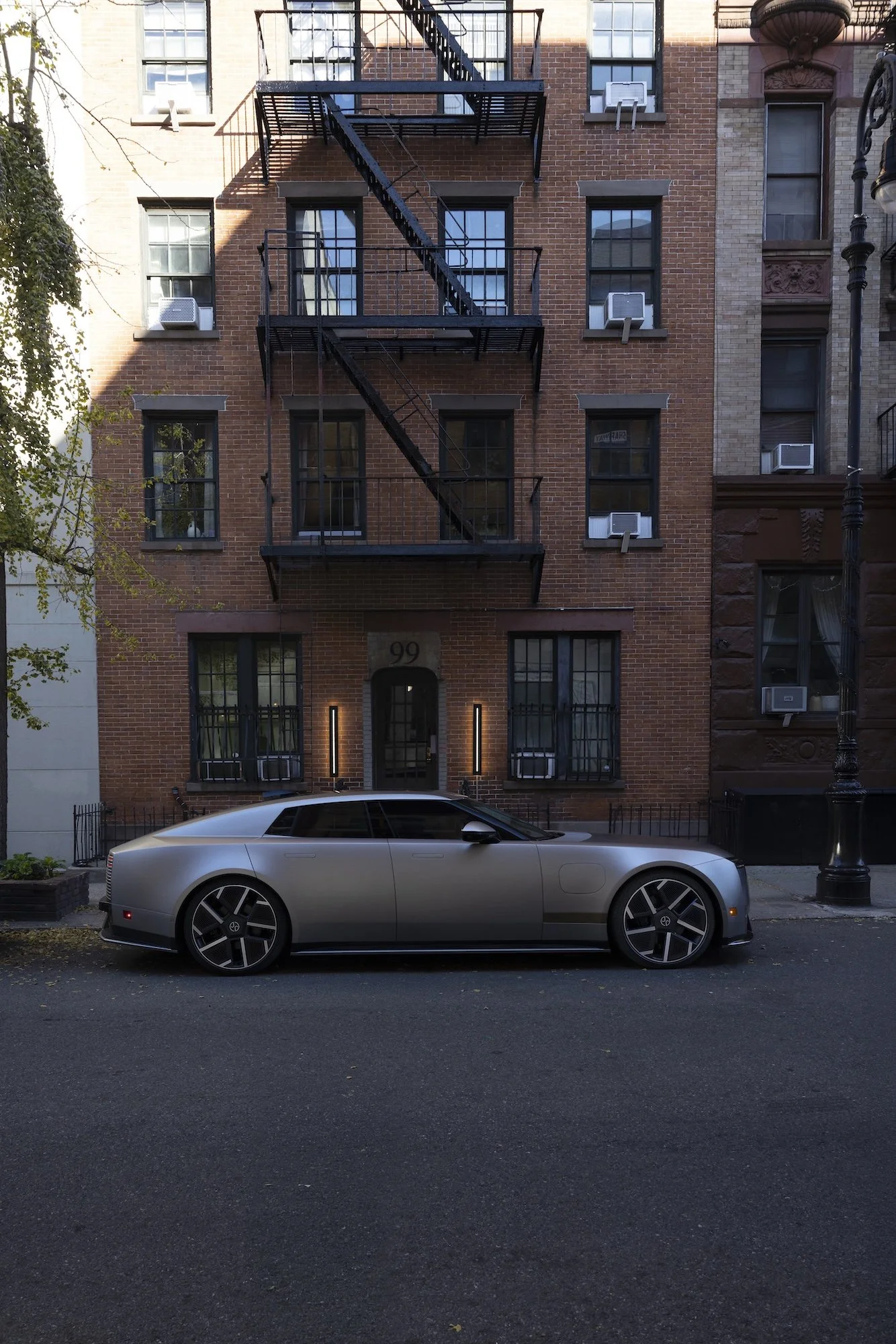
The Jaguar Type 01, photographed in New York (image: courtesy of Jaguar).
In his 1964 essay ‘The Highway and the City’, American sociologist Lewis Mumford provided a striking assessment of the centrality of cars to 20th-century identity: “he who had one was a king,” Mumford wrote, “he could go where he pleased and halt where he pleased; and this machine itself appeared as a compensatory device for enlarging an ego that had been shrunken by our very success in mechanization.” At a time in which traditional working and living patterns had been severely disrupted by the rapid industrialisation (and its attendant dehumanisation) of societies, cars were presented as a product offering what Mumford termed a “sense of freedom and power”: a design that seemed to embody autonomy and independence through mobility.
Mumford’s words seemed apposite last week, when the heritage British car brand Jaguar launched its latest vehicle, the Type 01, at an event in New York. The first production vehicle to emerge from the company since its 2024 pivot towards electric vehicles, the 01 is the commercial evolution of the Type 00 concept car that the brand first showed during Miami Art Week, and to whose design language it has remained strikingly faithful. Like its 2024 forebear, the Type 01 is explicitly designed to simultaneously signal a new era in the company’s history and to distance the brand from automotive design conventions. Jaguar’s founder, Sir William Lyons, is purported to have once remarked that “the car is the closest thing we will ever create to something that is alive,” and this attitude is clearly still resonant for the company today. A car suggests life because of the mobility that it provides, for instance, but car design itself, Jaguar suggests, should also seek to suggest a liveliness and relevance through an adaptiveness to the times and a willingness to innovate: as Lyons also remarked, a Jaguar should seek to be “a copy of nothing”. The company’s 2024 rebrand initially sought to express this ethos through an advertising campaign that relied heavily on vibrant colour and suggestions of artistry (with Lyons’ original quote mildly amended to provide the slogan “copy nothing”), in an approach that proved divisive, but which did succeed in separating the brand from the machismo and technical focus typical of much of the car design industry. Now, two years on, the Type 01 is seeking to transfer this same iconoclastic approach into the design of the car itself. “This is what we believe the 21st century should be,” explains Rawdon Glover, Jaguar’s CEO, “not only in terms of how it looks, but also in terms of how it drives.”
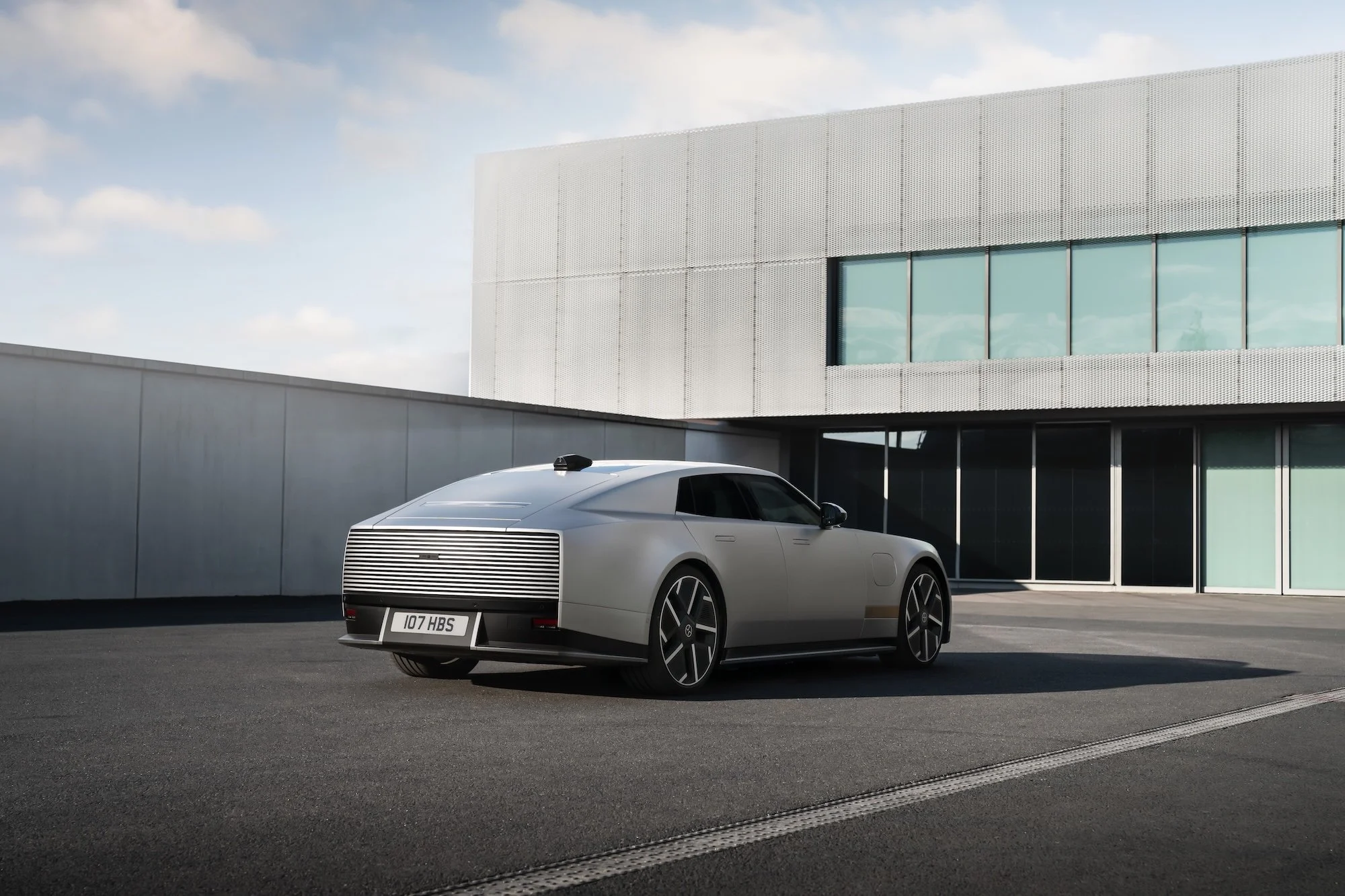
Image: courtesy of Jaguar.
While there are shared design cues between the Type 01 and previous Jaguars – the car features a dramatically extended bonnet and a low, compact glasshouse in the same manner as the company’s celebrated E-type (1961) and XJS (1975) – the new vehicle has been created to move the brand away from the expected design code that grew up around the leopardine sinuousness and elegance of its cars from the 20th century. Instead, the 01 has adopted an aesthetic that is more explicitly akin to the big cat for which it is named – rather than flowing and lithe, it is muscular and monolithic. The car is 5.2m long and 2m wide, set upon 23-inch wheels that occupy more than half of its total height. If the E-type spoke of the light, optimistic curves of the 1960s, the 01 seems more coded around reinterpreting Jaguar’s historic proportions in terms of unashamed physicality and mass, framing materiality as an expression of luxury and cultural validity – an interpretation that carries cachet in a time of digital creation and untethered AI aesthetics.
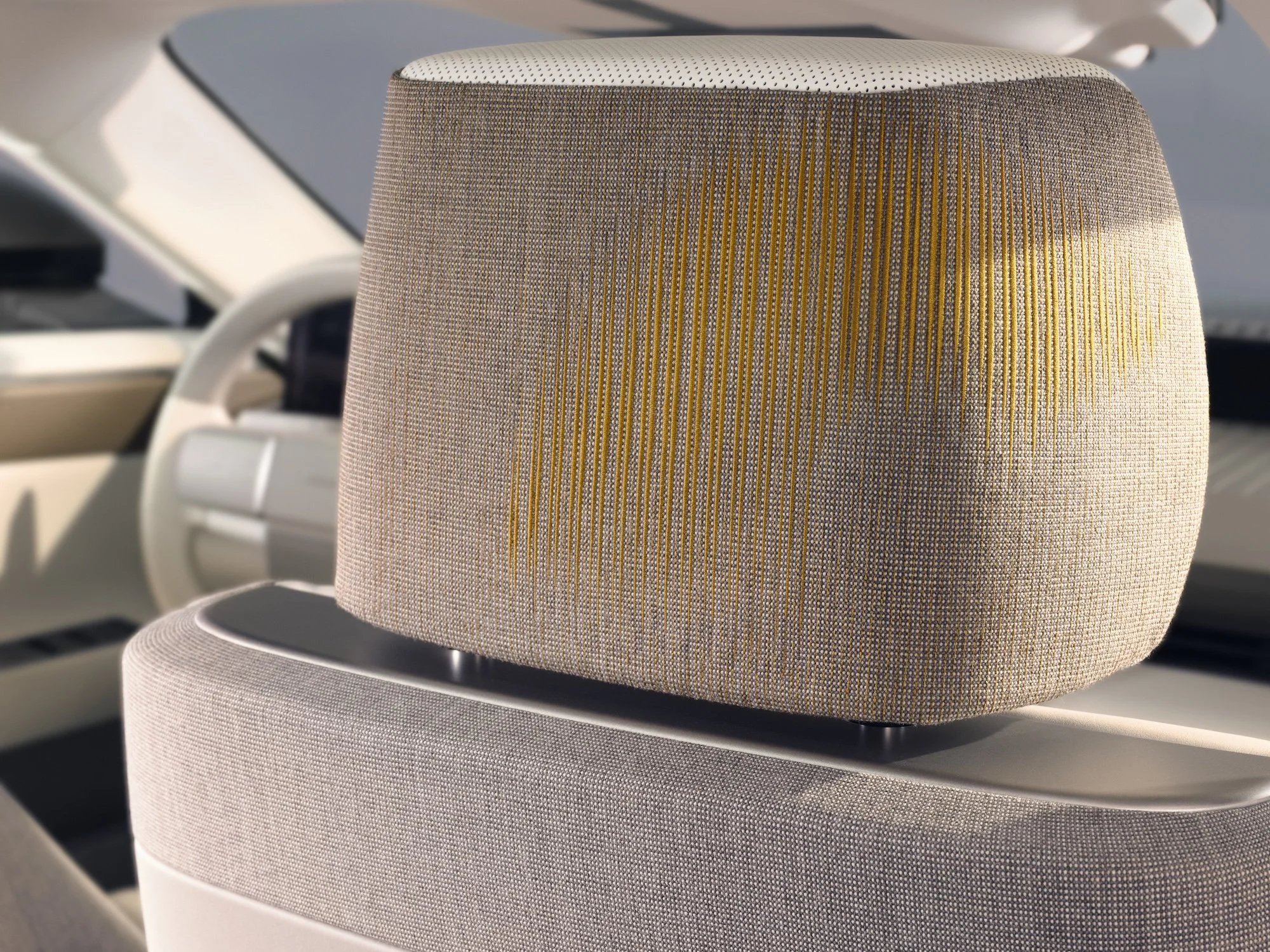
Image: courtesy of Jaguar.
Internally, Mary Crisp, Jaguar’s chief materiality designer, has prioritised Kvadrat textiles and Ultrafabrics synthetic fabrics in shades inspired by travertine stone, paired with aluminium anodised to resemble brass. “To me, it's all about the haptics and how it looks and feels,” she explains, with this emphasis on sensorial experience carried through into the interior proportions of the car. The Type 01’s cabin, for instance, is slung low to the ground, with battery cells shifted out of their traditional position in an electric car under the central cabin and moved to the front, allowing passengers to sit deeper in the vehicle’s body and stay grounded close to the road. Ahead of them, the car’s bonnet extends vast and flat, its surface purposefully kept pure to accentuate its length, culminating in a face marked by a grill that has been transformed into a graphic motif and four lamps that are positioned as slim lines at the four corners of the car. The rear, meanwhile, has foregone a back window (a camera system is used for visibility instead), in order to draw attention to the lines of its bodywork instead – one rear panel that passes from the boot of the car up over the roof, for example, has been dubbed “the impossible panel” by the car’s engineers in reference to the complexity of the incorporation of five different planes within a single piece of material.
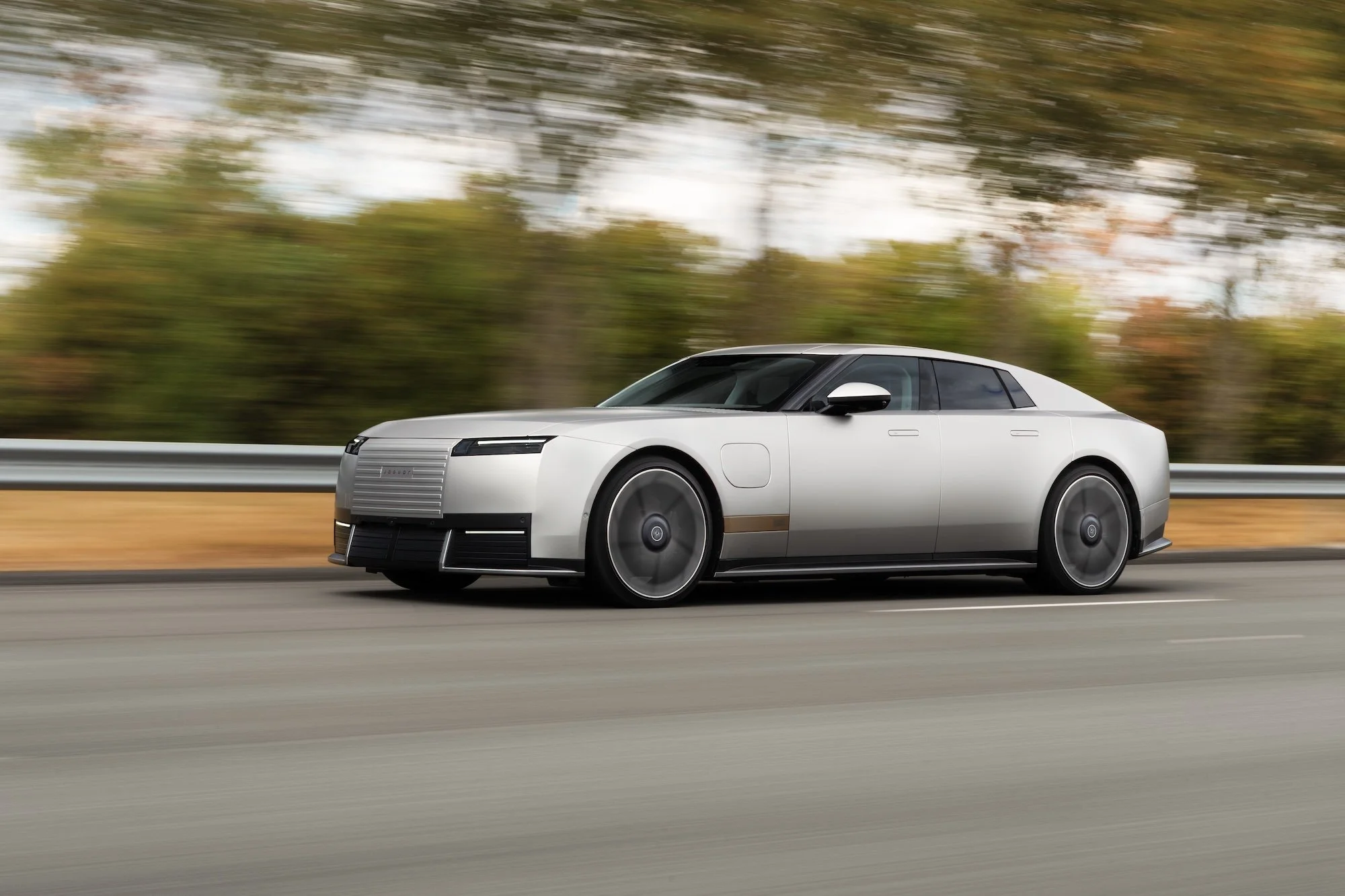
Image: courtesy of Jaguar.
“When you’re looking at this car as you are now, think of the word ‘exuberant’,” suggests Alexey Andreev, Jaguar’s lead exterior designer, describing the car’s external geometries. “What we focused on is making this car first and foremost a Jaguar. So it’s about drama. It’s about excitement. When you first see a Jaguar, you say, ‘Wow, I've never seen a car like that before.’” The development of Type 01’s design, Glover argues, “started with a single line” (tracing the silhouette of the car from bonnet to boot) from which the team then had to engineer the car, and there is no denying the visual impact of the vehicle that has resulted from this. While EV technology has often prompted designers to reflect on the capacity of the technology to result in radical new approaches of car design (the absence of an engine block or cooling grills, for instance, allows for the development of alternative proportions impossible given a conventional combustion engine), the Type 01 has instead opted to luxuriate in and extend many of the hallmarks of the traditional form, transforming previously functional elements of a petrol car into sculptural statements – the bonnet doubled down on as an expressive shape and statement of form-making; its grills transformed into graphic detailing. “Look at the proportions,” summarises Andreev. “Look at the modernity of the surface and really ask yourself: ‘Have you ever seen a car like this before?’”
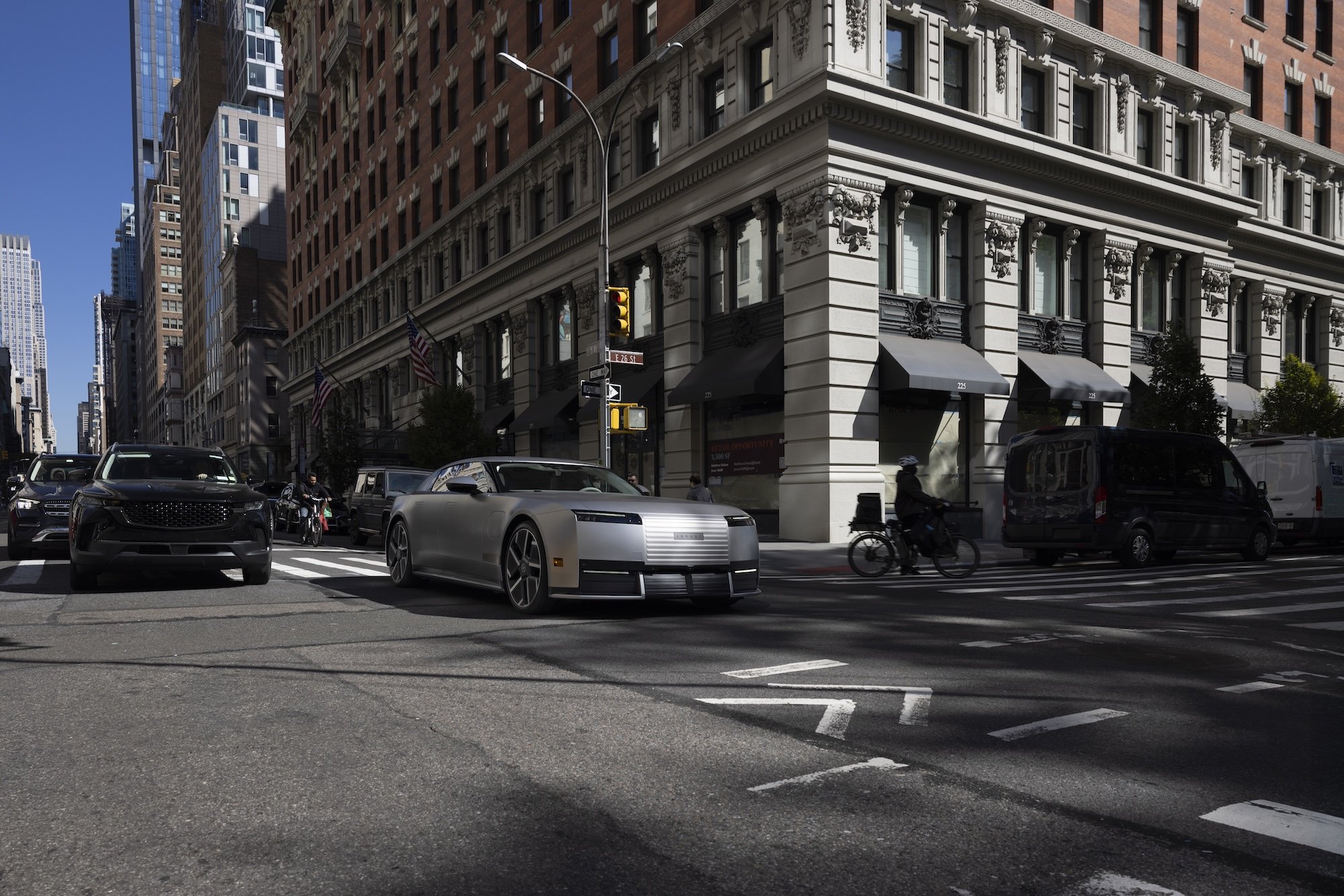
Image: courtesy of Jaguar.
The Type 01 is, in part, distinctive because its designers have approached its creation as a piece of object design, rather than a straightforward car. While the Type 01 is clearly a sophisticated piece of automotive engineering, the codes of luxury vehicle design in the 21st century are different to those that initially developed around the typology in the 20th century, when the car’s chief function remained its offer of “freedom and power” through mobility. Today, the kind of mobility that is offered by cars is largely taken for granted (if not cheapened through the realities of driving in traffic, as foreseen by Mumford’s prediction that the US highway programme would “wipe out the very area of freedom that the private motorcar promised to retain”), and there are undoubtedly cheaper, more everyday vehicles that offer this form of freedom more readily and completely than the Type 01: it has already been noted, for example, that the Jaguar’s size means that it is out of step with the smaller roads and parking spaces offered in both the company’s base in the UK and in many cities worldwide. Yet the reduction of form to function has long been an ill fit in the realm of luxury cars, where other design codes frequently come into play and take priority over basic utility. In the case of the Type 01, for instance, “the primary objective of this car is to connect with people at an emotional level,” Glover notes. “People need to desire this vehicle. Like all of the iconic Jaguars of the past, it’s about creating irrational desire.” While cars may have been developed around the idea of mobility, the Type 01, Glover seems to suggest, is equally interested in moving people in another sense of the term. It is designed to be emotionally engaging for those who drive it, but also for those who appreciate it purely as an object of aesthetic consumption – whether in-person or online.
In ‘The cultural identities of Jaguar’, an essay published by the brand to coincide with the launch of the Type 01, curator Brendan Cormier reflects on the legacy of Jaguar across visual art and cinema. “There are attempts in the cultural world to frame a car as a work of art, to view it in terms of pure sculptural aesthetics. There are similar efforts in the automotive world to frame a car as a work of performance, to view it in terms of a pure driving experience,” Cormier writes, drawing on his experience curating the V&A’s 2019 exhibition Cars: Accelerating the Modern Wold. “Neither of these quite hit the mark. The true beauty of the car is in its capacity to be a vessel of multiple meanings, to live with the times and to reflect back to us the joys, fears, fantasies, and agonies of our everyday experiences.” With the Type 01, Jaguar has sought to follow his advice. The company has aimed at offering a vehicle whose function is inseparable from its expression, and whose presentation of Jaguar can find renewed relevance in the 21st century.
Words Oli Stratford