
The Nook
Conceived by the charity Scottish Action for Mental Health, Glasgow’s The Nook is the first of a new series of mental health hubs which borrow from the design language of community spaces (image: Curse These Eyes).
Tucked away behind the pale green wire-framed windows of a Grade B-listed Thomson, Sandilands and MacLeod building in Glasgow is The Nook – the first of a new series of mental health hubs for Scotland. Behind those green windows, round, yellow-stemmed tables congregate at the entrance to the building, accompanied by glossy wooden chairs. Against a two-tone wall of blue-lilac and pale peach, the room unfolds into a series of loosely defined areas that can support different visitors, and render mental health services accessible, welcoming and community-focused.
The Nook was conceptualised by the charity Scottish Action for Mental Health (SAMH), which commissioned interior designer Anna Campbell-Jones and Finni Porter-Chambers, a community-oriented designer, to help deliver the space. “I think me and Anna are naturally quite playful designers anyway, and when we heard that SAMH wanted a non-clinical environment, that was like music to our ears,” explains Porter-Chambers, with The Nook intended to break with many of the conventions of more typical mental health clinics, which are often established within institutional healthcare spaces. Instead, The Nook is set in a colourful, cosy and open-plan space, designed to accommodate people seeking support in a casual setting without additional pressure or stigma. With around 2,600 adults currently waiting for more than a year to access mental health resources to begin treatment in Scotland, The Nook is an attempt to curb barriers to entry by delivering a suite of essential services while avoiding the need for waiting lists, appointments and counselling referrals.
Designing The Nook as a non-medical space was a key factor behind the design. “We're talking about acceptance of the idea that looking after your mental health is absolutely, completely normal,” says Campbell-Jones, explaining that The Nook occupies an early 20th-century building set near Glasgow Central Station, within a bustling shopping district in Glasgow’s Merchant City. “It's something that happens to most people at some point in their lives,” says Campbell-Jones, stressing the need to create an alternative space that feels positive and casual in order to encourage people to walk in without shame. “We don't want people just sneaking in through the door,” she adds.
Operated by SAMH, the space offers various services to children (10+) and adults, with these couched within a design language that borrows from that of community spaces, as opposed to medical facilities. Visitors can choose to have an informal chat in one of The Nook’s “sheds”, a collection of blue, pink and green booths reminiscent of beach huts. Alternatively, with staff trained in wellbeing practices, people can attend a self-help workshop or activities such as art classes. “It's so inviting, especially on a horrible rainy day, [seeing] all the colours,” says Hazel Mcllwraith, SAMH’s Director of Fundraising and Major Appeal. “You're just like, ‘I want to go in there. That's where I want to be.’”
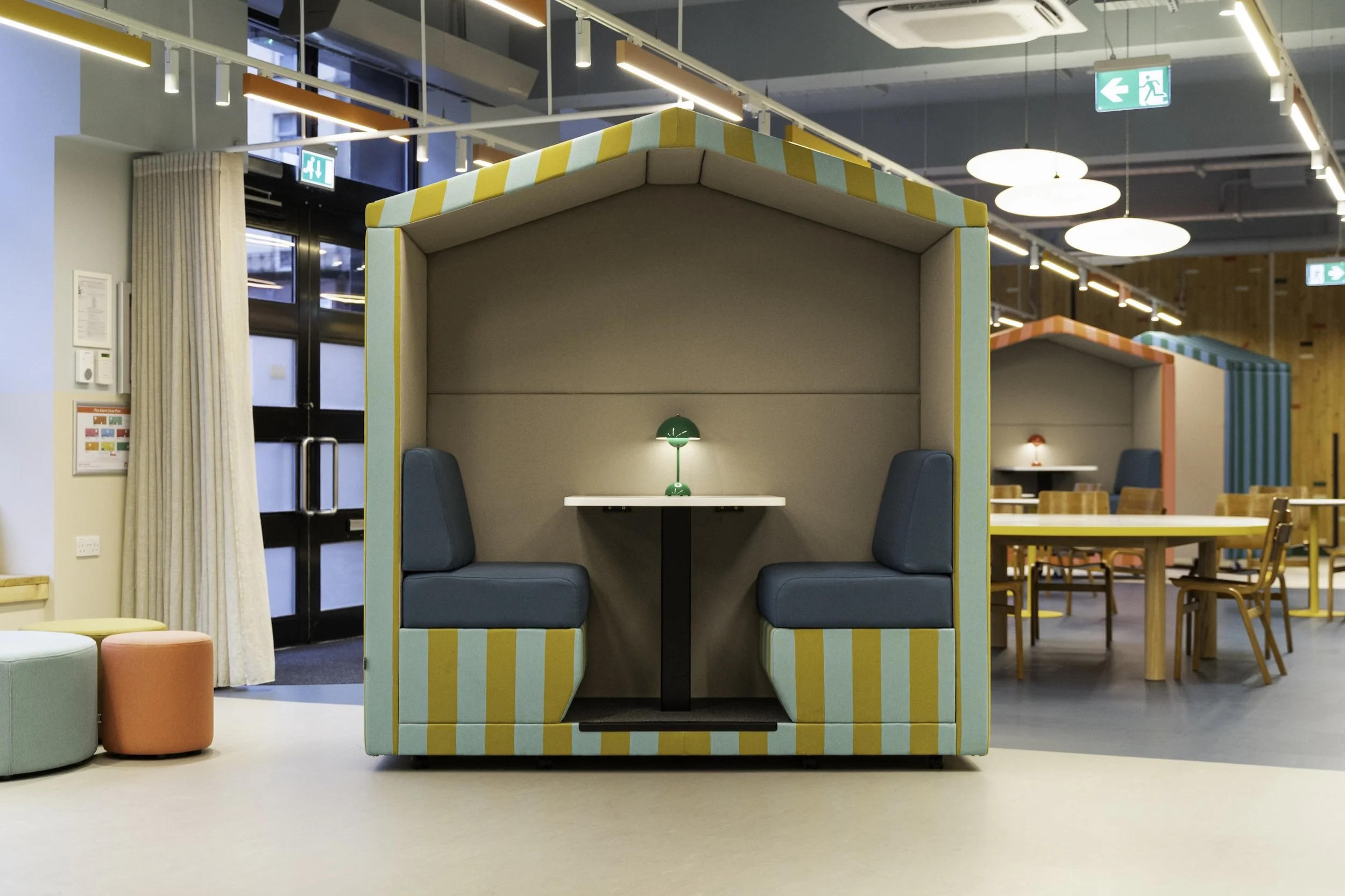
The Nook’s sheds are designed to resemble beach huts, and provide a space for people to have an informal chat (image: Curse These Eyes).
To ensure The Nook looks similarly approachable from the outside, the building’s large shop windows have been tinted with pastel hues, and detailed with botanical, stripe and shape patterns. Yet there is still the option to pull the blinds down for visitors seeking support more privately. In this vein, branding for the space has been kept intentionally inconspicuous in order to reduce stigma. “We want people to know it's SAMH, but you cannot have it [explicitly billed] as the SAMH hub because we are Scottish Action for Mental Health, and people will not come in,” Mcllwraith explains. Instead, the hope is that the design will allow passersby to notice the space because of its positivity, and avoid cultural baggage that might prove off-putting to potential users.
This same spirit has carried through into other design decisions. One of the team's first ideas was to avoid calling the different spaces within The Nook by names that you would typically find at a clinic. Rather than being confronted by an austerely named “Consultation Room One”, for instance, users will find the “The Snug”, painted in a friendly cursive above the door frame by Bungo Sign Co.. There’s also “The Library” for visitors who may have small children with them – a space that would more typically be called a “family room” in hospitals. “The language is all domestic, familiar,” says Campbell-Jones. “By calling those spaces and functions those names, that inevitably makes you think about how you design them in that different way.”
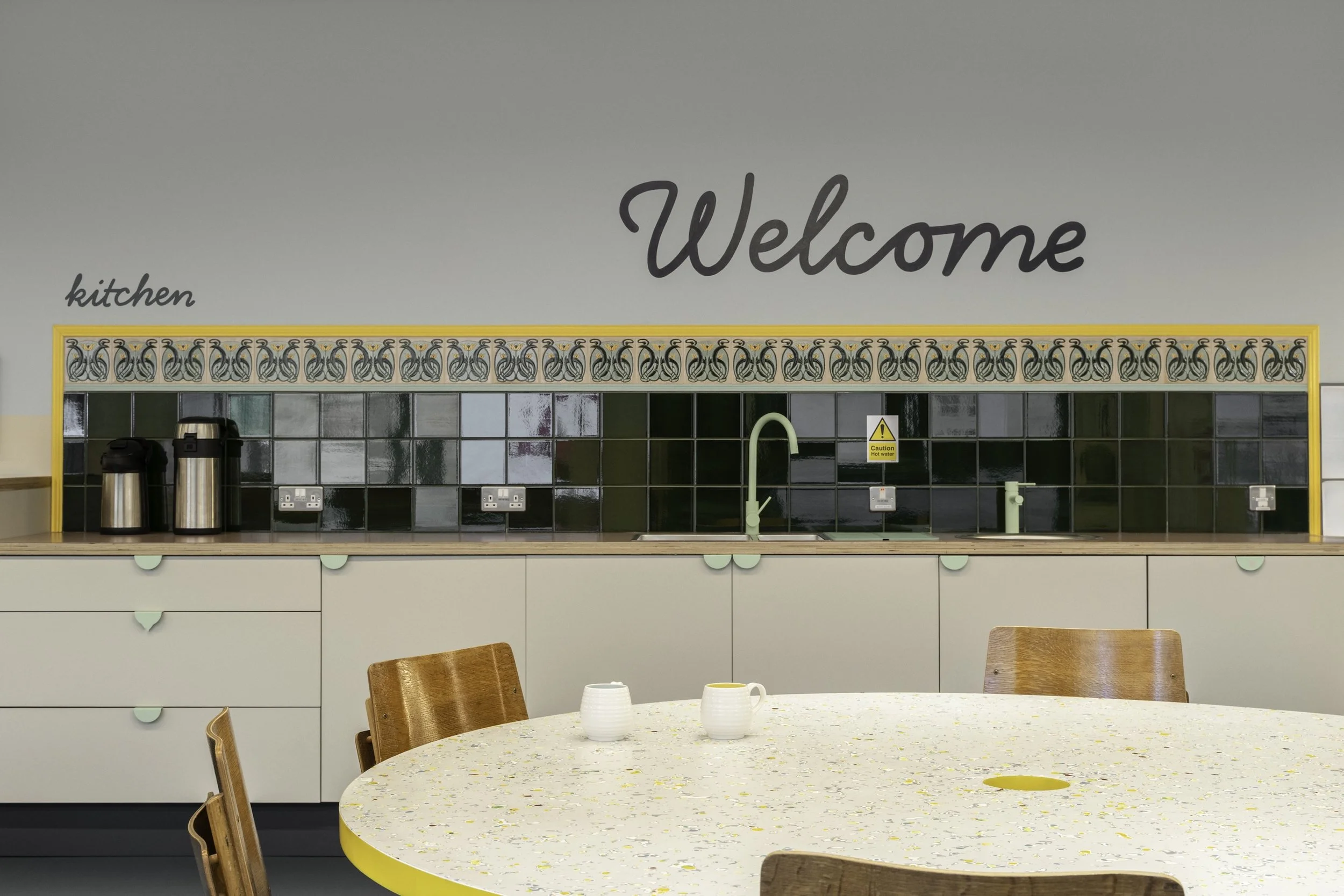
All of the spaces in The Nook are named using domestic, rather than medical, language (image: Curse These Eyes).
As the first space that people see as they enter The Nook, “The Kitchen” confidently introduces the design’s bold use of colour. Central to the space is a yellow-rimmed round table, featuring a tabletop speckled with green, red, blue, and yellow abstract shapes. The importance of a kitchen table is a passion point for Campbell-Jones. It has “healing powers”, she says: “You can sit at the kitchen table with a friend, with your family, that's where all the conversations happen: the difficult ones [and] the nice ones.”
Making The Nook feel like home was a core motivation behind the design, not only in terms of referencing domestic space, but also in materially grounding the centre within the context of its surrounding city. “The unfamiliarity of a clinical environment really can get in the way of progression,” explains Campbell-Jones. Sitting in front of the windows, for instance, are barstools upholstered using deadstock Clockwork Orange fabric, a textile used on Glasgow’s subway seats that Campbell-Jones was involved in designing in the early 1990s. The vibrant orange moquette fabric is intended to feel familiar and nostalgic, and allows visitors to “see themselves reflected in the space and maybe start a bit of storytelling,” explains Porter-Chambers. The inclusion of familiar design elements, she says, could lead to “a conversation that isn't just going straight into talking about their mental health.”
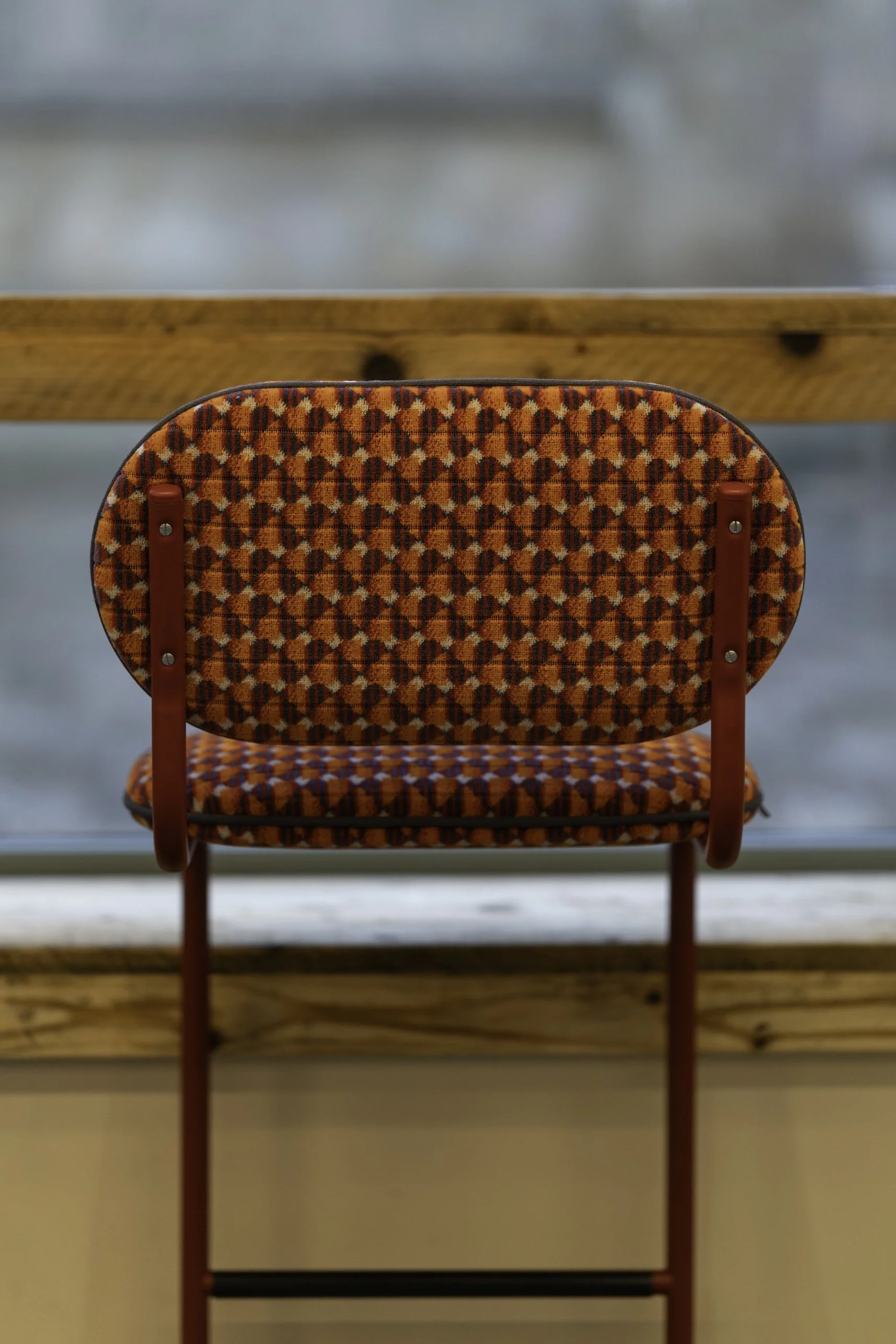
The space’s barstools are upholstered using deadstock Clockwork Orange fabric, a textile used on Glasgow’s subway seats (image: Curse These Eyes).
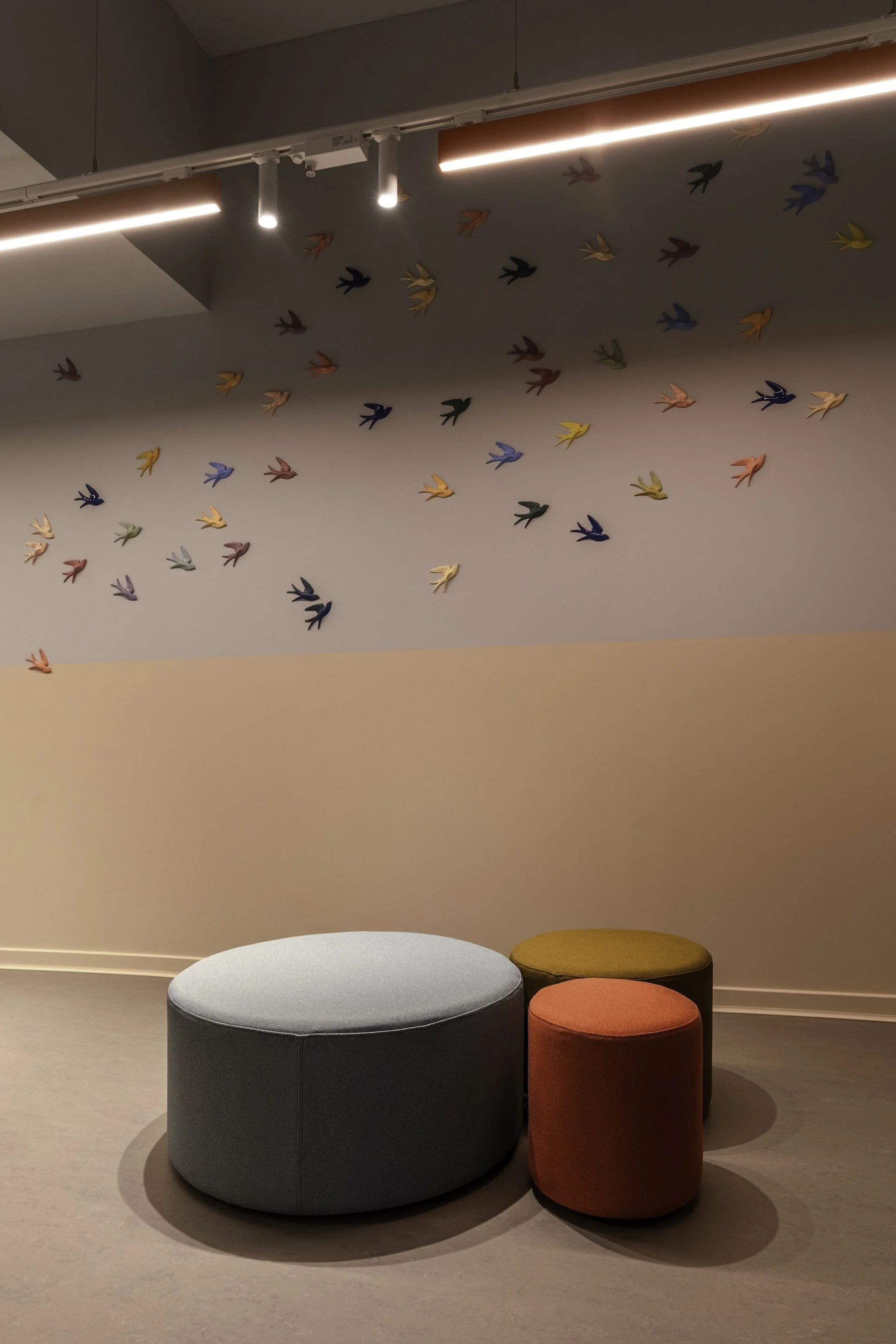
Alongside Clockwork Orange, other elements within the design have also been sourced from local businesses to support the designers in their aim to build up a sense of familiarity and closeness in The Nook. In this spirit, Campbell-Jones collaborated with Ocean Kitchen Scotland, a Glasgow-based company that specialises in products made from recycled ocean plastic, to create an art installation of swallows. “Swallows are an important symbol of hope and home, of loyalty and resilience,” she says. With 60 swallows carefully arranged on the wall to appear as if they are flying upwards as a united flock, the display evokes feelings of freedom, optimism and community. As a project made for Glasgow’s community, including the city within the design process of The Nook was vital to Campbell-Jones and Porter Chambers, extending the project’s theme of personal networks of support into their procurement process. “Each Nook is going to have aspects of it that are designed with an element of community consultation, so that they have not only a sense of place in Scotland, but also a sense of place in the cities and places going to be built,” says Campbell-Jones.
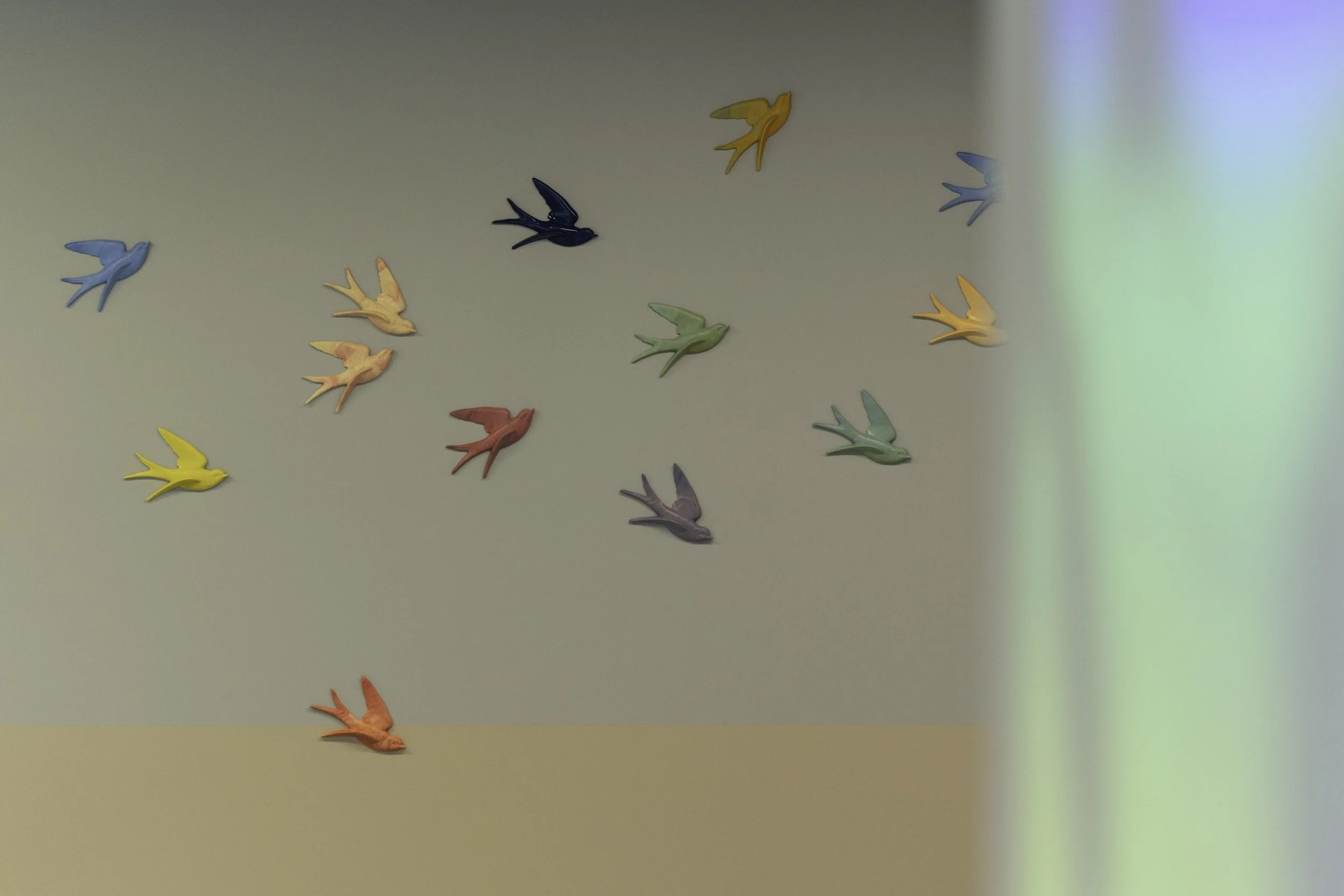
The designers created an installation of swallows made from recycled ocean plastic, referencing a bird that is associated with Glasgow and is symbolic of hope and resilience (image: Curse These Eyes).
Addressing the mental health emergency in Scotland, as in any country, is a complex and constantly shifting challenge. In this spirit, The Nook has been designed with a degree of flexibility, intended to be a living space that can adapt to different people’s needs, and also evolve itself in response to the issues it is responding to. Following the launch of the Glasgow space, for example, a network of Nooks is planned for various other cities in Scotland, including Aberdeen, Edinburgh and Lanarkshire. Mcllwraith also mentions the potential to work with corporate offices to install miniature Nooks within the workplace. Furthermore, to ensure rural and isolated communities are also reached, each Nook will have a dedicated outreach team, who will be able to install pop-up nooks around the city using different furniture elements from the design. “It’s almost like the Mary Poppins bag,” says Mcllwraith. “We can open it up, and then there'll be a little pop-up nook that will come out.”
Words Annalise Smith