
The Lost Cloth Object
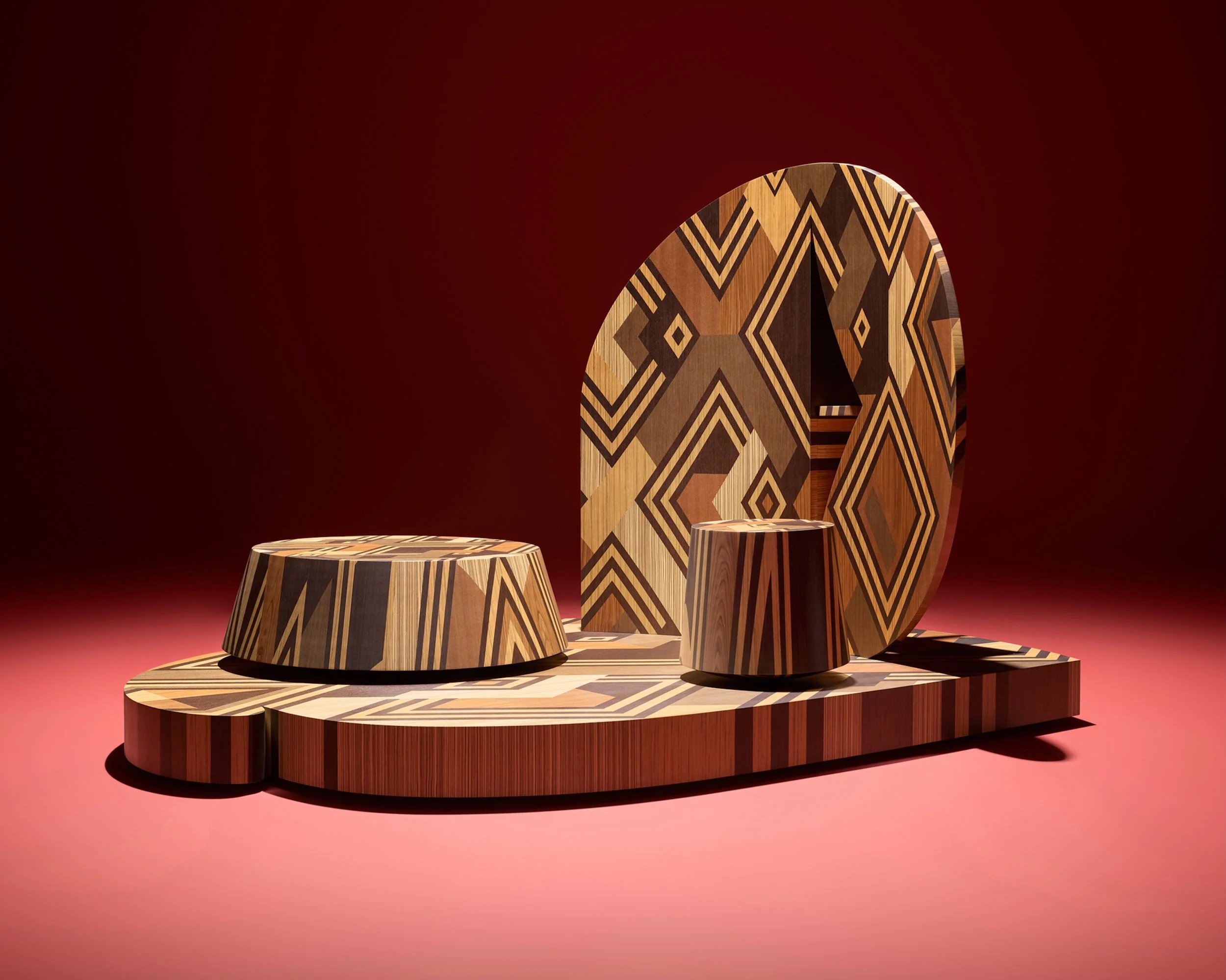
Stephen Burks Man Made’s The Lost Cloth Object, created in collaboration with Alpi, is a speculative ceremonial site composed of wood veneer marquetry whose patterns are inspired by Kuba textiles (image: Federico Cedrone).
Design studio Stephen Burks Man Made’s The Lost Cloth Object is made up of a platform, a stool, an ottoman, and a curved, shield-like shape, all of which are positioned to encourage a circular gathering. The arrangement is covered in wood veneer created by Italian manufacturer Alpi, with patterns of interlocking diamonds appearing at different scales throughout the piece – skinny ones stretch up the object’s sides, while wide ones sweep across its larger surfaces like a tailor-made piece of clothing.
“Seeing the process of Alpi taking a log and shaving it down with a giant lathe into very, very thin sheets of veneer, recomposing it into an Alpi log, and then moulding and slicing it until they literally create their own wood grain – it’s mind boggling,” says Stephen Burks, who runs the studio with his partner Malika Leiper. The straight, ridged wood grains that slice through the object reference woven raffia, a material that serves as the foundation of Kuba cloths from the Democratic Republic of Congo’s ancient Kuba Kingdom. Traditionally used in royal courts and funerary rites, these textiles are decorated with embroidery and cut-pile stitching to create geometric patterns like the one that clothes The Lost Cloth Object, and which will later serve as inspiration for a commercial wood veneer for Alpi. For The Lost Cloth Object’s unveiling at Design Miami 2025, however, the studio used thousands of individual pieces of veneer to create a bespoke industrial surface that resembles the hand-made cloths as closely as possible.
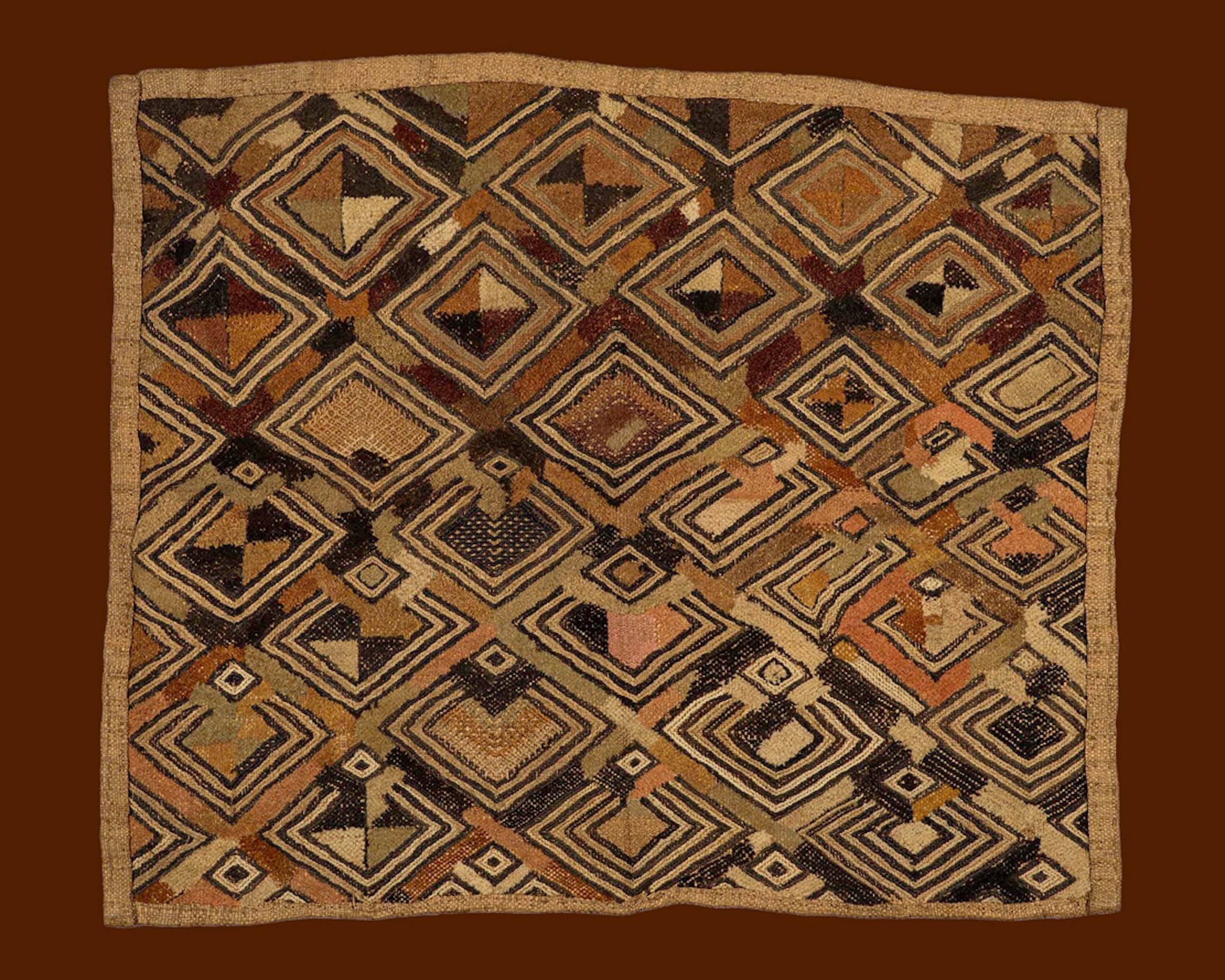
A Kuba prestige cloth from the Mint Museum’s Wesley Mancini Collection, which Stephen Burks Man Made drew inspiration from (image: courtesy of Mint Museum).
“One of the things we wanted to do is make it clear that it’s Kuba [cloth], because diamonds and other patterns have been disseminated throughout contemporary culture,” Burks says, explaining that the veneer mimics the pattern of a textile that will soon appear in Designing Dynamism, an exhibition dedicated to Kuba textiles that he and Leiper have co-curated for North Carolina’s Mint Museum. “So we needed to literally redraw the textile in marquetry.” While the cloths in the Mint Museum’s collection were mainly produced in the 1980s, similar pieces appear in many museum archives dating from the late-19th to early-20th century, when these textiles first appeared in European markets. “We had heard, in very casual conversations with scholars of Kuba, remarks about it being a lost or dying art form,” Leiper says. “And that was very surprising to us.” To explore the contemporary production of Kuba cloth, the pair travelled to the Democratic Republic of Congo on a trip organised by Congolese-French designer Jess Kilubukila, who runs a design brand creating furniture, rugs and textiles handmade by Kuba artisans. Here, they learned techniques from Kilubukila’s craftspeople, and saw commercial cloths available in the markets of the country’s cities, as well as ceremonial textiles being produced in its villages.
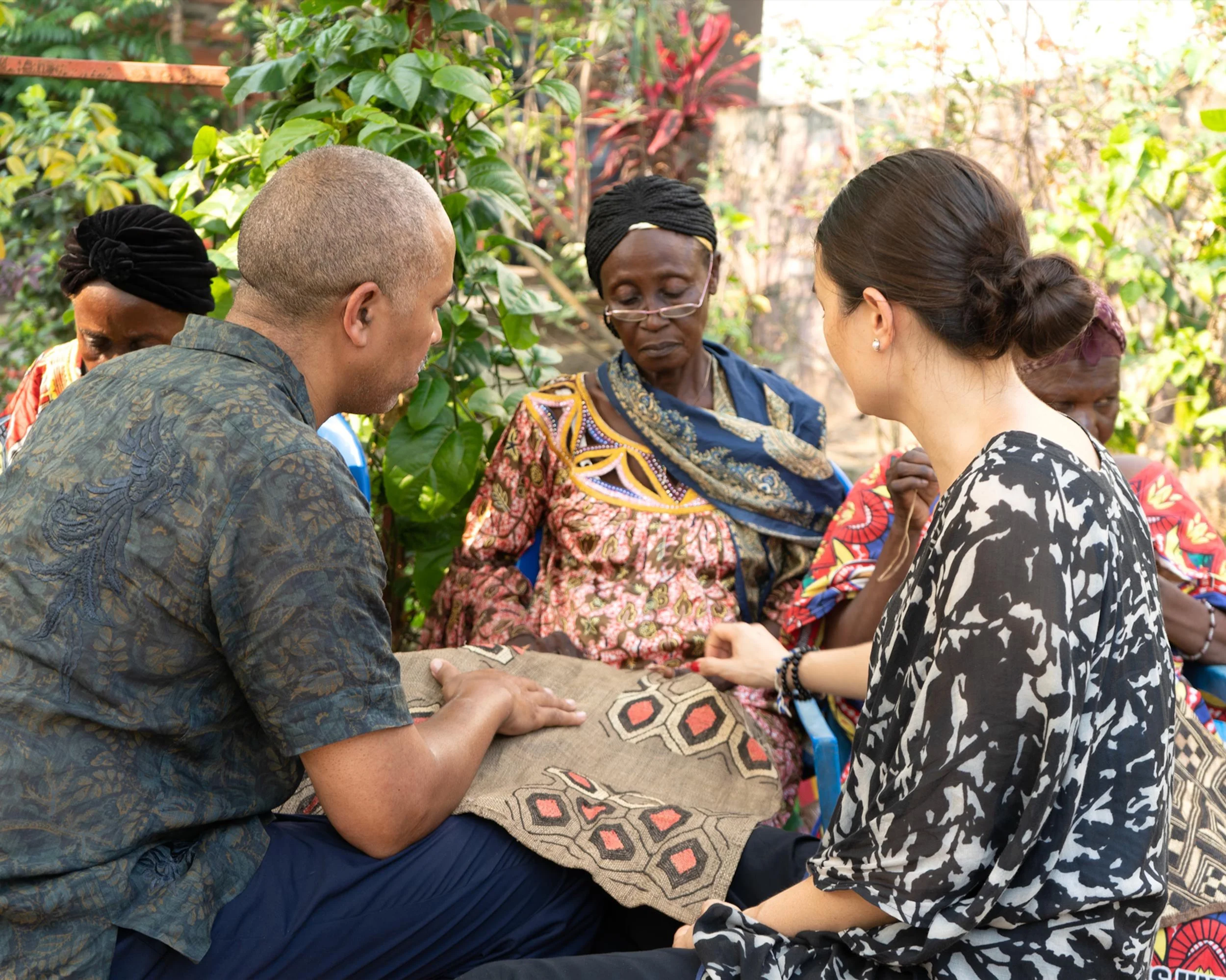
In June 2025, Stephen Burks Man Made traveled to Kinshasa, Democratic Republic of Congo, to learn Kuba with a local artisan collective Kilubukila, and document the state of the art form today in their short film In Search Of Kuba (image: Stephen Burks Man Made).
“People apply this notion that the techniques haven’t advanced, or that the quality has deteriorated in some way because they're now being produced for a commercial audience, so it’s no longer authentic,” Burks says, explaining the misconception that Kuba is a dying art. “When viewed from the West, [people] don’t actually have eyes on the contemporary practice, or don’t want to acknowledge that it’s part of a continuum, or acknowledge certain people’s right to progress and transformation.” Ranging from shades of honey to dark brown, The Lost Cloth Object’s veneer uses wood from Alpi’s Legacy Collection, which is designed to resemble species that are endangered or inaccessible, such as ebony, teak and rosewood. “We associated lost woods with lost cloth,” Burks says, tying together the object’s materiality with the idea of Kuba cloth being a neglected and misunderstood art form.
Leiper also acknowledges how political and socioeconomic realities have impacted the contemporary production of Kuba cloths. “The reality is that Kuba cloth is very hard to make, and for that knowledge to be passed down it really has to be invested in and supported,” she says. “Without that investment, many artisans are working under quite strenuous economic circumstances, which of course affects the value or quality of their work.” By spotlighting Kuba cloth on a global design stage through The Lost Cloth Object, the Designing Dynamism exhibition and their documentary In Search of Kuba, Burks and Leiper hope to inspire other people in the design industry to make connections with artisans and invest in the future of Kuba textiles. “It’s really about reclaiming this art form for another generation,” Burks says, noting that many textiles sold in the Democratic Republic of Congo resemble the lap-sized cloths favoured by Western art collections, rather than engaging with more experimental forms and aesthetics. “Reclaiming it from the commodification, from the capture of Western culture, and from this point of stasis where it hasn’t been allowed to grow, and trying to envision it existing in a modern context.”
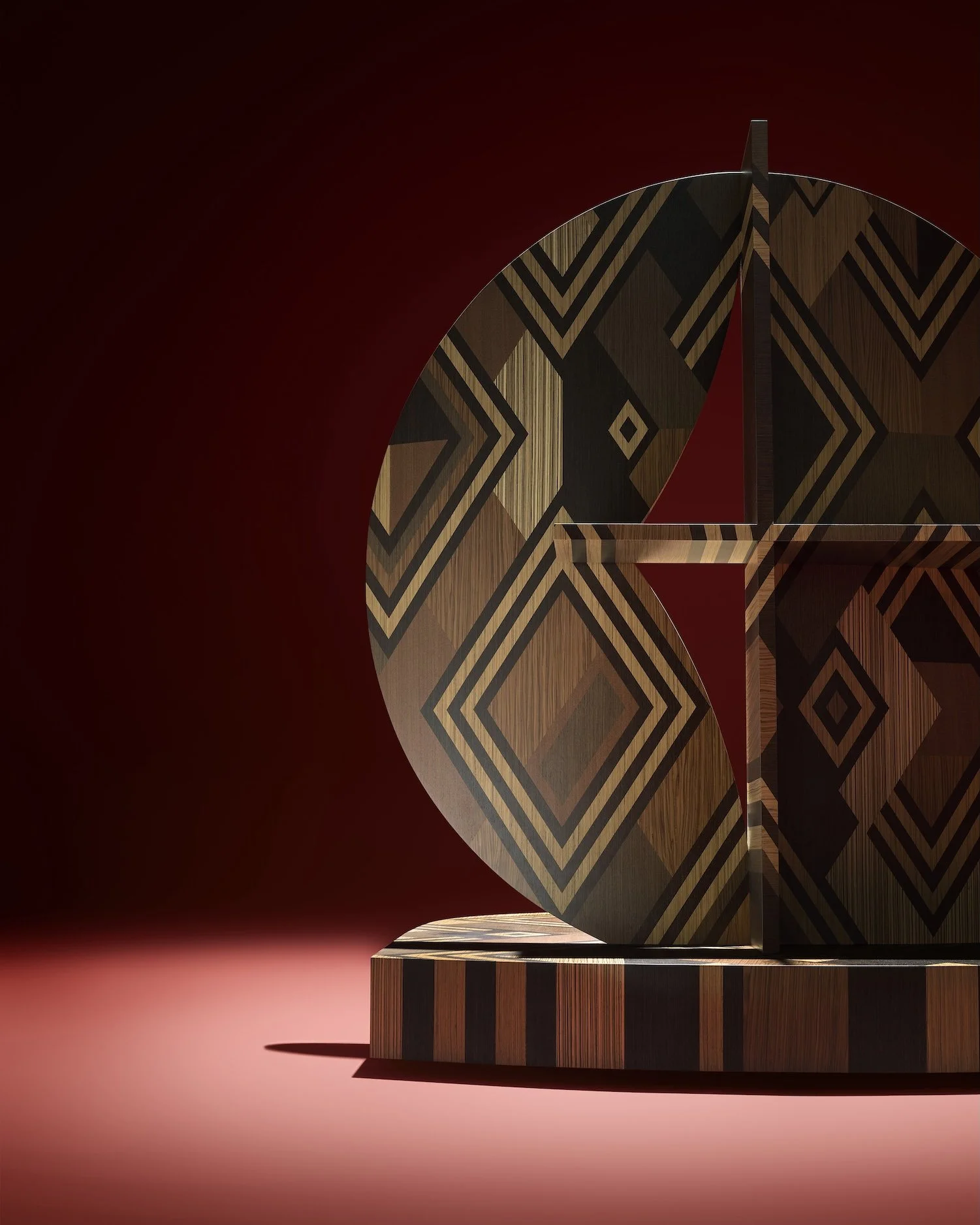
The back view of The Lost Cloth Object’s partition, which the studio interprets as a threshold between the physical and metaphysical worlds (image: Federico Cedrone).
While the pair see material innovation as a key way of translating Kuba cloth into contemporary design, the form of The Lost Cloth Object brings the textile’s ceremonial roots into a global commercial context. “Even though it’s Design Miami, it’s not a village outside of Kinshasa,” Burks says, “there is a way of looking at design which also tries to speak to the spiritual – and if other cultures are to participate in contemporary design, we also have to acknowledge their ways of being.” Designed as a speculative ceremonial site, the object’s curved shield acts as a threshold between the physical and metaphysical world – a concept the duo previously explored in their series of sculptures reflecting on African-American ancestors. “With the curved partition, you feel not only the physical sensation of acoustic amplification, but you also feel the focus of energy,” Burks explains. “The little window offers space for light to pass through, and gives you a strange viewpoint that feels like you’re looking into another world.” Despite the fact that visitors weren’t allowed to mount the platform, its shape still invited a ritualistic, circular gathering. “People began to surround it,” Burks describes, “and in surrounding it, the object became sacred.”
Words Helen Gonzalez Brown