
Sketches of Utopia From Hell
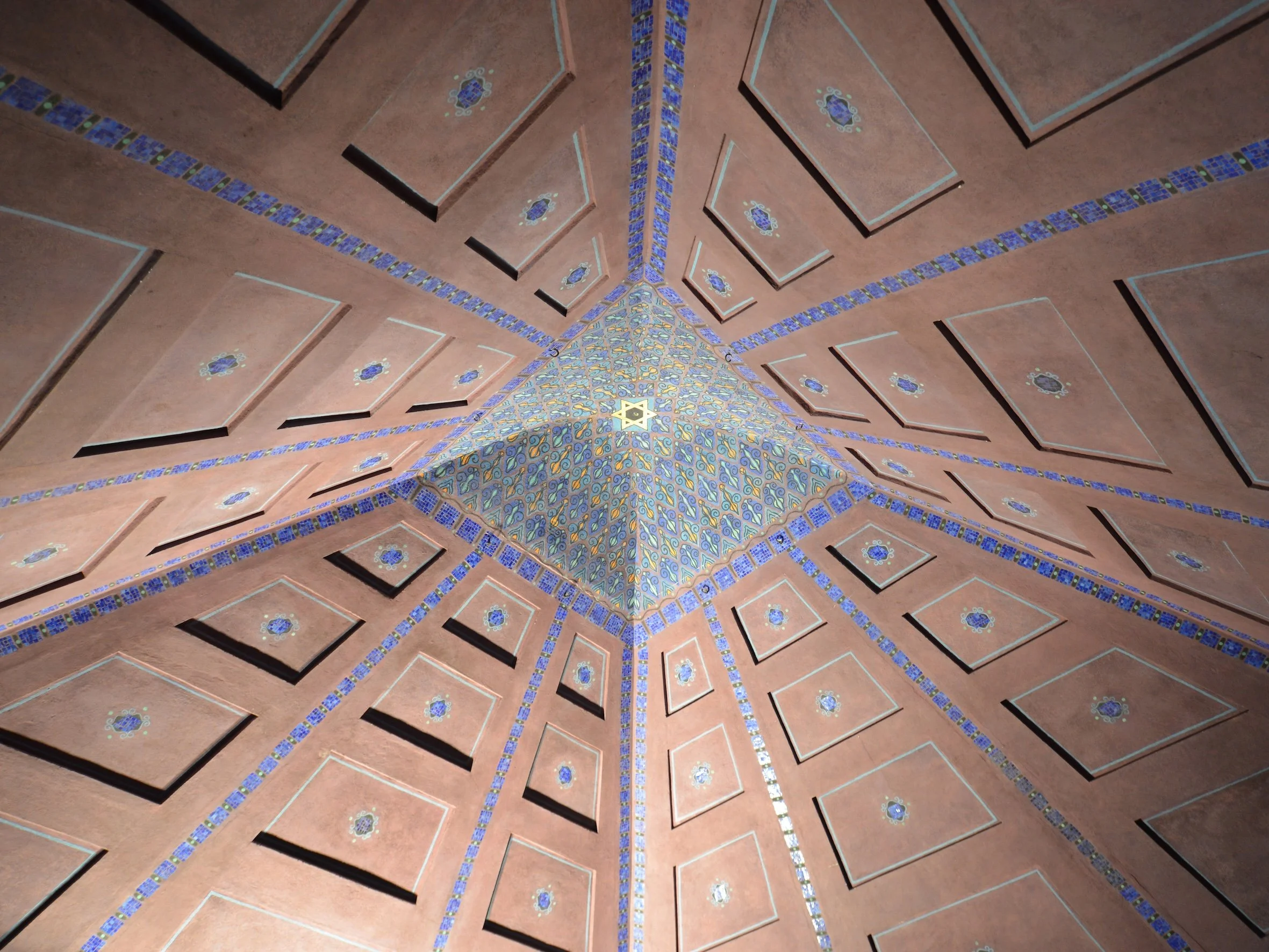
The ornate ceiling of the Mendelsohn House in Olszytn (image: Carsten Krohn).
In the graveyard of St Pancras Old Church, north London, dozens of headstones are huddled together in a bizarre tableau. Until its fall two years ago, they encircled an ash tree like figures kneeling in worship or grief. Surprisingly, the arrangement was the work of Thomas Hardy, future novelist, poet and thenjunior architect. He’d been assigned the task of dispensing with the gravestones by the Bishop of London to make way for the railways but, by rearranging them as a decorative spolia, instead saved them from a fate he’d later confront in his poem ‘The To-Be-Forgotten’: “Our future second death is near; / When, with the living, memory of us numbs, / And blank oblivion comes!”
It’s a short walk to King’s Cross station from the Hardy Tree and, from there, a series of trains to the airport and the skies over the continent. There are places where history abruptly shifts tracks, changing the lives of millions. Two gunshots outside Moritz Schiller’s delicatessen in Sarajevo on a summer’s morning in 1914. Mould on a petri dish in a Paddington hospital in 1928. My destination is one such place. A landscape of islands and forests, it resembles a picturesque wilderness, a historical hinterland. Yet it was here in the Masurian Lakes that Tsarist Russia began to fall apart, with the army halted then decimated by German forces, eventually leading to the end of 300 years of the Romanov dynasty, the Bolshevik coup and all that followed, with the rise of communism and fascism. The airport, near Szymany in northeast Poland, is quiet and near empty. All that can be heard outside is birdsong, belying the significance this place once had. Less than 10 miles from here, the commander of the Russian Second Army, Alexander Samsonov, defeated and disgraced, went into the woods and shot himself. The airfield itself would be used by the Luftwaffe during the Nazi invasion of Poland, which sparked the second world war. An hour and a half’s drive away are the ruins of Hitler’s Wolf’s Lair. It’s a landscape saturated in history, much concealed.
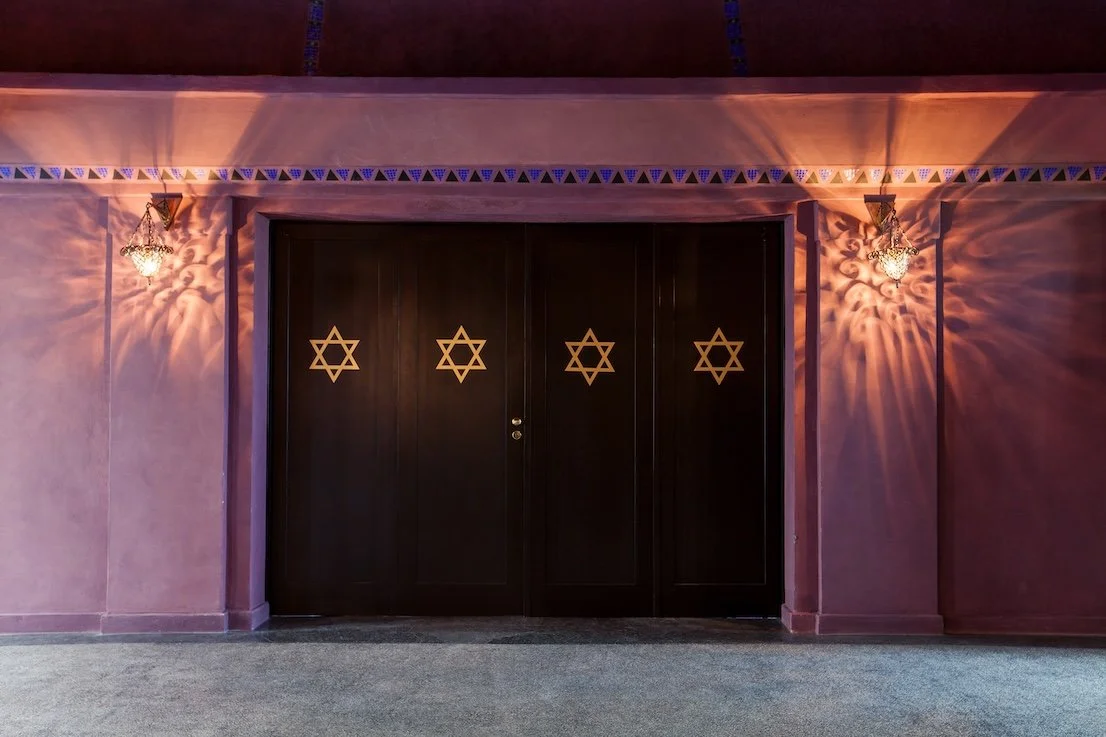
Image: The Borussia Foundation.
Reading old books on the region, I noticed the difference between the place names in the texts and the train stations we pass through. Szczytno, Pasym and Klewki were once Ortelsburg, Passenheim and Klaukendorf. My destination, the city of Olsztyn, was Allenstein. Part of East Prussia is now Poland. The war and ethnic cleansing that took place here is scarcely conceivable, even in our violent present. It wasn’t simply a change in history. For millions, it was the end of the world.
I’d come to Olsztyn to visit a building that, given the odds, shouldn’t have survived. Long before I knew his name, Erich Mendelsohn was my favourite architect. As a child, surrounded by the bombed-out militarised architecture of my native Northern Ireland, I’d glimpse otherworlds in the streamline moderne architecture occasionally found on the coast and in art deco cinemas. They felt like pastel and neon palaces of the future. Though they had many precedents, Mendelsohn was the driving force in this dynamic form of modernism. Here was an architect who was as much artist as engineer, balancing functionalism with sensuality, giving character, humanity, poetics, even music (one building, his Schocken Department Store in Stuttgart, was inspired by a Bach recital) to forms that might otherwise have been austere and technocratic. I’ve been on a pilgrimage ever since. The biomorphic spaceship Einstein Tower in Potsdam. His surviving Schocken stores which look as capable of velocity as any aircraft or ocean liner. The exquisite De La Warr Pavilion in Bexhill-on-Sea, East Sussex, where every fitting is prime gesamtkunstwerk, from the swirling stairwell onwards. Mendelsohn’s buildings feel imbued with an “anything is possible” spirit. Yet he dreamed up these visions in the midst of hell.
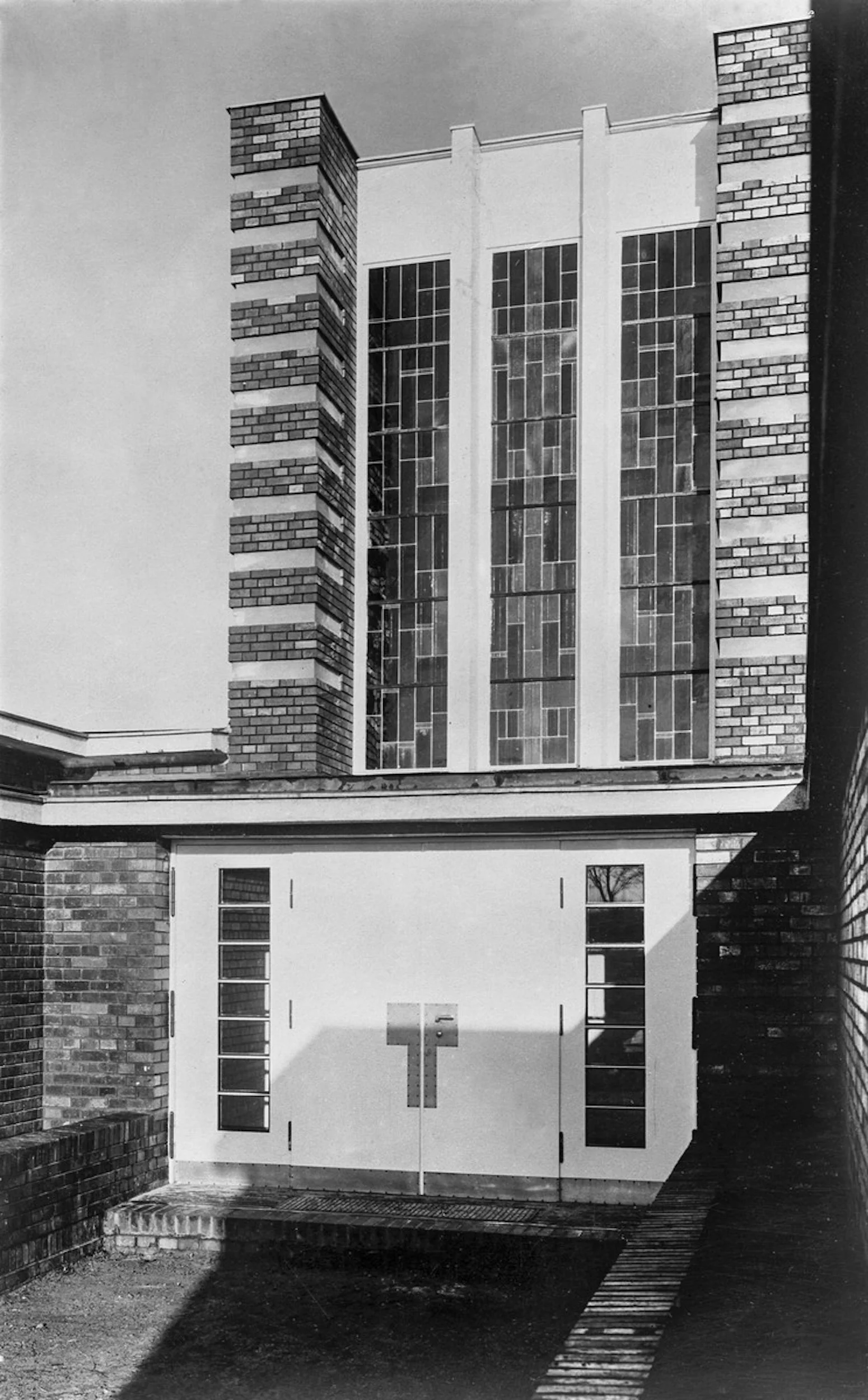
Erich Mendelsohn’s Jewish Cemetery in Königsberg, which was completed in 1929, was later destroyed by the Nazis (image: courtesy of Bildarchiv Foto Marburg).
In a 1948 lecture at the University of Los Angeles, Mendelsohn would recall: “In 1917, with the Kaiser’s army at the Russian front, in the unreal world of dugouts and trenches, my architectural dreams [were] the only reality.” To escape “the silent terror of no-man’s land” punctuated by “the terrifying din of rapid fire”, he spent his nights writing letters home to his love, Luise Maas. In the margins, he sketched fantastical buildings never seen before, clinging to the prospect of a new world in the murderous ruins of the old.
The writer Marcel Krueger meets me at the station. I’ve known him for a few years now; he is thoughtful, stoical, understated, a gentleman, and many other things I’m not. Without pretence and as comfortable discussing heavy metal as obscure Mitteleuropean literature. He was born in the Bergisches Land in western Germany, lives mostly in Ireland, but has ancestral roots here in Poland (he’s written and spoken in recent years on the role his family members played in the Polish Resistance). In 2019, he was awarded a writing residency in Olsztyn (“quite the opposite of a quiet retreat in the countryside”), primarily with the Borussia Foundation, which works on cross-cultural heritage and dialogue, and which also revitalised Mendelsohn’s first building. His grandmother Cäcilie Anna Barabasch grew up not far from Allenstein/Olsztyn. In 1945, she was deported with hundreds of thousands of other women, as forced labourers, to the Soviet Union. After four years, she made it to West Germany where some of her family had settled in Solingen. Marcel grew up listening to stories of her hometown, which she would never see again.
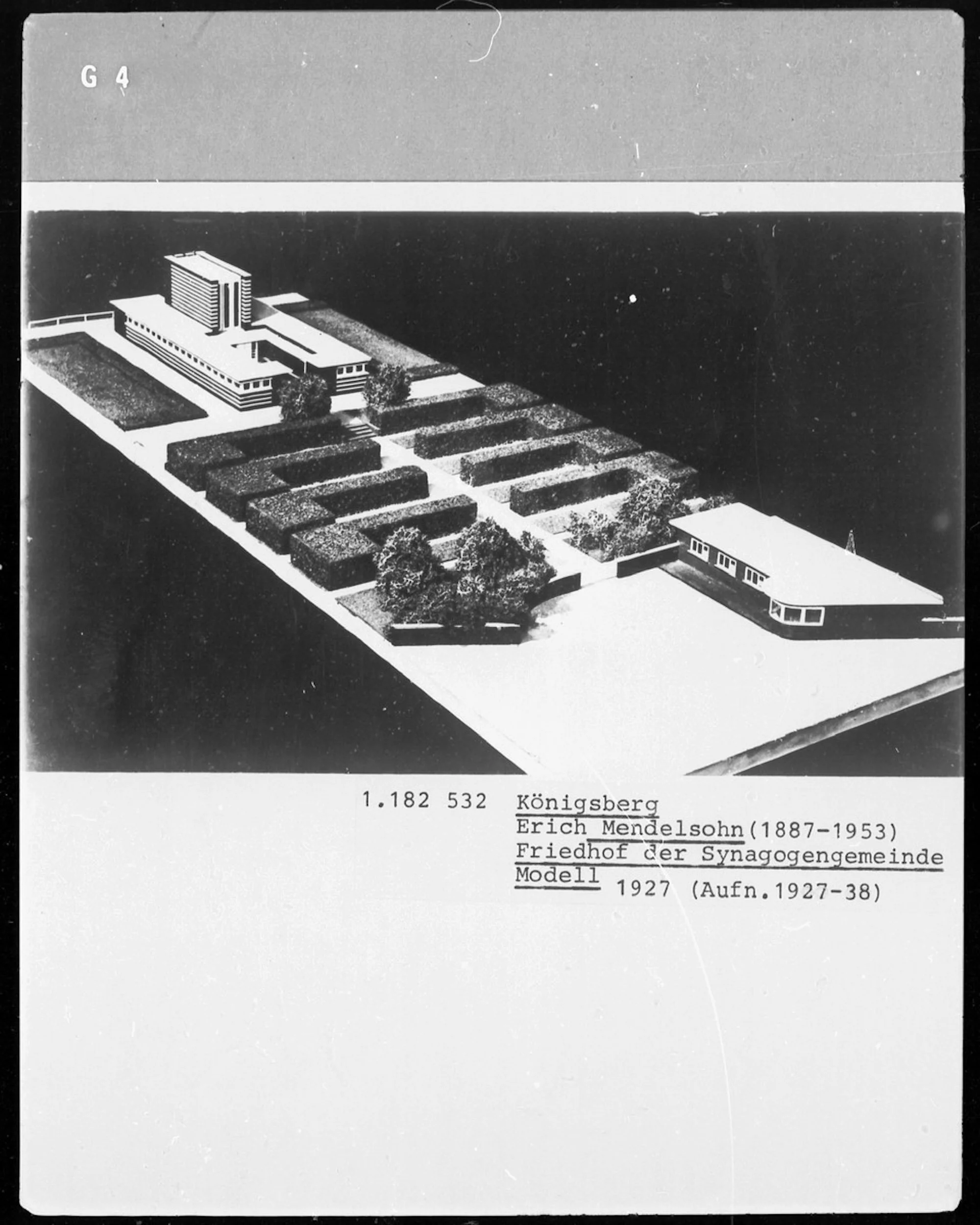
A 1927 model for the cemetery (image: courtesy of Bildarchiv Foto Marburg).
As we walk around the city, the layers of history become apparent. The epic High Gate into the Old Town. The brick gothic castle with its pagan Baba Pruska and statue of Copernicus, who battled Teutonic knights in between solving cosmic mysteries. The plaque to Mendelsohn at the site of his childhood home. We end up at the Monument to the Liberation of the Warmian and Masurian Lands, a memorial to the Soviet troops who freed the area from the Nazis (and then freed the Poles from their independence). Built from the rubble of the Tannenberg Memorial, it was initially called the Monument of Gratitude for the Red Army, but locals referred to it as “the gallows”. It is now fenced off and covered in anti-Putin, pro-Ukraine graffiti. There’s talk, Marcel informs me, of taking a wrecking ball to it. The streets are a palimpsest, with new layers being added while others are written over.
We plan to meet again later, at the Mendelsohn House, but I arrive early. Initially, it seems the wrong address: it’s nondescript, without the verve and imagination of the architect’s later work. Next to the building is a long, wooded field. It should feel serene, but there’s a sense of unease, accentuated by the overgrown steps leading nowhere. Marcel arrives with Kornelia Kurowska from the Borussia Olsztyn cultural organisation, who shows us around the restored site to discover the wonders that are well-hidden from outside. It was a Bet Tahara, where Jewish dead bodies were prepared for burial; a place of mourning but also ritual and care. It’s atmospheric and ornate, with stars of David everywhere and traces of art nouveau. A building before Mendelsohn found his voice (echoing the mystical influence of the Blue Rider group, whose members were his friends at the time), but also reflecting thousands of years of history. At its core is an astonishing hall that feels like being inside a pyramid, with a ceiling that is esoteric and celestial in the half-light. The survival of this building would seem miraculous if the lives of the Jewish population of Olsztyn and beyond had been similarly spared during the Holocaust. The city had been a base of the murder detachment Einsatzgruppe V (EG V-Allenstein) during the second world war, operated under the command of Ernst Damzog, who had a leading hand in establishing Chełmno death camp. He and his subordinates would be responsible for the death of countless Polish citizens, including hospital patients, teachers and children, and for the deportation and murder of Polish/Prussian Jewish families in ghettos and concentration camps. It’s only as I’m leaving the venue that I see, in a corner, piles of smashed headstones with Hebrew writing, and realise the adjoining field had once been a graveyard.
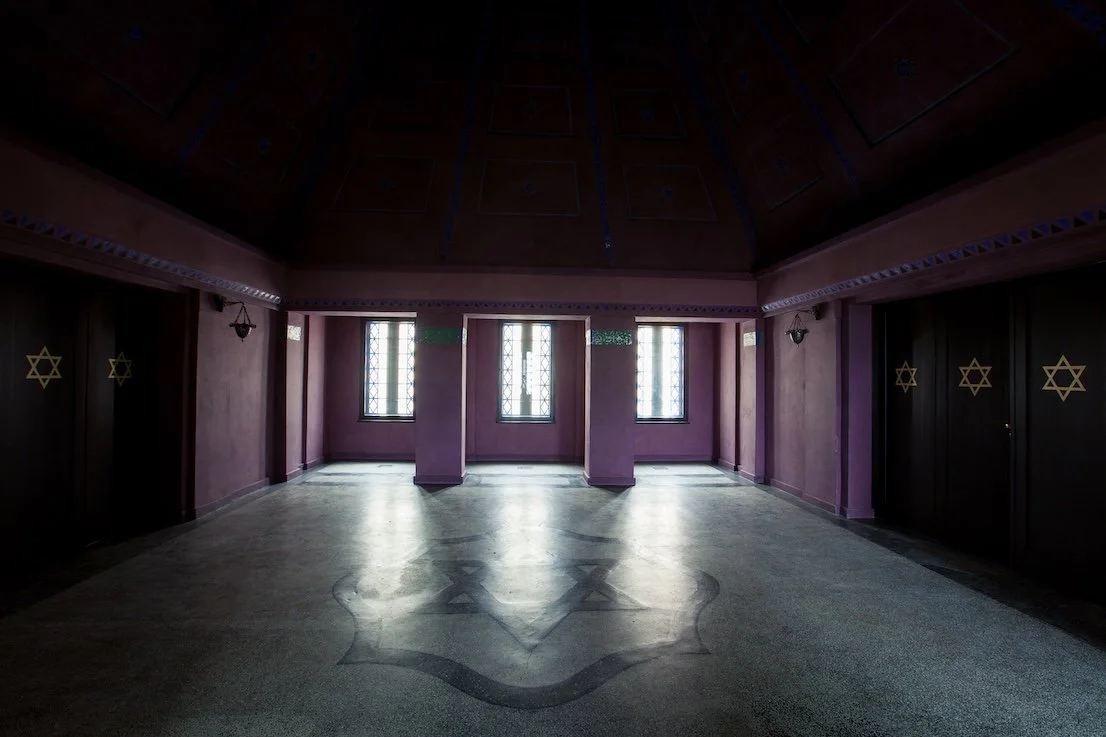
The Mendelsohn House was the architect’s first building, and has little in common with much of Mendelsohn’s later work (image: courtesy of the Borussia Foundation).
For decades, my late father worked as a gardener-groundsman for Derry city council in the local cemetery. Back then, kids were merciless and the prevailing taunt I’d receive at school was “your da is a gravedigger”, which felt – inexplicably, I realise now, given the nobility of the profession – shameful, and there were times when I disowned him. Later, I’d realise what I owed. The cemetery was a repository of memory, documenting wars, epidemics, colonisation, seafaring, massacres, culture and resistance. You investigated history there simply by walking, something that has informed most of my work since. My father would bring back antique objects he dug up, all containing buried stories, which would similarly inspire my memoir Inventory (2020). There were other lessons. Though the cemetery was geometric, its personality was in its quirks – the “devil’s tree”, for example, a dead but still-standing willow, with gnarled leafless branches set against the omnipresent rainclouds of Derry. Though a place of the dead, it was a thriving ecosystem with hares, squirrels and bats. And though death is the leveller between all peoples, even this place of meditation and sorrow was not immune to division. Desecrations of graves took place here in both 2016 and 2024, and while the motives remain unclear, it is clear in such contentious times that even the dead cannot escape personal vendettas, conflict or societal decline. Politics will not let even the dead rest easy.
Cemeteries may feel like a kind of antechamber separated from life, a threshold between this world and the next, but this is illusory. There are cities such as Manila and Cairo where thousands reside among necropolis tombs. Equally, there are graveyards (Père Lachaise in Paris, for example, and the Central Sofia cemetery) where executions took place. In Derry and Belfast, the funerals of those killed in the Troubles were often highly impassioned, the focus of community rage, security service surveillance and, as in the case of the Milltown massacre, all-out murderous attacks. Greed and desperation have also encouraged the defiling of sacred resting sites. Ancient Egyptian tombs were raided so comprehensively that caput mortuum, a brown pigment highly sought after by painters, was developed from pulverised mummy flesh. In Edinburgh and London, alongside rusting mortsafes, watchtowers in St Cuthbert’s Kirkyard and Holy Sepulchre London are reminders that cities were once haunted by bodysnatchers or resurrection men, who would unearth and sell corpses to anatomists. Graverobbing still thrives, with thieves breaking into 2,000-year-old tombs in Taosi cemetery in China earlier this year.
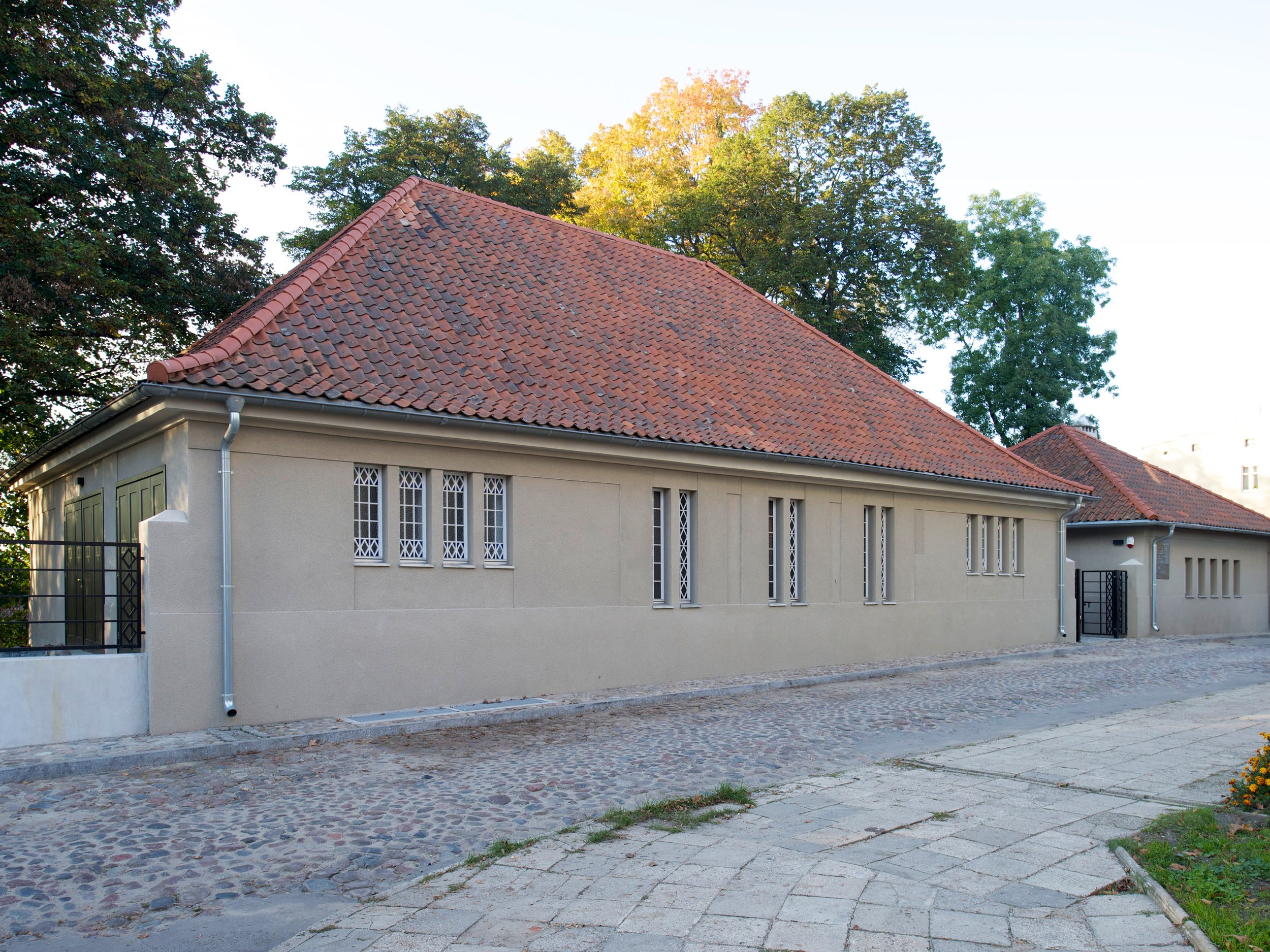
The unassuming exterior of the Mendelsohn House (image: Carsten Krohn).
In ancient Egypt, memorials to the late pharaohs Hatshepsut and Akhenaten were vandalised by their successors to alter history and even cause their souls to become lost in the afterlife. The ancient Romans would remove all memory of controversial figures through the process of damnatio memoriae, a practice still enacted today with Nazis, serial killers and jihadists buried in unmarked graves or at sea, either in disgrace or to prevent future worship. The destruction of graves is never simply a political or financial act: necroviolence always has a personal component. It’s intended to demoralise, degrade, uproot or ultimately erase a population. It begins with prominent individuals: after German nationalists murdered the Polish activist Bogumił Linka in Allenstein, they also targeted his grave. The final intention was not just to eradicate these peoples. It was to erase any trace that they’d existed to begin with.
Necroviolence exists still. Following Sri Lanka’s civil war, the military destroyed the graves of Tamil fighters and rumours of mass grave sites go ignored. Myanmar’s regime has similarly bulldozed Rohingya mass graves to hide the evidence. As well as dismantling mosques, the Chinese government has been razing Uighur graves across the country. Growing up during the tit-for-tat blood feud of the Troubles, it’s hard to witness the same cycles perpetuate elsewhere. In the Middle East, there have been successive waves of necroviolence since the end of the second world war, from Jordanian forces defiling Jewish graves on the Mount of Olives, to the Israel Defense Forces’ extensive desecration of Palestinian graves. In the West, we’re not immune, with memorials (such as the Stolpersteine stumbling stones in Rome) being defaced and certain cemeteries requiring 24-hour security.
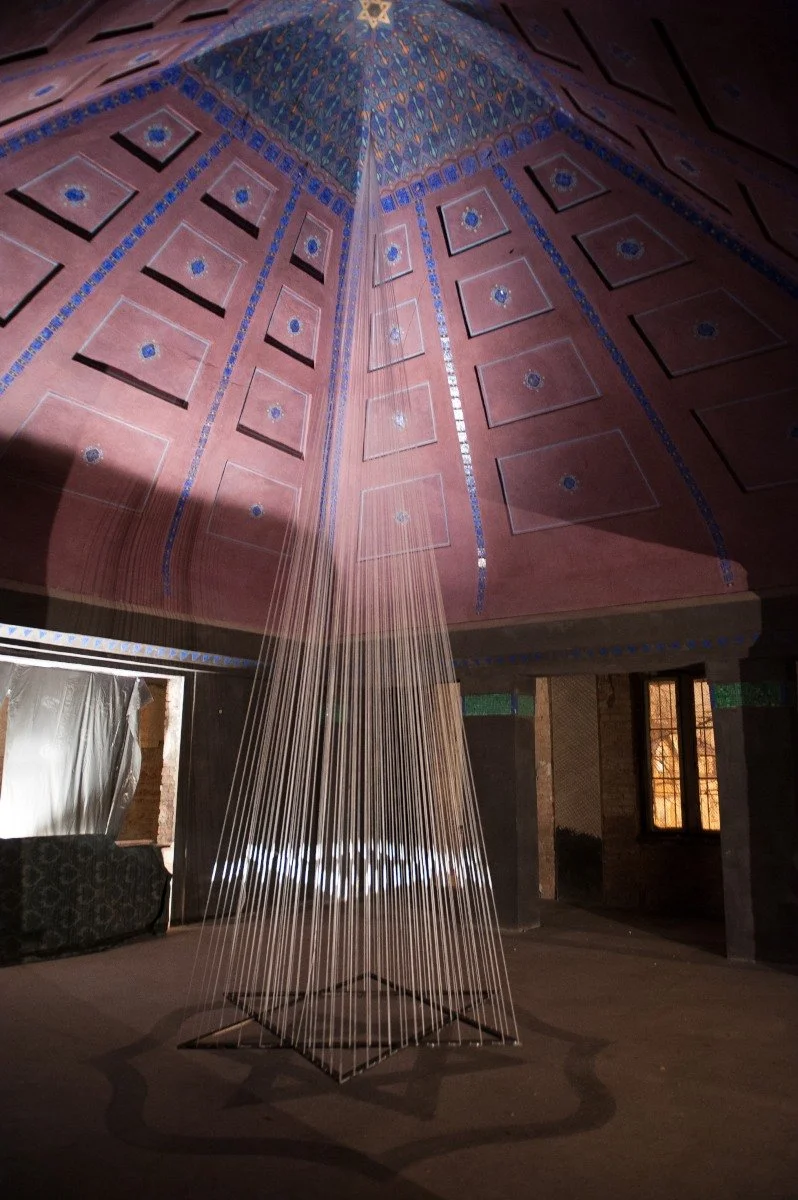
The Mendelsohn House is highly ornate in its decoration, with touches of art nouveau (image: courtesy of the Borussia Foundation).
All of this pales next to the deaths of tens of thousands of civilians. “The living are more demanding; the dead can wait,” Holocaust survivor Primo Levi wrote in If This is Man, his account of life in Auschwitz. Yet to neglect the dead can be ruinous, for their treatment is a warning sign. Just as those who burn books will eventually burn people (as German poet Heinrich Heine put it), those who would unearth and defile the dead will do so to the living. Any destruction of collective memory bodes ill. Amnesia aids the killers. Just before the invasion of Poland, Hitler referred back to one of the most horrific human rights abuses of the first world war, asking: “Who speaks today of the annihilation of the Armenians?” In the months prior to the beginning of the gassing of Jewish people at Auschwitz, the Jewish cemetery there was destroyed.
Erich Mendelsohn would escape the Holocaust, fleeing the Nazis. Disillusioned by the Soviet Union and Israel in turn, he moved to the US. He designed synagogues but his living was precarious, and he ended up working for the United States Air Force constructing authentically furnished German housing, to practise firebombing on before the real thing. He would not return home. Having somehow survived, albeit in a diminished state, Mendelsohn House was reinvented by the Soviets as a government archive. Following a period of looting and official antisemitism during the Polish People’s Republic, the adjoining cemetery’s headstones were “repurposed” to become construction materials for the local Casablanca restaurant. A number of headstones have since been salvaged, in varying states of disrepair. The building now belongs not to utopian dreams or the dystopias that followed, but to the bringing together of peoples, the acceptance of the complexities and brutalities of past and present, but still reaching out in spite of this. The space is now used to host events and exhibitions designed to deepen communication, interest and empathy in what was once a region beset by conflict and division. “Once, this place was for the dead,” Marcel tells me. “Now, it’s for the living.” The debt we owe is to both the living and the dead. What we honour and dishonour is the surest indication, all belief and vanity aside, of who we really are.
Words Darran Anderson