
Paper Heirlooms
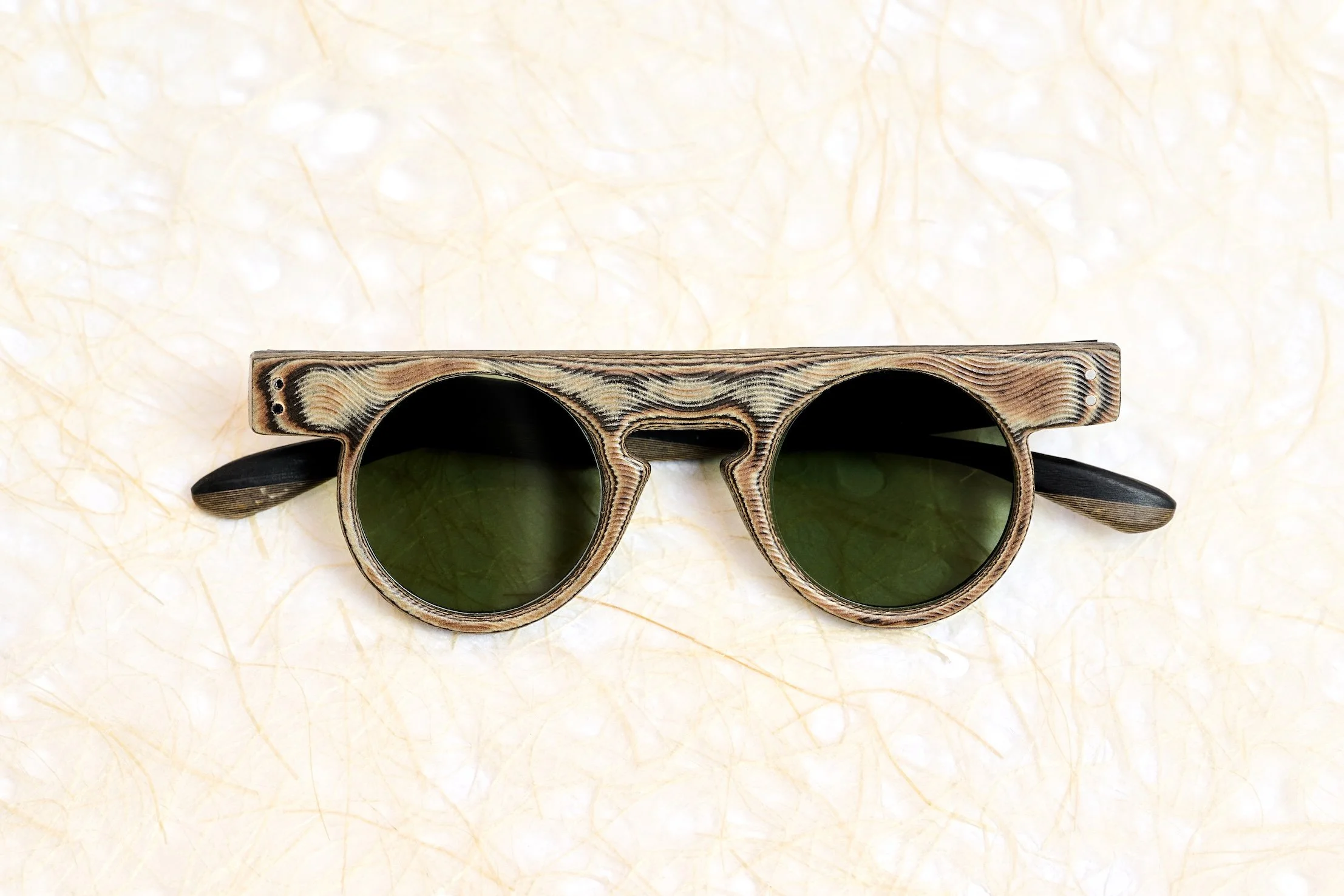
Tanaka Eyewear’s new glasses frames are made from compressed paper composite (image: Jonny Storey).
An appointment at the optician may seem entirely different to one at the hairdresser. Both specialists are, however, looking closely at your face, and a thick frame can emphasise the eyes as much as a blunt fringe. London-based eyewear designer Gow Tanaka understands this affinity. “Because I was a hairdresser and worked with all the models, I had to work with the makeup artist,” Tanaka explains. “Also with the face, the bone structure – all of that.”
Channelling this expertise, his eponymous Tanaka Eyewear brand recently launched two distinct silhouettes. “[For one] I’ve done a strong shape, creating an angular face,” he says. “The second one works with eye shape.” The first, Type-RO, has a blocky, square frame. The second, Type-I, has a more distinct silhouette, where circular rims are cut off by a thick, straight bar that runs along the top. Both types also share keyhole bridges that pinch at the nose’s side, as Tanaka plays with how face and frame interact. Experimentation with this relationship structures Tanaka’s design process. One of his whackier prototypes – consisting of small circular rims with cartoonishly angled end pieces – “makes your eyes slightly bigger,” he says.
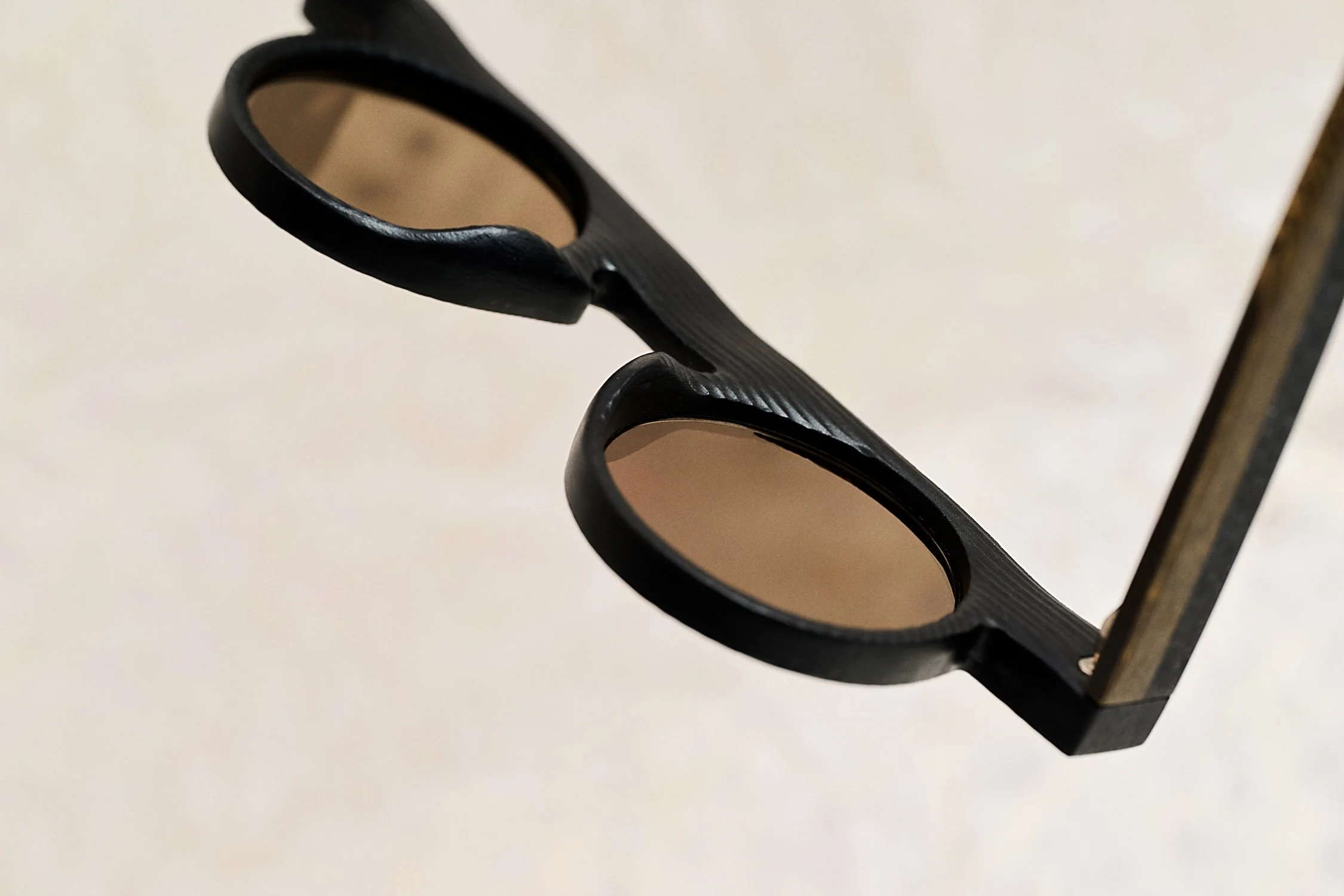
A CNC machine engraves waves onto the surface of the material (image: Jonny Storey).
Tanaka Eyewear started as a mid-career pivot because international, high fashion hairstyling “is quite hectic,” Tanaka explains. His glasses involve slower, much longer-lasting processes. Crafted from a compressed paper composite, the frames look like an uncanny blend of wood and plastic when freshly made. The composite is manufactured by saturating layers of paper with a thermosetting resin and then, while heating, pressing the stacks down. This compression of fibres lends the material a dense, non-porous solidity, meaning the glasses are heavier to hold than standard plastic ones. Such water-resistant heft accounts for the material’s typical use as a surface in interiors – “in high-end hotels and bars,” Tanaka says.
As with machining hardwoods, the material’s tightly packed fibres also allow for crisp edges and intricate etching. A CNC machine cuts out the basic silhouette and engraves waves on the surface of the material, Tanaka’s signature pattern, before he refines the joints and finer details by hand. “I know this material actually has the ability to hold for decades, unlike acetate or plastic,” he explains. “The resin infused in it doesn’t degrade – in theory, it could be an heirloom.” Over time, the oiled and waxed surface develops a streaky, patchy patina of light and dark brown. “It ages with you,” Tanaka explains. “So, you wear it more, and it becomes your thing.”
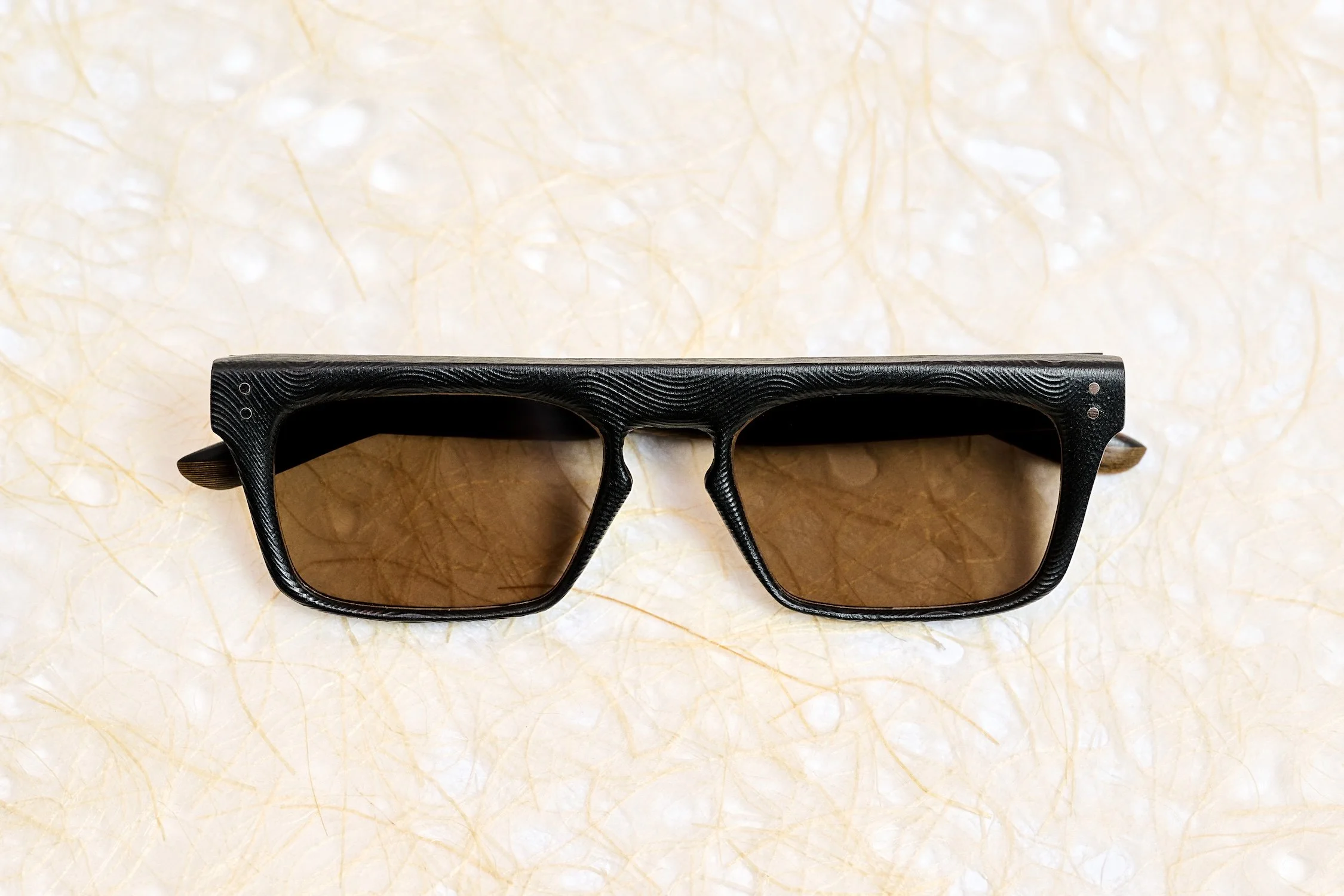
Image: Jonny Storey.
But accidents happen – arms, bridges and joints sometimes snap. Tanaka embeds these possibilities in his design philosophy. “Something [damaging] happens and I keep it as a memory,” he says. “So, if you break or drop them and you get a dent or chip, I fill that with gold.” This logic of repair is informed by the centuries-old Japanese practice of kintsugi, which involves using lacquer mixed with powdered gold to mend broken ceramics. Repairs gild the glasses’ material history. “That actually marks [the break] to keep it as a memory – not banish it,” Tanaka says.
This sense of permanence defines Tanaka’s designs. Today, eyewear innovations often involve AI and cameras, with Meta and other tech giants trying their hand at so-called “smart glasses”. “But that’s a tool, isn’t it?” Tanaka asks. “That’s a tool that is not about the face.” By contrast, Tanaka’s eyewear is “treasure – like a watch. You have your emotion attached to it,” he says. “I try to make it become part of your face, part of your life.”
Words Isaac Mead