
Craft and Spectacle
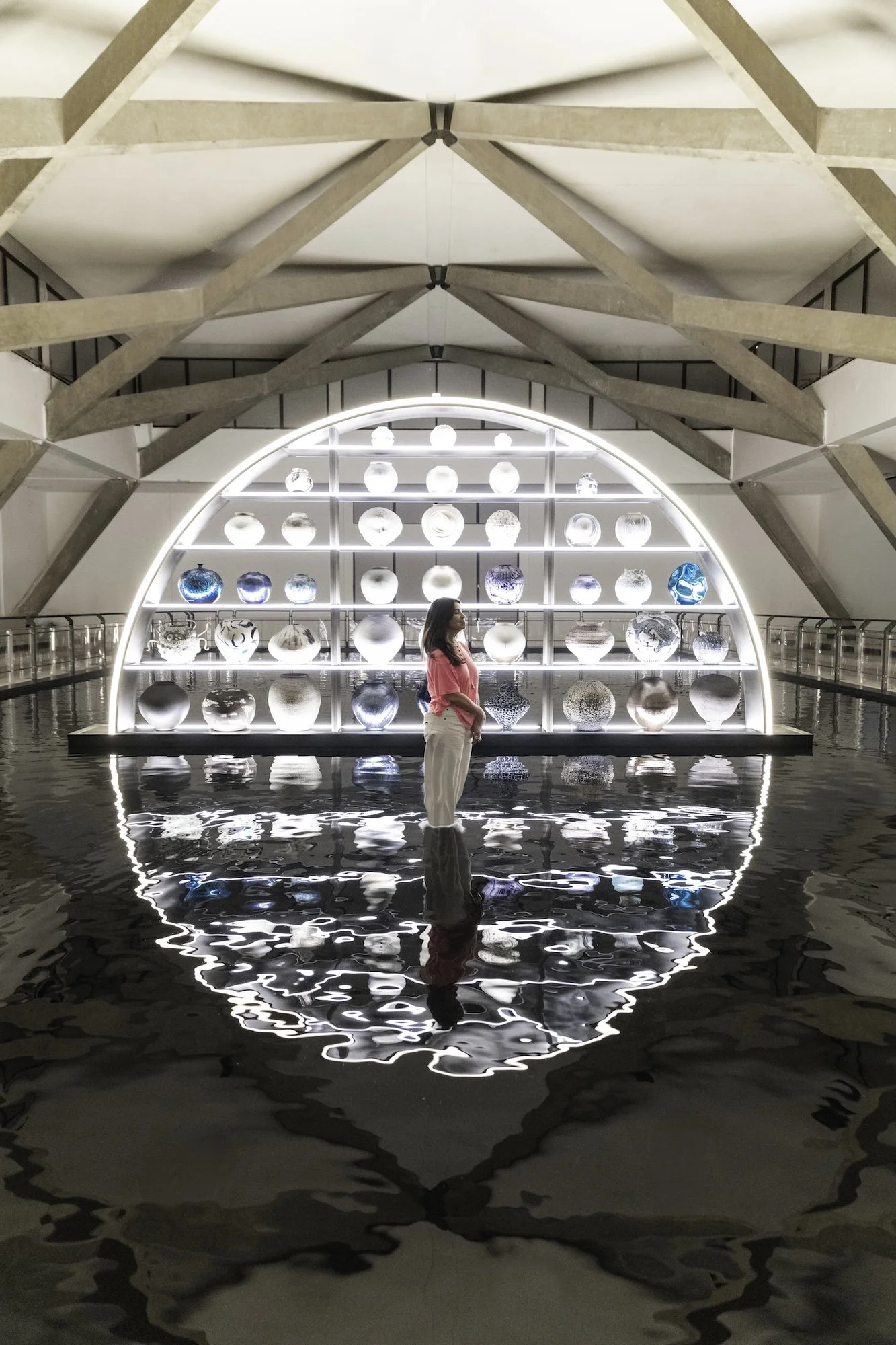
Es Devlin in the “A Full Moon Rising” space at Homo Faber (image: courtesy of Homo Faber).
As I arrived in Venice for the latest edition of Homo Faber, the biannual craft exhibition organised by the Michelangelo Foundation, my mind was focused on AI. All around the Fondazione Giorgio Cini, a former Benedictine monastery on the island of San Giorgio Maggiore, Homo Faber’s curators have seeded exemplars of exquisite contemporary craftwork, the foundation’s Palladian architecture and cypress groves playing host to displays of natural materials and hand-making drawn from across the world: traditional Chinese ramie fibres woven into translucent helixes of fibre, supported only by their own tension; an impossibly fragile Korean moon jar formed from shivered surfaces of glass frits, seemingly flaking away from one another and drifting into the atmosphere; and Senegalese bronze jars scratched bodily with golden symbols and studded with blackened nails. And yet, AI.
In part, this is simply a matter of contrast. Since being launched in 2018 by Johann Rupert and Franco Cologni of the Swiss luxury group Richemont, Homo Faber has prided itself as offering a “celebration of contemporary craftsmanship”. Alongside its flagship biennial, the organisation operates training programmes, fellowships, and international guides to craft production, devoting itself to platforming what Hanneli Rupert, the executive vice-chair of the Michelangelo Foundation, has termed “evidence of the human hand – traces of individuality, imperfection, skill and intention” within the realms of material production. Whereas AI technology can now “generate images, imitate voices and reproduce forms with astonishing efficiency,” Rupert continues, “many of us are rediscovering our hunger for authenticity and deeply human values.” In a world in which content can be generated immediately and effortlessly through algorithms, Homo Faber explicitly positions handcraft as the antithesis of this mode of creation.
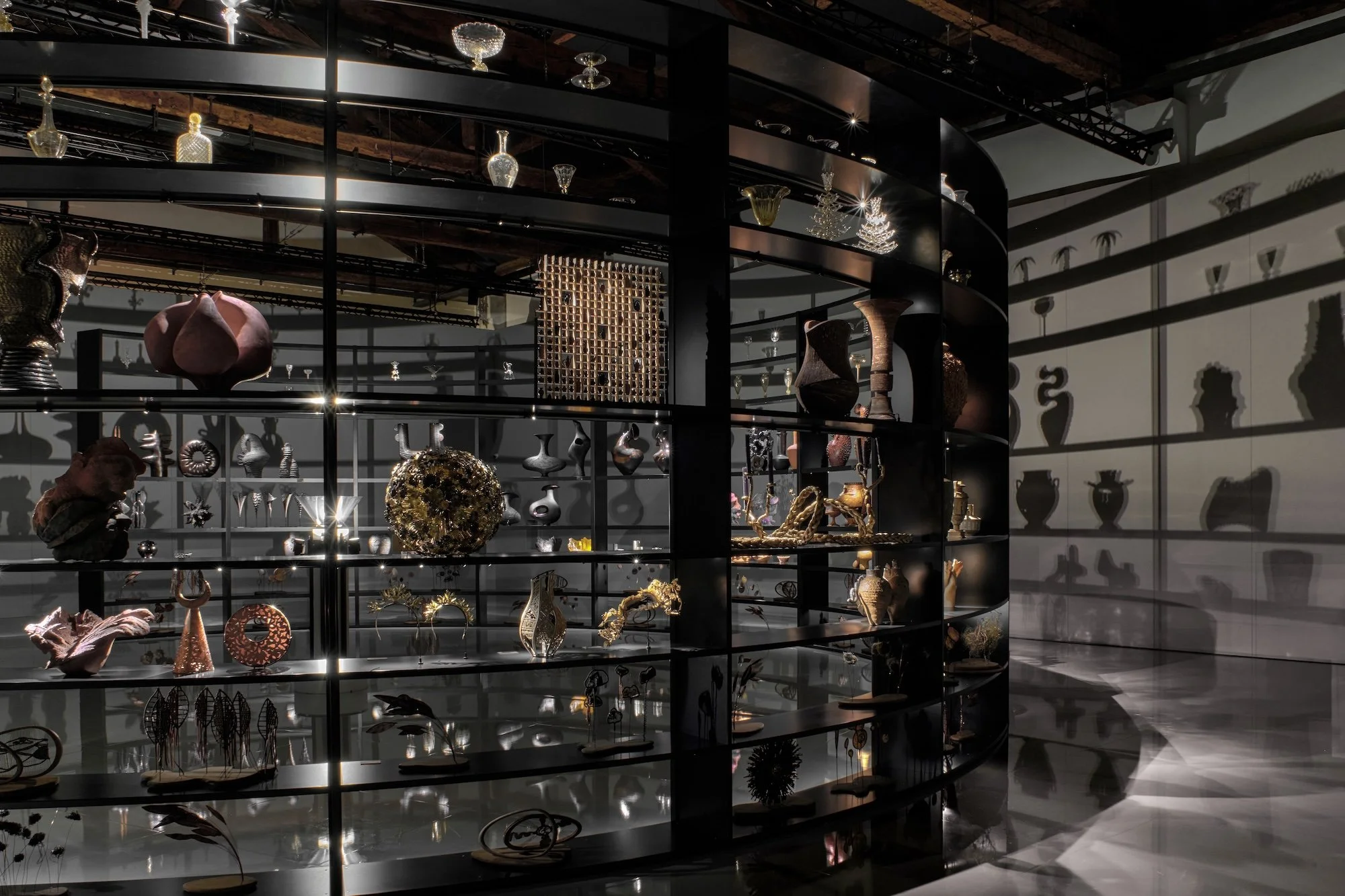
“An Alphabet of Objects”, a space in which craft is displayed on a carousel, with the objects casting shadows on the surrounding walls (image: courtesy of Homo Faber).
Across its three previous editions, the festival has established a remit of exhibiting masterpieces of craft within Fondazione Giorgio Cini, activating spaces across the foundation’s courtyards and cloisters with curated displays that are variously thematic or else material-led: studies of colour, usage or technique, invariably highlighting the skill and expertise of their makers, a selection of whom are also embedded in-person throughout the biennale, offering live demonstrations of their craft practices. While the 2024 edition of the festival was art directed by director Luca Guadagnino and architect Nicolò Rosmarini, with Guadagnino’s background in narrative art informing its theme of “The Journey of Life” (a chronological journey through the objects that support a person at different stages in their life), the 2026 edition has appointed artist and stage designer Es Devlin to the role, operating with the theme of “An Island of Light”. If Guadagnino and Rosmarini’s theme sought to explicitly place craft in dialogue with the rhythms of human life (“There is much to be learnt about life from seeing how things are made, by whom, where and why,” Guadagnino told Wallpaper), Devlin’s treatment of craft’s intersection with humanity is more abstract and rooted in the intangible qualities of craft itself.
In his 2013 book Why We Make Things and Why it Matters, furniture maker Peter Korn sets out his belief in the capacity for craft to condense meaning and social value into physical form. “Every man-made thing, be it a chair, a text, or a school, is thought made substance,” he writes. “It is the expression of someone’s, or some group’s, ideas and beliefs. […]It is a material manifestation of the collective consciousness of its time and place channeled through the individuals who commissioned and made it.” This same belief, it would seem, is at play in Devlin’s Island of Light. On the one hand, this island is simply Venice itself, which is widely known for the mediterranean sunlight that silver-dapples the waters of its surrounding lagoon, yet the central drive of Devlin’s theme is grounded in a kind of ethical “light” that Homo Faber believes is embodied within physical making and materials of the kind described by Korn. For Alberto Cavalli, the director of the Michelangelo Foundation, this analogy is explicit. Hand-making represents a “sparkle of light”, he argues, which can embed positive social values within materials, and which can stand as a counterpoint to less virtuous modes of creation and manufacture: exploitative mass production, for instance, or else the dehumanisation engendered by algorithmically-generated design practices. “We are idealists,” Cavalli explains at the biennale’s opening conference, “but we do believe that this island of light, put together by Hanneli Rupert, imagined by Es Devlin, [and] crafted by hundreds of talented people, can help to dissipate the darkness.” The purpose of Homo Faber, Devlin adds, is that visitors should leave “astounded by the extreme variety [of craft practices] that human hands have engaged in.”
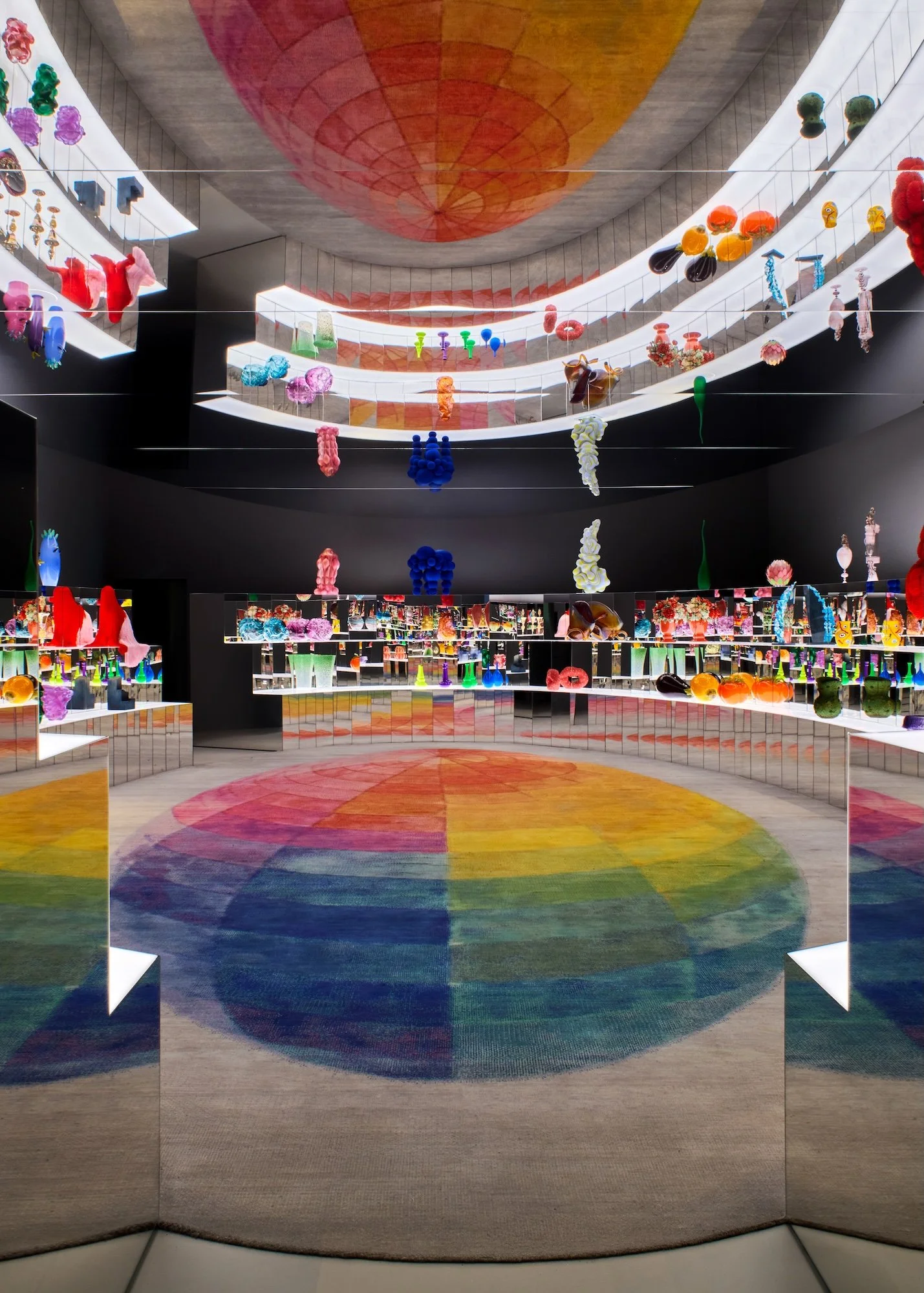
“A Rainbow of Forms”, devoted to examining colour in craft (image: courtesy of Homo Faber).
Devlin’s practice as an artist and designer is wide ranging, but much of her success has been derived from her extraordinary sense of stagecraft and capacity to grapple with the potential for spatial design to invite public participation with, and immersion within, art. For Homo Faber, these skills have been tested on a grand scale, with her studio having been tasked with designing scenography for more than 700 craft pieces from more than 70 countries, each of which varies dramatically in its material, technique and surrounding cultural context. Faced with this kind of diversity, Devlin has leant into spectacle. The opening space in the show, for instance, has been styled as a perfectly dressed craft atelier, the room designed to plot a careful course between busy specificity and reality (the walls and tables sumptuously lined with real tools and materials like Geppetto’s workshop, the majority of which have been borrowed from real craft studios) and a level of abstraction and theatrical remove that allows it to stand as an idealised space that can represent all of the 500 plus craftspeople whose work is present in the show. Elsewhere, this same intelligent use of theatricality abounds. The Fondazione’s darkened swimming pool, for instance, has been rigged with a concealed mechanism such that a semi-circular display of illuminated moon jars can slowly rise from and sink into its still, dark waters. This display has been patiently choreographed, such that its full ascendency sees the structure reflected wholesale across the still surface of the pool, creating a perfect lunar circle that illuminates further moon jars positioned around the space’s tiled surface. It is a spectacular framing, and one whose visual flair is both gorgeous and generous enough to accommodate the striking differences between the tens of jars found in the space – from the visual wit of Heidi Tarver’s stoneware tribute to the Pacific, teeming with tentacles and barnacles, to the roughhewn beauty of Maria Chang’s jars formed from broken fragments reforged with sand.
Spectacle of this kind is a purposeful design strategy in Devlin’s hands – a means of giving form to the disparate material she has been asked to corral, as well as a route towards emphasising the sense of meaning and wonder that can attend high-level craft by seeking to trigger a physical response within the visitors who see it. In Devlin’s view, the virtues of craft production are best captured by leaning into its materiality and the ways in which this can impact the human body. “One of the reasons I chose the title [‘An Island of Light’] was because I think that when you hold language in your mouth, you taste it,” she explains. “So I want you to hold the taste of the word ‘light’ and the word ‘island’ while you walk through the trees and through the architecture. […]I think this exhibition is inviting us to remember that consciousness in humans is embodied.” In place of dispassionate, intellectual reflection on craft, Devlin has moved to recast craft’s impact on the world in terms of sensory sensation. “I read recently that if we understood the body better, there wouldn't be a word for ‘mind’, and we are conscious from the soles of our feet, we make decisions with the hairs on the back of our neck, and we think with the tips of our fingers,” she says. “And when you enter the [biennale], I hope you’ll have a feeling of an environment of people who’ve been doing just that.” In the biennale’s “A Rooted Ascent” space, for instance, a selection of objects made from either wood or woven fibres are displayed within the Fondazione’s Sala Tipografia, with their forms (and the space’s green and red metalwork roof) repeated seemingly infinitely in mirrors placed at either end. Within such an arrangement, details of individual exhibits – from Lihuai Qian’s amebic bamboo mesh Mountain Lord structure to Santiago Urugi’s pyrographic solid cedar wood stool – begin to break down, resolving instead into an amorphous constellation of kaleidoscopic craft production from around the world. In a biennale as large as Homo Faber, individual nuance and context within this kind of spread is invariably lost, with basic biographical information about each exhibit instead relegated to an online catalogue accessible through QR code, but what its organisers hope can be gained instead is the kind of physical immersion within craft that Devlin describes.
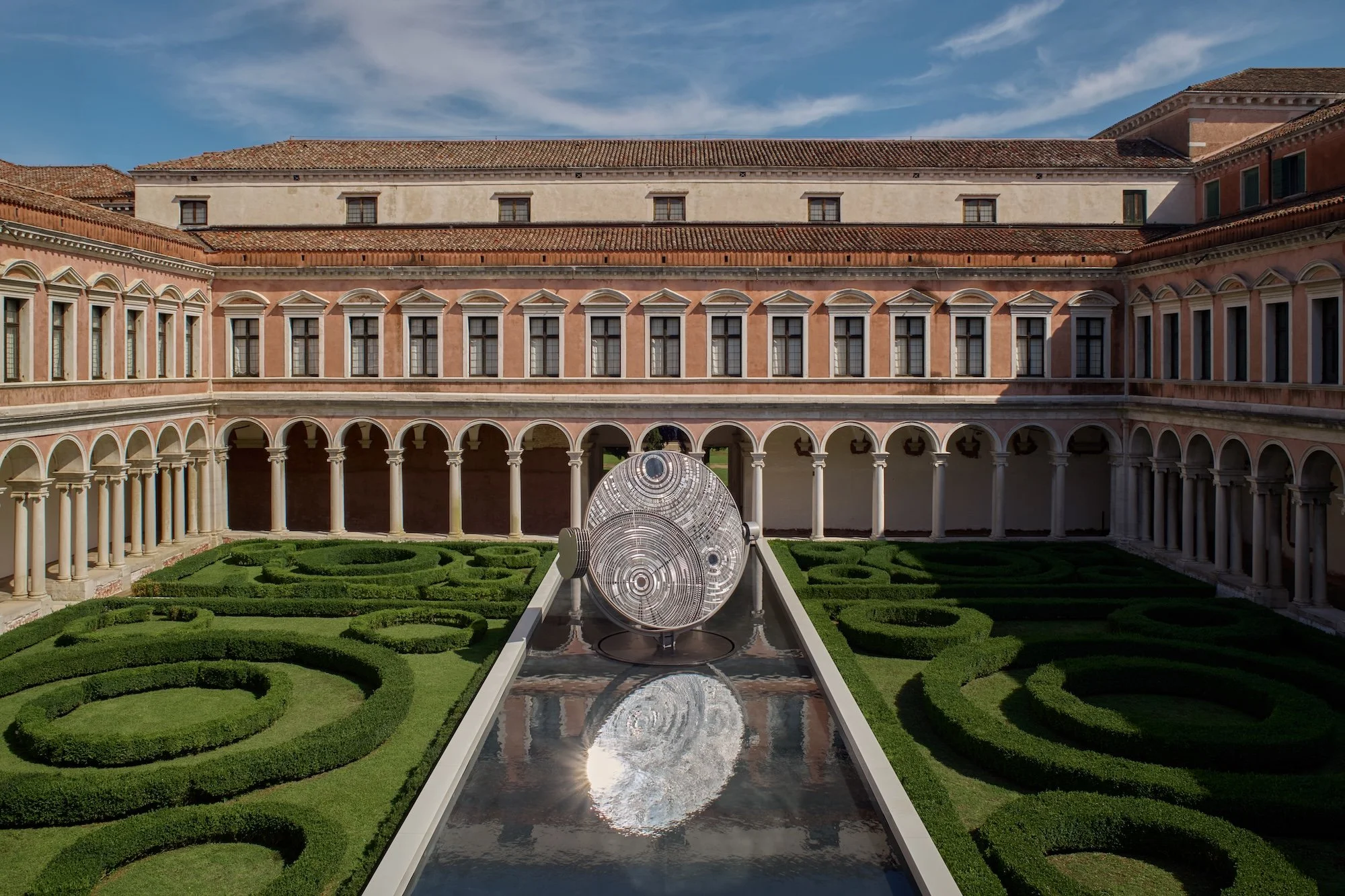
A Great Turning, a kinetic sculpture developed by Devlin for the exhibition (image: courtesy of Homo Faber).
This is a trade-off that Homo Faber has long shown itself willing to make. In his review of the 2024 edition of the festival for Wallpaper, craft curator Hugo Macdonald praised the initiative’s willingness to platform craft and raise questions around how the “values inherent in the practice of craft feel evermore relevant - responsibility, circularity, connection, repair, resilience, localism,” yet also reflected on the limitations of introducing scale and spectacle to the realm of hand-making. “Divorcing such an array of human achievements from the cultures and contexts, the minds and hands, which bring them to life inevitably renders these works as rarefied objects of beauty for consumption,” Macdonald wrote. “Each piece is an individual expression of people and place, material and time; to witness such a trove altogether dilutes the potential for intimate connection into distancing awe.” It is a legitimate critique of the biennale’s focus, but one that also hints at the scale of the challenge facing Homo Faber. While the biennale’s format means that it has comparatively little to say about the specific context of its individual exhibits (although the initiative’s admirable online guide to craft producers goes some way towards emphasising the sense of locality that McDonald describes), this is perhaps understandable given that the festival has been set up against a different target, purposefully utilising its visibility as an international biennale to marshal itself against preconceptions within popular culture that craft is either fundamentally nostalgic or else a niche or dying pursuit (“I think this is salacious,” Guadagnino told Wallpaper when this criticism of the field was put to him in 2024. “Just because craft deals in places with traditions does not make it nostalgic.”). While craft itself may typically be understood as inherently local and community-based, for example, the biennale’s purview is to establish the field’s disparate small-scale making networks as being capable of coming together to form a global pursuit whose practice is both culturally relevant and thriving. To achieve this aim, its curators have sought to demonstrate this internationalism through displays that emphasise both the discipline’s scale and the aesthetic impact of the objects it creates. “They [pay] witness [to the fact] that this is a big community,” Cavalli argues. “This is not niche; this is a powerful community.” While the kind of nuance and responsiveness lauded by Macdonald is inevitably diminished within this kind of display, Homo Faber’s organisers hope that the ethical values that they attribute to craft can still remain legible within the objects themselves, because it is “[our] task to promote the values that we believe in by reminding everyone the power of human talent and human creativity,” Cavalli concludes.
Whether this works, however, is one of the central challenges facing craft today and one that future editions of Homo Faber may ultimately seek to tackle. On the same day that I arrived in Venice for Homo Faber’s opening, the New York Times newsletter pushed me a link to an article that the newspaper had published earlier this year, in which journalist Vivian Wang examined the high levels of optimism surrounding AI technologies amongst Chinese citizens, as opposed to the pessimism that has met the technology’s usage in Europe and North America. “The question is, why?” Wang asked, before speculating that one difference has been the focus of Chinese companies on “real-world applications for A.I.”, whereas “many leading American tech companies have been focused on more abstract goals, like developing the most cutting-edge model, or achieving artificial general intelligence.” The result of this, Wang suggested, is that AI in China has come to be seen as holding tangible, everyday benefits for people’s lives, while “[potential] dangers, such as unemployment or increased inequality, still feel remote.” In Homo Faber, by contrast, the biennial’s focus has remained on craft’s overarching ethos and more intangible benefits – its potential as an “island of light […that] can help to dissipate the darkness” of technological alienation. In this vein, the exhibition’s emphasis upon displaying unashamed masterpieces of one-off, authored craft production – as opposed to other manifestations of the discipline in forms such as batch production or community repair or making practices – ably highlights the beauty, care and wonder of high-level hand-making, but leaves it up to visitors to make the imaginative leap as to how these values might subsequently impact upon their day-to-day lives. Within Devlin’s stagecraft, after all, attention is understandably centred on the transportive power of craft, and its capacity to touch upon our shared humanity, but this leaves little space for the more mundane or everyday forms of making and production that might touch people’s lives more regularly.
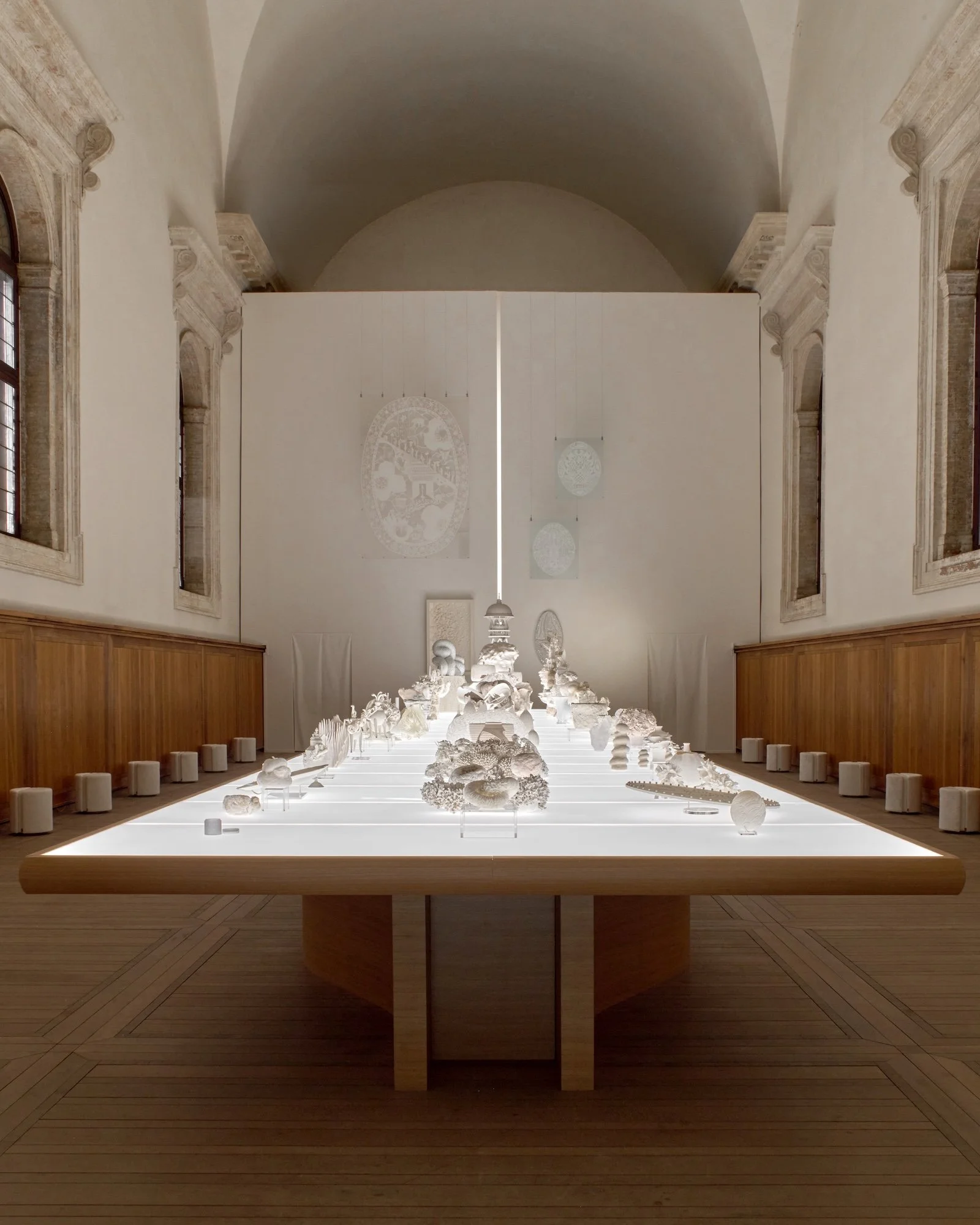
“A Feast of Light” is a display of purely white objects in the Fondazione’s Palladian Refectory (image: courtesy of Homo Faber).
This, of course, need not be a criticism of Homo Faber itself – in exploring a topic as sprawling and multivalent as craft, no single initiative could hope to exhaust all facets of what hand-production means today, with Cavalli himself regularly stressing the need to perceive the biennale as “a movement that fosters the creation of a community”, as opposed to any kind of single authorial statement. Likewise for Devlin, her work on the 2026 edition of the biennale betrays her deep facility with the tropes of theatre and performance. Her art direction is attentive to the potential for scale and spectacle to drive interest and raise broad questions around craft, but never loses its faith in the capacity of Homo Faber’s audiences to move from her own design performance to instead pursue their own, more intimate questions and thoughts around how craft affects them today. For Devlin, the capacity of craft and materials to condense meaning into themselves is paramount, and the potential to think through physical immersion in a space is what can convey the message of Homo Faber most effectively. It is, after all, the very same effect that she perceives within the biennial’s host, the island of San Giorgio Maggiore. “[When] I'm landing in the aeroplane at Venice, I can see this island like an object, like a jewel, like a Fabergé egg, like something I might pick up and hold very carefully so I don’t break it,” she says. “And yet, when I’m here on the island, I have a very different sensation. I feel held by the stone, by the architecture, by the garden, by the cypresses.” In surrounding Homo Faber’s visitors to this island with contemporary craft production, she will hope that this same physical proximity can take hold in relation to it too – a transformation from craft being seen as distant, precious and precarious, to a field that is alive, vibrant, robust, and supportive of the human lives it frames.
Words Oli Stratford
Homo Faber is on display at Fondazione Giorgio Cini until 30 September 2026.