
Presented as a Group
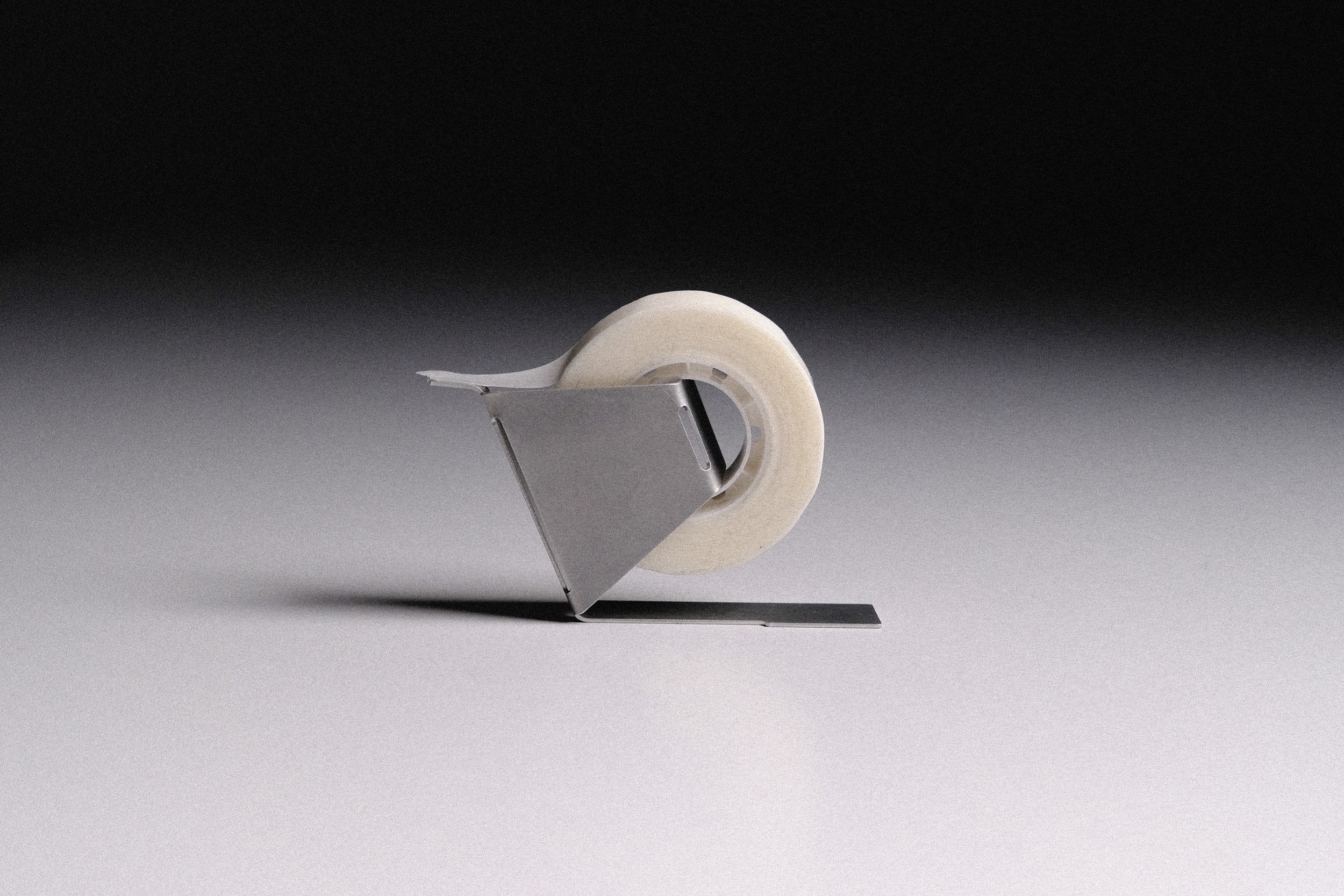
The Office Series tape dispenser (image: courtesy of Office Series).
The objects of the Office Series have no named designer. Or, rather they have 11 named designers, each of whose contributions bleed naturally into one another’s, mixing and iterating on one another until the final results become, to all intents and purposes, anonymous. “desk accessories / collaboratively designed,” reads a business card created by the group, neatly slotted into a card holder that has also, as its cargo explains, been collaboratively designed. “Presented as a group,” reads the final line of text, neatly printed on the pristine white card.
Office Series is a project undertaken by students of ECAL, a university of art and design in Lausanne, Switzerland. “It started off with a messy desk, in a way,” recounts Wouter Kellens, a student at ECAL and one member of the Office Series collective,[1] whose members are spread across the school’s MA Product Design and MAS Design for Luxury & Craftsmanship courses. To deal with his untidy desk, Kellens designed a paper tray, which he subsequently showed to another student for feedback. “[That student] liked it, so I said, ‘Well, why don't you make a second version?’ He did that and then we just thought, ‘Why don't we open this up even more?’” From there, a collaborative method began to take shape, with further students invited to iterate and freely develop one another’s designs – albeit always centred around the idea of creating objects for an office. “Why the office? Well, I think it kind of just happened,” Kellens explains. “I think it was really important to have quite a strict framework, otherwise it could go every direction.”
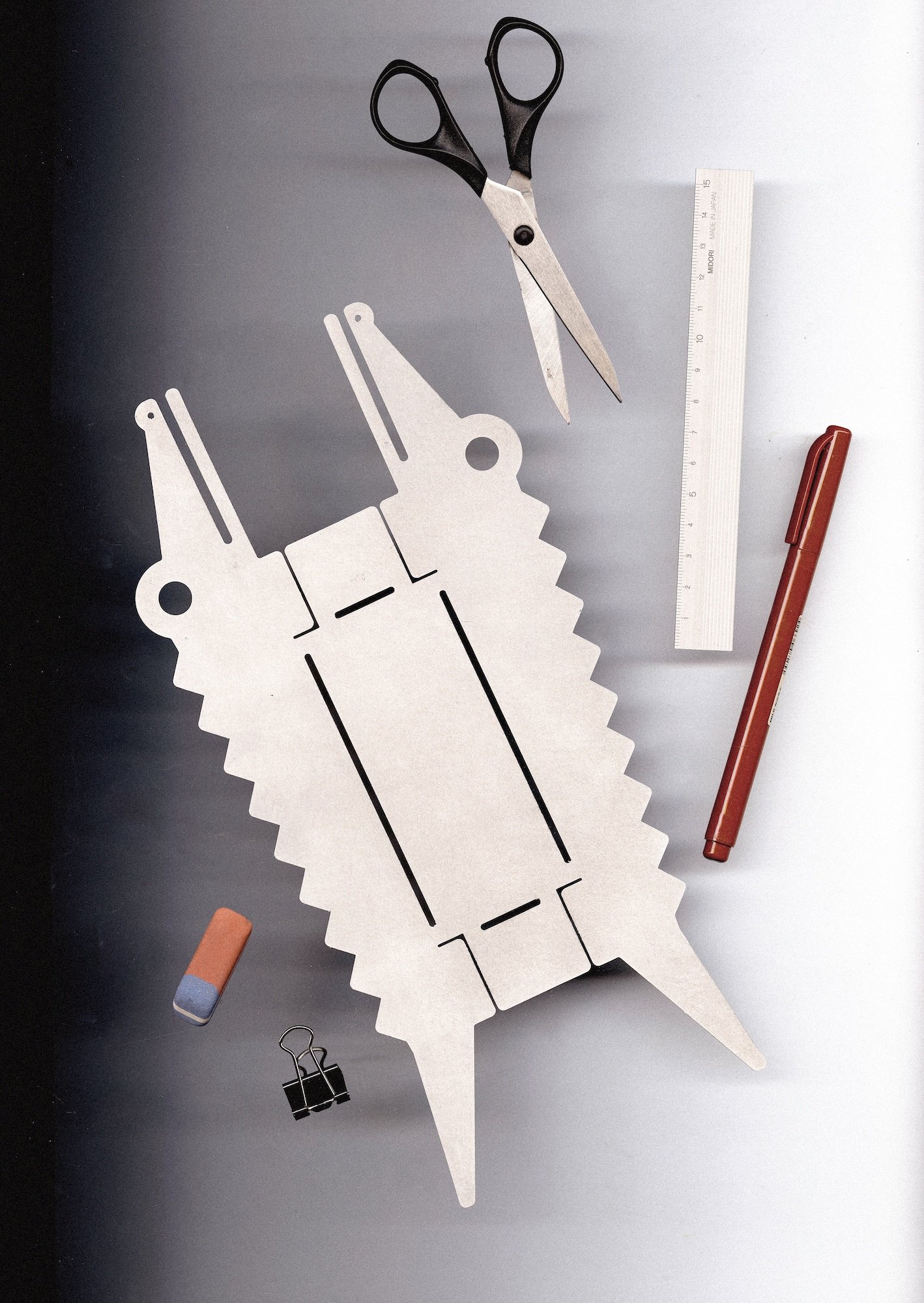
A crocodile-shaped pencil tray, ready to be folded into shape (image: courtesy of Office Series).
The resultant Office Series is a collection of nine aluminium desk accessories, all of which have been laser cut from 1.5mm sheets of metal, and all of which can be folded into shape by the user – two of the few constraints set by the collective. There are tape dispensers, in-trays and pencil holders, as well as miniature desk-bound slingshots (equipped with an elastic band), and a table lamp whose shade is provided by a rolled up piece of A4 paper. The results are clean and functional – albeit not without wit and character, as a pencil holder shaped like a crocodile testifies to – and honed through careful iteration, with each stage of the design process overseen by a different member of the collective. “We’ve ended up with several pieces that are very different from each other,” explains Júlia Claveria, a member of the collective who studies on MAS Design for Luxury & Craftsmanship, “but they still feel similar somehow, because they share this initial approach of the brief around aluminium and the context of the office.”
All of the objects created by the collective were developed through repeated iteration, staged within a communal slide show. One member would submit a design as a publicly available slide, detailing both its key elements that they felt should be retained, as well as “unfinished areas that could be a good starting point for interpretation”. “NOT FOLDABLE BY HAND YET…,” notes V1 of the paper tray, which by V3 has been developed by another designer to allow for “Small fold lines for one handed folding”. Later in the process, V5 of the tray raises the need for a “little clip” in the structure that, in the event of over-bending of the leg component, can create “a sturdy whole”, but worries that this addition will make “everything look quite technical”. One iteration later, however, and this issue has been resolved, with the clip redesigned in “the least ‘technical language’” in order to skirt the problem. Read back through, the design process becomes a dialogue, in which different designers respond to and build upon the work of their colleagues.
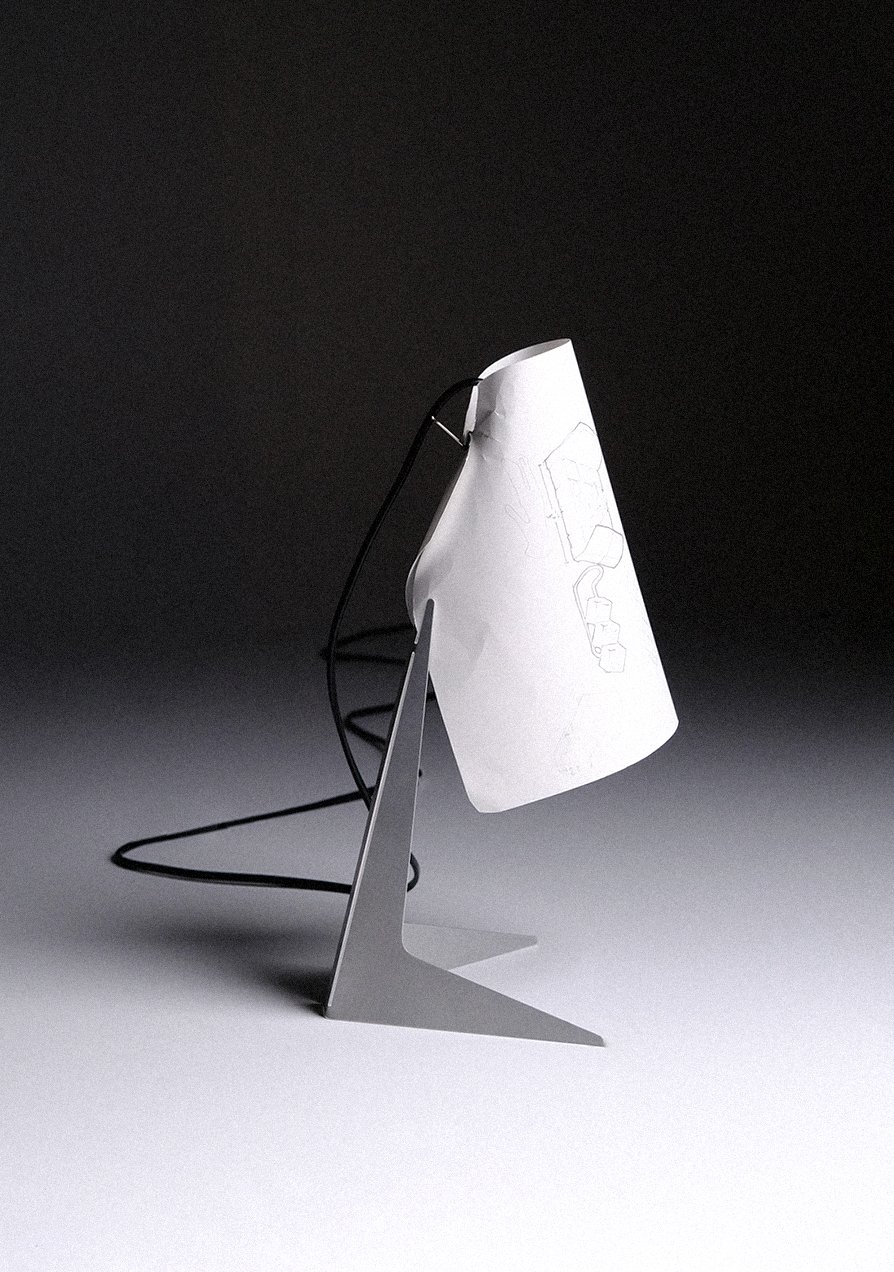
The Office Series lamp (image: courtesy of Office Series).
This form of back and forth, and reliance upon the insights of others to elevate one’s own work, is at the centre of the project. “We’re all in the school environment, but we are also in our own bubble [with separate courses and projects],” explains Vanessa Shababzadeh, a student on the MAS Design for Luxury & Craftsmanship course. “So it’s nice to experience something collective that lets you really talk to each other and give feedback on the process along the way. You're not by yourself, but you're guiding each other through the project.” It is a point picked up by Martin Brouckaert, another member of MAS Design for Luxury & Craftsmanship, who highlights the approach’s capacity to allow for “different points of view on one object that we couldn't have thought about otherwise.” The group’s tape dispenser, for instance, evolved radically across the design process. Early versions are functional and see the tape stretched from its reel at one end of a long metal strip to its cutter at the other extremity, with one designer querying whether “anyone [has] any better ideas to make it more minimalistic? Or is it fine as it is?” By the time the design has reached V5, however, the device has become radically more condensed, with its reel and cutter folded much more tightly. It has also become more characterful, with a “pop out” sheet of metal extending below the roll of tape to “[break] the otherwise boring long surface.” “Depending on the vision you have of an object, you might not always agree on what people could add to it,” Brouckaert adds, “but then there’s a whole discussion around that which becomes interesting, because it opens you up to new ideas.”
The Office Series was originally developed for ECAL’s Christmas Market, an annual event in which students at the school can design and produce small objects to sell to friends and family. It is, by the nature of its holiday setting, a highly collegiate event, and one in which more spontaneous, relaxed interpretations of the design process are encouraged – a neat match for the ambitions of the Office Series collective. “It felt completely different to the basic work life of a studio, because in the end of the day, it's not the chief designer whose name is on the product,” explains Ivo Allgoewer, an MA product design student. “I think that really changed the exchange, because it's not a hierarchy in any way, and it's much more about an appreciation of small things and thoughts.” This sense of refreshment and liberation, adds Claveria, was critical to the ambitions of the project. ”It was an experiment in how things can go in many directions, led by a lot of people with different approaches,” she says. “It enriches the objects, because it's not a design from one single person, but one from a shared process.” Looking back through the group’s spreadsheets, it becomes clear how elements of each designer’s iteration mutate, disappear, recur and reappear in the final objects, rendering any claim towards individual authorship not only impossible, but faintly absurd.
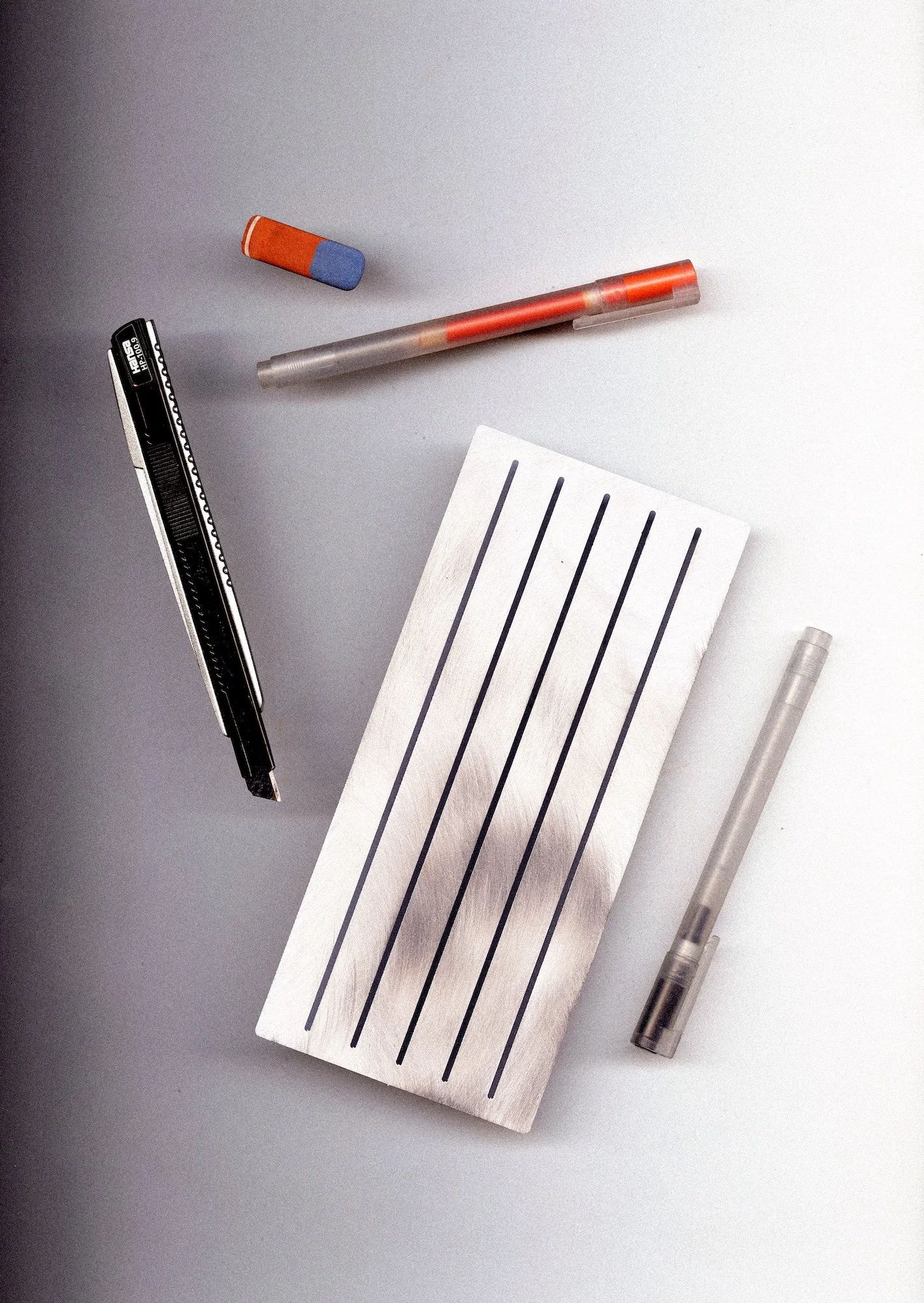
A pencil tray designed by the collective (image: courtesy of Office Series).
To enable this approach, the collective had to design a clear process that could handle both disagreements and disjunction. Claveria, for instance, highlights the difference in background between the different courses and their reliance on different CAD tools. “We do the same thing, but we don't do it the same way,” she says. “So, for example, one [designer] is using SolidWorks, the other is using Rhino. That was an issue.” Aside from practical considerations, questions of interpersonal relationships were key. Allgoewer notes that some members of the collective preferred face-to-face discussions, while others benefitted from the distance allowed for through a WhatsApp group. “What you need,” he says, “is the possibility to give everyone kind of their space that they need to communicate.” Shababzadeh additionally notes the importance of working across multiple objects at once, as opposed to an individual sinking all of their time into, and becoming overly invested in, a single design. “We had so many different objects, so you were not feeling as if you had to focus on one thing, which took away the temptation to [fixate] on one detail,” she says. “It became about seeing all the objects as a collective too.”
While the objects were initially created for the 2025 ECAL Christmas market, they were also later exhibited and sold in April 2026 during Milan Design Week at Drop City. This second outing for the project represents both an endorsement of the collective’s success (“We sold very well at the Christmas market,” acknowledges Brouckaert, “so even objects that sold out after two hours, people were still asking for”), but also served to offer an antidote to many of the prevailing criticisms of the design week of which it became a part. In one review of the 2026 Milan Design Week, for instance, penned by journalist Jasmine Jouhar for the thing Magazine, the festival was described as “no longer [deserving] to carry the word ‘Design’ in its name.” In place of displaying “curious, risk-taking, experimental, at times humorous, even utopian [design],” Jouhar argued, the week had instead descended into “a highly refined spectacle of exclusion,” in which design was presented as being in the sole service of capitalism. In place of content, Jouhar concluded, the week had prioritised celebrity designers and unattainable luxury, resulting in a display in which “the greater the spectacle, the less the substance.”
By contrast, the Office Series is quiet and thoughtful. Its objects are simply made, affordably priced, and offer a reflection on the value of collegiate cooperation in place of ego-driven authorship. “I think we’ll have to see what the the next chapter is,” Kellens says. “Will we do another one in a different material? Or is it not Office Series, next time, but Kitchen Series?” In addition, he notes, the group are interested by the idea of incorporating students from courses that sit outside of object design, including graphic design and photography. “I think that would be even richer, and you would feel those differences even more in the result,” he says. “But at the moment we’ve just finished one chapter of the project. We’ll have to see what the next might be.” It is the kind of ambiguity that is fitting for designers who still remain in full-time education, yet the experience of Office Series has, at the least, provided the collective with the opportunity to reflect on the kind of practices that they hope to form a part of in future. “We described it as an experiment, and I think for me it’s interesting to know that it works,” Allgoewer says. “It is quite nice as a designer to see that, OK, we could work like like this if we wanted to, and it actually makes sense.”
Words Oli Stratford
[1] The full list of participants in the Office Series project are as follows: Ivo Allgoewer, Martin Brouckaert, Judith Burgard, Stephen Chan, Júlia Claveria, Federico Giuberti, Fiona Handermann, Wouter Kellens, Anton Oberländer, Lion Sanguinette and Vanessa Shababzadeh.