
Everybody’s Chair
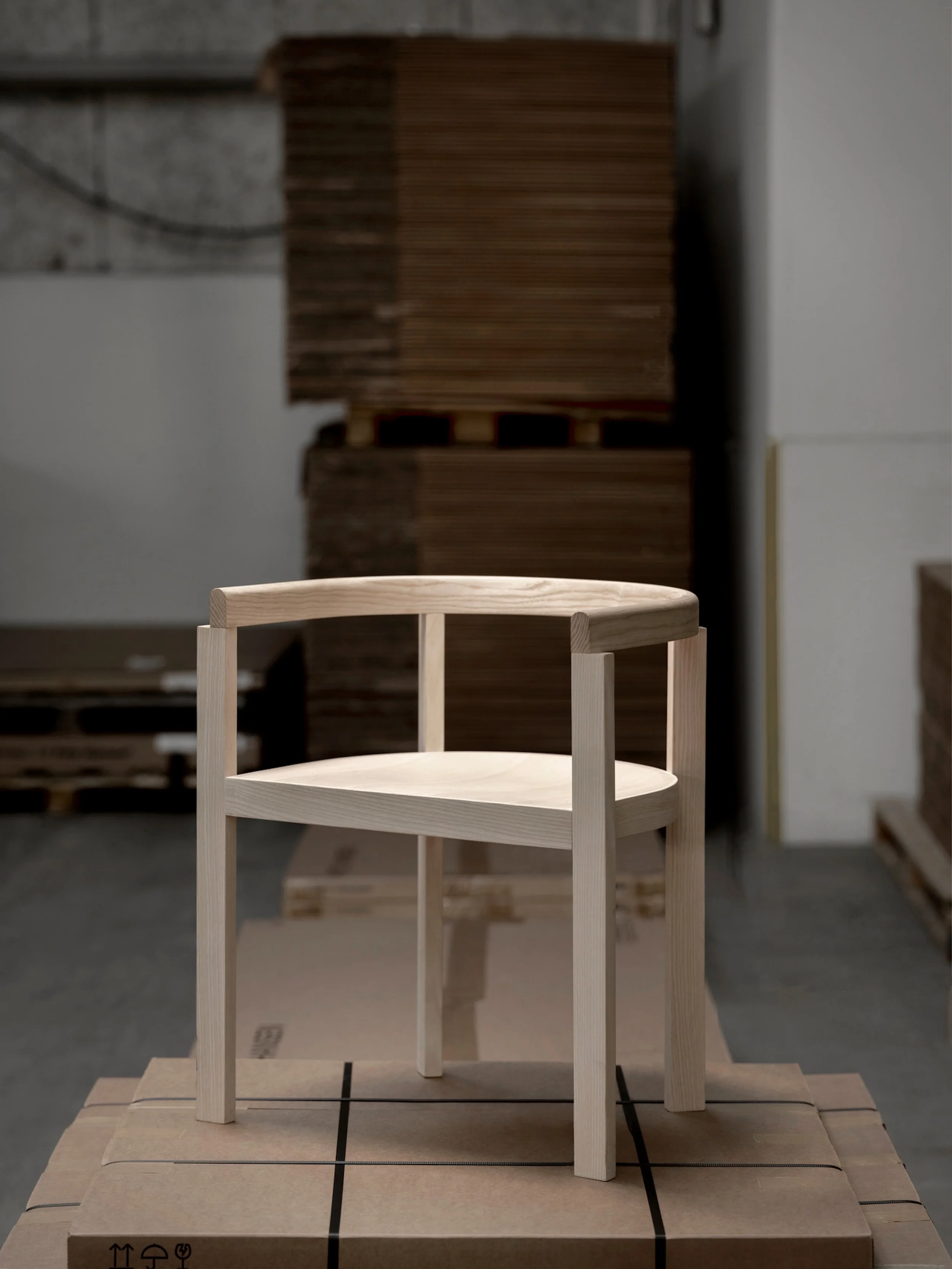
Michael Anastassiades’s new chair for Fritz Hansen pays homage to the ancient Greek Klismos chair, and all of the 20th-century Danish designers who were inspired by its form (image: Fritz Hansen).
“If you look at the classic examples of Danish furniture design, you quickly understand that the starting point of comes from an older chair typology,” says designer Michael Anastassiades. “The contributions are small adaptations of traditional furniture, rather than a completely new concept – so even if it’s a [Hans] Wegner chair, a [Kaare] Klint chair, or a [Poul] Kjærholm chair, in reality it’s everybody’s chair at the same time.”
Anastassiades’s new After chair, designed for Fritz Hansen, draws upon the typology of the Klismos chair – an ancient Greek design that was popularised by Danish designers such as Klint in the early 20th century. Classically, the chair features a concave backrest and curved, tapered legs, but Klint experimented with models with straight forelegs and seats rendered in rattan or leather. “Klint’s chair is very much an evolution from the Klismos, yet it clearly refers to its key points,” Anastassiades says, adding that he was also inspired by Kjærholm’s PK12 armchair, whose bent tubular steel backrest wraps around to sit beneath the user’s elbows as an armrest. “I was particularly attracted to [the PK12] because it’s not necessarily the comfort that invites you,” he says, describing how the chair’s metal form is less enticing than wood.“It’s more that it makes you curious; it’s this childlike excitement of occupying something.”
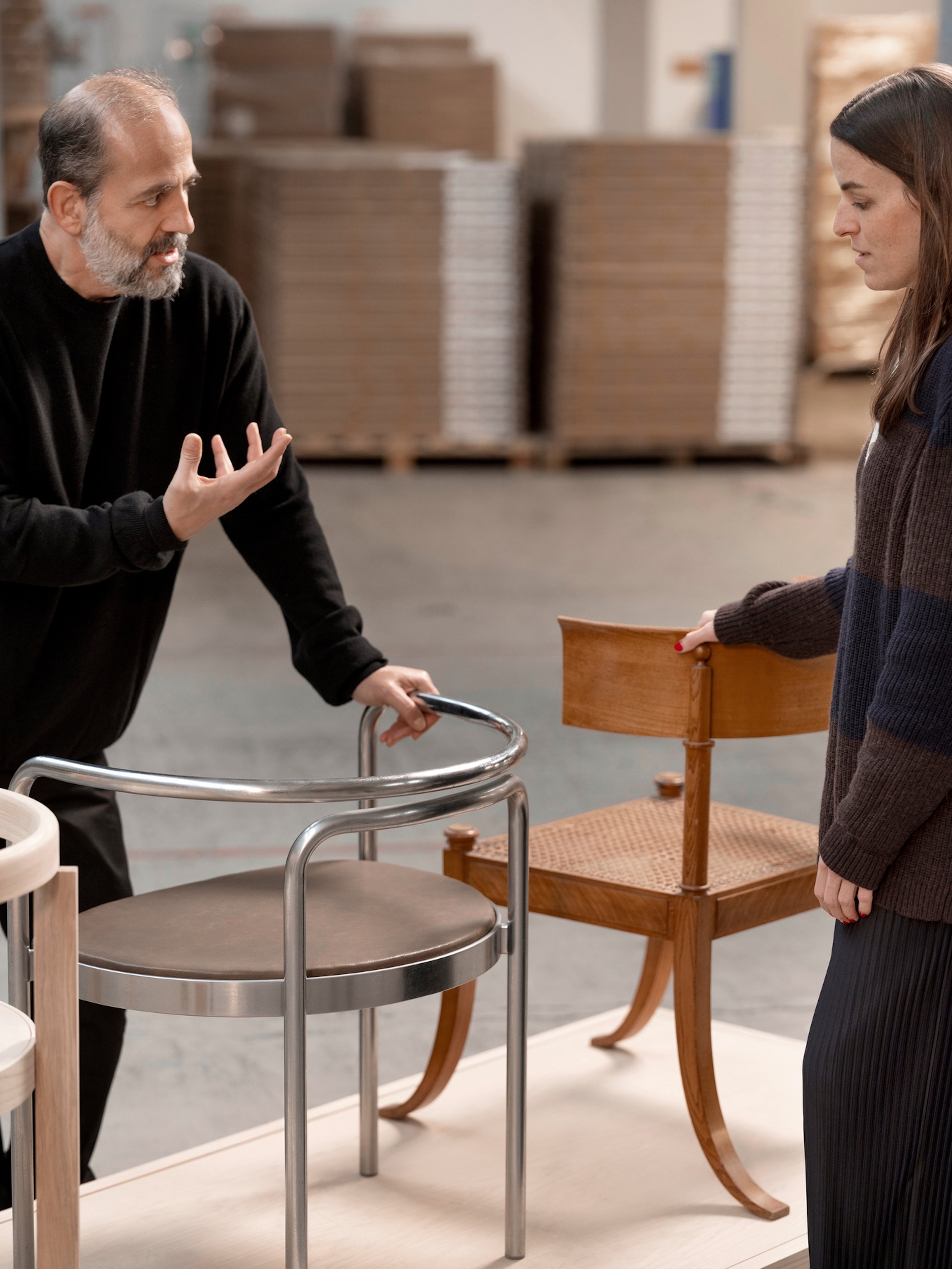
Michael Anastassiades and Fritz Hansen’s creative director Els Van Hoorebeeck looking at chairs from the brand’s archive that toyed with the form of the Klismos chair (image: Fritz Hansen).
The After chair retains Kjærholm’s wraparound armrest design, which Anastassiades has rendered in ash wood rather than steel. “It’s very much a chair that you hold,” he says, stroking the armrests, which swoop backwards to hug the lower back. All of the chair’s legs are straight and squared, giving it a more geometric appearance than its bow-legged antecedents. While the chair’s curved backrest is the same thickness as its legs, the backrest is mounted vertically rather than horizontally, making it appear thinner and giving the impression that it is floating on top of the frame. “Wood is a natural material – it’s never stable, it’s alive,” Anastassiades says, explaining that the team had to slice the wood with fine blades and glue two pieces together in a crescent shape in order to create a curved backrest made from solid wood. “It was very difficult to achieve the precise alignment – the tolerances seemed impossible,” he adds. While Danish designers in the past might have used steam bending to create a similar effect, Anastassiades was able to take advantage of Fritz Hansen’s latest technology to execute every joint to the millimetre and thereby create a sturdier chair. “Even steam bent wood would still move afterwards,” he says. “This technique creates that stability by breaking the structure of the wood.”
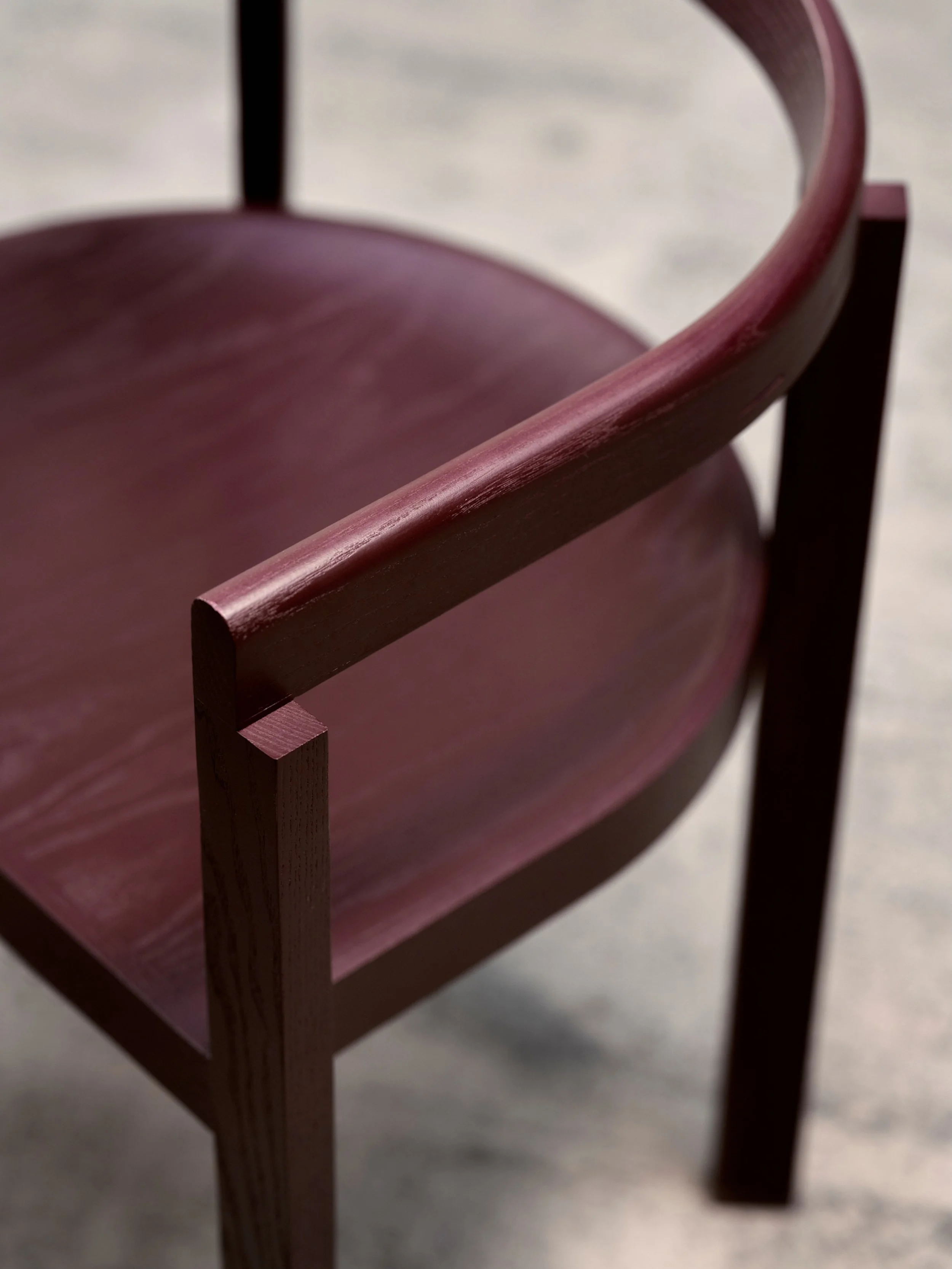
The chair is also available in a painted burgundy, which acts as a modern take on a traditional dark wood version of a chair (image: Fritz Hansen).
While Anastassiades always knew that he wanted to create a wooden chair, his choice of ash was determined by which species of tree was plentiful on the market and therefore could be sustainably sourced. “All wood is beautiful,” he says, explaining that he chose to finish the chair with a combination of wax and oil to make it look as natural as possible. “It’s a hard-wearing finish that feels like it has never been treated.” The chair is also available in a painted burgundy, which acts as a modern take on a traditional dark wood version of a chair. “By painting it, we were able to rescue the wood by covering up small imperfections that might distract a little bit visually,” he says. While the natural wood version is sanded smooth, the texture of the painted chair’s wood grain is retained. “Maintaining the grain gives you that natural feel,” he explains. The chair’s matching table uses a similar design language, with its circular tabletop hovering over thick rectangular legs, but the burgundy version features a marble tabletop that is more durable than painted wood.
The form of the Klismos chair can’t be attributed to any singular designer, and ancient examples of the chair have only survived through depictions in pottery, sculpture and bas reliefs. The name of Anastassiades’s chair, After, acknowledges its position in a collective evolution of design, recognising its connection to earlier designers and archetypes and challenging traditional ideas of authorship. “The people who revisited [the Klismos chair] learned from the exercises of the designer before them, which led to the evolution of what we know now,” Anastassiades says. “I'm curious about whether [the After Chair] will inspire somebody else to explore further.”
Words Helen Gonzalez Brown