
Crooked Pencils
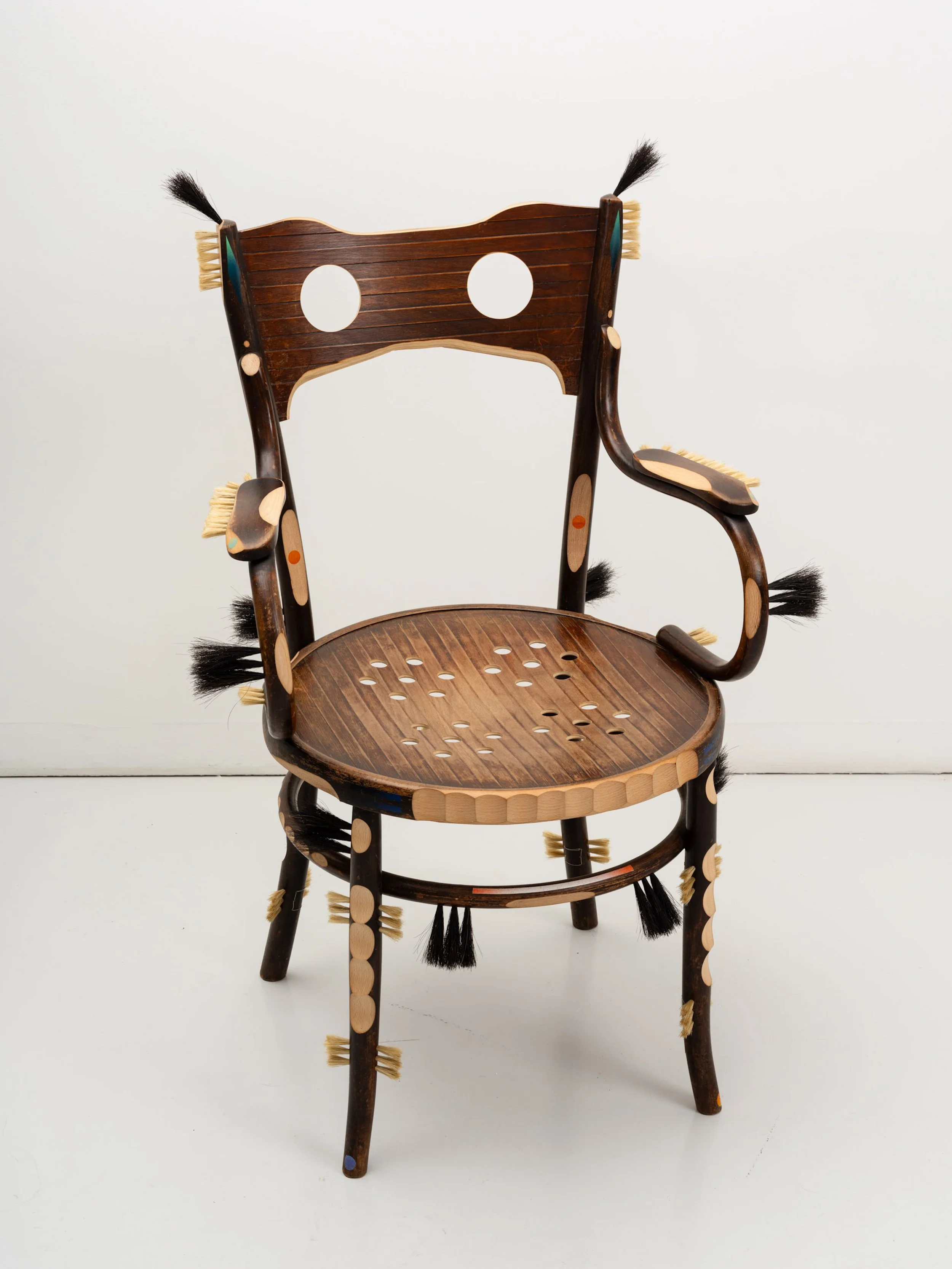
Rio Kobayashi’s solo show, Crooked Pencils, at Kate MacGarry gallery mixes new and repurposed materials to create furniture that is both humorous and ceremonial (image: Angus Mill).
“‘Crooked Pencils’ means beauty in imperfection, or beauty in individuality, but the third meaning of the phrase is corruption – it refers to bad accounting,” designer Rio Kobayashi says, discussing the title of his new exhibition at London’s Kate MacGarry gallery. “People cannot always be good,” he says, adding that his first solo show was titled One Hand Washes the Other, another double entendre that means both friendly collaboration and a corrupt system of mutual favours. “I think a bit of a cheekiness is essential, to show the imperfection of humanity.”
All of the pieces in Crooked Pencils are made from a mixture of new and repurposed materials, a practice which Koyabashi began during the pandemic when artist Peter McDonald asked him to repair his broken Thonet chair. “I kind of went crazy, because I had so much time to kill,” Kobayashi says, describing how he added bristles that stick out of the chair like tassels, which were inspired by his friend Flavia Brändle's research into hand brooms. “But then I went too far, and I was super scared to give it back.” Luckily McDonald was pleased, and Kobayashi is now exhibiting two more versions of what he proudly refers to as his “hairy chairs”, whose black and white brushes spoke out of their legs, arms and backrests like the tails of happy animals. Kobayashi has also chipped off parts of the chair frames, creating patches of paler wood that resemble dappled deer fur. “I had the chair in front of me, and I could sand it, grind it, rout it, so I just did what looks good,” he says, describing his intuitive creative process before adding conspiratorially, “but you should write that I planned everything.”
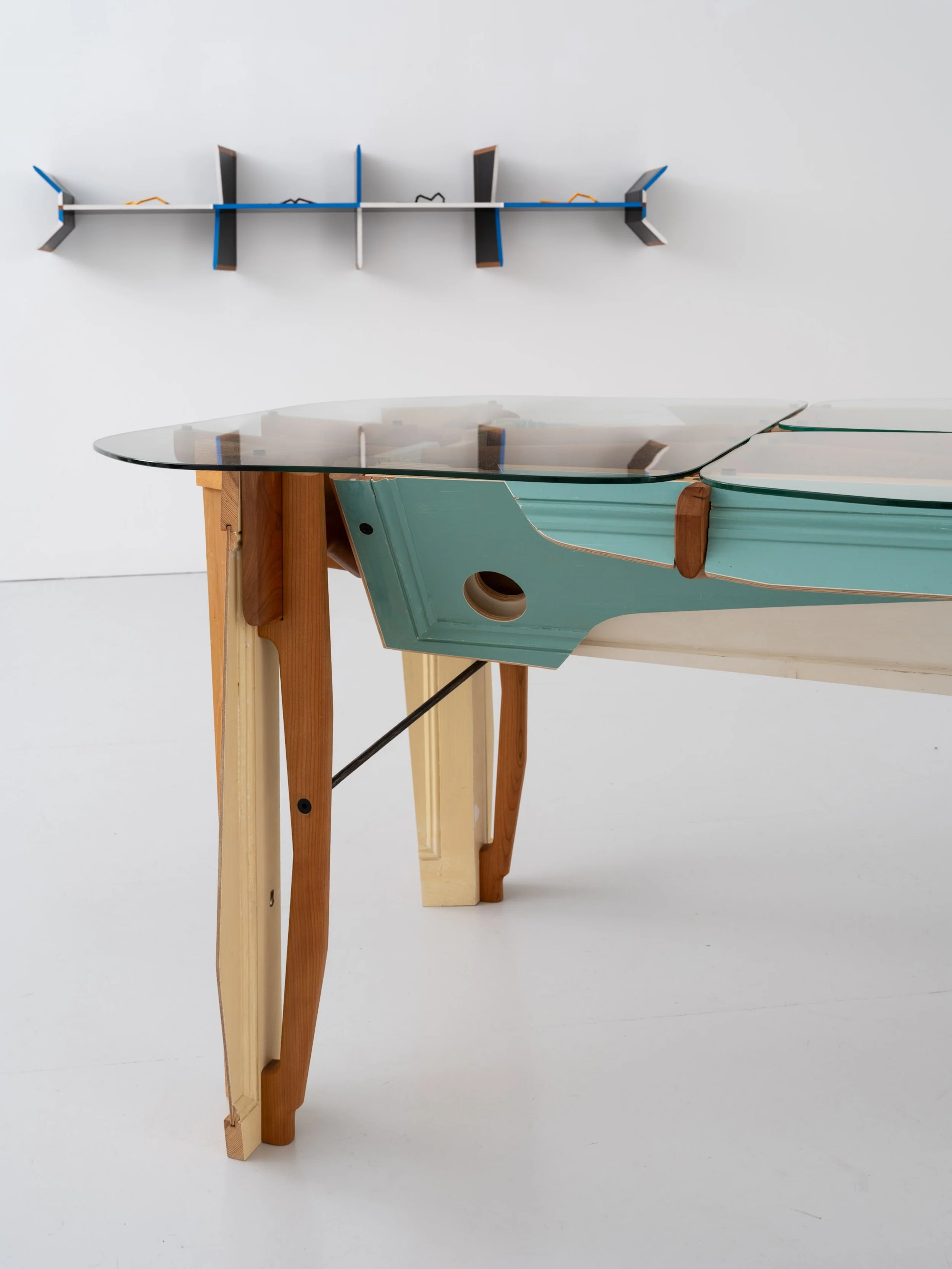
Kobayashi’s table and shelves have dynamic shapes that resemble boats and spaceships (image: Angus Mill).
Kobayashi came into contact with more reclaimed materials when interior designer Irenie Cossey purchased a near-derelict Victorian townhouse in De Beavoir Square, and invited him to use the space as a temporary gallery before renovations began. To thank Cossey for her generosity, Kobayashi made a table out of doors, shelves and fireplaces salvaged from the building, and in preparation for Crooked Pencils used some of these leftover materials to create a matching bench, coffee table and chair. “I called it the Ghost Series, because it was so spooky in there before the refurbishment,” Kobayashi explains. The table is made from fragments of light blue doors that have been angled to look like the hull of a boat, while the bench is shaped like a surfboard. “When I started putting things together and making the shapes, I realised they looked so speedy and fast,” he says, explaining that he decided to emphasise their dynamic nature by adding vintage motorsports stickers. “But then Kate [MacGarry] came over and said, ‘Maybe hold off on the stickers,’” Kobayashi says. While some people would be perturbed by criticism from their gallerist, Kobayashi and his collaborator Maki Suzuki, cofounder of graphic design collective Åbäke, decided to turn her words into an elaborate joke instead, creating an exhibition poster that doubles up as a gigantic sticker.
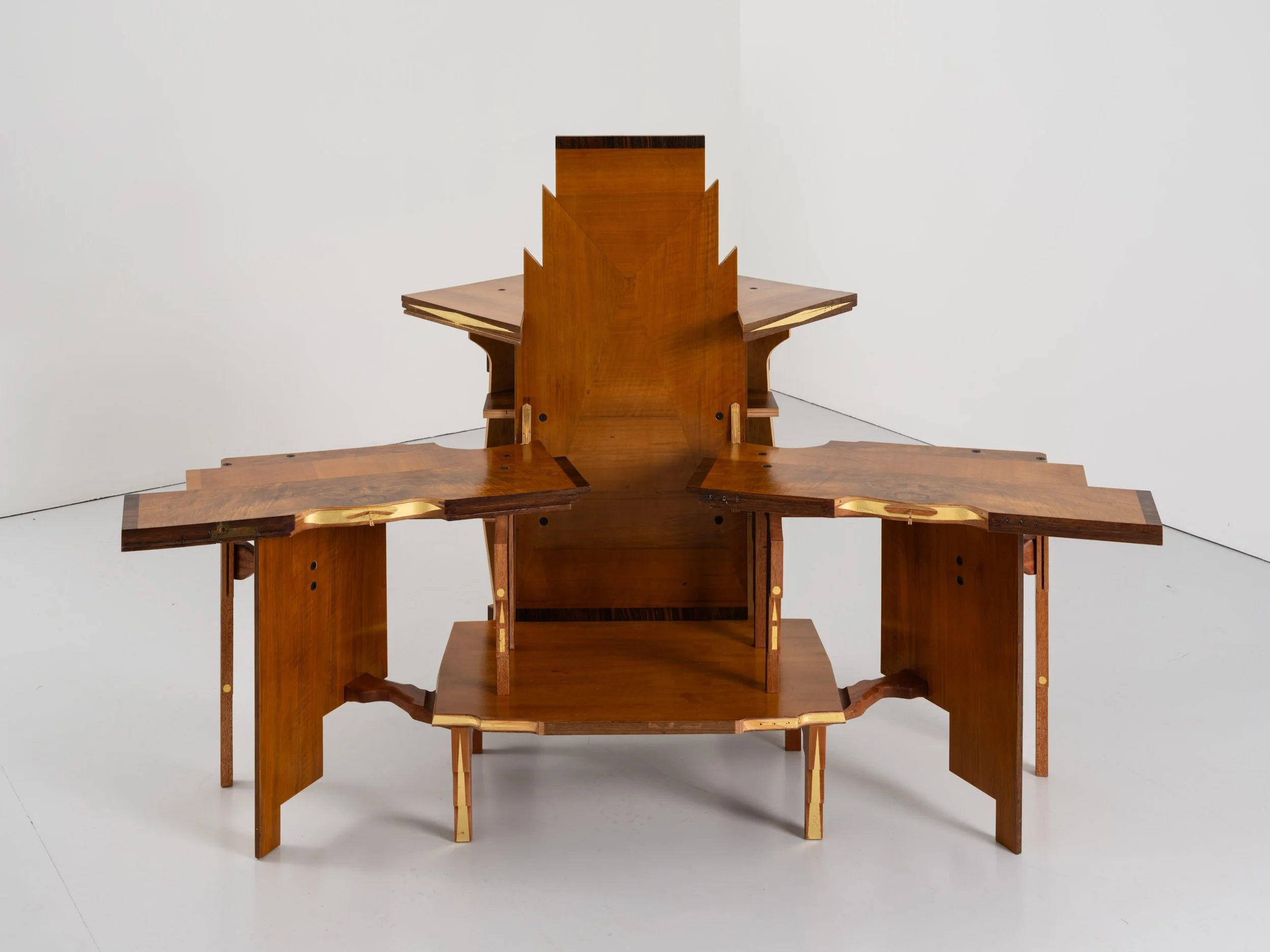
Made from a cabinet he found on the street, Kobayashi’s Nio piece merges the aesthetics of church furniture with references to Buddhism (image: Angus Mill).
Kobayashi’s series of shelves made from a broken Victorian room divider also mimic the shapes of vehicles. Made from pieces of glossy black wood that resemble a piano, the frames of the shelves are positioned at irregular angles to evoke movement. “I wanted something that could move, in my imagination, like a Star Wars battleship,” he explains. Another piece made from a cabinet Kobayashi found on the street has the heft of a mothership, featuring a central tower of wood with two tables erupting out of its sides like wings. “I don’t know what it is,” he admits. “Is it a credenza? A side table? Is it even furniture?” While working on the piece, Kobayashi found patterns on the wood veneer that resembled the faces of the Nio guardian statues that stand outside Buddhist temples. “One has their mouth open and the other has their mouth closed, which represents breathing out and breathing in,” he says, explaining that he wrote the “ah” sound of the inhale and the “um” of the exhale on the back of the piece in Japanese calligraphy as a reference to his childhood education. “In Japan, the teacher would always come in the next day when the black ink is dried and correct it with Vermillion ink,” he says, explaining how he initially fumbled the letters before correcting himself in red as a nod towards his schoolboy mistakes.

Kobayashi corrected his own Japanese calligraphy in red, as a reference to his childhood education (image: Angus Mill).
“It looks like church furniture, and I added a Buddhist feature so it is a religious thing in a way, but it’s totally mixed, which reflects my heritage,” Kobayashi says, referring to his Japanese and Austrian-Italian parents. This sense of ceremony, however, echoes throughout all his pieces, whose showy details – which range from stickers to bristles to gold leaf – give the impression that each one could be the centrepiece of an eccentric ritual. Kobayashi’s attention to detail means that the entire show rewards close inspection: one shelf has tiny neon orange car indicators painted on either side; the shape of a sticker has been carved into the bench so that it appears embossed into its surface; and the back legs of his chairs have tiny stitches where their hairy details have been added. At the same time, Kobayashi never takes his craft too seriously – underneath the faces in the wood veneer, for example, he added a gold-plated silver tongue which sticks out like a tiny key. “It’s a bit cheeky,” he explains. “Like sticking your tongue out in church.” This mixture of dedication and silliness is what makes Kobayashi’s pieces so intriguing, with each one executed with the professionalism and absurdity of a court jester.
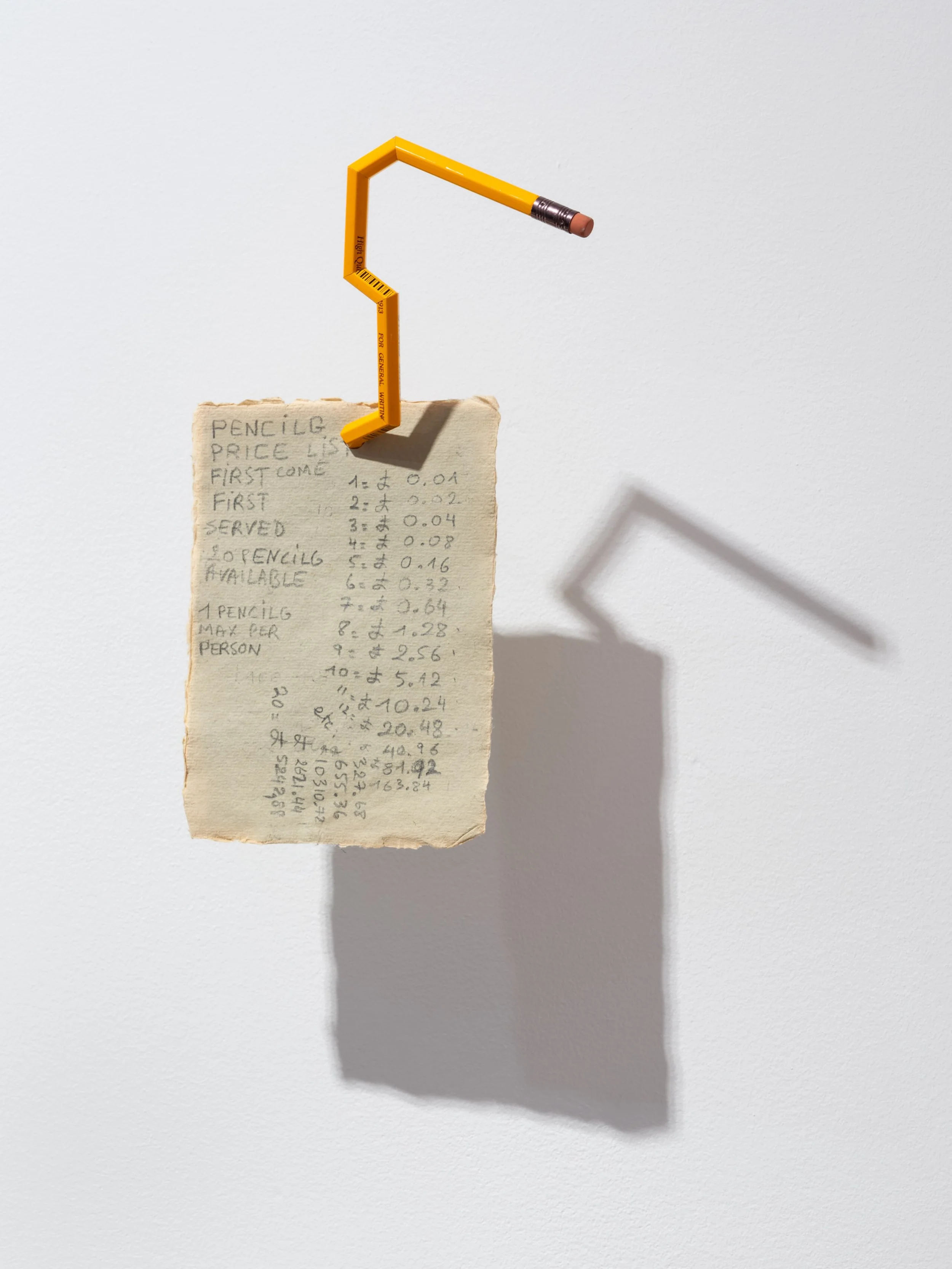
Each edition of Kobayashi’s crooked pencils doubles in price, with the first one starting at 1p and the most recently sold pencil purchased for £655 (image: Angus Mill).
As one final act of mischief, Kobayashi is selling his own crooked pencils at the show. “I thought, what if I take the cheapest products in the gallery and make them potentially the most expensive thing they could sell,” he says, explaining that each edition of the pencil doubles in price, with the first starting at 1p and the most recently sold pencil purchased for £655. “It was like a fish market at the opening – people carrying the pencils and saying, ‘I’m first!’” he laughs. Here at Kobayashi’s solo show, his gallerist, his audience and himself all take turns bearing the brunt of his good natured fun, his objects holding a mirror up to human imperfections and peculiarities in order to give everyone the opportunity to laugh at them together. “I think it’s funny, and very crooked pencil,” he says, using the show’s title as an adjective to describe his own distinctive blend of humour and craft, and adding yet another layer of meaning to the phrase.
Words Helen Gonzalez Brown