
Gilding the Lily
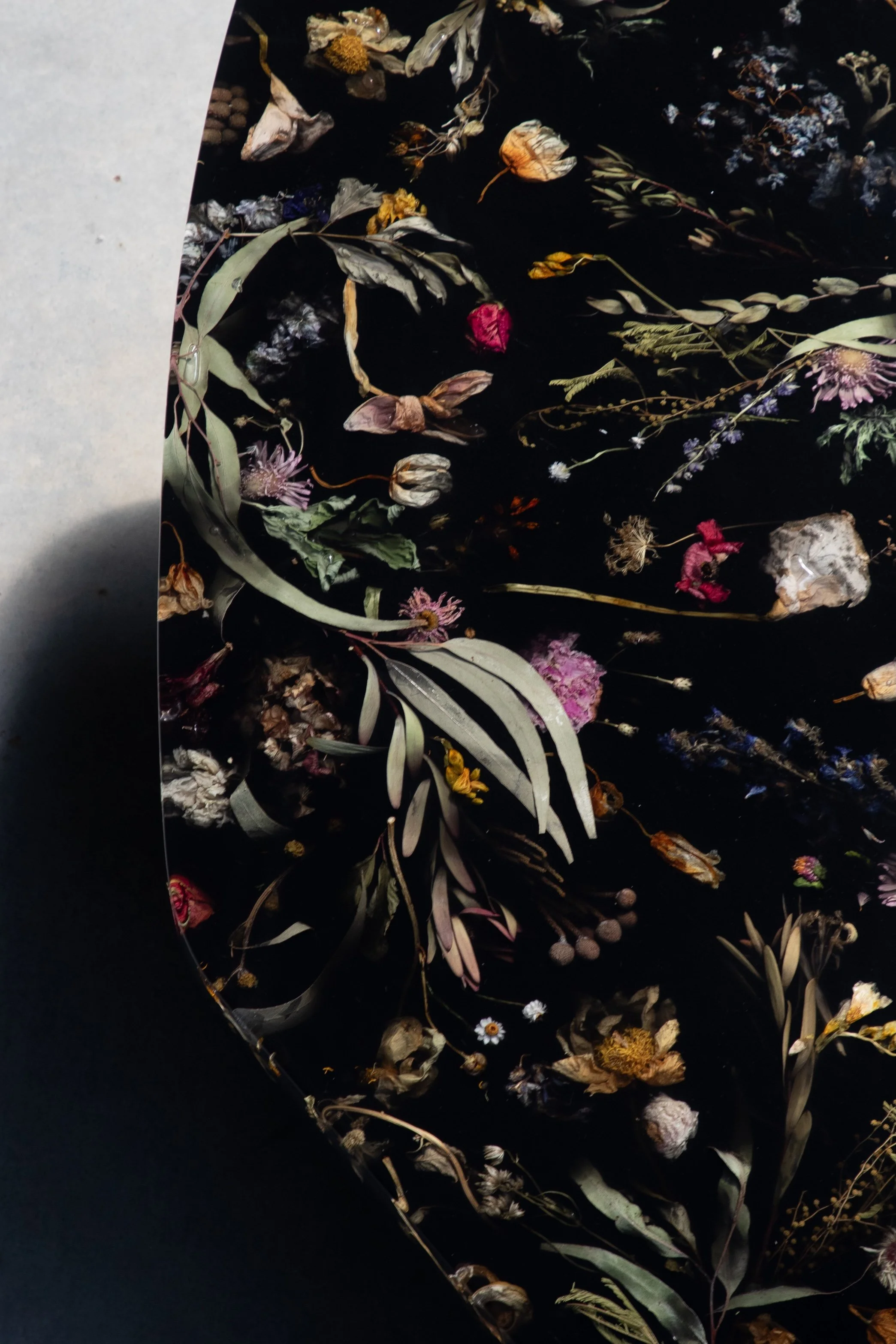
Marcin Rusak’s work explores the preservation and decay of plants (image: Marcin Rusak Studio).
Inside Marcin Rusak’s studio on the outskirts of Warsaw is an archive of material research: lightweight tableaus of fresh flowers sprayed with bronze, which later became credenzas at his exhibition Forum Florum during this year’s Milan Design Week; models of spoons with bowls shaped like orchids that were unveiled two months later at Copenhagen’s 3daysofdesign; and a brown vase that resembles a murky pond, made from plant matter mixed with organic binders such as shellac and tree resin, which acts as an example of the perishable objects he has been exhibiting since 2014.
Rusak’s work centres around the preservation and decay of plants, themes that have intertwined since his earliest years. “I have a history of flower growers in my own family,” he says, explaining that his grandfather had a flower business in Warsaw which closed down around the time Rusak was born. The derelict, overgrown greenhouses later became the designer’s childhood playground. “My mom and my sister [now] run a flower shop in the city centre, so we collect quite a lot of waste from them,” he says, gesturing towards shelves filled with boxes of dried plants that stretch towards the ceiling. “I would say 90 per cent of the plants come from waste the flower growers couldn’t sell, and they’re super happy that we can buy it from them,” he adds, opening a plastic box filled with dried sunflowers with crispy leaves, curved stems and shrivelled petals, their moisture removed to make them compatible with resin. Unzipping a grow tent designed for cultivating plants indoors, Rusak reveals metal trays filled with mimosa sprigs, sunflowers, and bittersweet orange berries, which will sunbathe beneath heat lamps for three days before becoming ready to use.
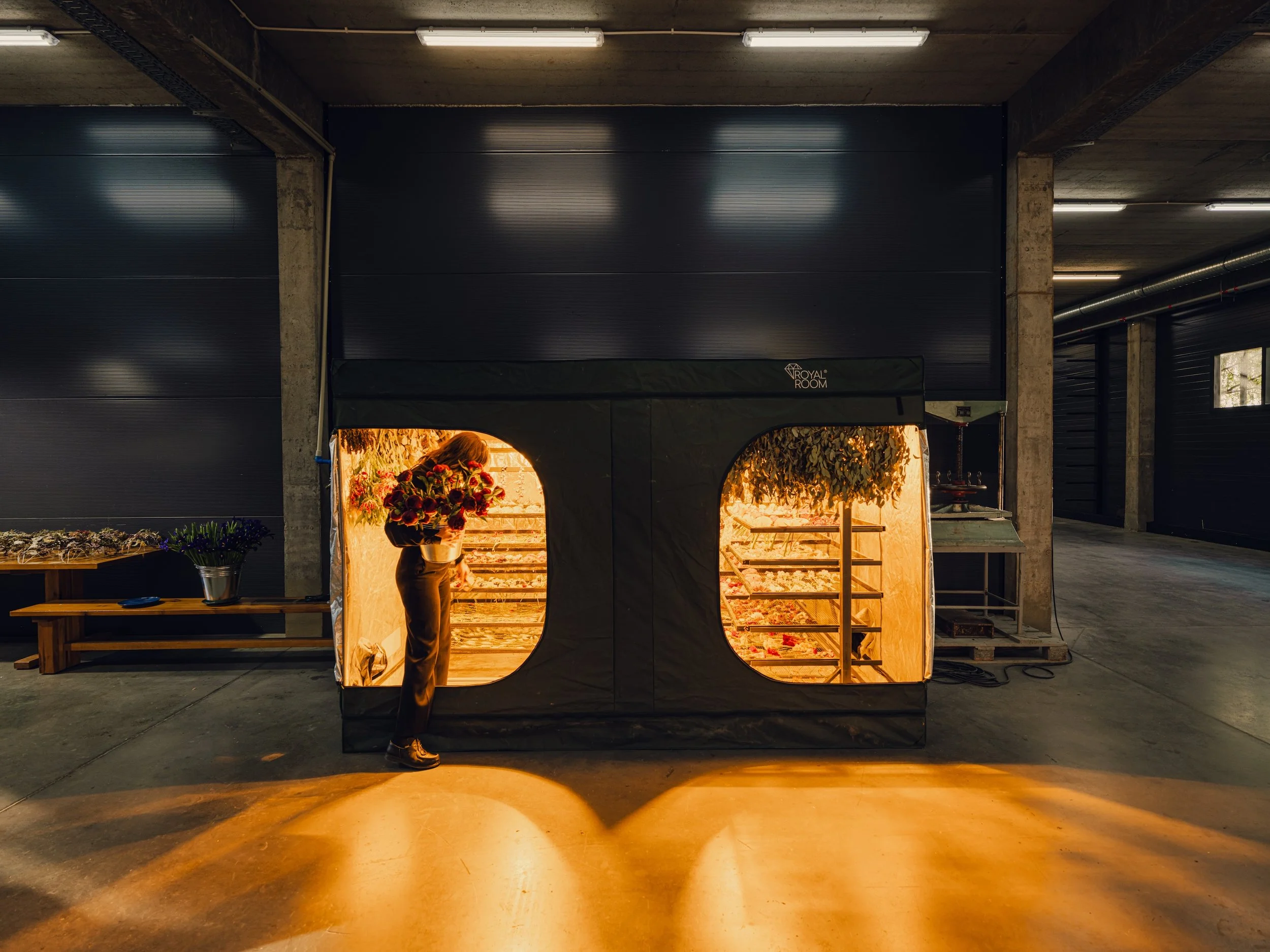
Drying flowers inside a grow tent in Rusak’s studio (image: Marcin Rusak Studio).
The studio’s work largely focuses on making furniture and objects out of flowers encased within resin, which are commissioned for museums or individuals. “The material lifespan of synthetic resin can be 1,000 years,” Rusak says. “I don’t think everything should be preserved, so we try to give meaning to things that we will preserve and keep for future generations.” The studio weaves in plants and details relevant to each client’s personal history to create bespoke furniture pieces, in a process that can take months or even years. When working with international clients, for instance, obtaining plants from different areas of the world means that the studio has to navigate biosecurity laws that prevent the spread of invasive species, pests, and diseases. “We managed to do a piece with plants from the Middle East, but we had three embassies working on it,” Rusak says. “Because of the drought, plants are under protection, so you can’t just go and pick them. We had to find a botanical garden and experts over there to work with whatever falls from the trees, and collect that for us and ship it here.” To appear as though the plants are floating inside the material, each one is placed by hand directly onto the resin casting tables, with the compositions taking one to two days to complete. “There’s always a lot of investigation into how to make something look quite effortless,” he says.
Moving through the rest of Rusak’s studio, there is a wood workshop where furniture pieces are made, and a resin casting room with natural resin experiments that resemble amber fossils. Inside the metal workshop, a colleague in head-to-toe protective gear is in the process of metalising a sculpture by spraying it with a machine fed by a spool of golden thread, like an industrial Rumpelstiltskin. While Rusak originally founded his studio in London after having graduated from the city’s Royal College of Art, he relocated to Warsaw in 2018 partly because of the increased availability of craftspeople. “London is more industrial,” he says, describing how companies were reticent to let him use their machinery without operating on a large scale. “In Poland there are many more small companies. For example, we started working with a metal company that makes staircases a few years ago, developing their quality and methods of making, so they could do all the complicated metal structures for us.”
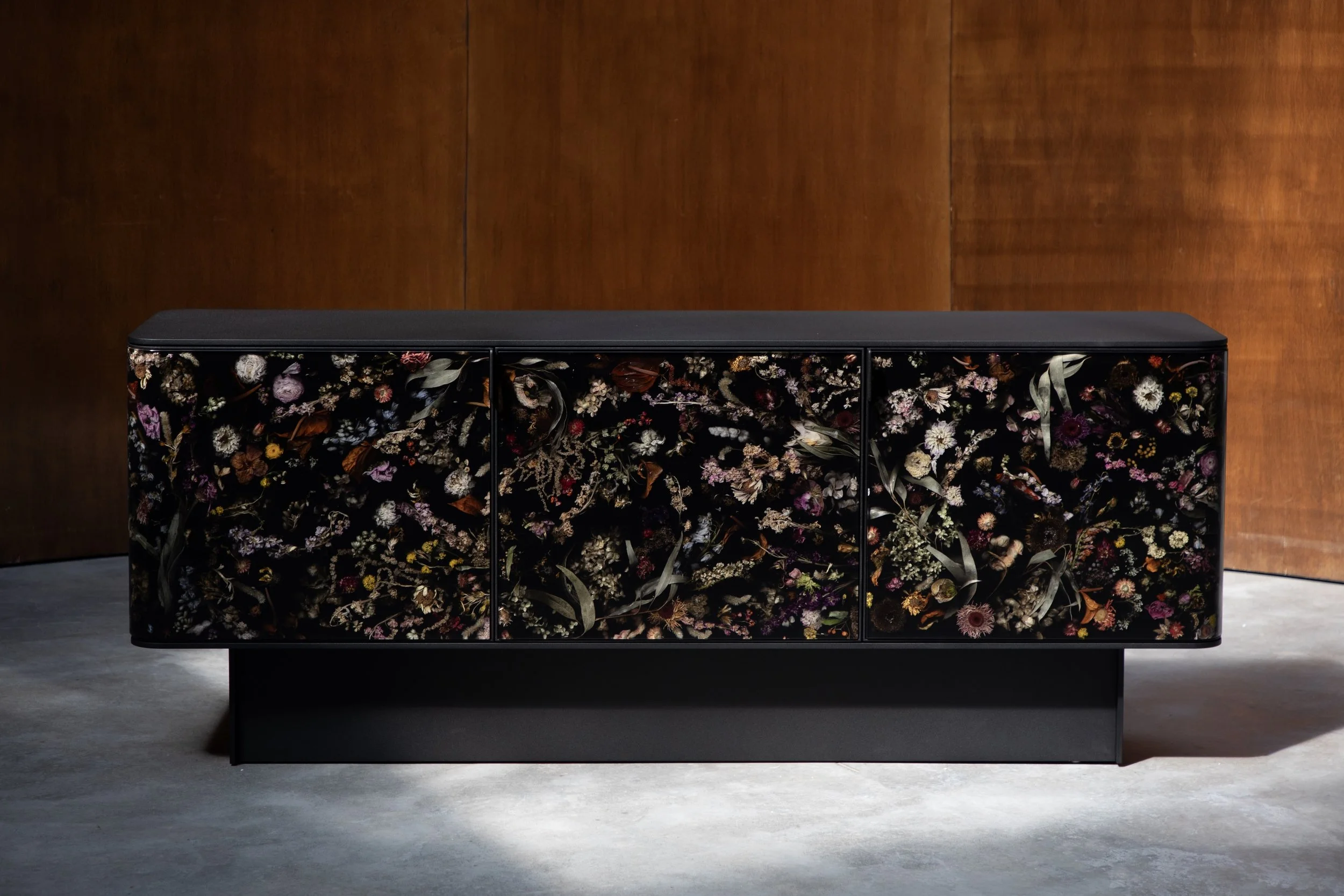
A credenza made from resin and dried flowers (image: Marcin Rusak Studio).
Despite achieving commercial success through his resin pieces, Rusak’s favourite objects are the perishable vases, where plant matter peeks through brown resin, resembling muddy autumn leaves. “It’s so hard for me to part with them, because they’re almost alive,” he says. “The [synthetic] resin pieces will look exactly the same in 50 years’ time, but I won’t get to observe the changes [of the perishable vases].” In his series of installations dubbed The Nature of Things, Rusak has displayed these pieces inside of incubators that use enzymes, bacteria, UV light and humidity to induce decay over the course of the exhibition. “It looks a bit like when human skin starts crippling, and a lot of heat can make it collapse inwards,” he says. While the vases initially served as conversation pieces, he has since found collectors who see their decomposition as a valuable part of the work. “I really love that there are a few collectors who love the idea that the vase is not permanent and that they will have to part with it,” he says, describing how interest in these designs grew after the Covid-19 pandemic. “I think people discovered their own mortality,” he reflects.

Perishable vases displayed as part of Rusak’s exhibition The Nature of Things II (image: Marcin Rusak Studio).
Valuing impermanence runs counter to the norms of the flower industry, which frequently seeks to extend the natural life of flowers through selective breeding, temperature control, and chemical preservation techniques, often privileging specific visual qualities over sensory values such as texture and fragrance. In Rusak’s studio, a large open-plan space with double-height ceilings houses a monumental bronze relief which he illustrated with 87 scenes that trace the history and ethical complexities of the cut flower industry. “It’s a lot like the food industry, but because we don’t eat [flowers], we don’t think about it so much,” Rusak says. “This is a screenshot from a documentary of a worker who says she has to cut 480 stems in one hour,” he says, pointing to a cast of a still from a Business Insider documentary about the flower industry in Colombia, which supplies the majority of the cut flowers sold in the US. Another scene, of flower growers in the Netherlands destroying crops when the market crashed during the Covid-19 pandemic, touched the studio directly. “We tried to get in touch with [them] and take these plants,” Rusak remembers. “But no one even got back to us.”

The Ghost Orchid sculptures are made from bioplastics, and are designed to allow plants and insects to inhabit them (image: Marcin Rusak Studio).
By repurposing flowers that are past their prime, creating designs that are often specific to their clients’ local environments, and embracing decay, Rusak’s work resists the flower industry’s focus on freshness, uniformity, and detachment from place. In the centre of studio’s open-plan space, a large 3D-printed sculpture made of bioplastics engages with another aspect of the flower industry, taking its inspiration from the hybrid orchids Rusak’s grandfather grew in the 1970s. “I’m a little bit against the breeding of plants and playing God, so I limit myself to these digital experiments,” Rusak says. The wispy, smoke-like sculpture will be mounted outdoors, where insects and plants can grow on and inhabit its hollow structure. “Hopefully in 10 or 20 years it's going to be completely overgrown, and in 50 years, maybe the plants are going to take over the bioplastic, and it will collapse and disappear, and in 100 years, it won't be there anymore,” Rusak says.
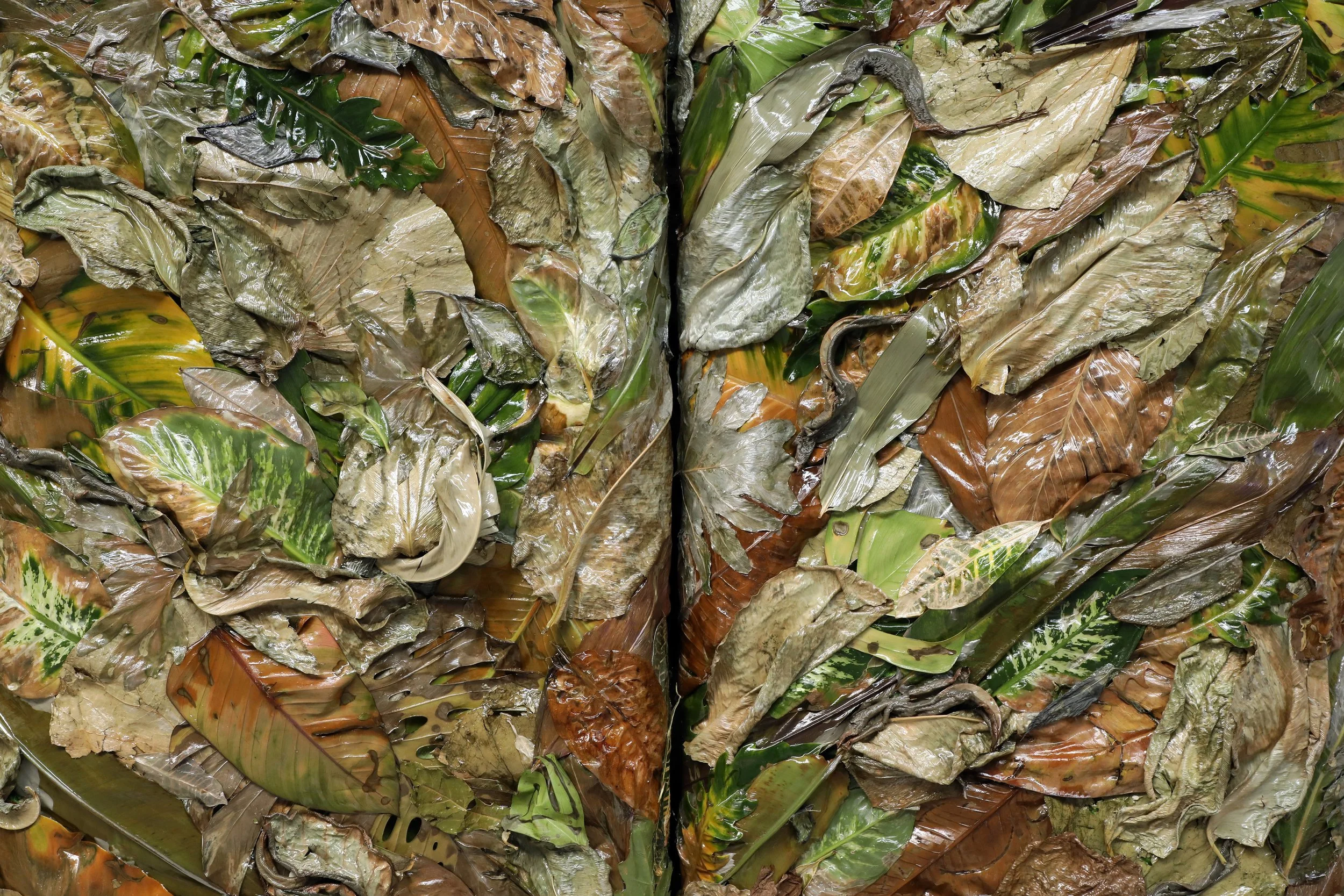
In Rusak’s Protoplasting Nature series, a thin layer of resin is applied to limit oxidisation while allowing the plants to continue transforming (image: Marcin Rusak Studio).
Many of Rusak’s pieces respond to sunlight, which turns the hollow plastic sculpture golden, or gleams on the surface of his metalised plants. In his resin furniture, drawers or doors drawn back to reveal the translucency of their material, the blooms silhouetting the coloured resin like a stained glass window. Even these flowers which have been carefully preserved hint at death – while many of the colours are remarkably vivid, their dehydrated forms are still crisp, with some petals wilted or browned. “Preservation and [degradation] were always hand in hand for me,” Rusak says. “Because the [synthetic resin pieces] became very desired by people, we put a lot of energy into refining them and working with collectors. But I’m trying to free up my time to do more conceptual projects,” he explains, walking towards a chair that is about to leave the workshop to join the permanent collection of the Pompidou Centre. Made of large tropical leaves wrapped around a steel skeleton and covered in a very thin layer of resin, it is designed to limit oxidisation while allowing the plants to continue transforming. Originally glossy and green, the piece has already become blanched and skin-toned, and will continue to evolve once it reaches the museum, its ageing only serving to make the space more alive.
Words Helen Gonzalez Brown
The visit to Marcin Rusak’s studio was supported by a trip organised by the Polish Cultural Institute.