
A Cartographical Statement
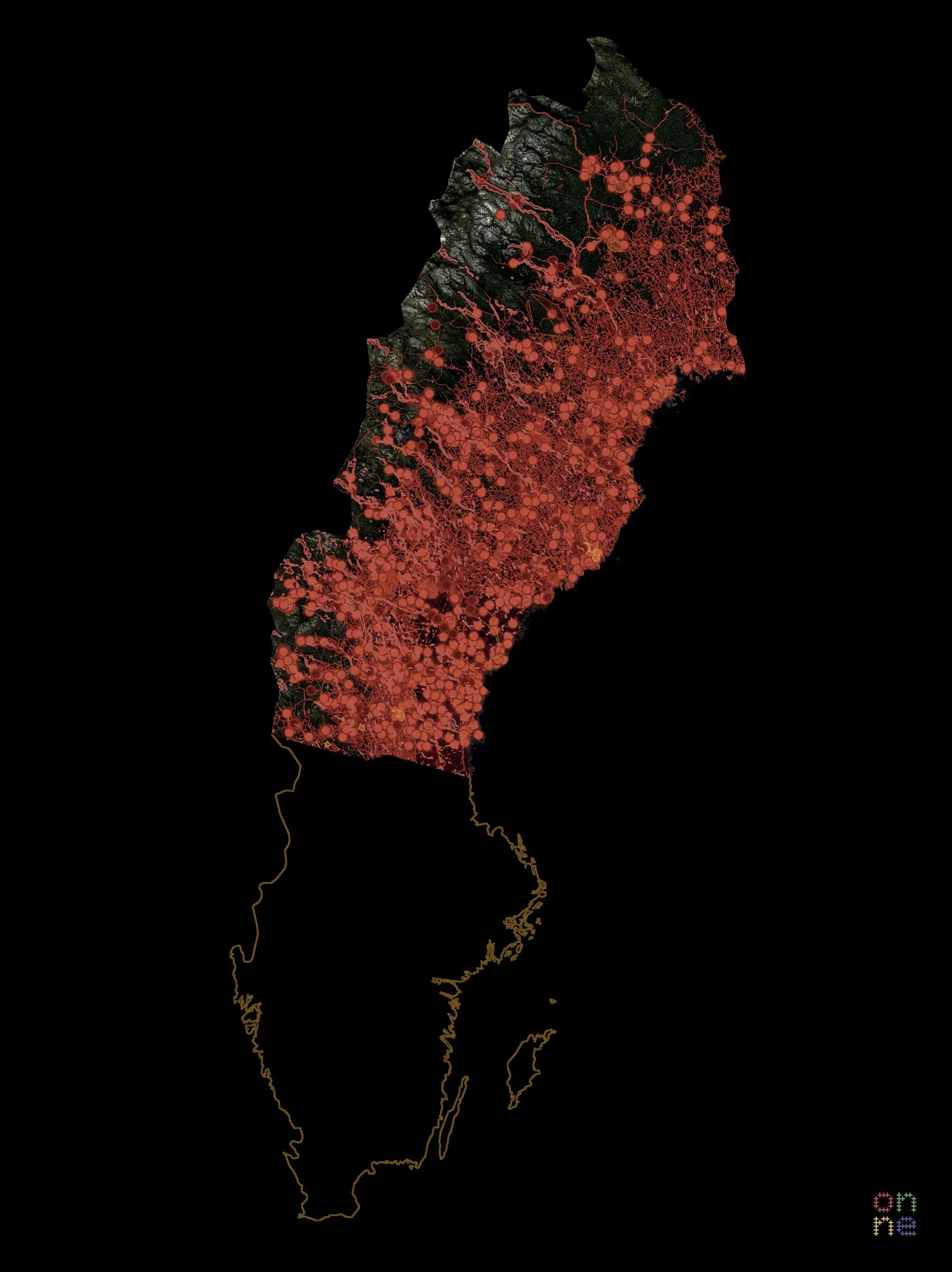
Onne is an interactive map of Sweden marked in red to show the threats to Sámi communities (image: Petter Schölander).
“In Sweden there is a narrative being spread that the indigenous, reindeer herding, Sámi people who have walked these lands for thousands of years, have too much land,” reads the text that accompanies Onne, an interactive online map.
Onne details the environmental and sociopolitical forces shaping the Swedish portion of Sápmi, an Arctic territory that is home to the Sámi people, an indigenous group of some 80,000 to 100,000 people, many of whom are assimilated in surrounding countries, but whose contemporary culture retains connections to reindeer herding. Sápmi spans the northern regions of Norway, Sweden, Finland, as well as Russia’s Kola Peninsula, but predates all of these nation states who now hold sway over its governance. It is a complex story of autonomy, colonisation and land rights, but the Onne map itself is simple. The land it depicts is dark and rugged, with an accompanying colour-coded key to designate the different human-made infrastructure and climate conditions present in the region. If you toggle on those that are beneficial to reindeer herding Sámi communities and their way of life – nature reserves, for instance – a smattering of phosphorous green spreads across sections of the land, predominantly in the mountainous west. If, however, you toggle on the threats to these same Sámi communities – mines, power infrastructure, transportation systems, military zones, fire zones, tourism, deforestation, waste dumps, buildings, hunting, freeze-thaw events, and more – the map is overwhelmed. The phosphorous green is washed out in an encroaching easterly wave of danger red.
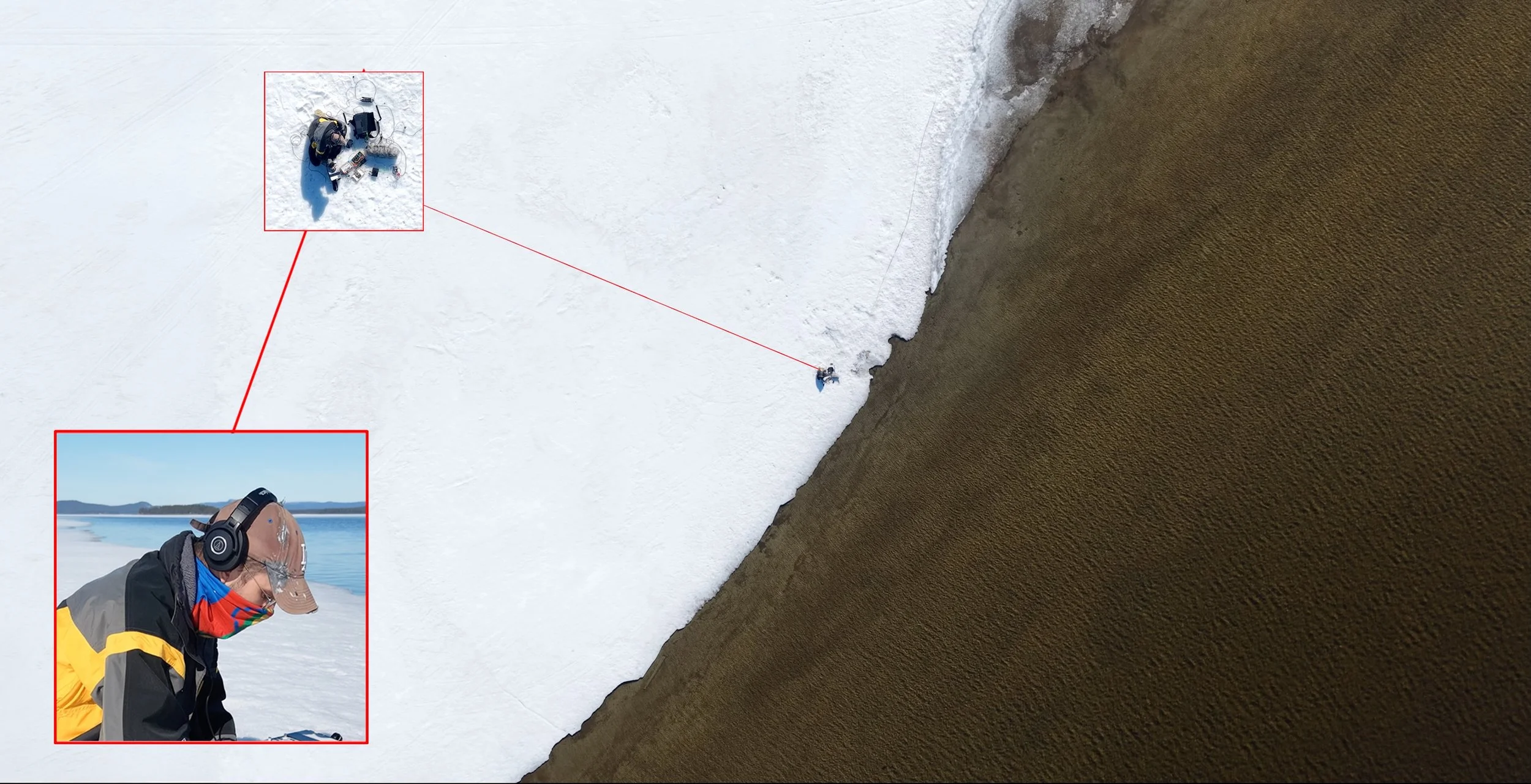
Designer Petter Schölander in Forsnäs, a village in Sápmi (image: Petter Schölander).
“Naively, some people might think that the threats facing the Sámi were in the past,” explains Petter Schölander, a Swedish and assimilated Sámi artist, who is the designer of Onne. “But they are very much in the present and, in many ways, have actually been getting worse the past couple of years.” Historically, the Sámi have faced heavy marginalisation, colonisation and discrimination within Sweden, with their languages and culture having been forcibly suppressed by the state and church, and their land rights either explicitly stripped away or else threatened by the rise of industries that pose a threat to the grazing lands many Sámi communities still rely on. While recent years have seen legislative improvements, many Sámi argue that little difference has been made on the ground. “After the Swedish Supreme Court in 2020 granted the Sámi the exclusive right to manage hunting and fishing rights in the area of Girjas Samby, near the Norwegian border,” notes journalist Lisa Abend in a 2023 New York Times article about Sámi writer Ann-Helén Laestadius, “reindeer killings (which had long plagued the community), increased markedly. It was an expression, many Sámi believe, of anger among local Swedes who resented losing their hunting rights to a people they had long denigrated. ‘They kill our reindeer,’ Laestadius said, ‘because they can’t kill us.’”
Onne, Schölander says, arose as an attempt to give a tangible, designed expression to these threats that Sámi people implicitly feel, but which have become obscured in the national debate in Sweden. “For the past four years, we’ve had a right-wing parliamentary bloc as our government, who have been trying to protect capitalistic interests in Sweden,” Schölander summarises, describing an economic framework for which the Sámis’ more reciprocal, less extractive relationship with the land proves an awkward fit. Although the legal protections that the Swedish state has granted to Sámi land rights in the past 20 years remain partial and subject to ongoing pressure (the country has not, for instance, ratified the Indigenous and Tribal Peoples Convention, 1989, set by the International Labour Organization), Schölander explains that right-wing voices have nevertheless led propagandistic efforts to present the Sámi as the beneficiaries of excessive protections that are detrimental to the nation’s geopolitical interests. “Essentially, they have been trying to bring a narrative that the Sámi stand in the way of ‘Swedish progression’,” Schölander says, with Sápmi presented as a territory whose minerals and other natural resources, if opened up to extraction, would enable greater national self-sufficiency. “They claim that the Sámi are in the way.”
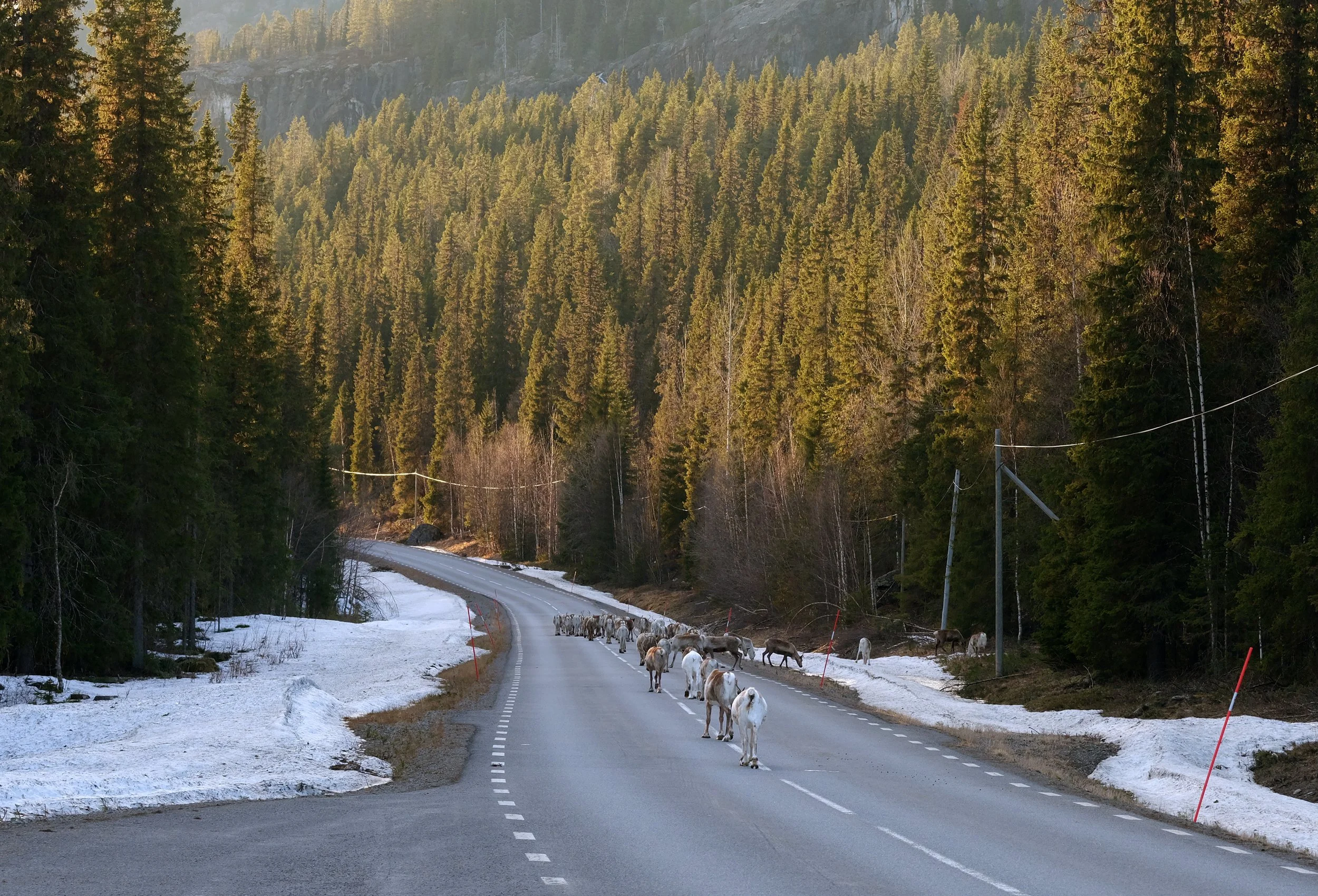
Deer on the road in Sápmi (image: Petter Schölander).
To counter this narrative, Schölander partnered with Rebecka Ekberg, a Sámi lawyer specialising in indigenous rights, and set about gathering data on forestry, logging, mining and quarrying, infrastructure and other forms of pressure being applied to Sápmi, as well as conducting fieldwork in Sápmi’s Sorsele municipality alongside reindeer herders from Sámi reindeer herding communities. While the country’s Sametinget Sámi parliament acknowledge that reindeer grazing rights currently apply across roughly 50 per cent of Sweden’s land area, the map aims to visualise data that highlights the extent to which this number may offer an inflated impression of the land actually available to the Sámi, and reveals the extent to which external pressures have circumscribed the Sámi’s rights. “The north of Sweden is often seen as empty wilderness that we should make use of,” Schölander says. "So I thought, ‘OK, what if I make a map that just has layer after layer after layer showcasing what it actually looks like today.’”
Onne was developed with a particular focus on providing a communication tool surrounding the issues facing Sweden’s Sámi population in the run up to the country’s recent general election – a vote that saw Prime Minister Ulf Kristersson’s right-wing bloc, which had made clear it would invite the far-right Sweden Democrats to form part of any future government, narrowly defeated by a more progressive bloc led by Magdalena Andersson, leader of the Social Democratic party. While Schölander welcomes this result, he notes that further development and usage of the map is planned, particularly in relation to meeting the ongoing needs of Sámi communities. “I feel that a lot of Sámi people have been contacting me and have been appreciative of having this,” he notes. “Because the issues are not new, and there is only so much that this community can say without just repeating the same thing over and over again. There has been hundreds of years, and generations of Sámi people doing this work, that it has been really nice to see people actually sharing this to help tell the story of what is happening to their land.”
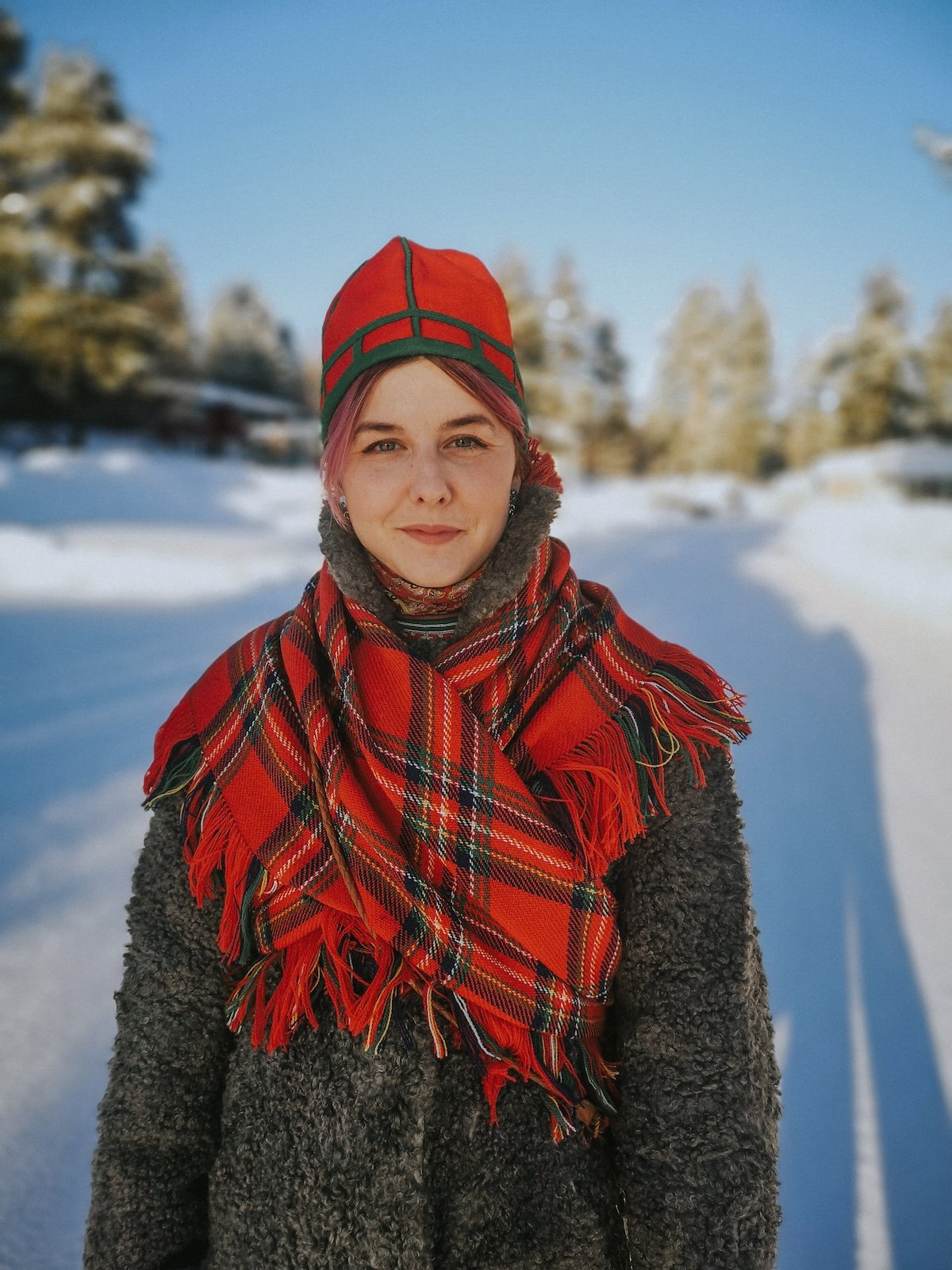
Schölander partnered with Rebecka Ekberg, Sámi lawyer specialising in indigenous rights, for the project (image: Petter Schölander).
It is a story whose results make for disturbing viewing. Although the map only explicitly includes certain forms of threats to the Sámi (the cultural threat posed by discrimination, for instance, is more challenging to represent in hard data), the pressures that have been brought to bear upon Sápmi are stark and clear when allowed to wash crimson over the territory. Although the date that Schölander has employed is granular and also allows for time-lapse comparisons with the same territory over preceding decades (“Even though this started from an artistic project, it needs to be 100 per cent accurate,” he explains), the map’s force derives from what Schölander terms its element of “shock value” – the full extent of Sweden’s interventions into Sápmi made clear in its bold graphic treatment. There is an additional irony, Schölander observes, in using a map to make this point: cartography is a form of charting that has often been linked to colonial projects and is a process that was not, traditionally, used by the Sámi people in their own navigation of Sápmi. “So this is something that the Sámi communities can use to show the colonisers, so to speak, or the Swedes, what has happened,” Schölander notes. “The map is not for the Sámi themselves, in the sense of showing them what’s happening to the land. After all, they already know what’s happening.”
Words Oli Stratford