
Future of Health
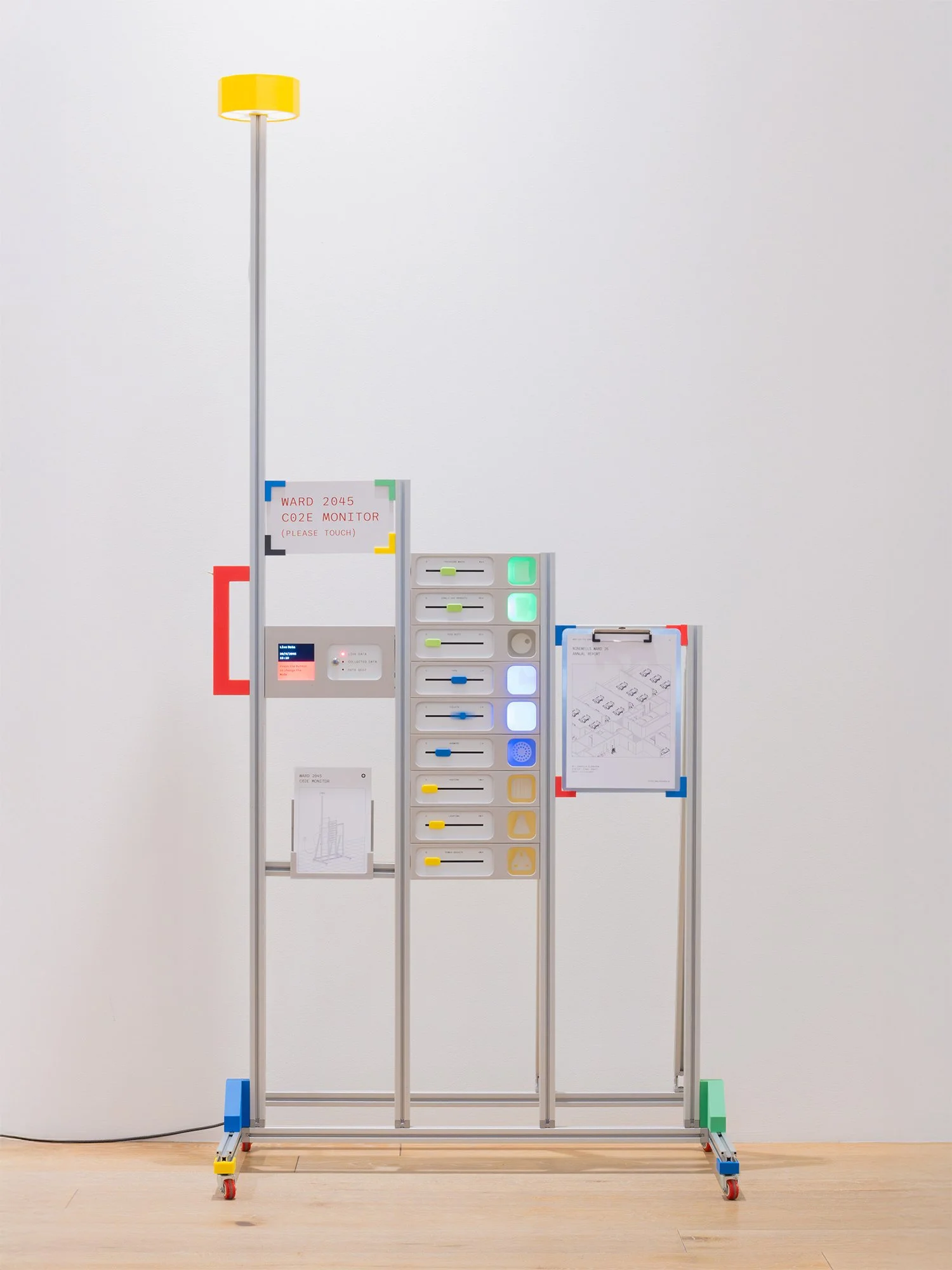
Brown Office’s Ward 2045 CO2e Monitor is a speculative device designed to visualise energy consumption data for NHS staff and patients (image: Brown Office and VAST).
It’s 2045. At the end of a dark hospital corridor stands a metal structure, its silver aluminium punctured with glowing lights. Coloured sliders move steadily left and right along metal tracks, continuously collecting, measuring and processing data. Its mission is simple, if ambitious: to reduce the environmental impact of hospitals.
Ward 2045 CO2e Monitor is a speculative device designed to visualise energy consumption data for NHS staff and patients, helping hospitals to understand – and potentially reduce – their carbon footprint. The project marks the second commission that Dean Brown, founder of London-based studio Brown Office, has received from Design HOPES, an initiative that pairs designers with researchers to help meet net-zero targets in healthcare settings in support of the NHS’s target of achieving net zero carbon emissions by 2045 for all indirect emissions. Design HOPES is a collaborative design-led research initiative, including five Scottish Universities and NHS Scotland, which is funded by the Arts and Humanities Research Council (AHRC) as part of the Future Observatory Green Transitions Ecosystem Hub Programme at the Design Museum. The monitor is currently on display as part of Design HOPES: From hope to health, an exhibition hosted at V&A Dundee until 8 February.
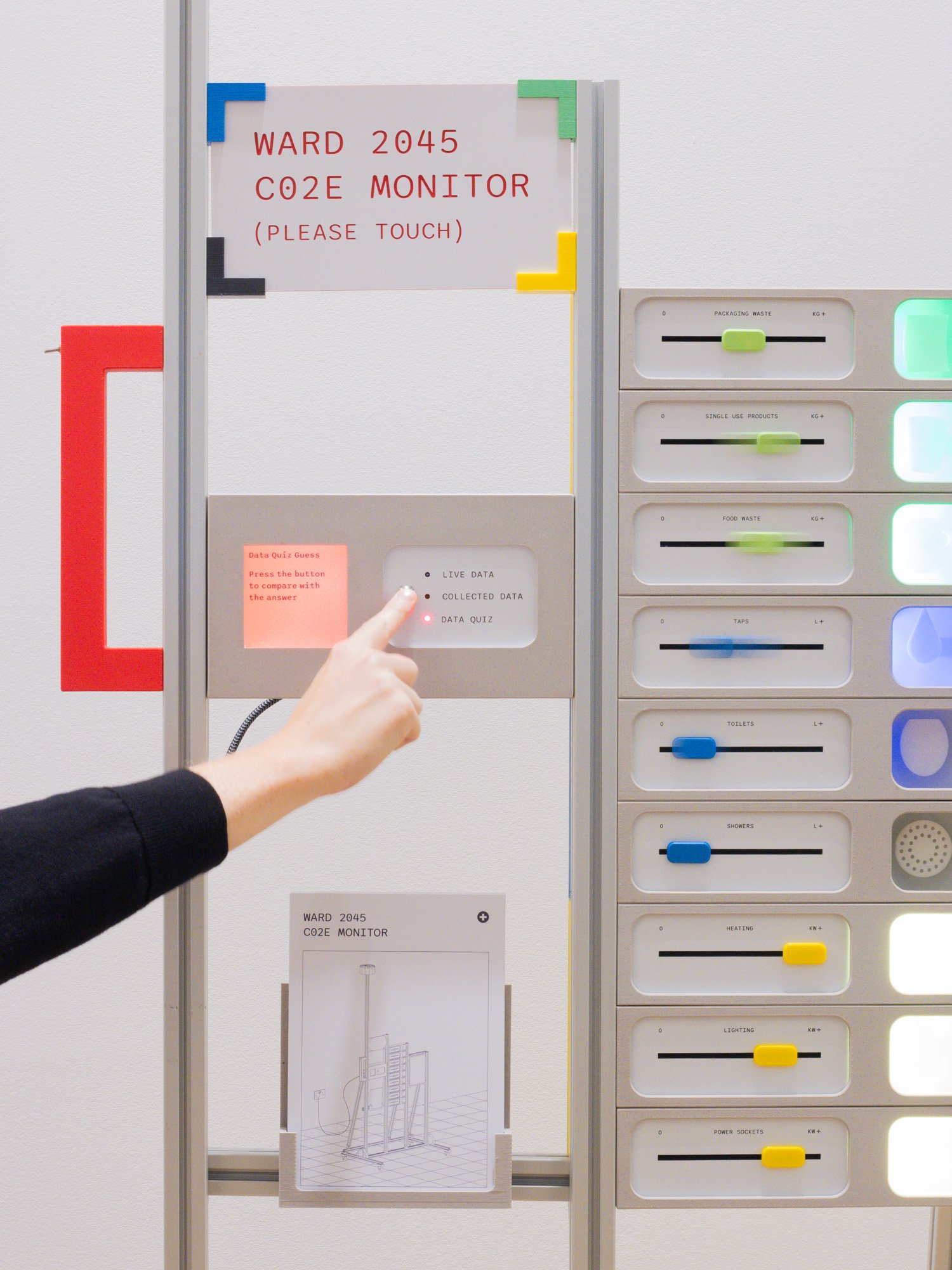
The speculative device has movable sliders that correspond to energy, water, and waste (image: Brown Office and VAST).
“I don't think I've ever designed something that's so niche and specific,” says Brown, who worked with creative technologists VAST to create the monitor, which was developed in concert with the Green Ward Tool kit team at the University of Dundee (Fraser Bruce, Chris Lim and Jack Fletcher), who work with NHS Tayside to co-design tools and resources that can support hospital staff to implement sustainable practices. Brown’s speculative installation features flashing colour-coded lights and icons embedded within an aluminium-frame, with movable sliders that correspond to energy (yellow), water (blue) and waste (green). Its shape and material feel utilitarian and akin to the visual language of hospital equipment, yet the addition of a bright colour palette and icons displaying different energy sources, along with a canary yellow lamp that sits atop it like a beacon, prompt interaction. The inclusion of this lamp, Brown says, came from thinking about its proposed hospital setting. “It's to do with the idea that wards are 24-hour places,” he says. “People work through the night, patients get up and go to the toilet, so it felt appropriate that it was able to be self-lit at nighttime.”
The impetus for the design emerged out of a study of the sustainability data included in annual hospital reports in Scotland. “The interesting thing is that, right now, it's calculated at a big picture level that represents the whole building,” Brown explains. “But in the future, you could be much more granular with those reports. You could report on a specific ward’s behaviour rather than the behaviour of the whole building.” At this scale, environmental data could be made personal, with Brown’s design examining how, as a patient or as a staff member, you might be encouraged to feel like you have agency over how your contribution is affecting the environmental impact of the hospital as a whole.
This attitude of accessibility pervades the physical design of the monitor. At the top of the aluminium frame is a panel printed with red letters spelling out the instruction “Please touch” – a warm rejoinder to the convention for medical equipment to be labelled with “Do not touch”, and an invitation for self-reflection and engagement. “For the most part, it's a necessary part of the job for hospitals to use resources when delivering care,” Brown says. “But you could still deliver really fantastic healthcare and save waste in certain areas.” In this sense, Ward 2045 CO2e Monitor operates as a catalyst to medical professionals to reflect on waste, energy, and water usage, and how these could be reformed.
This provocation becomes even more pertinent given the way that Brown has interpreted the speculative element of the Ward 2045 CO2e Monitor’s design. Whilst the device is not currently installed in hospitals, “it's designed to be quite real,” Brown explains. “It's aspiring to be a real thing. We could move this into a ward tomorrow and it would do its thing as described.” The device is mounted on wheels so it can easily move through a hospital, and its use of aluminium extrusions to form the body of the structure allows for easy reconfiguration or adaptation if needed. “It is a really great material because it has an inherent adaptability,” Brown says. “You can slide things up and down, and you can order slightly different lengths of it. So we might realise that the device needs to change if we start deploying it more thoroughly. The aluminium builds flexibility into the design.”
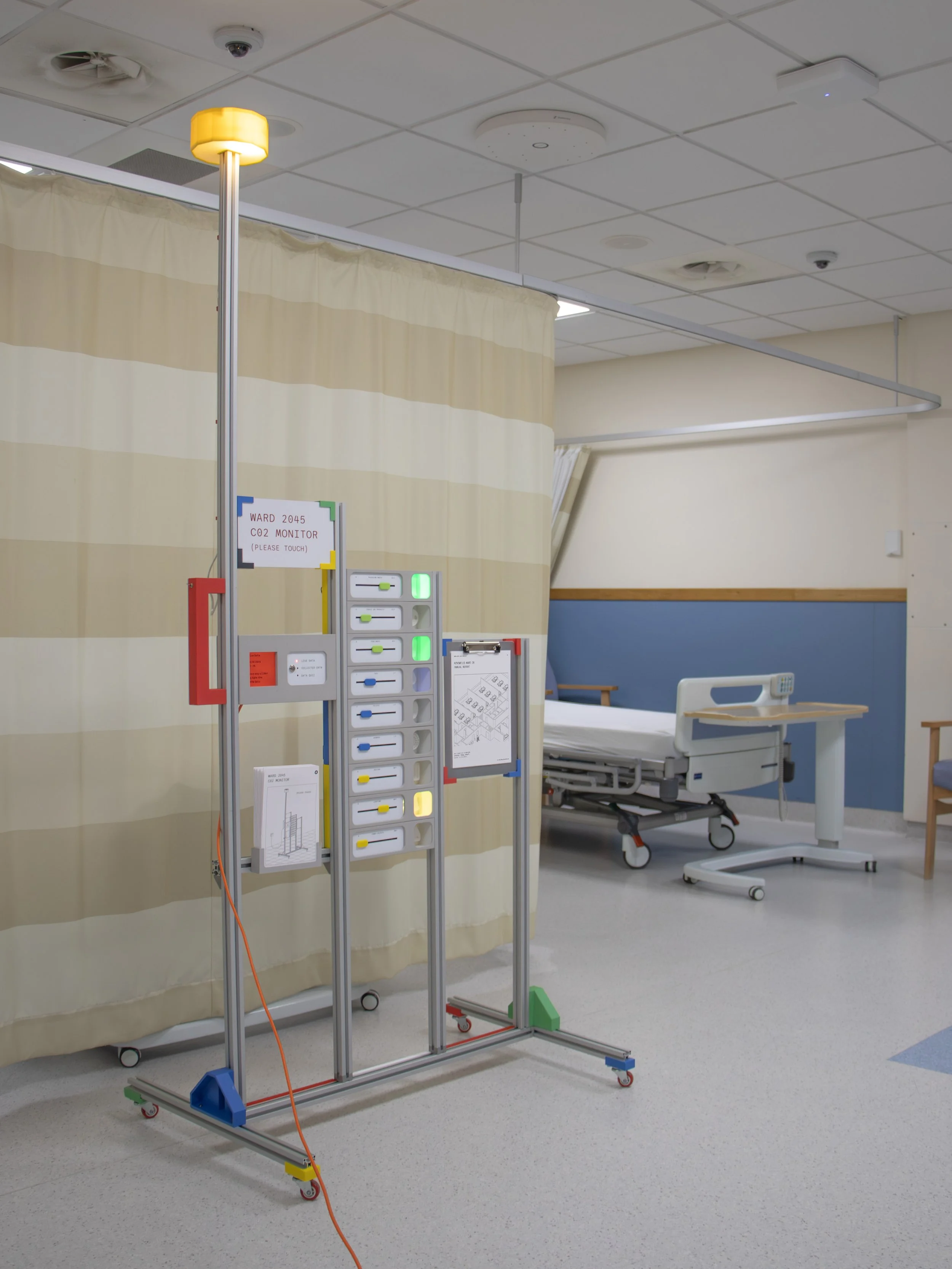
Image: Lauren Bloor.
There are pragmatic reasons as to why the design is, as it stands, only speculative. “To sense water, energy and waste streams correctly within the hospital is possible, but you'd need to embed all these sensors within the architecture of the building,” Brown explains. “It's speculative, because there's other aspects of the scenario that don't exist yet.” After appearing at the V&A exhibition, however, the installation is set to be displayed in several Scottish hospitals to encourage further debate. “This is something that can drift in and out of different scenarios within a hospital,” he explains.
Although speculative in its nature, the conversations that the Ward 2045 CO2e Monitor seeks to create are very real. Finding solutions to the climate crisis is not a simple task and, after the installation is exhibited in hospital wards, Brown hopes that future research may continue the project’s goal of sparking conversations about sustainable practices in healthcare. “The whole point of this thing is to get people thinking more about waste and energy usage and water usage,” Brown explains, “and whether it is efficient and effective, or whether some of it needs reform.”
Words Heather Frances Gosling