
Heirloom Comics
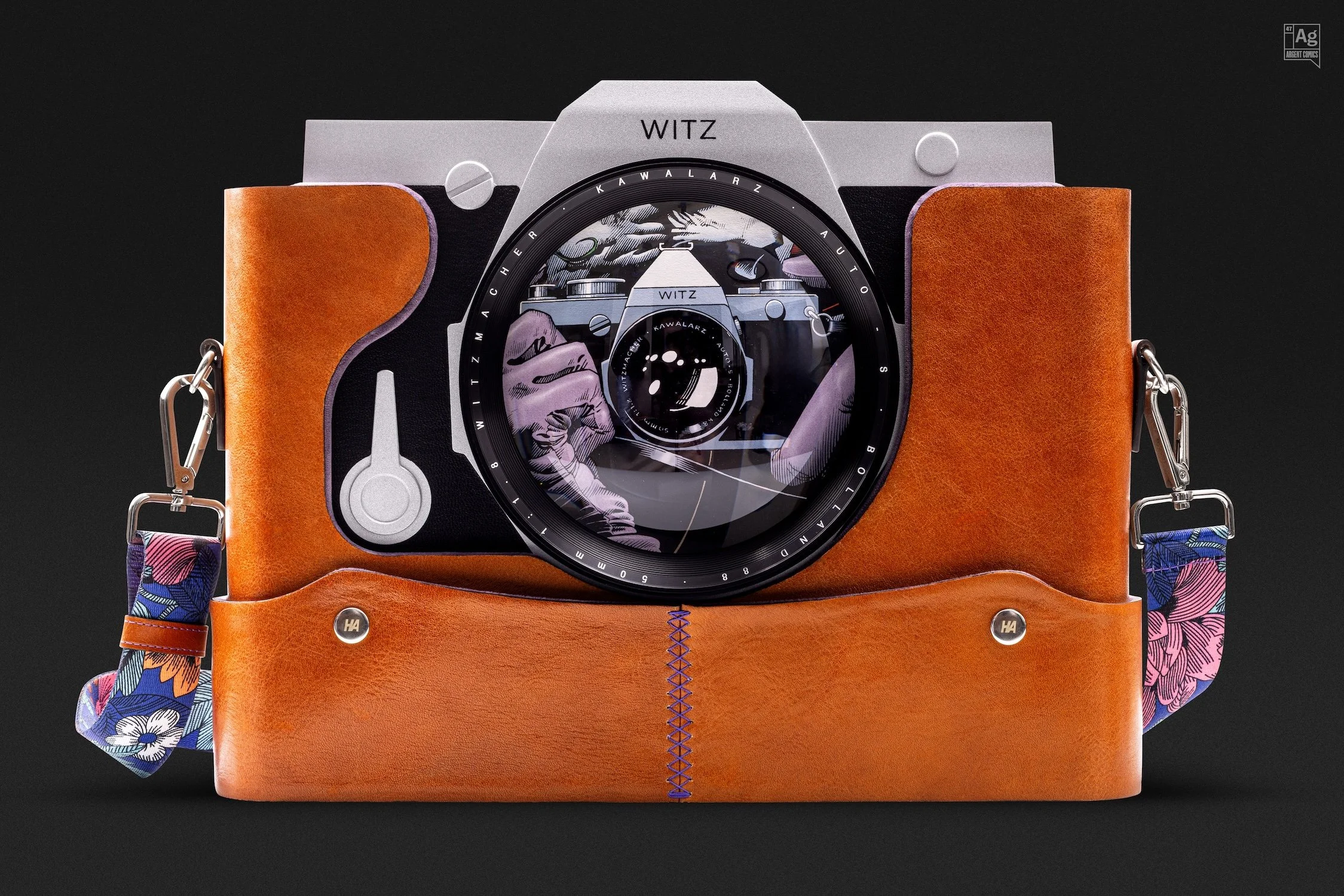
Pigment Collective’s new imprint, Argent Comics, is bringing luxury bookmaking techniques to the world of comics, starting with a fine art edition of Batman: The Killing Joke (image: Argent Comics).
In Pigment Collective’s video revealing its new Avant-Garde Edition of Batman: The Killing Joke, an oversized vintage camera case thwacks onto the table. Its poppers unclasp with a satisfying click, and the comic book glides out with a leathery whoosh. After popping the detachable camera lens off the front cover with a soft clack, a hand flicks through the thick pages, which pop and swoosh before closing with a decisive thud. “It’s a heavy, heavy thing,” says Marko Matijašević, the Zagreb-based company’s founder. “Once you put everything together, it has this whole picture of a luxury item.”
Matijašević founded Amaranthine Books in 2015, which creates limited-edition designs of popular novels such as Catch-22 and 2001: A Space Odyssey, taking inspiration from the themes of each book to create fine art objects that range from around £200 to £2,000. The publications are intricate pop culture Easter eggs, filled with hidden references designed to be discovered by attentive fans. One edition that combined the first two books of the Alice in Wonderland series, for instance, included two chess boards, oversized playing cards that give the player the impression of being tiny, and Jacquard-woven optical illusion illustrations on its book covers. Last year, the company added two new brands – Aurelian Hands, its in-house production wing, and Argent Comics, an imprint set up to create fine art editions of DC Comics’ archives – and renamed itself to Pigment Collective. “The negotiations took a long time, because DC Comics doesn’t usually do this kind of contract,” Matijašević explains, “and now we’re just trying to prove our worth.”
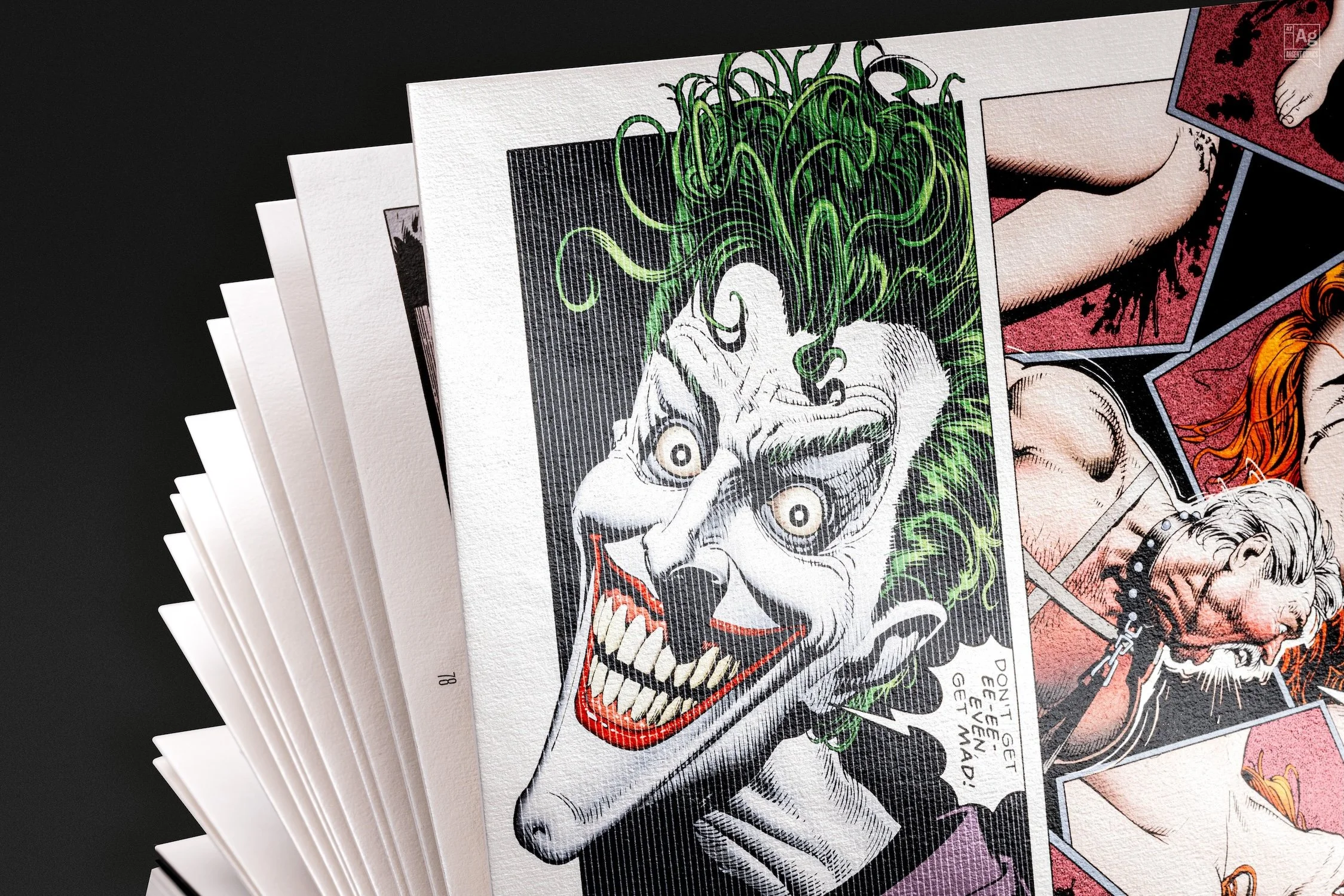
Image: Argent Comics.
While comic books are typically mass-produced products rather than luxury goods, Argent Comics speaks to fans’ love of collecting and memorabilia – as Matijašević points out, Action Comics #1, which is widely regarded as the beginning of the superhero genre, became the most expensive comic ever sold earlier this year when a copy was auctioned for $15m. “I think nowadays comic books are really taken a lot more seriously than they were before,” he says. “I’m just trying to give the story the form I think it deserves.” Given the company’s quest to bring the fine printing and craftsmanship typically reserved for luxury bookmaking into the world of comics, The Killing Joke is a fitting choice for its inaugural edition. “The Killing Joke was part of a 1980s movement that changed the attitude of comics being something just for kids,” David Barnett writes in The Guardian, describing the book’s reception as enabling a more literary assessment of the form. “They became darker, richer, more sophisticated.”
Written as a self-contained narrative that sits outside of Batman’s main storylines, The Killing Joke tells the origin story of the Joker, Batman’s nemesis. While it has been criticised for the gratuitous sexual violence perpetrated on character Barbara Gordon – which has since led author Alan Moore to distance himself from the piece – the comic has been celebrated for its psychological complexity, including its portrayal of the Joker as an unreliable narrator, and its ambiguous ending. “When I was reading it for the first time, I expected the classic, you know, Batman beats the Joker up, and sends him to Arkham Asylum,” Matijašević says. “But them basically being in an embrace at the end and laughing together is a point where this comic really takes a different path from others in that era.”
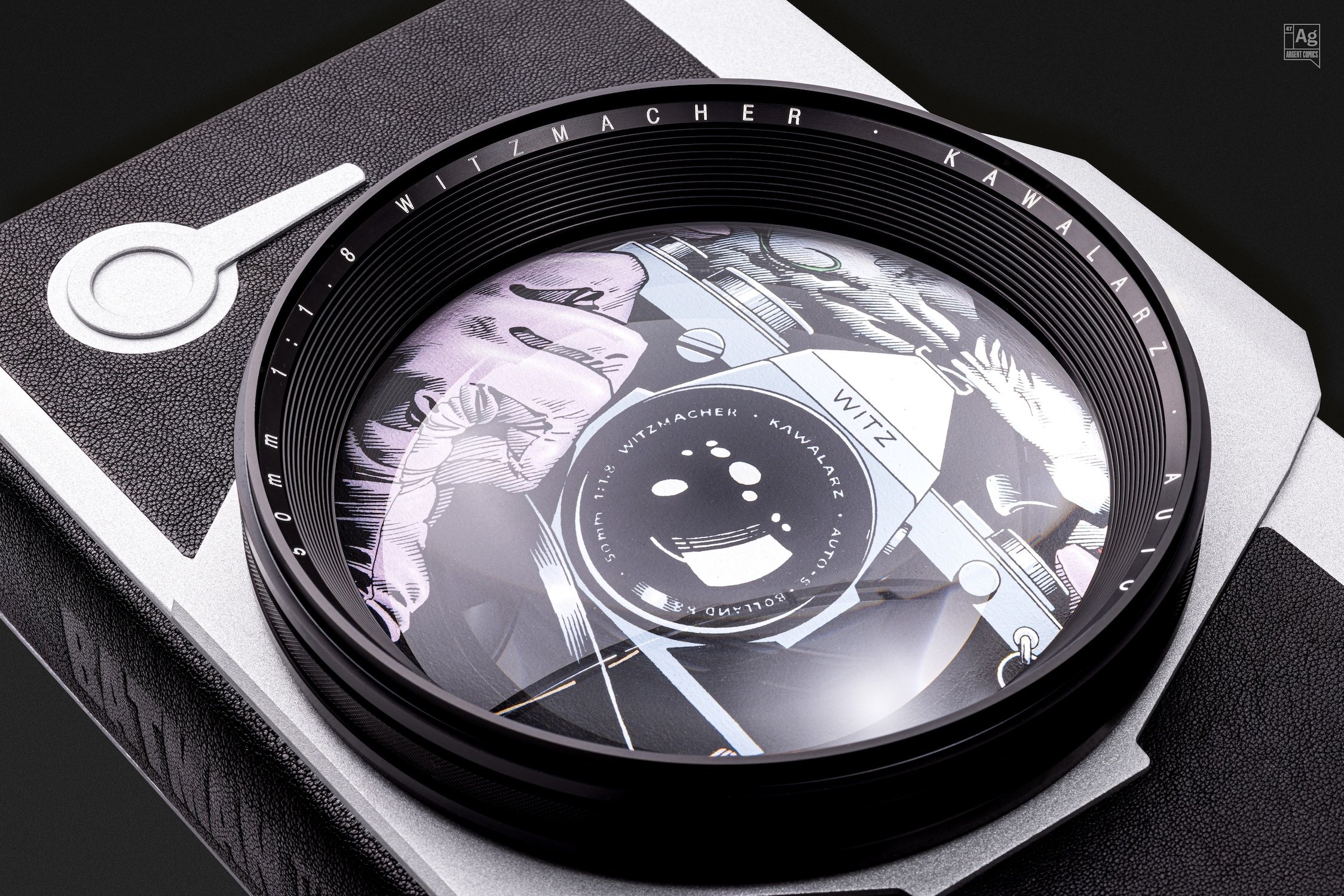
The Avant-Garde edition of The Killing Joke is housed inside a leather camera bag and features a real camera lens detail (image: Argent Comics).
While posters drawn from comic books are often created using giclée printing – a high quality inkjet printing process that provides greater longevity and colour accuracy – Matijašević couldn’t find any examples of giclée-printed comic books. “We noticed that nobody had ever attempted it, and I now know why,” Matijašević says, laughing. “It’s extremely difficult.” Giclée-printed paper is typically one-sided, and the high-quality cotton paper the team wanted to use from manufacturer Hahnemühle could not be folded and sewn. “If you fold it in any place, it's scarred forever,” he explains. “We had to develop our special method where you fuse two sheets together to create one page, with a medium in between that creates the book’s binding. So you can open the comic book anywhere, and it opens up perfectly without [the reader] ever holding the page.” In order to create each edition, one person had to glue the pages together 112 times without making a single mistake, with this part of the process alone taking over two days per book. “The end result is absolutely amazing, but it's extremely slow and painful to do,” Matijašević says.
The paper choice for the Avant-Garde Edition also had a lasting impact on the identity of the entire imprint. “The metallic silver paper looked almost like those holographic Pokemon cards, everything was flashing from the page,” Matijašević says, explaining how he was inspired to choose the name Argent Comics as a reference to Argentium, a type of silver alloy. “We knew there was no way we could make more than 50 copies of this comic per year,” he says, due to the complexity of the production process. “So we used the atomic number of silver, 47, as our limitation for this run.” The case of the book, meanwhile, references the original cover of The Killing Joke, which features an image of the Joker taking a photo. “We wanted to take that camera and bring it to life,” he says. “The cover has an actual lens, which weighs around two kilos.” The rest of the case is made from tawny leather, and has a strap so that it can be carried like a satchel. “The Joker wears this Hawaiian shirt in the most morbid scene [of the comic],” Matijašević recalls. “We imagined this to be the Joker’s camera case, so when we found this tropical print strap, we thought he would probably like that.”
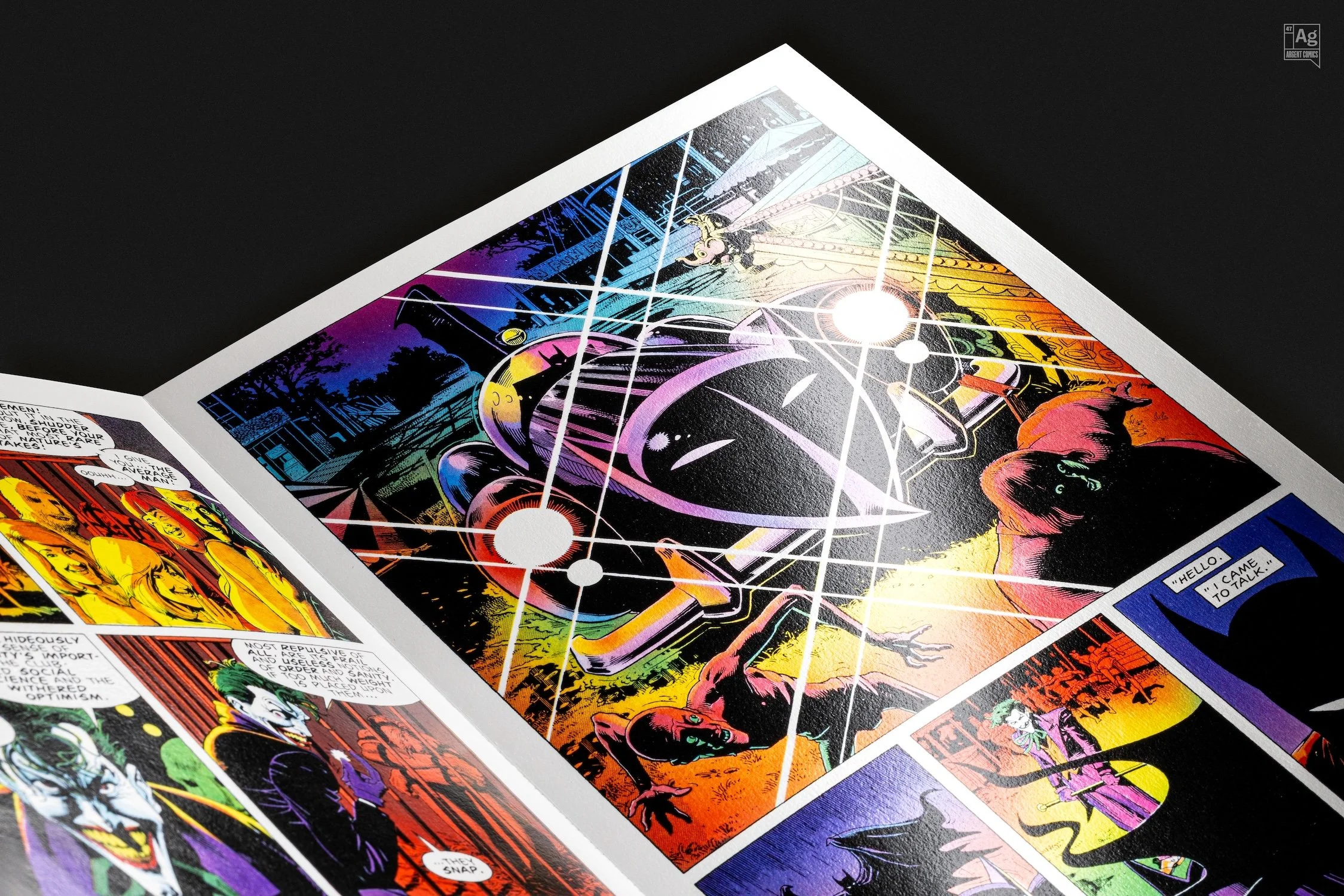
The comic was giclée-printed onto shiny silver paper (image: Argent Comics).
Amaranthine Books produces at least two versions of each book it publishes, with each design focusing on different details from the narrative, and Argent Comics has followed in its footsteps. The upcoming Noir Edition of The Killing Joke draws from illustrator Brian Bolland’s 2016 black-and-white version of the comic, and will be printed onto thick cotton paper using a vintage Heidelberg Cylinder SBG letterpress. “It’s a completely different experience to the Avant-Garde version, which is just colours galore. This one is just black and white and sensation,” he says, explaining how readers will be able to feel the pillowy indentations the letterpress creates on every word and illustration. In order to create this effect, the ink had to dry on each page before it was printed on the other side, with the process taking over three months to create the comic’s 50 pages. The Noir Edition will feature a goatskin cover with letterpress details, and will be housed inside a case that is even heavier than the Avant-Garde Edition’s camera bag. “I haven’t said this to anyone yet,” Matijašević says mysteriously, “but it will involve a lot of concrete.”
Each edition of The Killing Joke represents hundreds of hours of craftsmanship, with countless more dedicated to the research and development required to use giclée and letterpress printing on the comic form. “As we like to say, we loved every miserable minute of it,” Matijašević says. One of Amaranthine Books’ editions of Dracula makes the amount of effort the team puts into every publication eerily visible, with a title written in real blood extracted from the creatives that worked on the book. Pigment Collective’s publications not only aim to pay homage to influential works of art, but to reflect the identities of their makers and their buyers, allowing both objects and people to endure the test of time. “I’ve always believed that your library is like a mental fingerprint. If my grandkids find my library one day, they’ll be able to see the sense what kind of person I was,” Matijašević says. “It’s kind of like a hopeless chase of immortality.”