
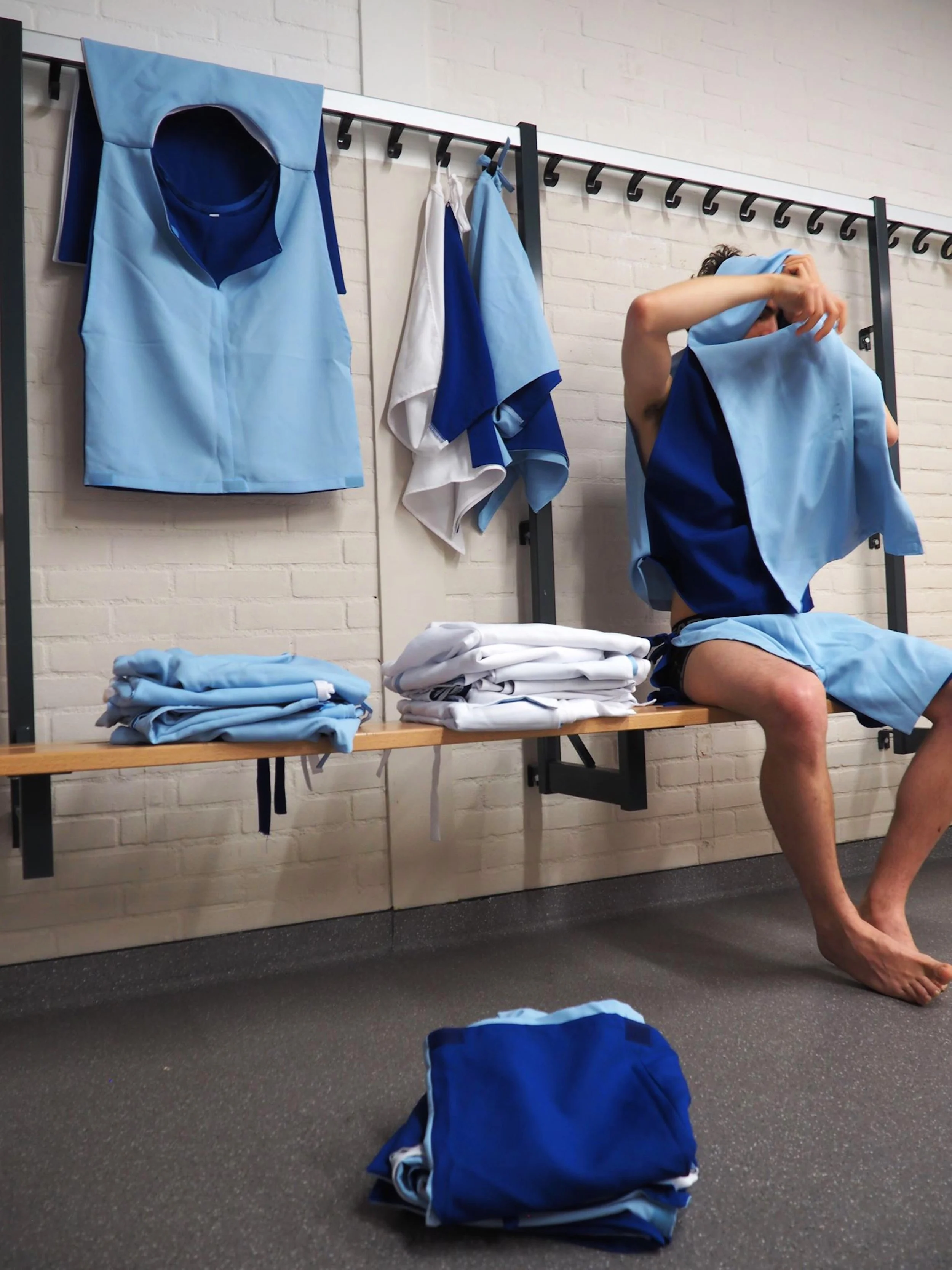
Changing into uniforms for Multiform, a sport designed by Gabriel Fontana (image: Iris Rijskamp).
Twenty-four players stand at the edges of a large hexagon taped onto the floor, divided into three teams of eight. In the centre of the court, a yellow sponge ball rests on the floor. We are waiting for the referee’s whistle.
I scan the other teams. To my left, the light blue team has a few tall, strong players. To my right, the dark blue team looks quicker, more agile. My own team – the white team – seemed well-balanced, a mix of size and speed.
The game is a kind of variation of handball and basketball, but with three goals instead of two. The rules are simple: score in the opposing goals while protecting your own. No running with the ball – only passing.
The whistle blows. Gabriel Fontana, the designer of the game and the referee, signified by his striped uniform, signals the start from the sidelines.
We launch into action. Quick passes, sharp plays, and before long, my team scores the first goal. We exchange high-fives, celebrating the early lead. But then, Fontana’s whistle and voice cut through the game. “Open your shirts over your head,” he commands.
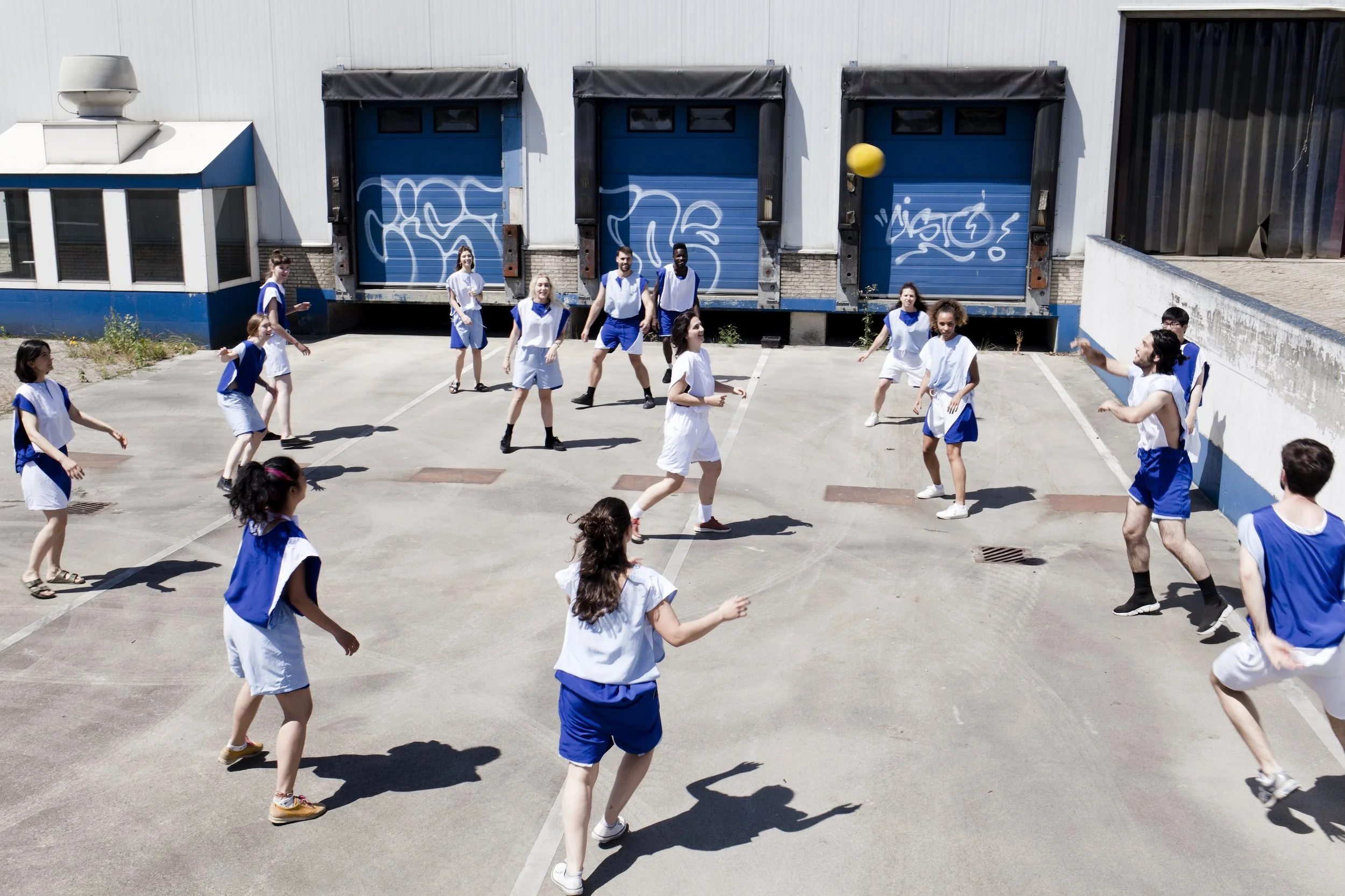
Multiform in action (image: Iris Rijskamp).
Obediently, I reach for the flap of fabric on my back, peeling it forward. My white shirt has transformed – it is now light blue. “Now go to the goal that matches your new shirt colour,” he says.
In an instant, the teams have shifted. The game we thought we were playing has changed entirely.
Confusion ripples across the field. I am no longer part of the winning white team and what’s more, my new light-blue squad has shrunk to just five players, while the dark-blue team now has ten and the white team seven.
The sudden reshuffling disrupts everything – team sizes are suddenly unbalanced, new alliances are formed, and the familiar sense of teamwork is upended.
But the real shift isn’t just physical – it is psychological. We are forced to adapt, to rethink our strategies, and to navigate the unsettling experience of being both in the majority and the minority.
Winning no longer seems like the goal. Instead, the game has transformed into something else entirely: a test of adaptation, collaboration, and the ability to understand shifting social dynamics in real time.
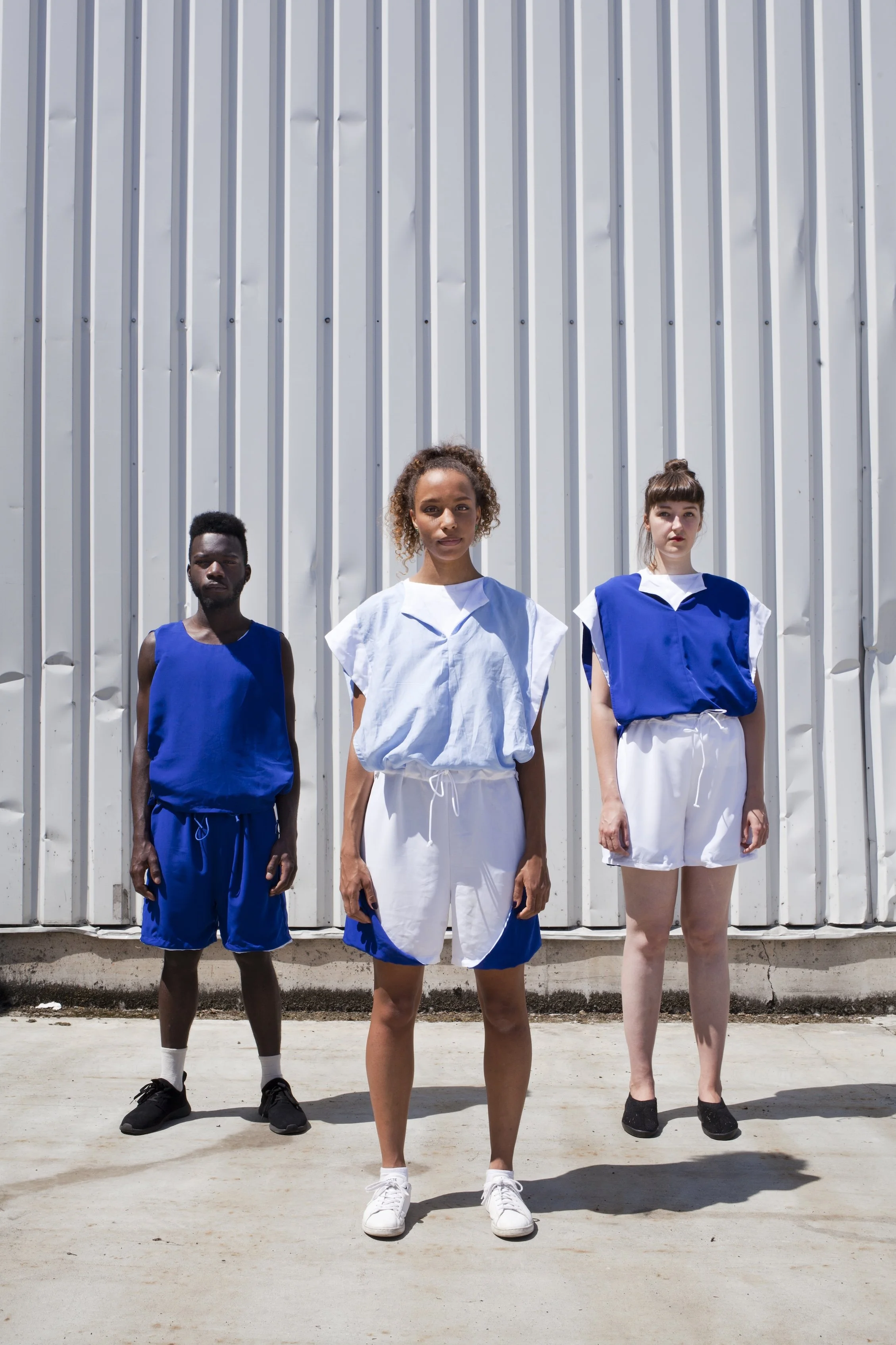
Image: Iris Rijskamp.
That was the first time I played Multiform. It wasn’t just a game; it was a kind of undoing. Fontana had invited me to experience it for myself while he was still developing it back in 2018 for his graduation project at Design Academy Eindhoven. The rules weren’t like anything I had encountered before – fluid, shifting, designed to dismantle the very idea of fixed teams and clear winners. The game went on for four rounds, and with each round, flaps unfolded, team sizes changed and player roles reshuffled. By the final round, the scores didn’t belong to any one team, but to all of us. Winning wasn’t about dominance – it was about what we had built together.
I remember feeling a strange unease at first. I had spent years internalising the rules of traditional sports: pick a side, fight for it, win or lose. But here, everything kept changing. I found myself on a team with people I had just been playing against minutes earlier. The shifting alliances meant that no one could cling to a singular identity as “opponent” or “ally”. It forced a kind of radical openness – a trust in the process.
Since then, Fontana has refined Multiform into something even more expansive, establishing himself as a designer at the intersection of sport, design, and social intervention. When he talks about it, it’s clear that this game isn’t just about movement – it’s about the systems that shape us.

Image: Iris Rijskamp.
“For many of us, PE class was a hostile and unsafe environment,” he tells me. “Dominant ideas about gender, ethnicity, physical ability, and sexuality are reproduced in sports and physical education. Research shows that marginalised groups are often excluded. These moments of exclusion don’t just stay in the sports hall; they shape a child’s well-being and social development far beyond the game.”
His words make me think of my own fraught relationship with sports. I always loved movement, but for years, I approached it in a way that drained me – physically and mentally. Gym class never felt like a place of joy; it was a series of measurements against others. I wasn’t the fastest, wasn’t the strongest, and so I learned to see sports as something that defined my shortcomings rather than my strengths.
Years later, at the gym, I would push myself to the brink, always measuring my worth against those who lifted heavier, ran faster. It took me years to unlearn that mindset, to realise that progress isn’t about punishment but about care, patience, and steady growth.
But where do these ideas about competition and winning come from? Are they as natural as we assume?
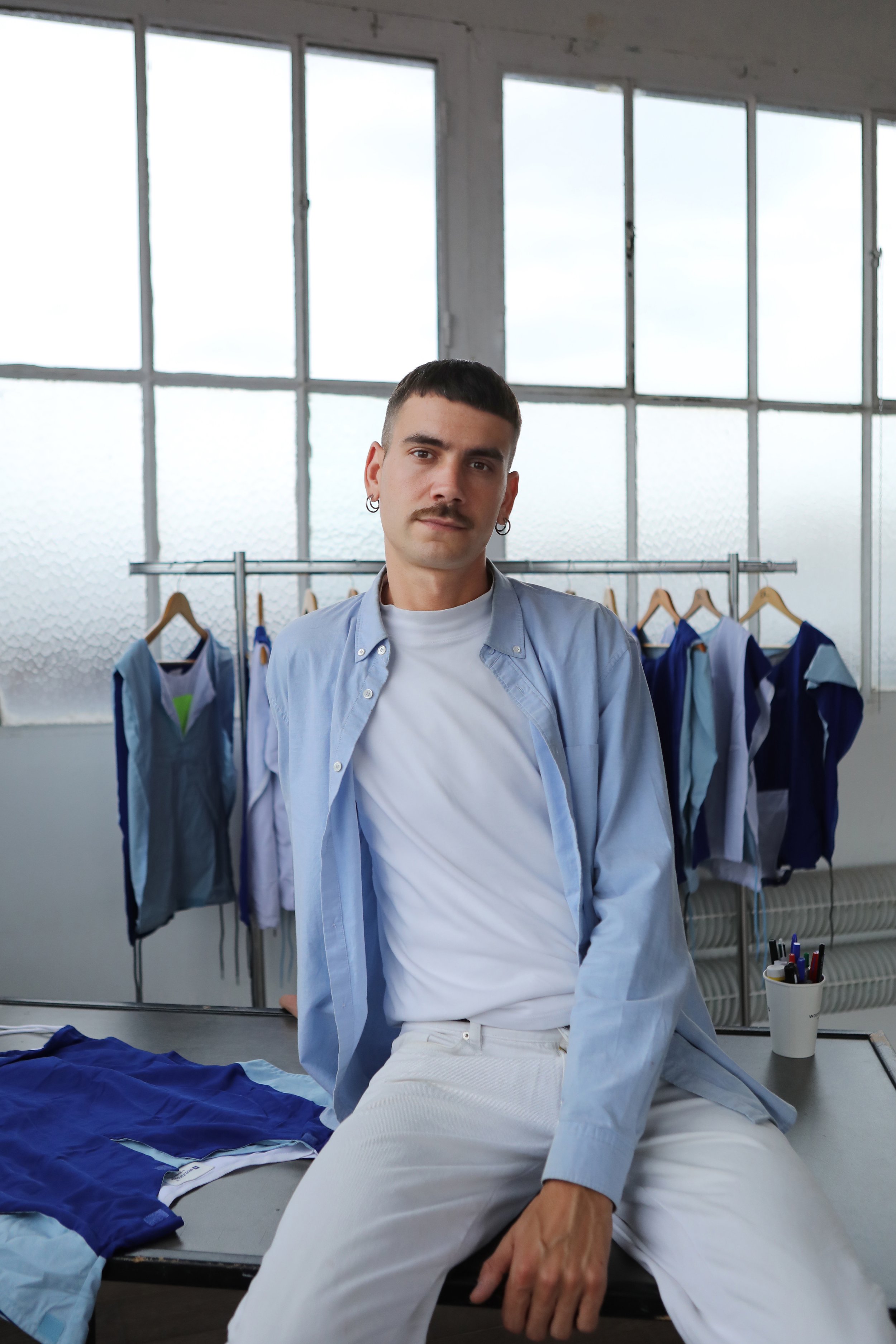
Gabriel Fontana, the designer of Multiform (image: Laurine Gentilhomme).
I’ll tell you a little story. One day, after a workout, I sat in a sauna with two men I didn’t know. The conversation turned to a hypothetical question: If you had only five hours left to live, who would you want to have dinner with? One by one, they listed their choices. Both of them landed on Joe Rogan. They admired his mixed martial arts (MMA) commentary, his worldview, and his hyper-masculine approach to life. They spoke about him with reverence, as if his values – dominance, control, self-reliance – were the pinnacle of strength. When my turn came, I said Tilda Swinton.
Silence.
One of them snorted and dismissed her as “weird”, then quickly pivoted to Wes Anderson – still within his comfort zone.
I realised then that this wasn’t just about celebrity dinner choices. It was about the worldview they had absorbed – through sports, through culture, through everything around them. MMA had shaped how they saw strength and success. Anything that deviated in any way from their rigid definition of masculinity was dismissed outright. A casual conversation in a sauna, yet it reflected something much larger: the way sports culture reinforces narrow ideas of power, leaving little room for anything outside those norms. I couldn’t help but be disappointed by their short sightedness.

Turnbuckle, an installation by Julius Thissen at the Tournament of the Unknown (image: Zazia Stevens).
How did we end up this way? I know what Joe Rogan would say – “survival of the fittest”. But this concept has long been disputed by thinkers and studies that highlight how collaboration, not competition, has often been key to human survival and flourishing. In fact, research in fields ranging from sociology to evolutionary biology has demonstrated how cooperative behaviours, such as mutual aid and collective action, are often more essential for survival than individual dominance.
It’s social conditioning. Take, for example, the Olympics – one of our main references for what sports should be. What kind of social values can we derive from these games? “If we look at history, we can see that sports have not really moved on since the first modern Olympic Games, in 1896,” notes Fontana, “and therefore, team sport games are still reproducing conservative values of an age gone by.” While society has evolved, the Games have remained largely unchanged – raising the question of whether it’s time for them to finally catch up. That said, there are signs of change: as part of a special invitation from Pride House, an initiative advocating for more inclusive sports, Multiform was facilitated every day in front of Paris City Hall during the 2024 Olympic Games, suggesting that new approaches to sport are beginning to find space within this rigid framework.
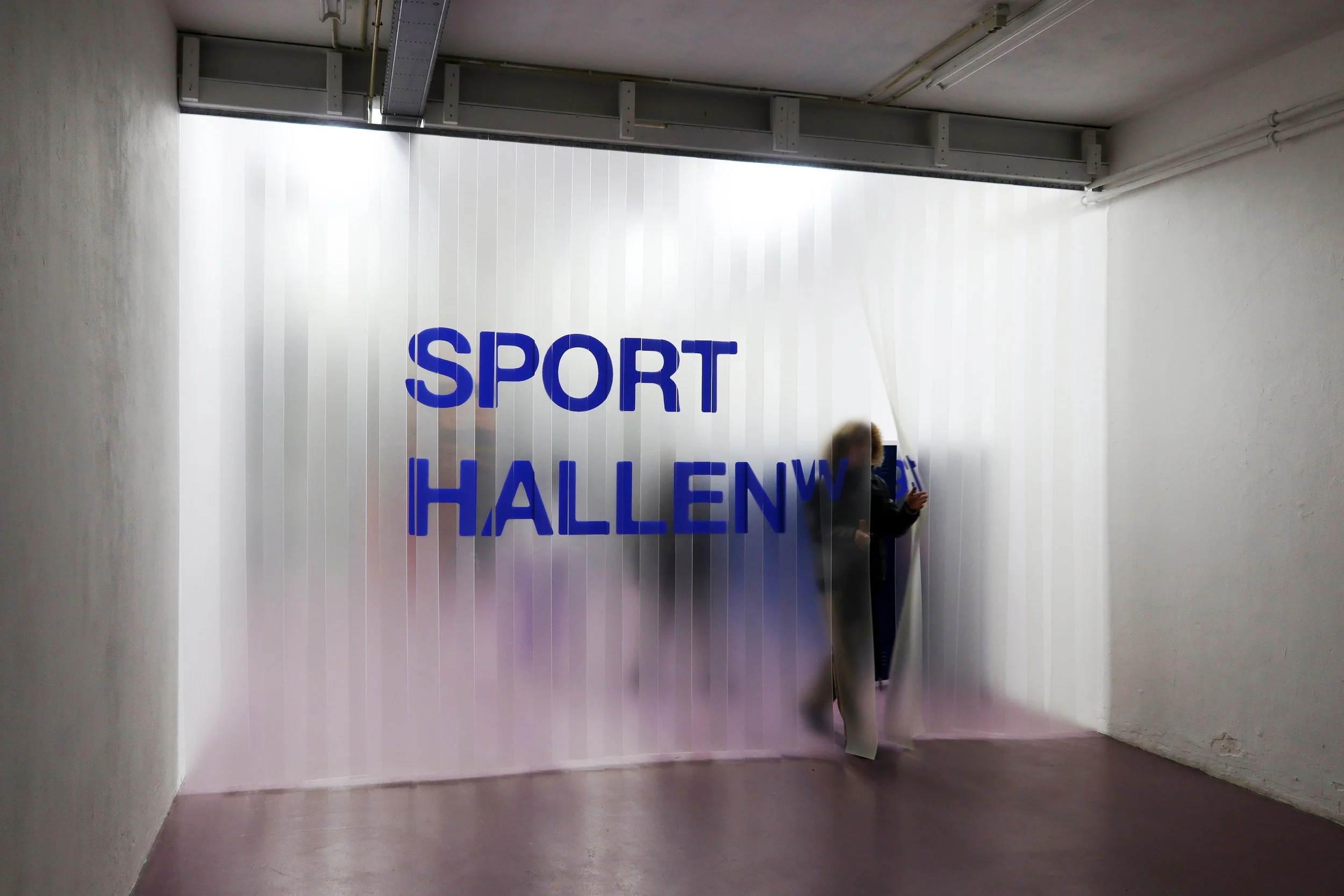
The entrance to Fontana’s Tournament of the Unknown, which ran in Amsterdam parallel to the 2022 Qatar FIFA World Cup (image: Zazie Stevens).
While the Olympics are celebrated for showcasing incredible sportsmanship and were originally conceived to promote world peace and unity, they have also been leveraged as tools for shaping national identities. Over time, this has led to the promotion of values that, at times, distance the competition from its original intent. The Games became a platform for countries to distort competition in ways that would promote strength and dominance as ideals, often aligning these qualities with national pride and political power. During the Second World War and the Cold War, nations such as the United States and the Soviet Union used Olympic victories to reinforce political ideologies – presenting their athletic dominance as proof of moral and physical superiority. Yet these values, shaped by the political agendas of the early-to-mid 20th century, have distorted the essence of competition, turning it into a means of reinforcing hierarchies rather than genuine human connection. In today’s interconnected world, these ideals are increasingly irrelevant to how we understand collaboration, shared growth, and collective well-being.

The finissage of the Tournament of the Unknown (image: Elodie Vreeberg).
This disconnect extends to sports psychology too, which, like the Games, is rooted in outdated military values: discipline, hierarchy, and mental toughness. Athletes have been trained to endure, follow orders, and fight. Even today, we still “defend”, “attack”, and “conquer”. In this system, victory becomes an obsession, teamwork is about sacrifice, and losing is failure, not a chance to learn.
But I get it – the rush of winning feels incredible. So, how did this drive become so distorted? Fontana offers a more balanced perspective. “It’s not that competition is inherently bad,” he tells me. “It can be a great source of motivation. But when it becomes the only focus, it is a destructive force.”
That’s exactly why games such as Multiform feel so urgent: they help to disrupt the imbalanced focus on competition. Multiform’s structure forces players to move through multiple vantage points, constantly reassessing their position within the group. Power isn’t static – it’s fluid, collaborative, and shifting. Imagine if society were structured this way: not as a hierarchy, but as an ecosystem of shared adaptation. Wouldn’t we be more resilient? Happier?

The visual identity for Fontana’s 2024 En Jeu tournament (image: Tal and Sheona Turnbull).
This is a question that extends beyond Multiform. Romy Rockx, a trans man and founder of The Queer Gym, the first queer gym in the Netherlands, is asking the same thing. Rockx’s gym isn’t about domination, exhaustion, or pushing to the limit – instead it’s about sustainability and self-awareness. “Before my transition, I’d go to these gyms, and there would be a lot of men taking up space,” he told me. “Most classes were just about pushing yourself to the edge. But why? Life is hard enough. Why am I punishing myself just to get fit?”
That philosophy also resonates with Nike Running’s global head coach, Chris Bennett, whose audio-guided runs reshaped my approach to running. Using the Nike Run app, I listened to him coach me through various runs, with his pre-recorded guidance playing like a podcast while the app tracked my progress. He taught me to pace myself, accept that some runs are hard, and that the message is simple: be kind to yourself. Many runners see kindness as a weakness, but as Bennett insists, “kindness is hardcore”. To him, true strength doesn’t come from pushing through pain with harsh self-criticism. It comes from embracing vulnerability and showing yourself compassion. As he says, “My job as a coach is for you to leave me a little bit better.”

En Jeu (image: Émile Ouroumov).
This perspective helped me learn to give myself grace. Instead of feeling worse after a run, I started to feel better – and it made me want to run more. I began to realise that strength doesn’t lie in relentless competition, but in the ability to care for yourself through challenges. When I embraced that idea, everything shifted. Running stopped being about destroying myself to prove something – it became about working through something, towards something. And it paid off. I’ll never be a professional athlete (not that that was ever the goal), but my performance skyrocketed.
For so long, sports have been built around exclusion. According to a study by the Women’s Sports Foundation, by the age of 14, girls in the US drop out of sports at twice the rate of boys. For LGBTQIA+ youth, the situation is even more alarming: The Trevor Project, a non-profit that provides crisis counselling for LGBTQ+ young people, reports that 40 per cent feel unsafe in traditional sports environments. Additionally, the GLSEN Research Institute highlights how patriarchal structures in sports have created a hostile climate for transgender and non-binary students, who are more likely to avoid sports-related spaces at school than their cisgender LGBTQ peers. Though these statistics come from US-based studies, the exclusion of marginalised groups in sports is a global issue, as many cultures still uphold patriarchal norms that serve to create barriers worldwide.
“Capitalism thrives on competition. It teaches us that success means outperforming, outworking, and outmanoeuvring others. Sports, in their conventional form, become a rehearsal for this ideology. ”
But movement is essential. It reduces stress, builds connection, and encourages resilience. Strength isn’t just about muscle – it’s about the ability to move through the world in a way that feels whole.
Fontana and Rockx know this, yet the struggle remains. These values don’t align neatly with capitalism, which, alongside patriarchy, shapes the social structures we navigate daily. Capitalism thrives on competition. It teaches us that success means outperforming, outworking, and outmanoeuvring others. Sports, in their conventional form, become a rehearsal for this ideology. From childhood, we absorb the lesson that self-worth is tied to measurable outcomes – scores, rankings, trophies. The gym, the playing field, the office: they are all arenas where bodies are optimised, disciplined, and pushed to extract maximum value. Even our leisure becomes work.
In a system where success is often measured by profit and scale, queer sports spaces challenge the dominant narrative. They aren’t sidelined because they lack value, but because their value isn’t easily commodified. Rockx’s gym, though fully functioning, operates outside the traditional capitalist model of rapid expansion and high-margin profitability. What it offers is something more essential: a sanctuary where those historically excluded from sports can reclaim movement on their own terms. In many heteronormative gyms, queer bodies often do not feel like they “belong”, and the advice given tends to push individuals toward fitting into a narrow, standardised ideal. This creates a disconnect, where instead of embracing the unique needs and desires of each individual, the focus is on conformity. Rockx’s gym, however, pays attention to the needs of each client, both in group and individual settings. He asks what they want to work on, offering tailored advice to their unique bodies. Rockx helps people recognise the beauty in their personal journey, creating a supportive environment where they can find joy and strength in their own bodies, on their own terms. For many, it’s not just about fitness – it’s about survival, belonging, and working through the struggles of daily life.

Fontana delivering a Queer Sports Workshop in Mexico (image: Jordan Beckett).
Fontana tells me about kids who play Multiform for the first time. They instinctively try to find ways to win within the conventional framework, only to realise that the game resists such logic. He watches as they adapt – sometimes struggling more or less, depending on their age. “I notice that the smaller kids, who haven’t been indoctrinated by our societal rules yet, have a much easier time with my game and find great joy in it,” he tells me. “However, the older kids, like the teenagers, sometimes come back to me and say, ‘Yeah, it was nice, but it’s not sports.’ I find that interesting – where did they learn such rigid rules for what defines sports?” Alternatively, Fontana has also received insights from those who often feel left out of sports – people of colour, gender non-conforming people, and female players. “These groups tend to feel much freer in my games and find much more enjoyment,” he says. “Sometimes they come to me after the game and say they prefer playing this way than the typical sports they play.”

Image: Iris Rijskamp.
Looking back, I too had been challenged by what I thought “sports” were. That initial discomfort – the moment my team dissolved, the way the familiar structure of team sports fell apart – wasn’t just a challenge. It was a lesson in adaptation, in embracing uncertainty. Disorientation, as Fontana’s work suggests, isn’t something to fear. It’s an opening and a space of potential.
Sports have long been about direction – who moves forward, who gets left behind. But in a game like Multiform, direction is fluid. The goal isn’t to charge ahead but to navigate, to find a rhythm within constant change. This isn’t just about making sports “more inclusive” – it’s about rewriting the very nature of movement, of belonging.
In the end, what Multiform offers isn’t a game with better rules. It’s a game that asks us to rethink what rules are for. It reminds us that every stumble, every moment of confusion, is an opportunity – to see differently, to play differently, to be together in ways we haven’t yet imagined. What happens when we rewrite the game? When we stop thinking about competition as the only measure of success? Maybe the answer isn’t in winning, but in how we play.
Words Tiiu Meiner