
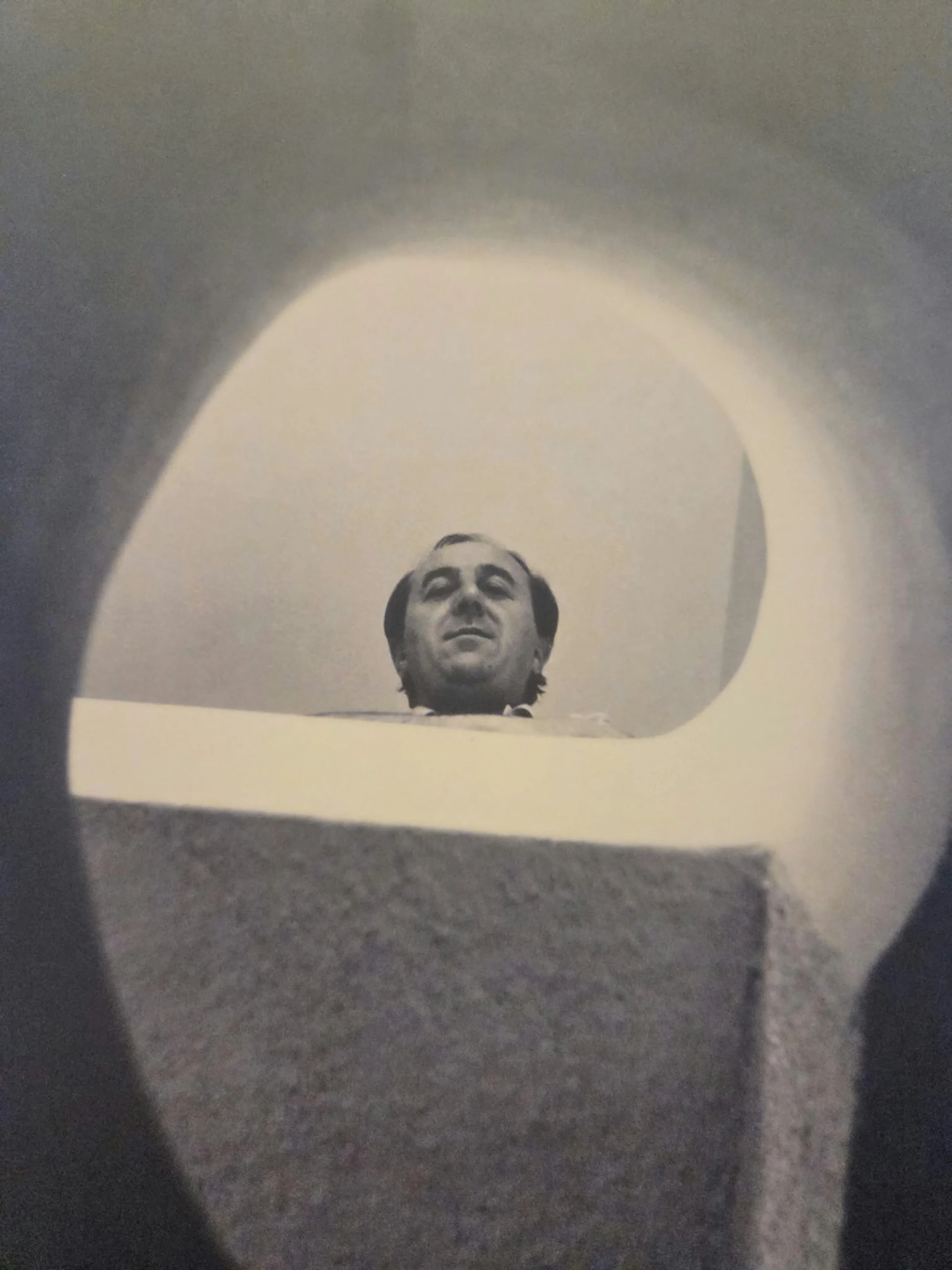
Nicolau Carmenati turned the sculptures of his grandfather, architect Vincenzo Carmenati, into lamps (image: Carmenati Archive).
“‘Oblò’ in Italian means windows, and my grandfather saw these sculptures as windows into the soul,” says Nicolau Carmenati, the grandson of Italian architect Vincenzo Carmenati. “Instead of writing down his feelings, he did these kind of graphic representations, that were made of pieces of wood that were put together by hand in the shape of a window.”
In Carmenati’s Oblò series, thin pieces of wood are carved and assembled together, creating indentations that rise and fall inside of a square frame. While some of the sculptures have organic forms that resemble ripples, others are more architectural, their abstract forms evoking building facades. “My grandfather was really proud of everything he did in architecture,” Nicolau says, referring to Carmenati’s role in establishing the architecture of Spain’s Costa Brava region in the 1960s. “But these sculptures [he made] were intimate, and he felt a little bit naked showing them.” As such, the series was only exhibited once during Carmenati’s lifetime, in a small village in Costa Brava where he was encouraged by friends to display his artistic work back in 2012. After his grandfather’s passing in 2015, however, Nicolau and his mother Emanuela and his aunt Paola began archiving Carmenati’s artistic and architectural work. The pair have since created an online archive and explored Carmenati’s designs through events, conferences and exhibitions. Nicolau was inspired to use his training as an industrial designer to reimagine his grandfather’s sculptures as lamps, which were revealed for the first time as part of the annual Spanish furniture and lighting fair Feria Hábitat Valencia, hosted in September 2026. “We decided [the Oblò series] has some beauty that has to be shared with the world,” he explains. “We didn’t feel comfortable just using the originals, because they were something intimate to him. So we did our own version.”
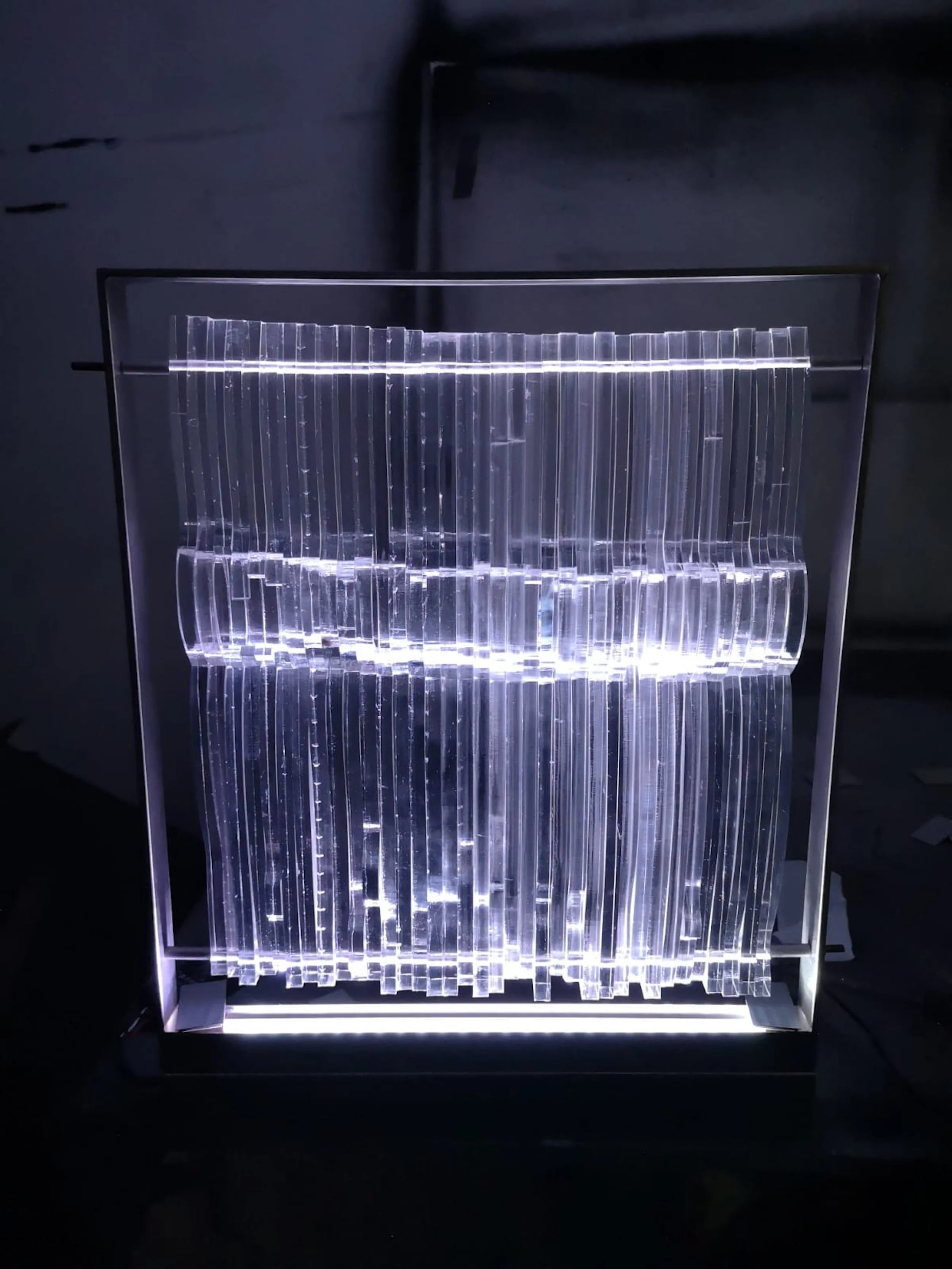
Nicolau’s lamps are made from 3D scans of his grandfather’s sculptures (image: Nicolau Carmenati).
Although Carmenati felt conflicted about revealing his sculptures to the world, the exhibition text he wrote for the Costa Brava show gave Nicolau license to explore them. “I have tried not to commit the sin of pride by boasting about my professional achievements,” Carmenati wrote. “But neither do I wish now to deprive anyone of the opportunity to use them – drawing on my experience – to achieve new, more far-reaching results.” To build on his grandfather’s work, Nicolau created 3D scans of the sculptures and recreated them in different materials, swapping wood for laser-cut plexiglass set inside of a metal frame. The lightbulb, which is embedded into the frame, shines upwards and emphasises the indentations in the glass, creating an effect that resembles a topographical map. While re-editions of historic designs often maintain the shape of the original while substituting more contemporary materials, Nicolau sees his lamps as a continuation of his grandfather’s creative vision. “It’s a parallel edition that could have been made by him in another life,” he says. “In his era, he didn’t have access to this kind of technology, but he was always very modern and playful with materials.” The lamps are currently prototypes that were shown as part of the Nude (New Spanish Design) section of the fair, a space dedicated to emerging designers and design schools, but Nicolau is hoping to connect with manufacturers to develop them into a commercial product.
Throughout his career, Carmenati moved in the circles of some of the 20th century’s most celebrated Italian architects. Born in Milan in 1931, he studied at the Politecnico di Milano under the mentorship of Piero Portaluppi before establishing his own studio and moving to Venezuela, where he crossed paths with architect and designer Gio Ponti. When Carmenati first settled in Costa Brava in 1961, the region remained largely untouched by tourism, with limited infrastructure and a coastline dotted with small fishing villages. “It was a blank page to create,” Nicolau says. “And he wasn’t just building things. He promoted the radio station, and made the first cinema.” One of Carmenati’s most celebrated projects was Maddox, a nightclub in Platja d’Aro that opened in 1967, introducing innovative design features that have since become commonplace. According to the archive, the club’s circular DJ booth was later replicated at venues including New York’s Studio 54, and Carmenati also collaborated with lighting designer Cesar Fiorese to create a system using emerging technologies such as UV and strobe lighting. At the entrance stood a sculpture by Carmenati – the only one included as part of his architectural work – that was composed of suspended cylinders, resembling a surreal candelabra. The piece reflected the club’s undulating design language, which included swooping circular seating arrangements and forms that protruded from the ceiling like drums.
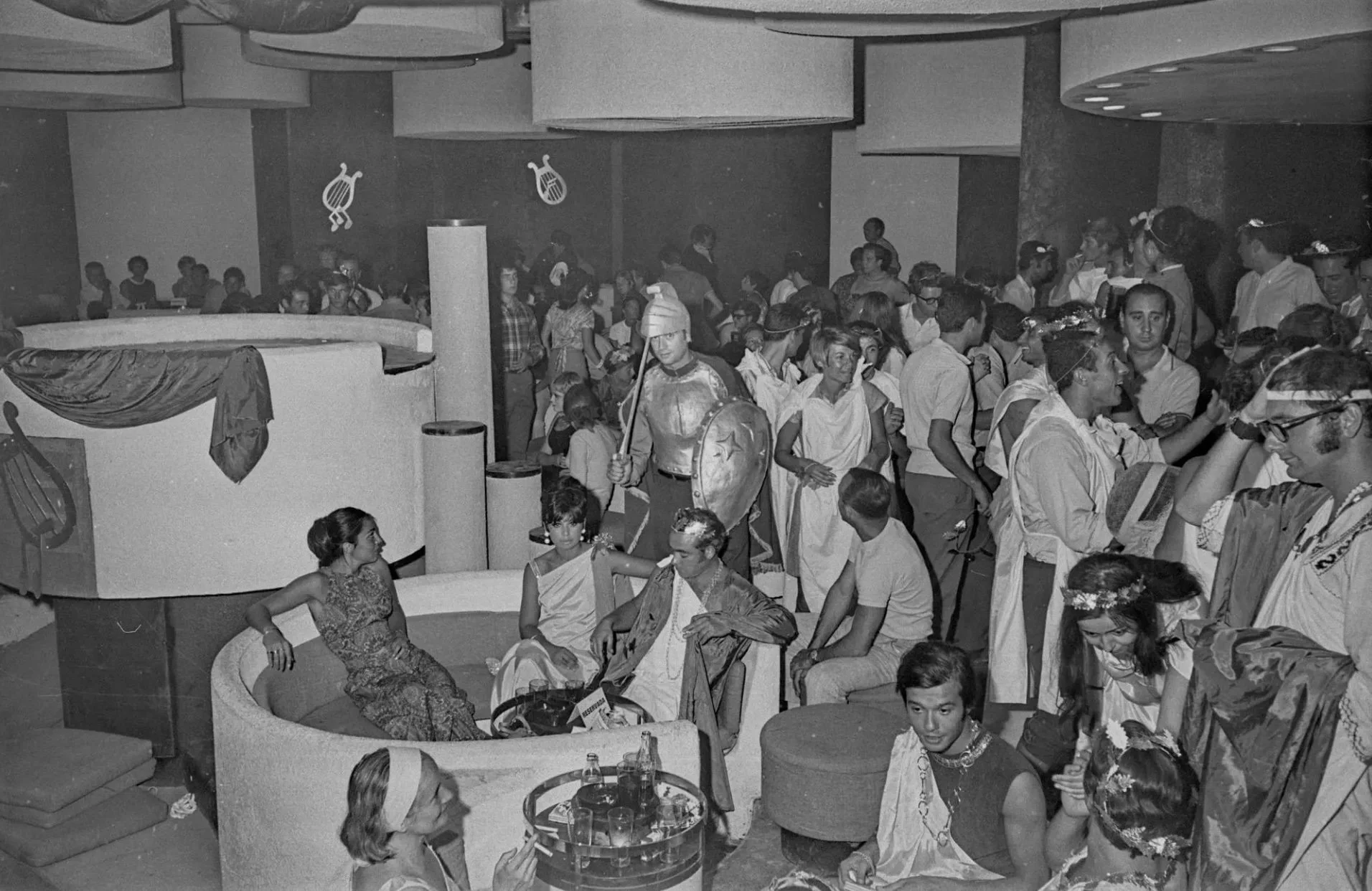
Carmenati’s Maddox Club had a sculptural ceiling, and pioneered features such as a round DJ booth (image: Carmenati Archive).
“His work had a lot of impact in a very focused place in the world,” Nicolau says. “Maybe if [his studio] was located in Barcelona, Madrid or Milan, he would be more recognised than he is now and very impactful.” The purpose of the archive is to expand Carmenati’s influence, and bring to light projects that were previously kept private. “Every architect, when he makes his own house, his soul lives there,” Nicolau says, referring to Carmenati’s residence in Costa Brava. “We are working to make it into a museum.” The archive’s most intimate project of all, however, concerns Carmenati’s final design: Città per Hena (2015), a series of sketches of a city he designed for his wife while she was in hospital for several months. “He dedicated those days to designing, by hand, a utopian city, tailored just for her: an ideal space where they could continue living together,” the archive website reads. “This city of paper and pencil became a testament to their love and a symbol of hope for their reunion.” Nicolau and his mother are now working on making these sketches into a book. “It’s really dreamy, the buildings are very tall, and everything sort of melts together and is very organic,” he describes. “But there are hospitals, schools and roads.”
Alongside personal struggles, Carmenati also bore witness to many political conflicts, including World War II in Italy, numerous coups in Venezuela, and the final years of the Franco regime in Spain. “[These are] events which profoundly impacted him, and which he channeled through art and architecture,” the archive website reads. By displaying Carmenati’s sculptures, sketches and diaries as well as his architectural achievements, the archive offers a more intimate glimpse into his emotional life, revealing a shared humanity that makes his work feel all the more immediate and alive. While Nicolau acknowledges that his lamps tread the line between honouring and exposing his grandfather, he maintains that the Oblò sculptures are abstract enough to evade interpretation. “I don’t know what that means,” he says, gesturing towards glass forms that resemble a wave hitting the shoreline. “I think everybody can see something different in it, and that’s beautiful.” Carmenati, for his part, insisted that audiences should allow his sculptures to express pure feelings, rather than weighing them down with literal interpretations. “Do not try to recognise anything from our daily lives in what is presented here,” he wrote in the 2012 exhibition text. “They are simply sincere excuses to give voice – without further justification – to the emotions and feelings of my lived experience.”
Words Helen Gonzalez Brown