
Text-to-Clay
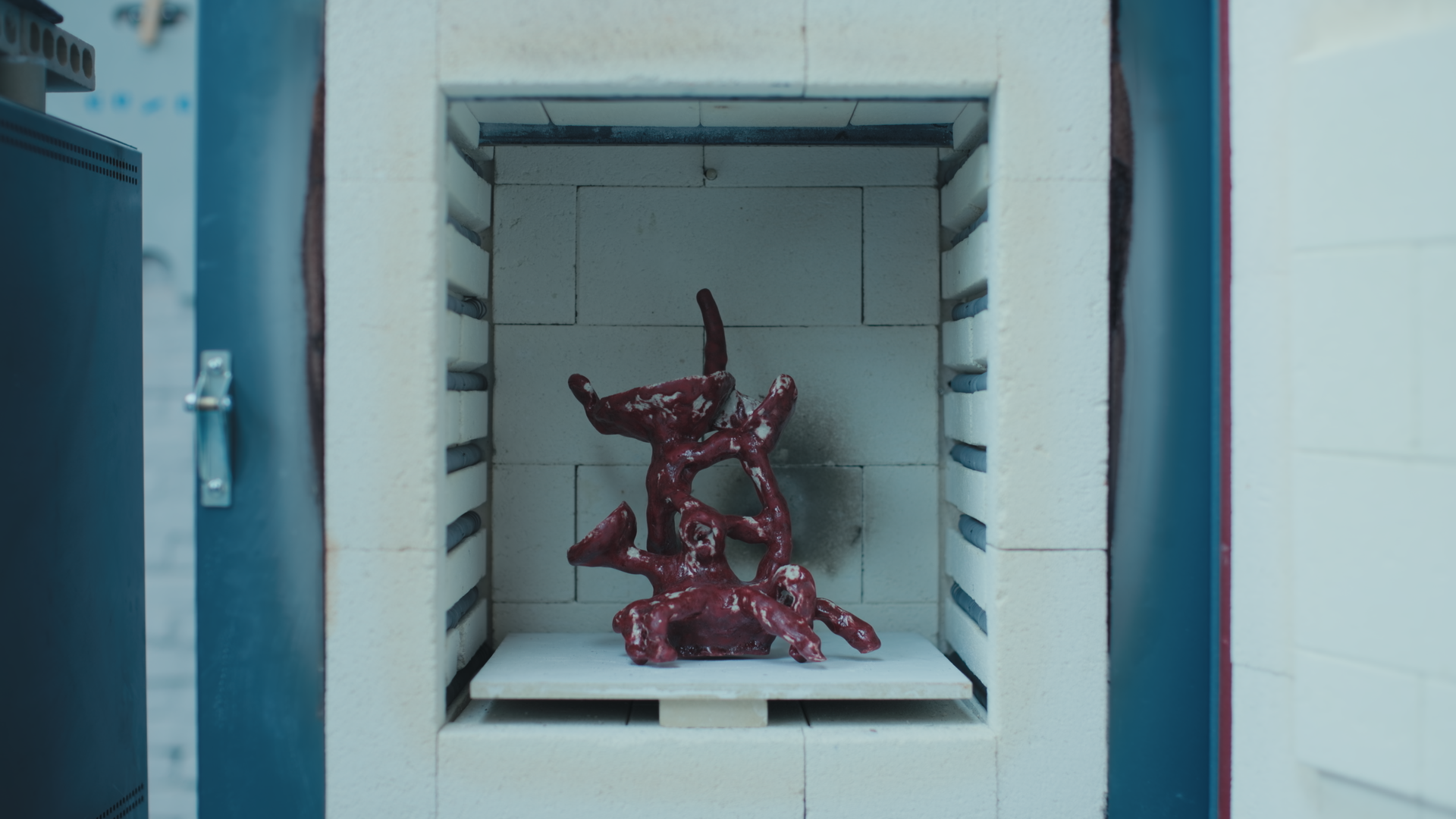
Designer and researcher Vera van der Burg trained an AI model to generate ceramic forms that she later hand-built in clay, challenging anthropomorphic ideas about the technology by treating it like a material (image: Marcia de Michele).
Designer and researcher Vera van der Burg dislikes describing AI using anthropomorphic terms such as “alter ego”, “oracle”, or “friend”. “For me, AI is more like a material that you can learn to adapt to what you want and who you are – it’s like ceramic or wood,” she explains. “It shows you something about yourself because it’s not you; it’s something you work with.”
Van der Burg’s interest in AI algorithms dates back to her Masters at Design Academy Eindhoven, where she developed an interest in using technology to interrogate the creative process. “I did a Bachelors in neuroscience and then I went to design school and I was like, ‘Oh, everyone here is a really good maker, and I cannot really make,’” she remembers. “But I was very interested in how these people worked with materials, and their feeling for how something was composed.”
While algorithms are often designed with the ideal of being impartial and providing concrete answers – even if the reality often falls short of this – van der Burg’s work is intentionally subjective and intended to inspire reflection. Her installation Objective Portrait, made in collaboration with Gijs de Boer, for example, interrogated whether training an algorithm on someone’s personal values can capture their particular way of seeing the world – a project which later morphed into a workshop for students at Eindhoven to analyse their own practices. “It’s fascinating to me that you can actually externalise something of yourself, and then [the algorithm] gives you something back,” she explains. “And maybe it's not the truth, or maybe it's upsetting, or maybe it's insightful.”
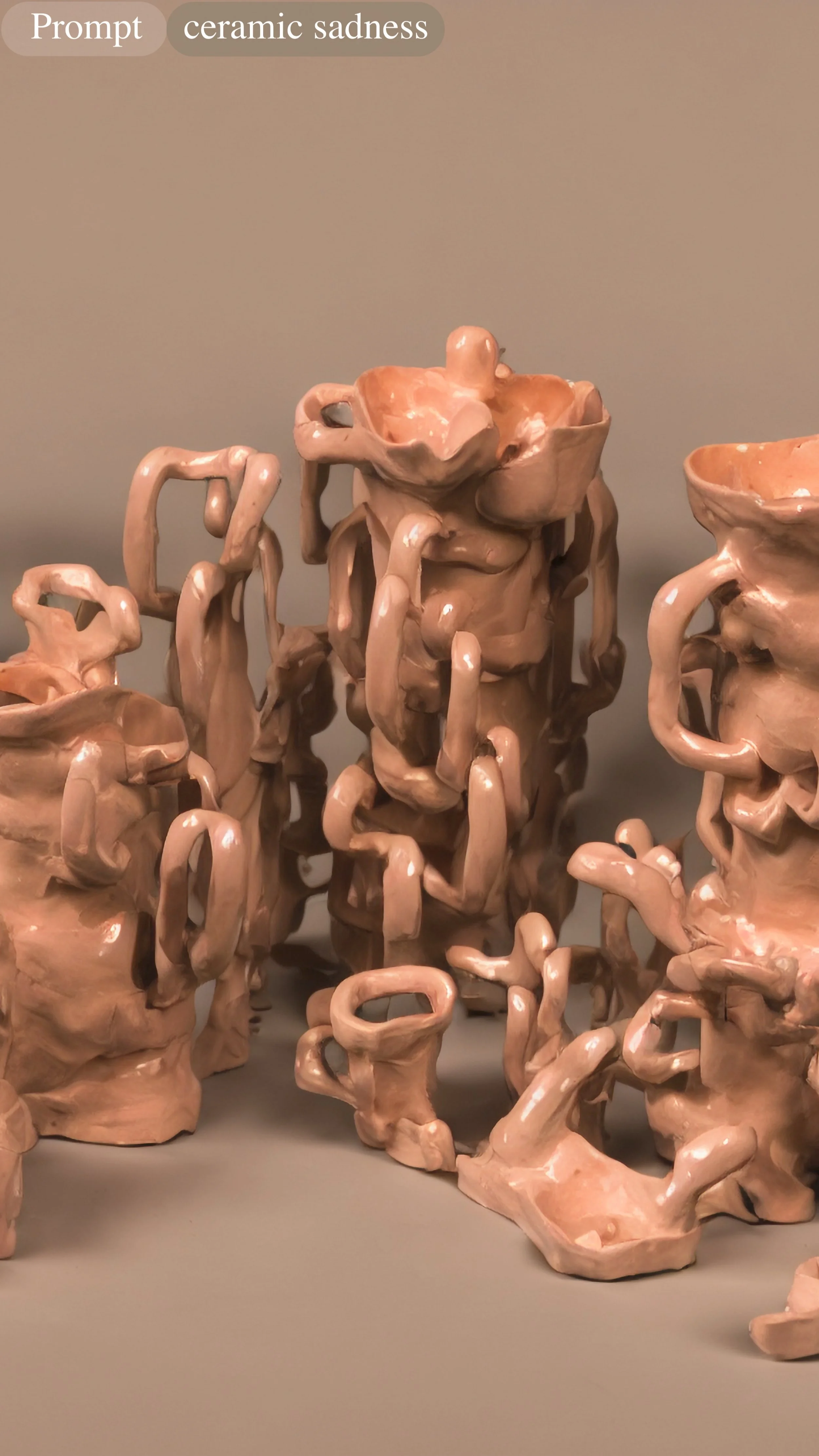
The AI-generated image for the prompt “ceramic sadness” refracted images of van der Burg’s cups, bowls and plates into a sculpture dripping with handles (image: Vera van der Burg).
Her latest project, From Text-to-Clay, was developed during a residency at the European Ceramic Work Centre, and illustrates her approach to using AI algorithms as a material – something that can be shaped, yet also possesses an inherent unpredictability. “To me, the kiln was like a black box,” she says, drawing a comparison between the unknowability of AI and the difficulty of predicting whether a ceramic piece will hold its shape or what colour a finished glaze will become when fired. “We put stuff in there, and we just have to accept whatever comes out.” Using open-source image generator Stable Diffusion, she trained an AI model using images of her own ceramics, each labelled with abstract, emotional words rather than purely descriptive ones. Then, she generated images of potential ceramic pieces using prompts such as “ceramic divorce” (producing a wobbly tower gaping with holes) alongside other outlandish shapes. “The images made no sense, because the shadow is weird, or the construction points are really difficult to do,” she says, describing how the algorithm lacked any understanding of the structural properties of clay.
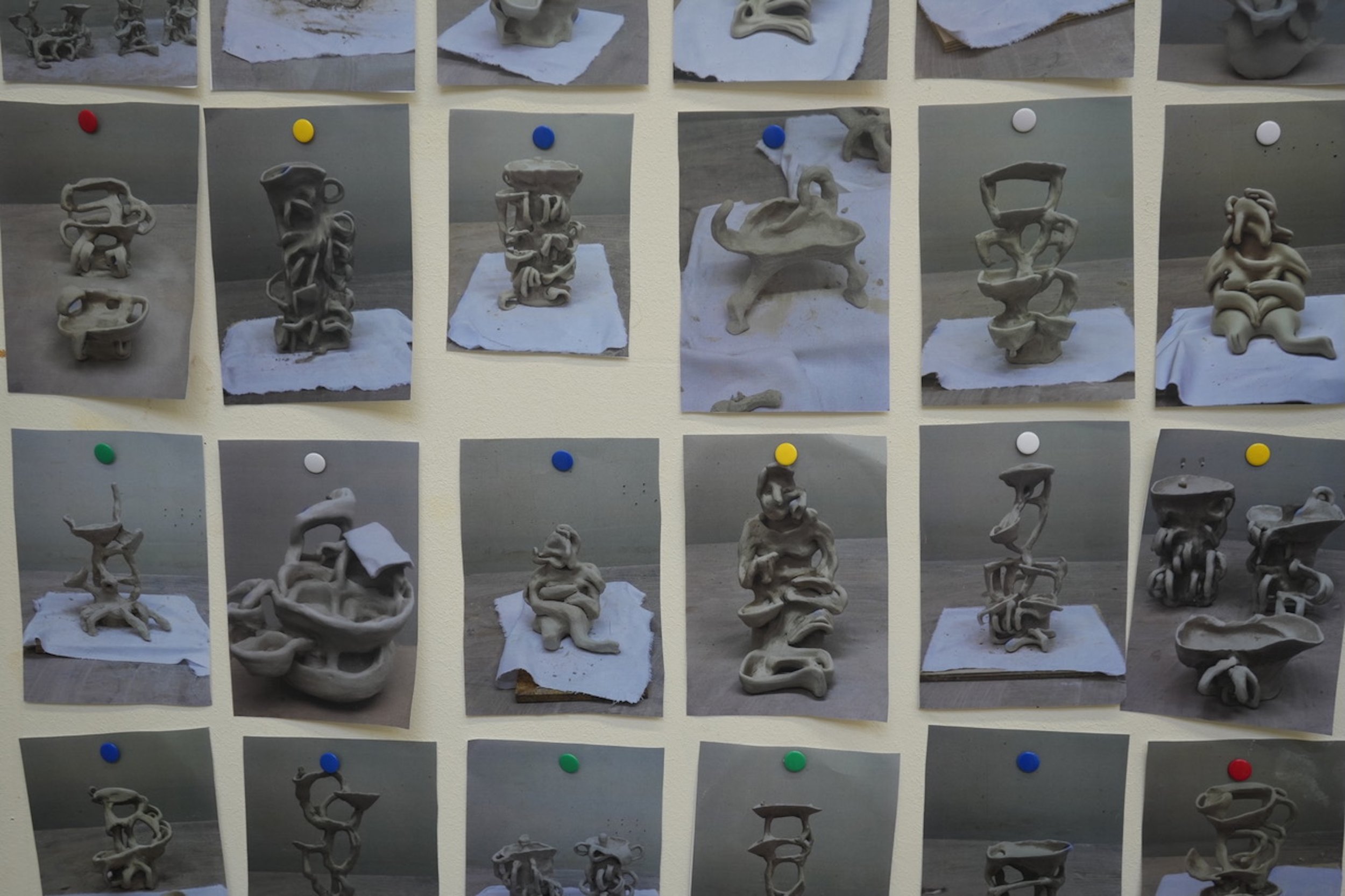
Van der Burg attempted to recreate the AI generated ceramics, and fed her attempts at sculpting them back into the AI model, going back and forth until she reached a finished object (image: Esther van der Heijden).
By marrying together AI and ceramics, van der Burg emphasises the similarities between them while also slowing down the immediacy of AI by filtering it through the laborious process of ceramics. After trying to sculpt the AI-generated image, she fed pictures of her attempts back into the AI model, going back and forth until she reached a finished object. “I was kind of retracing a making process,” she says. “Nine out of ten times, it became a different thing, because reality is different, and clay has its own agency.” While van der Burg’s ceramic practice had mainly consisted of cups and plates, the AI refracted these traditional shapes into elaborate sculptures, pushing her to try out more ambitious techniques. Tens of droopy mug handles drip from the form of “ceramic sadness”, for example, while two bowls form the base of “ceramic jealousy” before twisting into thinner and thinner shapes. When choosing the glazes for each piece, van der Burg imitated the alien aesthetic of the AI-generated images. “They received a bit of spray paint from one angle to mimic the fake shadows,” she explains.
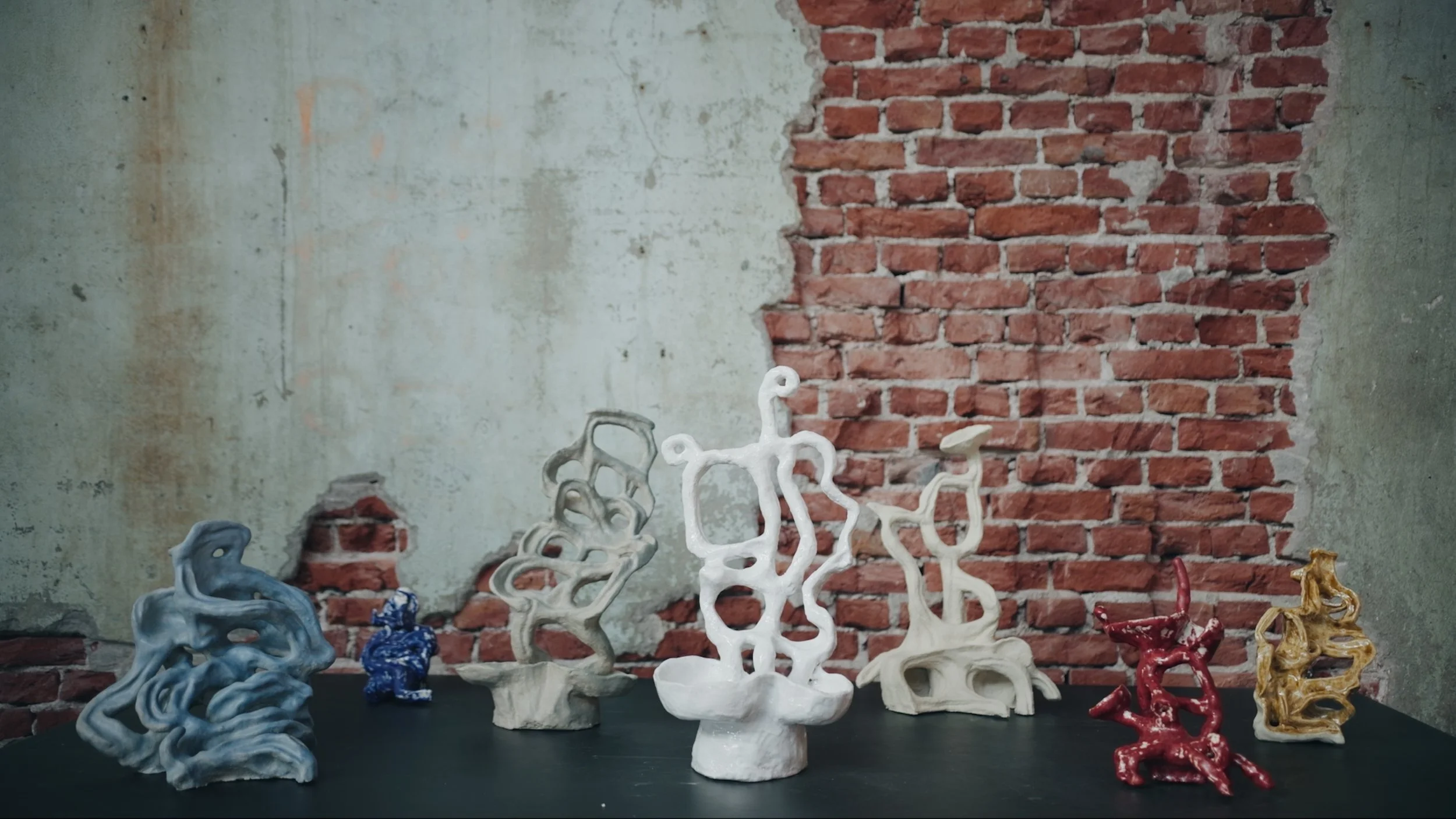
A selection of van der Burg’s finished ceramics, made using prompts such as “ceramic female pain”, “ceramic divorce”, and “ceramic jealousy” (image: Marcia de Michele).
Van der Burg’s peers who work with AI have suggested that she optimise her model to understand clay better, but she believes that this would reduce the creativity of the exercise. “It’s always interesting for designers or artists to be in a limited space and create from that,” she says. While she believes it is possible to work reflectively with programmes such as ChatGPT or Dall-E, she rejects the framing of these tools as something that should increase efficiency. “Taking away labour in a field where labour is the whole point doesn’t make sense to me,” she says. By collaborating with AI algorithms to create near-impossible ceramics, van der Burg continues to embrace the time-consuming and uncontrollable nature of creative work, rather than reducing its difficulty and unpredictability through streamlining or automation. “[The algorithm] creates boundaries, it creates friction,” she says. “It does not give you the answer.”
Words Helen Gonzalez Brown