
Where’s Your Cow From?
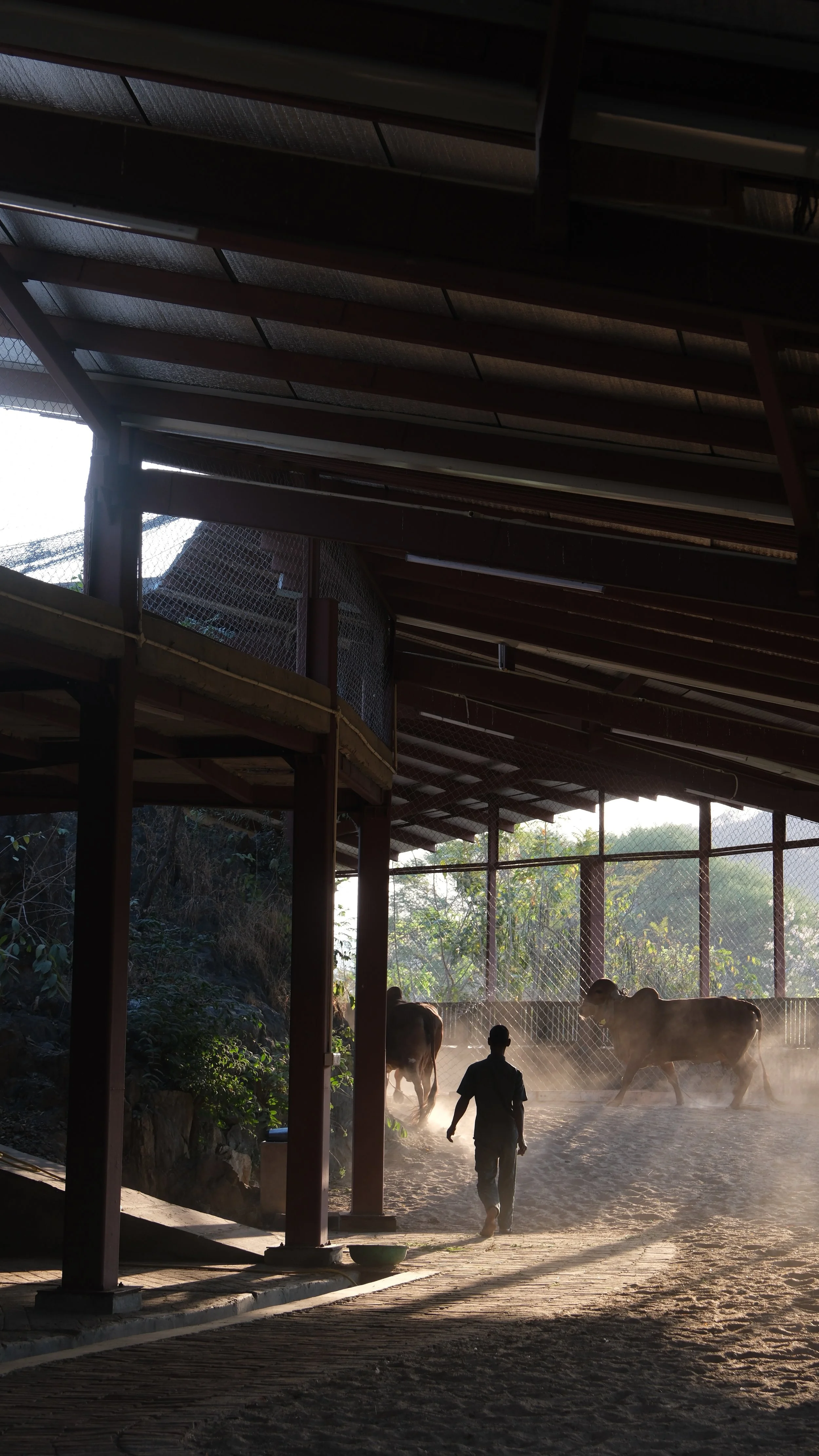
Studio Saar’s gaushala in Delwara, Rajasthan was designed to house a herd of native Gir cows (image: courtesy of Yuri Suzuki).
Anyone who has lived in or visited India will note cows to be a common feature of the streetscape. They are hard to miss as you find yourself slamming on the brakes of your car when one suddenly steps down from the road divider or, if you decide to walk, dodging blobs of dung like a game of hopscotch.
Cows, it seems, are a survivor of the country’s rapid urbanisation: they have not disappeared in the process of wetlands being swapped for parcels of real estate and clusters of brick houses being replaced with swanky towers. Unaffected by it all, they huddle together on sidewalks and munch over jumbles of kitchen waste and plastic, all while enjoying the title of gaumata (cow-mother) bestowed by Hindu culture. Keeping up with the times, most have had their ears punched with a bright yellow tag displaying the 12-character identification number that helps the government keep track of the cattle count in the country, which was recorded at 193.5m in the 2019 census.
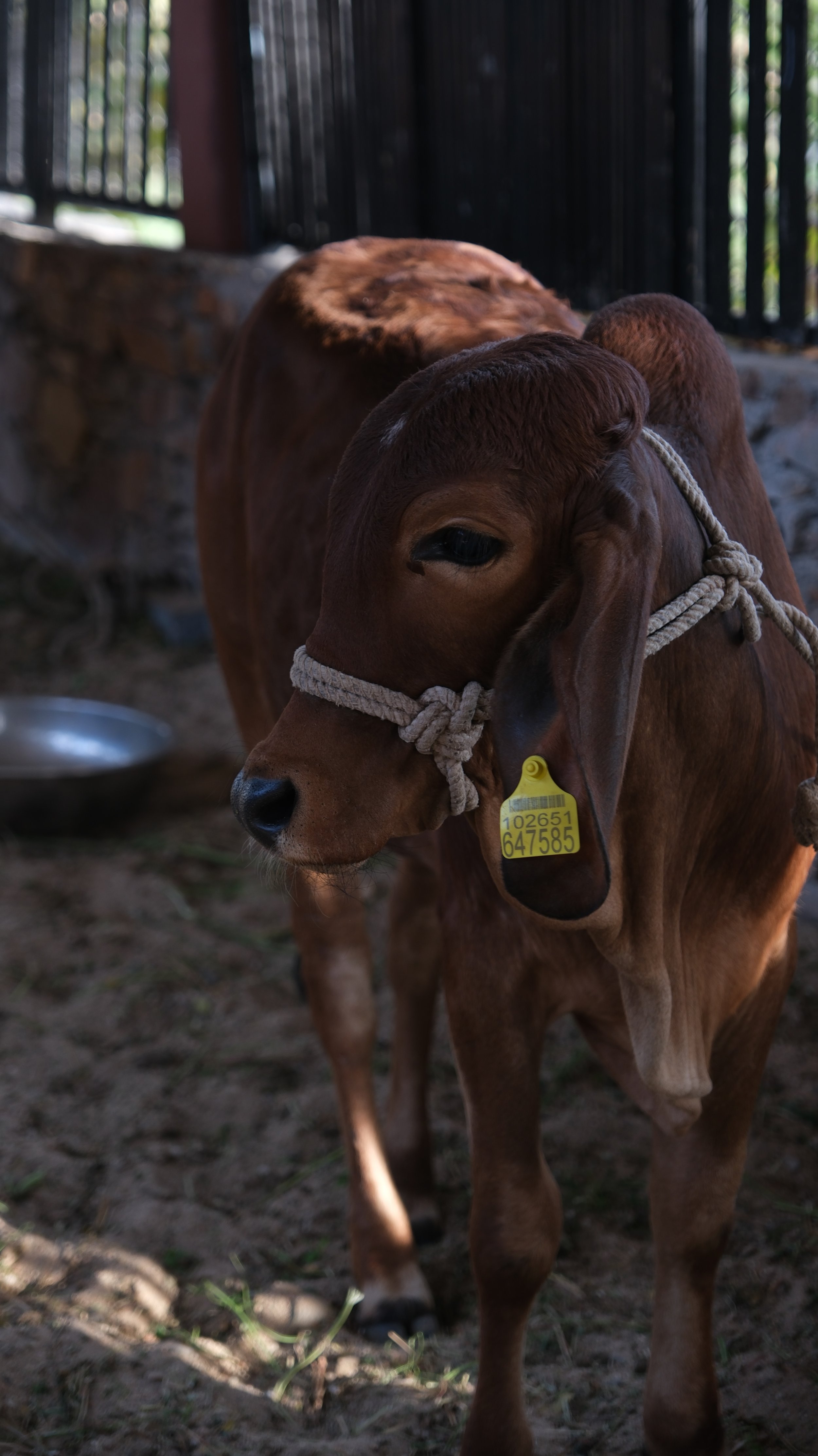
Native Gir cows produce milk with a low lactose content, and require significantly less water to care for than European breeds (image: Eshwarya Grover).
The survival of the country is also tied to the cows’ own, given that milk production makes up 4 to 5 per cent of the national GDP. India’s current position as the world’s largest producer and consumer of milk can be traced back to the East India Company setting up its first military farm in Allahabad (now Prayagraj) in 1889 to boost the dairy supply for British troops stationed in colonial India. This, and the subsequent military farms that cropped up across the country, introduced systematic crossbreeding of India’s indigenous cows with European, high-yielding varieties – a practice that continued well past independence, when the Indian Army assumed responsibility for their operation, until the closing of the last such farm in 2021. This practice alone, however, is not why more than a quarter of India’s entire cattle population is crossbred.
In 1970, the Indian government launched a phased programme, Operation Flood, intended to turn India from a milk-deficit nation dependent on imports into a self-sufficient one. While the initiative is today deemed to have been a success – it facilitated linking new and existing cow sheds with more than 700 towns and cities, setting up farmer-owned cooperatives, and improving access to feeds and veterinary service – it still continued to promote crossbred cows such as Holstein Friesian, Jersey, Brown Swiss, and Red Dane. These breeds are known to have more productive value as compared to those that originated in India, but are not as well adapted to the warmer climate, therefore requiring more water-intensive care to protect them from the heat and remain healthy.
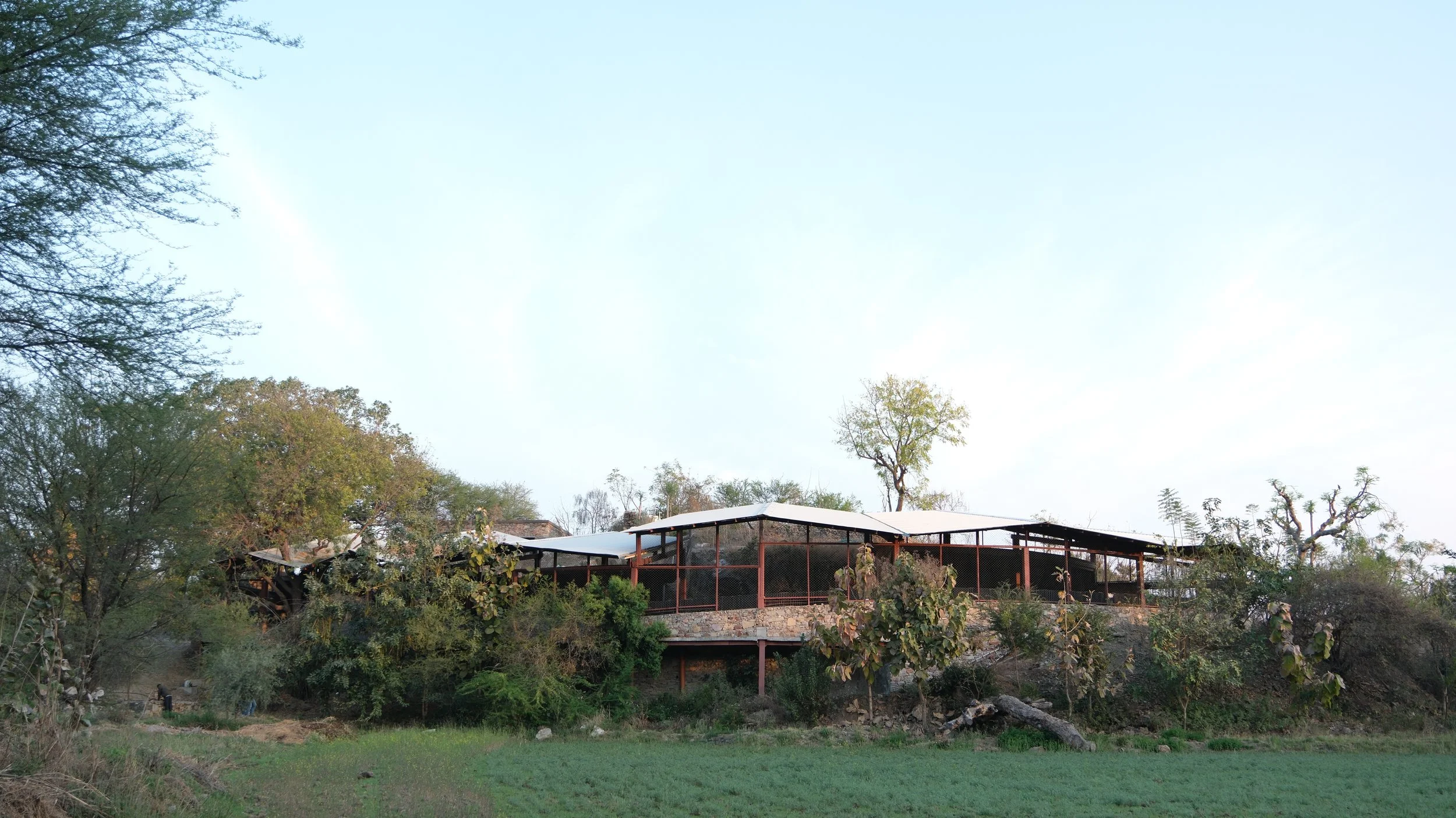
The gaushala has been designed to sit sympathetically in the landscape, with minimal disruption to the surrounding site (image: Eshwarya Grover).
Crossbred or not, the omnipresence of cows has resulted in many of us in India having daily or weekly rituals of feeding or petting them. I, for one, begin my Thursdays scouting for a cow to offer food to: a fresh roti laced with ghee and jaggery. On spotting one, I stand a couple of feet away and extend my arm to present the roti as ready for the take. The cow never hesitates before swirling its tongue to scoop up the snack. The whole affair is oddly fulfilling, despite being predictable.
Admittedly, beyond my brief Thursday interactions, I had not given much thought to how these animals are cared for regularly, what breed they are, and whether they have somewhere to go in the evenings after their daytime wander. My childhood memories of visiting a gaushala, or the shelter in which they are kept and milked, are a fuzzy mix of the familiar smell of dung cakes spread out to dry in the sun and the dimly lit aisle under a tattering tin shed, feeders installed on either side from which cows could retrieve their food as and when they pleased.
How have gaushalas today changed from what they were 20 years or even 200 years ago, given the upgrades that agricultural and dairy practices have received in terms of technology and machinery? What does a mid-sized shelter with the capacity to supply milk locally, door-to-door, look like? And how does such a facility engage with traditional communities to revive their connection to land and support ruralurban economies? With these questions scribbled into a notebook, I visited a gaushala designed by Studio Saar in Delwara, Rajasthan, around 25km north of Udaipur.
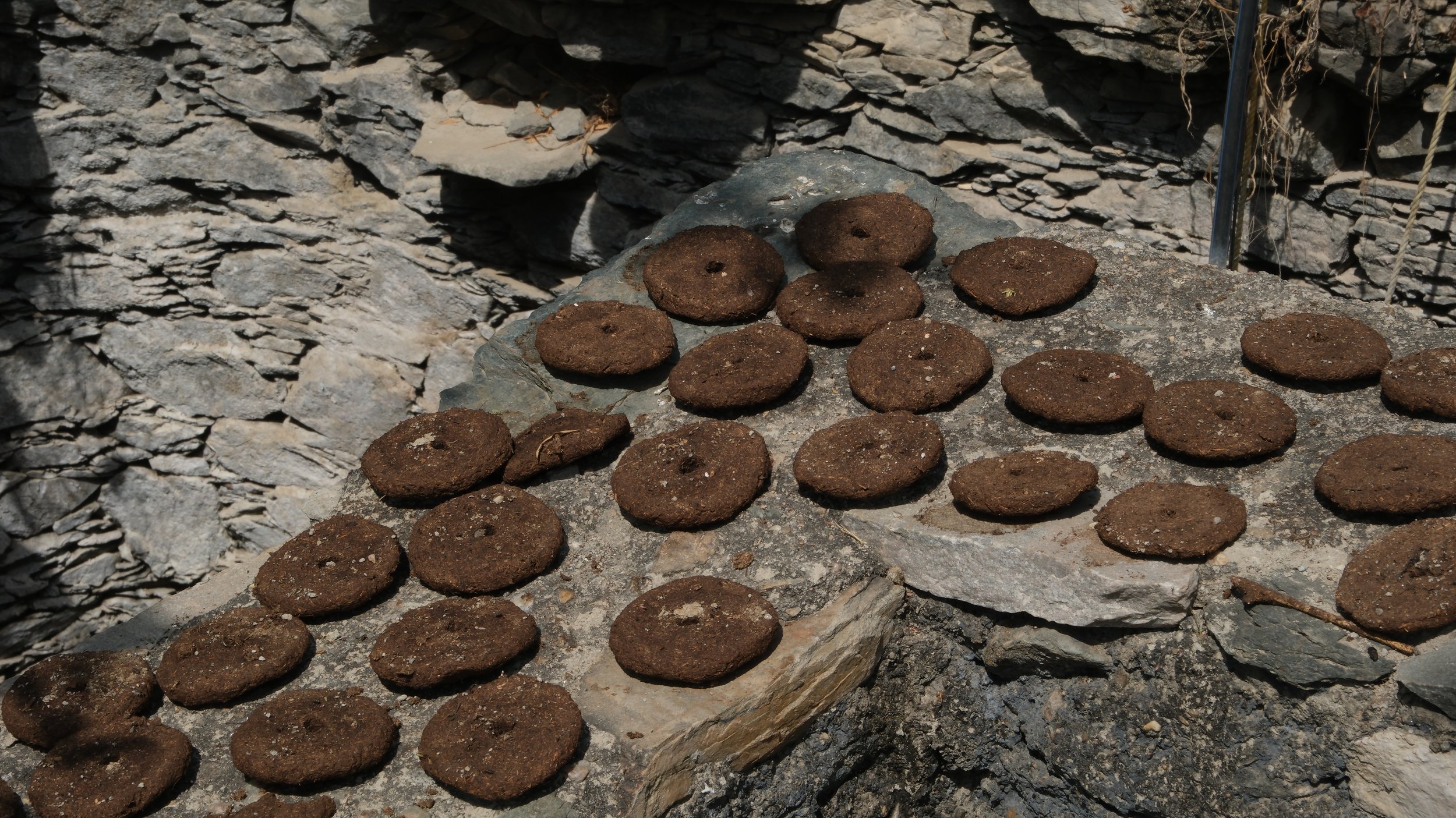
Dung cakes, used in both the fields and as a fuel for cooking (image: Eshwarya Grover).
On a bright January afternoon, I accompany the firm’s co-founder Ananya Singhal on the drive up to the gaushala. The highway leading toward Delwara is flanked by marble processing factories as well as tourist resorts, and, as one gets closer to town, the large complexes give way to more intimate houses and shops. Taking a sharp turn onto a quieter road, we halt in front of the entry to a 50-acre, privately owned property comprising farmland and untouched green hills. The main gate faces a large banyan tree, its trunk encircled by a chaupal, a common public space element in rural India that serves as a pause of sorts: a place to rest, have your meal, or chat with friends. We walk around the chaupal to ramp up to the gaushala’s blue paint-coated steel doors that have been slid open for the day’s activities. I can hear the cows mooing from inside the building, and manage to catch a glimpse of them standing by the chain-linked openings that capture a panoramic view of the fields and hills beyond. Before we can get any closer, however, the gaushala’s caretaker informs us that one of the cows is in labour and would be best given privacy. “We could have built this anywhere on the farm,” says Singhal, whose family own the property and commissioned the gaushala in 2022, “but here, we have some building ruins and an old well close by.” He pauses, waving his hand to gesture in the direction we came from. “Let’s look at those first.”
We retrace our steps and take in the gaushala’s surroundings. Piles of stone and pieces of repurposed steel mark the trail up to a two-room structure that is currently under renovation. It is to function as a dairy and ghee-making facility to support the gaushala’s target population of 40 cows. “We want to have all the systems in place before reaching that number,” explains Singhal, “and of course, get the locals more involved to take up charge.” The gaushala is part of the vision of Singhal’s family, who are behind the multinational Secure Meters energy company, to build a commercial quarter of the farm that will be accessible to the people of Delwara. The building’s size and capacity are a result of this future brief.
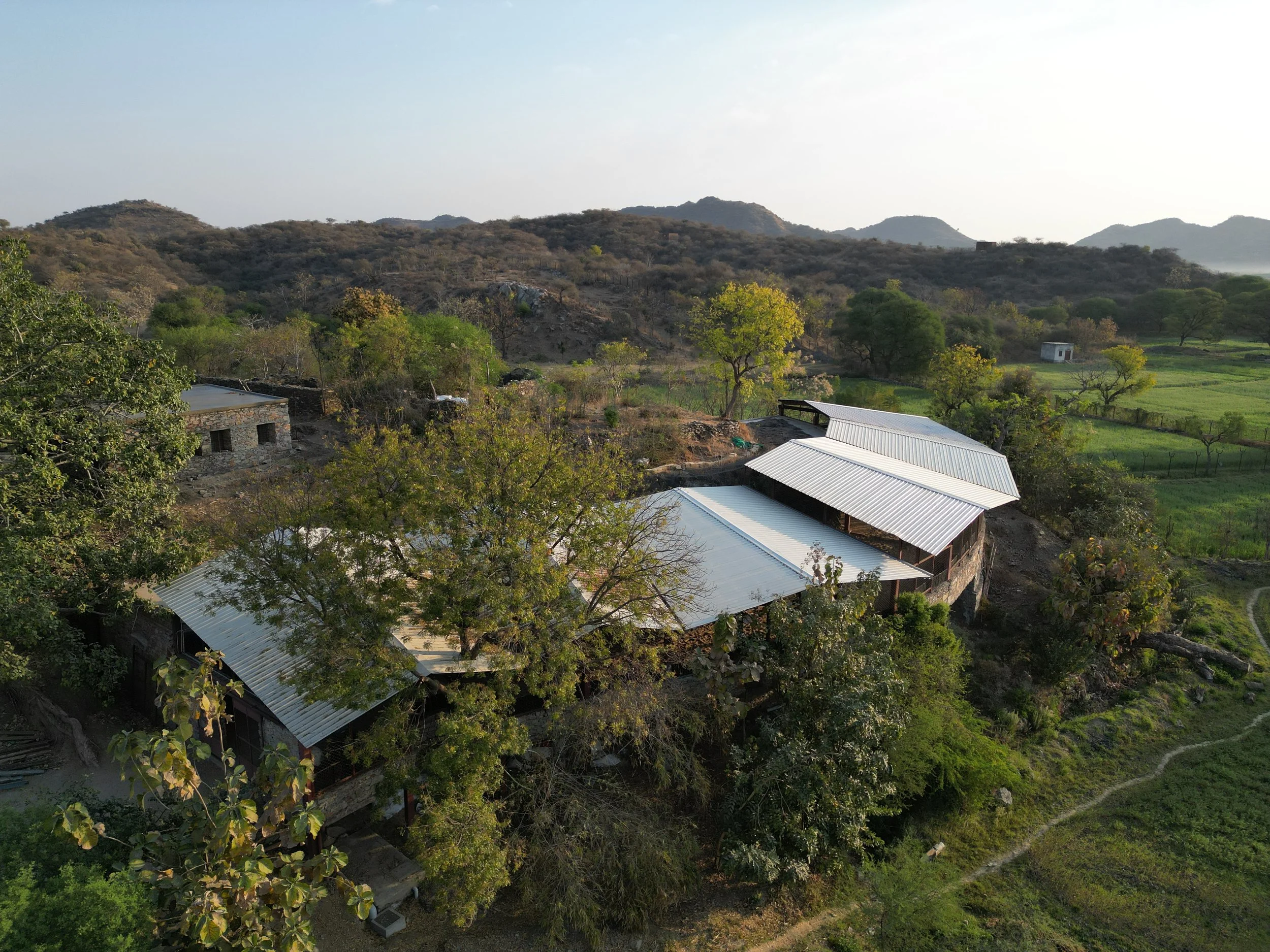
Image: Eshwarya Grover.
We hike up to reach a set of two concrete terraces that top the service area which lines the back of the gaushala, and which are level with the steel white roof perched over the rest of the free-flowing space like a light summer hat. One of the terraces functions as a platform to sun-dry hay and the dung cakes that are used both in the fields and as fuel for outdoor cooking; the other is a provisional space to mount solar panels to meet the increase in energy demand in the years to come. Standing here, I can better appreciate how constraints of the land have informed the building’s design, with its orientation catching the prevailing westerly winds to keep the gaushala cool and ventilated. “The building’s form came as a result of it wrapping around the edge of this hill,” Singhal continues, “and for that, we needed a lightweight roof that could change direction without any funny joints. Easily drain off the rainwater too.”
The alternating pitched roof, with six ridges and neat gutters in between them, could be compared to a folded origami sculpture, were it not for a large rocky outcrop that looms inside the building and divides its volume, almost into two halves. “We let the landform interrupt the building instead of carving into it, but then, a key challenge was to make all that open space panther-proof,” Singhal adds. “The chainlink can take the weight of three panthers at once.” These wild leopards are not a rare spot in and around Udaipur’s scrub-forested landscape and, once in a while, they make their way into inhabited settlements to steal easy prey. I could certainly imagine why a somewhat remote gaushala like this one needs complete sealing from the outside.
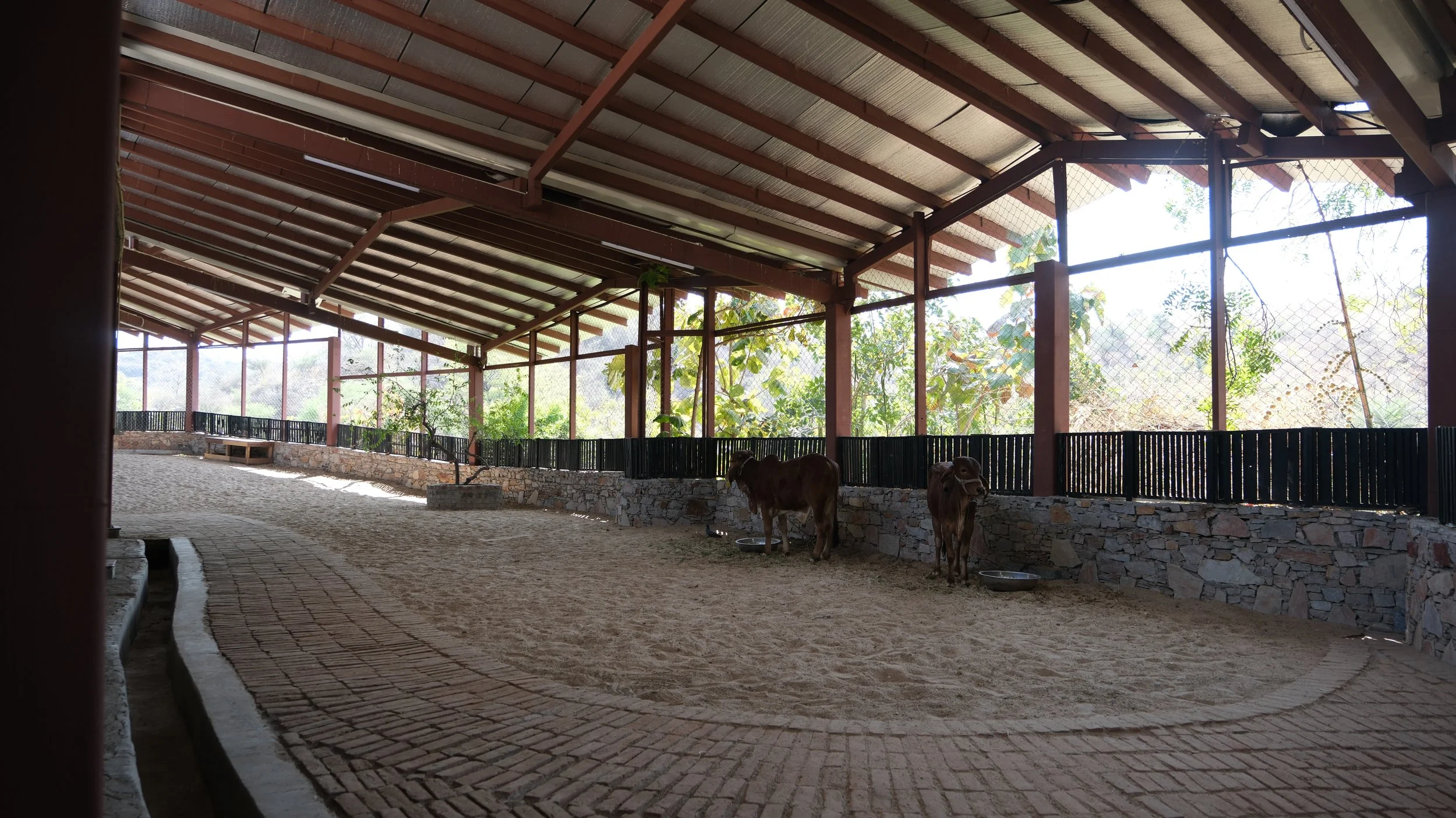
The design borrows many lessons learned from traditional gaushalas, such as soft sand floors (image: Eshwarya Grover).
The building partially sits on land, with a 3m overhang propped up on steel columns. The semicovered space below stores cow dung for biofuel generation, which will make the operation net-zero in the future. “You see those granite starters that raise the steel columns off the ground to keep them from rusting?” inquires Singhal as we walk past this alley to return to the gaushala entry. “They cost us nothing as they’re from a mining site’s overburden – stuff that can’t be used to make slabs and usually goes to waste.” The rest of the building has also been largely built out of structural steel and rubble stone procured from demolition sites within a 30km radius.
After going around the gaushala and viewing it from different angles, it is time to take the actual building tour and meet the resident cows – two originally brought from Gir in Gujarat and the others born here. “We grew up with cows as part of our lives because my grandmother used to keep some,” says Singhal, “but back then, there wasn’t much of an understanding of breed and what difference it made to the quality of milk we consumed.” This new facility, he tells me, will keep the cows genealogically pure, with the project specifically focused on rearing the Gir, an indigenous breed. The Gir cow is distinctly recognisable by its reddish coat, long pendulous ears, and slightly domed forehead, and has been favoured for having better disease and heat resistance, as well as a higher milk yield, when compared to other indigenous breeds of India. To address the declining numbers of the Gir and other such native breeds, the Indian government launched the Rashtriya Gokul Mission in 2014 to support the conservation of indigenous cattle through selective breeding. “There is now a lot of established value in reintroducing the milk from the Gir cows in our diet,” notes Singhal, “not only because of its low lactose content, but also because these cows use approximately one-tenth of the water required to care for, say, the Jersey cow.”
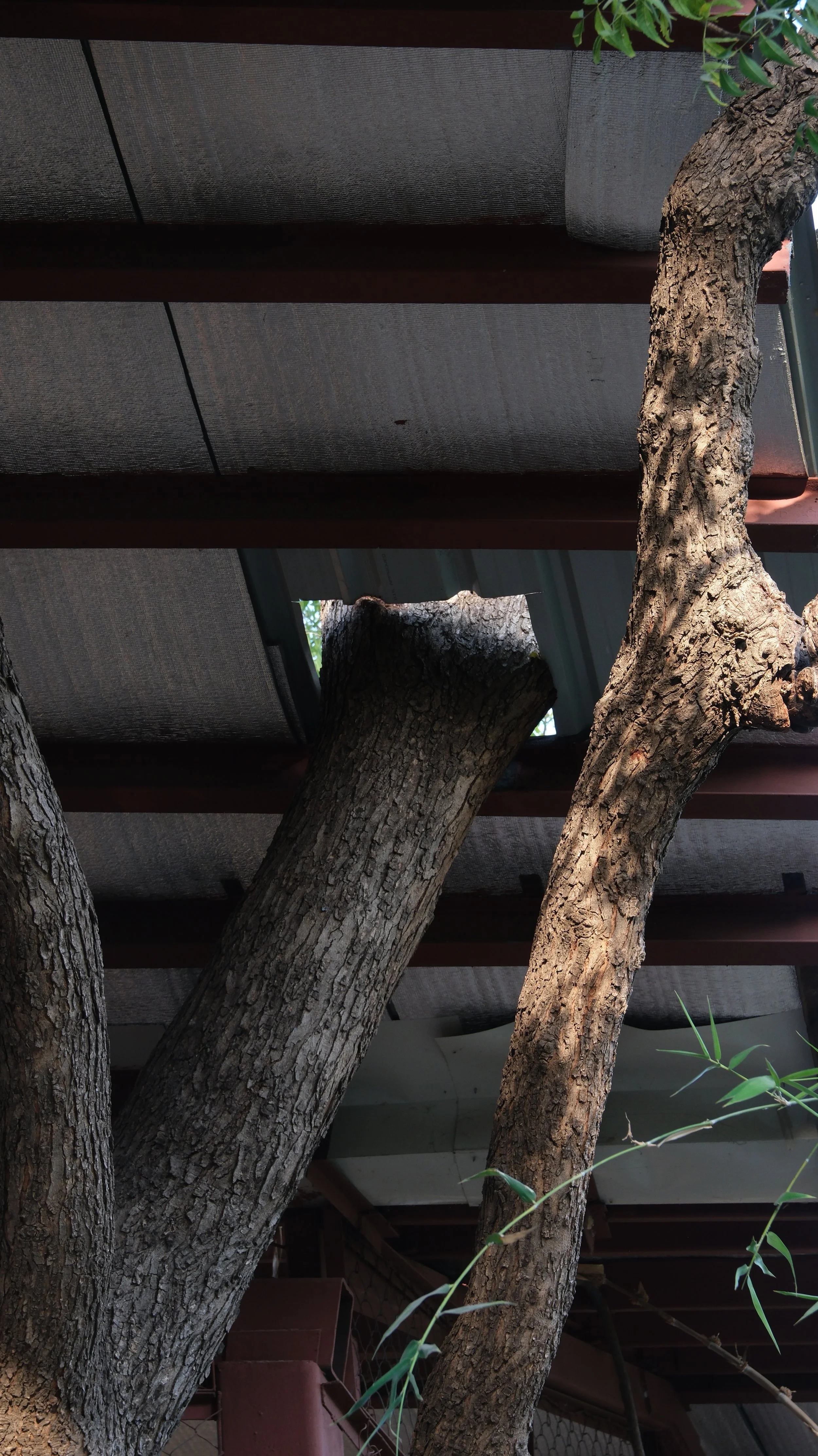
Image: Eshwarya Grover.
Walking through the shelter’s pleasantly shaded interior, sandwiched between its sand floors and the 4m-high steel roof punctuated with tree trunks that were carefully preserved throughout the 12-month construction period, I can hear the unfamiliar grunting of the newborn calf, only minutes old. Since its mother has assumed a defensive stance, we don’t venture near it and, instead, start to explore the back of the building. This portion retains the earth against which the building has been constructed and has a series of ancillary service spaces flowing along the curve of the land – including a caretaker’s accommodation, silos to store cow feed, and rows of feeders for food and water. The excess water from the floor and feeders drains into a gutter that channels it to the fields, making use of the cow’s waste as natural manure. “When we started designing, I didn’t want to be stuck in the typical gaushala type,” says Singhal, “but at the same time, we weren’t looking to mechanise everything like the West does.” Some of the features that this gaushala borrows from traditional ones are a sand floor that provides a soft surface for the cows to walk on, and the size and shape of the feeders, which have been ergonomically optimised over centuries. “It was about reinventing the process of taking care of cows in a way that would be safe for the cowherds, as well as more productive in running the facility.”
The gaushala allows for “a more humane approach to taking care of cows,” as Singhal puts it, with simple design gestures like a wooden railing mounted on the stone bund wall that runs the length of the farm-facing side of the building. The top of the railing comes just under eye-level for the cows, giving them the impression of being level with the fields instead of elevated off the ground. “Otherwise they’d get scared of the height, you see,” Singhal smiles knowingly. At the same time, the gaushala incorporates certain process-based upgrades by combining Studio Saar’s exposure to dairy farms in the West and the Singhal family’s experience in manufacturing through their work with Secure Meters. One such upgrade is introducing feed silos with a first-in, last-out system, which prevents feed from going stale if left at the bottom of a tall pile, as is usually the case in gaushalas.
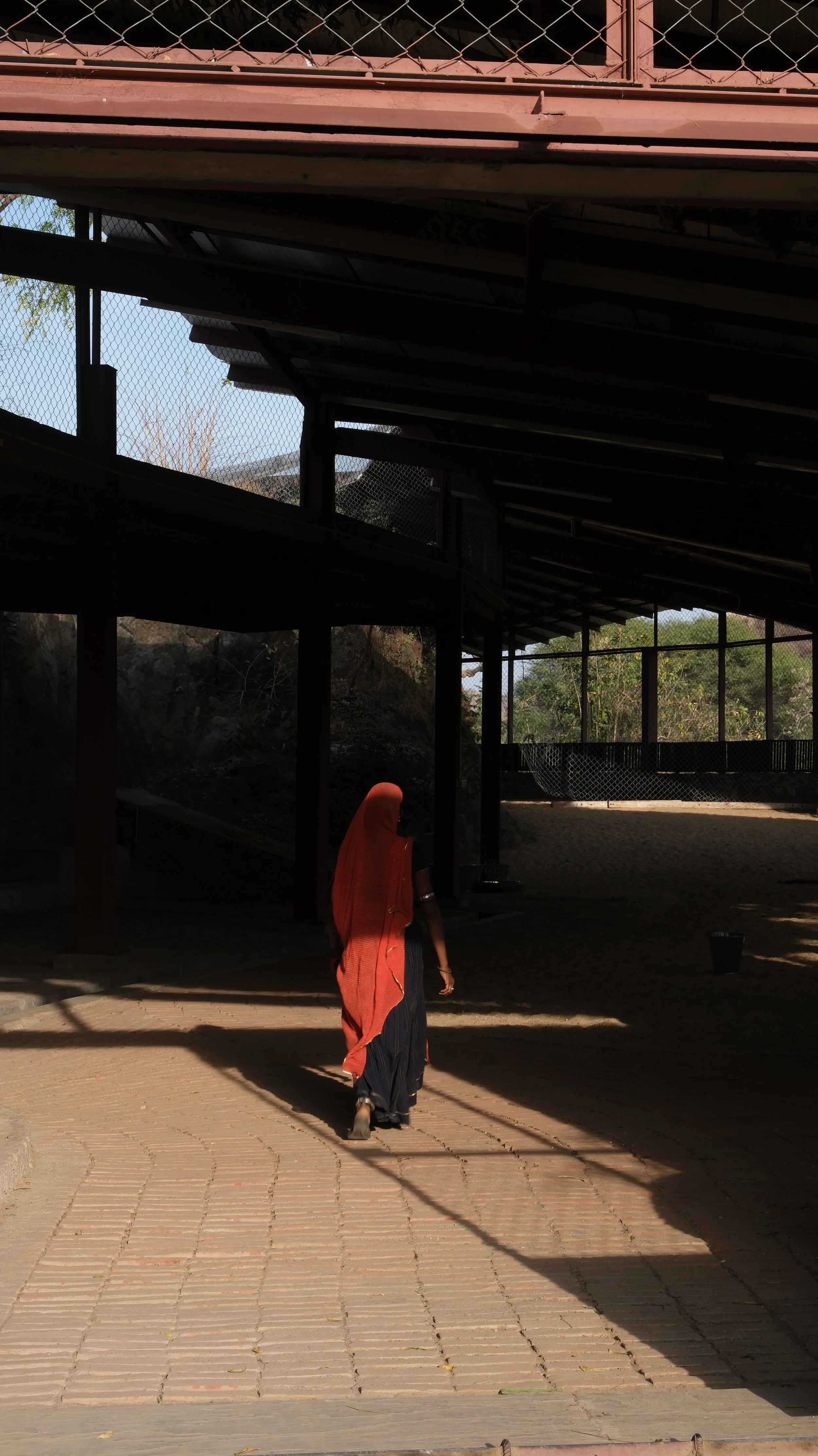
Image: Eshwarya Grover.
“It was a struggle for me to get the workers here to use something as simple as wheelbarrows instead of carrying everything on their backs,” Singhal remarks once we are out of the gaushala and seated at the edge of the open well, by the side of a vegetable patch. “This balancing act between efficiency and tradition, and getting the culture change in place, was kind of interesting.” Saar’s gaushala embraces the survival of the land, the people, and, naturally, the Gir cows in an uncomplicated yet rigorous way. The property’s banyan tree, in many ways, served as the reference point to chalk the pathways out and position the gaushala, and the structure’s bay sizes were adjusted to accommodate the tree roots that penetrate deep in the ground. “This is a building that we had designed a heck of a lot, and then redesigned for what we found on site,” laughs Singhal. The multi-purpose concrete terraces, for example, were initially planned to be very lightweight and therefore not suited to carry any live load, but seeing where they came up against the hill, they were assigned uses – a decision that helped avoid any additional hardscaping of the site.
The building is a product of its place, both in its design and execution, and including its employment of local fabricators and stone masons, and its continued engagement of men and women from semi-rural Delwara for ongoing farm- and gaushala-related chores. As more cows join the existing ones, the facility aims to establish links with a resort in the vicinity that is interested in sourcing organically produced ghee. “I think mid-sized cow sheds like this one can become a really important part of the dairy economy of our country,” Singhal tells me.
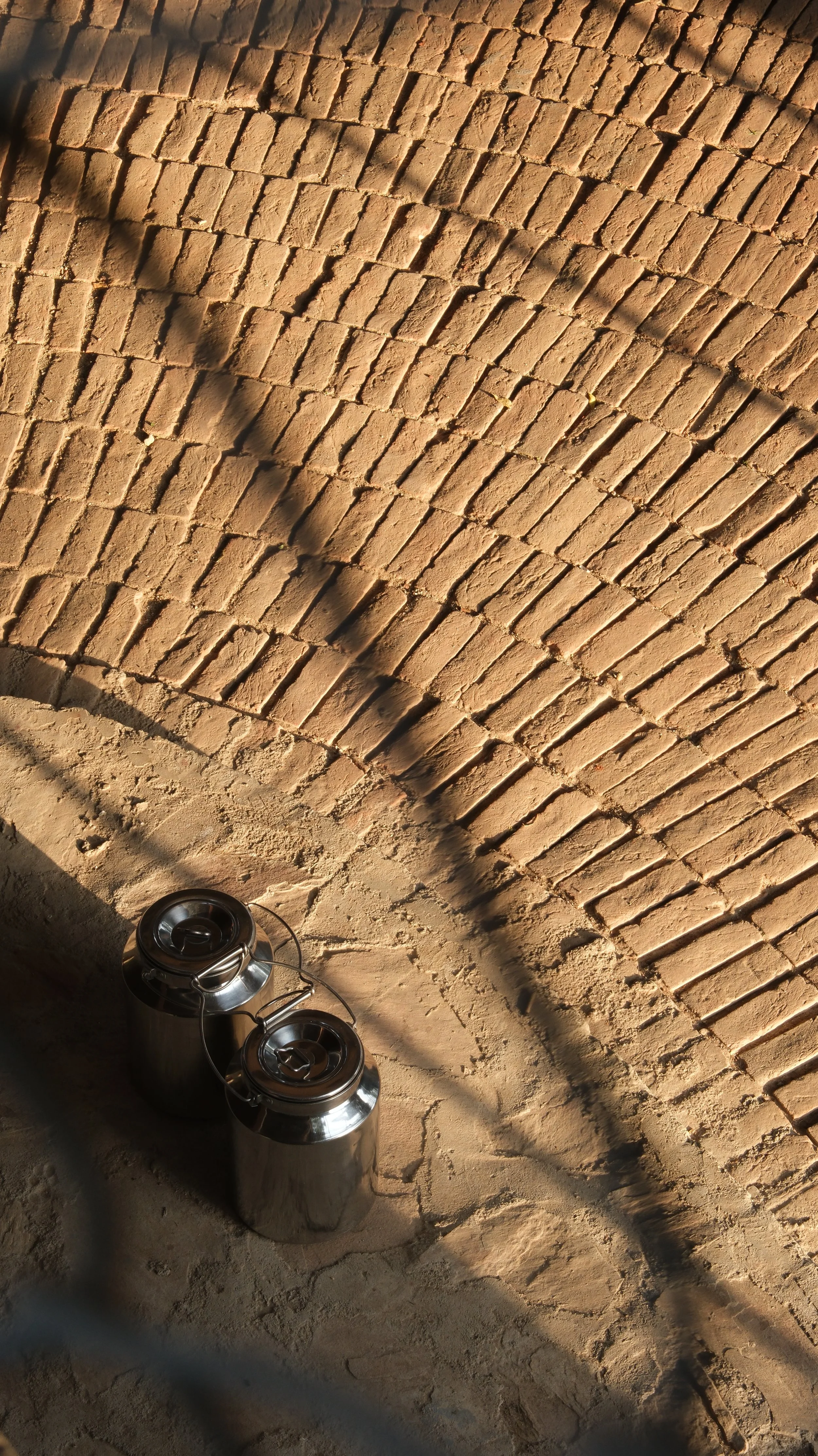
Milk churns in the gaushala (image: Eshwarya Grover).
With the recent launch of the government’s 2024 programme dubbed “White Revolution 2.0”, India has doubled down on its efforts to promote indigenous bovine species, build new gaushalas, and introduce certain state taxes to maintain existing ones. Currently, milk demand is catered for by either large-scale milk cooperatives or else singly owned shelters that are not economically sustainable. “We’re missing something in the middle, where gaushalas are sizeable enough to invite volunteers and children to see where their ghee and ice cream comes from,” says Singhal. The gaushala by Saar, beyond being a climate-ready architectural prototype, also strives to become a viable, profitable model for the town to adopt and self-sustain.
In this part of the world, where cows hold so much cultural significance and are an intrinsic part of people’s living, it is time for gaushalas to enter formal design discourse and for their potential as community assets be explored properly. Feeling inspired the next morning, I catch a few moments of conversation with our milkman, Dharmendra, who delivers a litre each to some 10 households from a volunteer-run ashram in the outskirts of Udaipur. As he’s swiftly swapping the empty glass bottle kept on the kitchen windowsill with a milk-filled one, I ask him what made him leave his village to help out at a not-for-profit gaushala with 15 cows. He shakes his head slightly, as if to dismiss the question, then pauses in order to meet my eye. “I learned to care for cows from a very young age,” he tells me. “I understand them, and in turn, they bless me with good health.”
This article is a tribute to the newborn calf, who sadly passed away the morning after the author’s gaushala visit having been born four weeks premature.
Words Rupal Rathore
Images Eshwarya Grover