
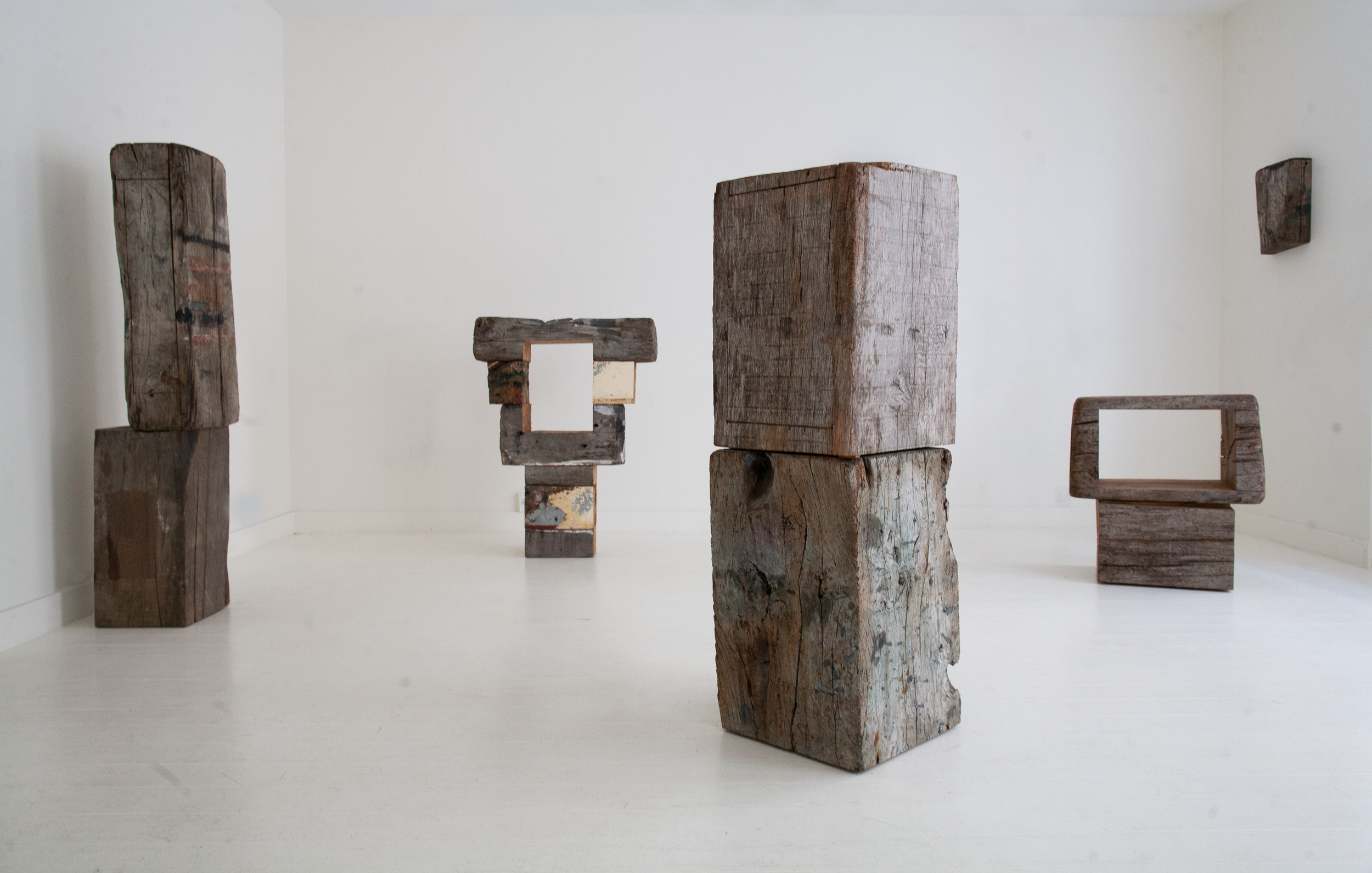
Objets de valeur by Martin Szekely, installed at Galerie Signé (image: courtesy of Galerie Signé).
In 2011, in the run-up to his landmark Ne Plus Dessiner exhibition opening at Paris’s Centre Pompidou, designer Martin Szekely welcomed Disegno into his Paris studio. The journal was preparing its inaugural issue, and Szekely was to be one of its first subjects. Ushering the title’s founder, Johanna Agerman Ross, into his neatly organised studio, Szekely provided a commentary on how he saw his then-four decade career within furniture and object design.“I don’t do it for people,” he told Agerman Ross, whose resultant feature focused on the duel strands of practical making and theoretical reflection that run through all of Szekely’s design. “I don’t do it because I want create a better world. I do it because I like to consider the boundaries of furniture. What makes a chair a chair?”
Fifteen years later and Szekely is still probing at these same boundaries. In Galerie Signé, a space in Paris’s Saint-Germain-des-Prés, a white room is now home to Objets de valeur, Szekely’s latest, and ostensibly final, body of research into the questions that have fascinated him for more than fifty years. Since his breakthrough Pi furniture collection, created between 1982 and 1985 for Pierre Staudenmeyer’s Néotù gallery, Szekely has spoken of a desire to get to the “hard stones” of an object: conceptually and physically paring designs back until their origins, purpose and material choices come to suggest an inevitability to their final form. “Pierre Staudenmeyer,” Szekely explains, “who was the first to show my work in the 1980s, once remarked: ‘Furniture occupies humble ground within the territory of art because of its inescapable ties to function, and yet, for that very reason, it has a power that works of art do not possess.’” Szekely’s Pi lounger, for instance, the collection’s most celebrated constituent, broke its typology down into an elegant assemblage of graphic licks of lacquered steel and aluminium, replacing volume and excess with a concentration of essential lines and forms that beautifully bore down into the construction and purpose of a lounge chair. “The utilitarian dimension,” Szekely says, “is ever-present in my work.”
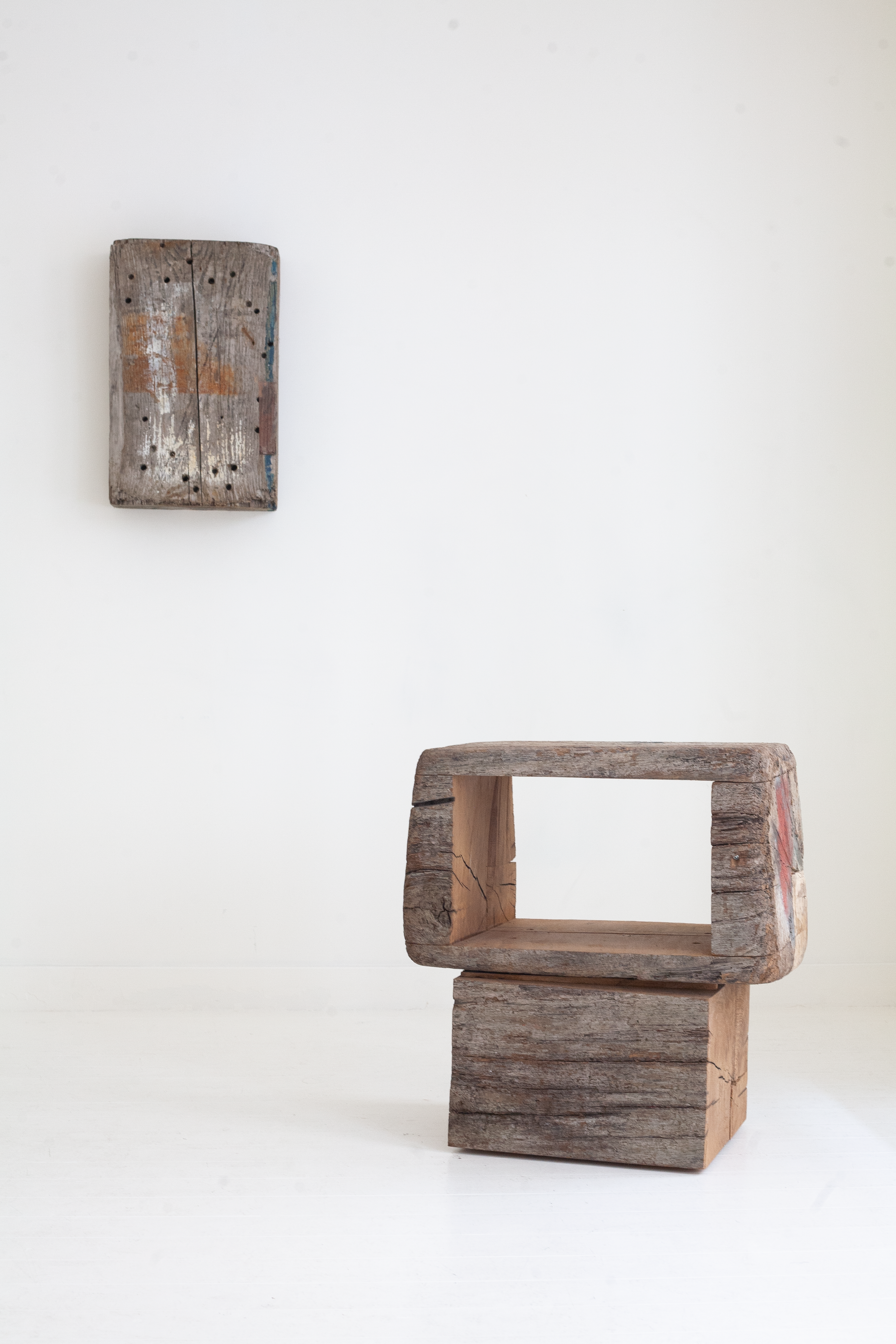
Image: courtesy of Galerie Signé.
The Objets de valeur pieces do not resemble Pi physically, but are possessed of the same attitude as Szekely’s earlier collection. Spread throughout the Signé space are wooden benches, shelves, pedestals and cabinets, yet the Objets are simultaneously none of these things too. Each piece is suggestive of a defined functional usage, but remains resistant towards easy categorisation: there are surfaces on which to sit, place objects or lean, yet the forms are not so rigorously defined as to admit of no other possible interpretation. Each object is an assemblage of wood that Szekely has salvaged from shipyards in Normandy, the region in which his atelier is now based, and which he has treated with consummate care and preservation: each Objet has been formed from a small number of simple cuts made into the reclaimed material using simple hand tools. “The approach taken in Objets de valeur is concerned neither with the history of the object, nor with the choice of material –which, in this case, imposed itself on me – nor with its intended use,” Szekely says. “Only the methods of making played an essential role, expressed through geometric cutting lines (the intellect) marked out on large blocks of wood with uneven surfaces (nature): what Western carpenters have called the Art du trait since the eighteenth century.”
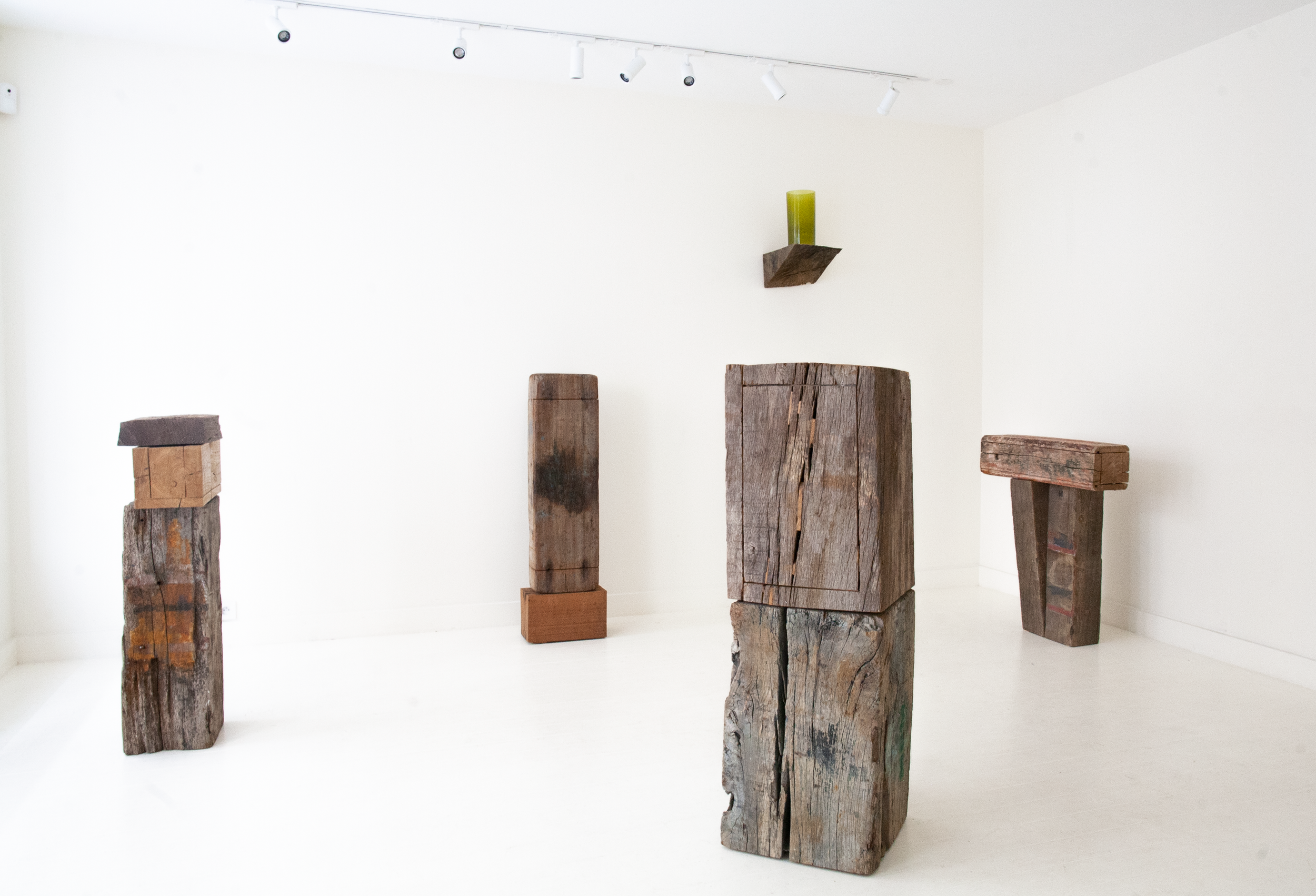
Image: courtesy of Galerie Signé.
Szekely’s work has often manifested an elegance and refinement in materials, from the tempered glass of his celebrated 1996 Perrier glass and a 1998 stainless steel reflex hammer for the European Neurological Society, to his 2011 plaster and glass units for Galerie Kreo and solid wood podium for the 1992 Winter Olympic Games. By contrast, the wood of Objets de valeur wears its history and past usage plainly. Each piece is made from fragments of beams and boatyard chocks, whose fabric of drill marks, holes, cracks and faded paint have been preserved and put forward as essential to the character of the material. “These large blocks of wood were originally trees, then fashioned into ships’ timbers,” Szekely explains. “Years later, dismantled, they became support blocks in shipbuilding and repair yards, handled without care. They immediately drew me in through the traces of life they bore: wear, impacts, stains. These accumulated traces are the visible marks of their journey, and this is what makes them unique. This is the state in which they appear to me and make their presence felt. It was a matter of preserving the impression conveyed by these almost ‘individuals’ of wood at our first ‘encounter’, and prolonging their lives.” The objects display their hard stones, and Szekely’s theoretical inclinations are in full flow throughout Objets de valeur, yet the more practical elements of his practice have been kept purposefully restrained and unobtrusive. The pieces are furniture, yet also remain unashamedly gathered raw material, salvaged from the immediate surroundings of Szekely’s Normandy atelier and subjected to the minimum intervention required to push them in the direction of objecthood. “Had I modified them more than necessary,” Szekely adds, “these blocks of raw material, laden with history, would have lost their intrinsic strength and appeal.”
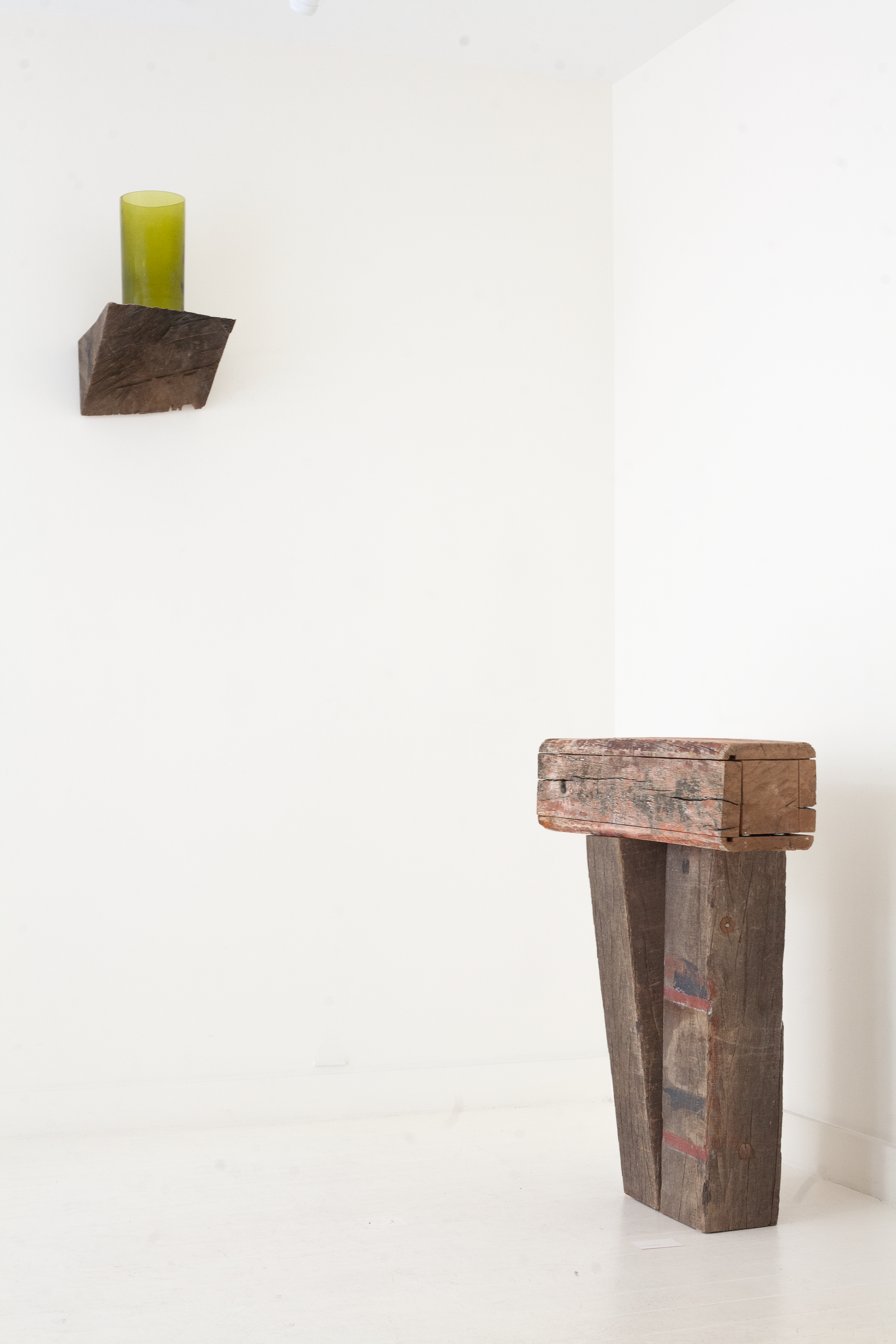
Image: courtesy of Galerie Signé.
The Objets de valeur, then, are a fitting closing act for Szekely’s life’s work within design, uniting his thoughtfulness surrounding his profession with his grounding in practical making: he trained, after all, as a cabinet-maker at the Boulle and Estienne schools in Paris, before working as a carpenter prior to finding recognition for Pi. In Objets de valeur, this same balance between practice and principle plays out in the meaning that lies behind the cuts that Szekely has made in each piece. “Above all,” he explains, “the guiding thread in Objets de valeur is a method of making used long ago in China: the ancient Chinese made coffins by making six saw cuts around a tree trunk. Once the six cuts had been made, the core of the trunk was removed and the deceased laid in the resulting hollow. This principle, with its extreme simplicity and evident economy of means, is powerful. Applied to raw wood, it allows its status to change without altering its outward appearance. Issey Miyake used to say that a new principle inevitably generates something new. In this case, it is the reinterpretation of this ancient principle that makes it new.”
Words Oli Stratford