

The Swiss landscape from which new scent design brand Eryon has drawn its inspiration (image: Daniel Civetta).
As Nathalie Noël speaks, the Valser Rhine bubbles through the Vals Valley, glinting in the early evening light, and the wind whirls down from the Grisons Alps, whipping itself around the curtains that frame the balcony of the room in which she is standing. “We tried to bring deep Swiss elements into the world of scents, so we worked with the light and we worked with the wind,” she explains, pausing for a moment as a gust draws the curtains up into a linen flurry. “Which is obviously very present today.”
Noël, a former marketing executive for the Swiss design brands Vitra and V-Zug, has travelled to Vals in Switzerland’s Canton Grisons from her home base in Lucerne for the launch of Eryon, a new scent brand that she has developed with her partner Thomas Serres and perfumer Clémence Besse. “So why was this brand born?” Noël asks her guests, who are assembled in a Kengo Kuma-designed hotel room above the town’s 7132 Thermal Baths, a monastic spa designed and opened by Swiss architect Peter Zumthor in 1996. “The world does not need a new fragrance brand – there’s already a lot of them,” Noël continues. “Saturated is an understatement, yet there was a reason why we’ve done it.” Eryon, she continues, is an effort to introduce the “intention” of product and furniture design into the world of scent creation. “One day, I looked into my fragrance wardrobe, and realised that I had actually stopped wearing any of it,” explains Noël, whose career prior to design began with a role at cosmetics brand L’Oréal. “When I wondered why that was, I realised that I wasn’t sure it was being designed in the way I was asking other products in my home to be designed.”
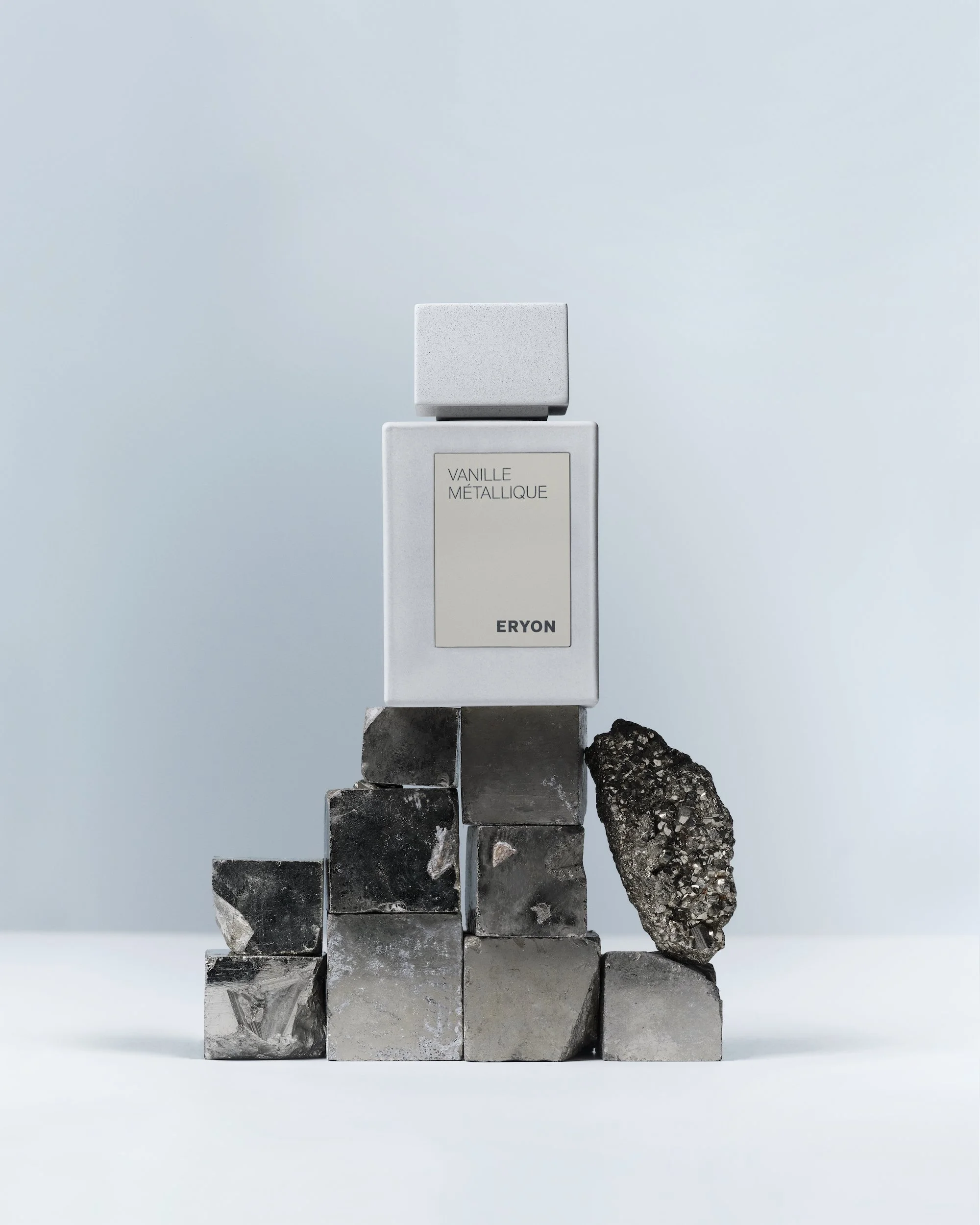
Vanille Métallique, one of the eight Eryon eaux de parfums (image: Nacho Alegre).
Across the room, Besse begins to hand out samples of one of the eight eaux de parfums that she has created for Eryon, for which she has mixed aromatic molecules to explore “the materiality behind a scent”. “So the first reference of the collection is Alba Bianca, which means ‘white dawn’,” she says, distributing strips of paper that wear her work lightly. “I wanted this presence of white light suspended between air and water, and I composed it with many facets to make it clean, luminous, like a white morning.” The smell is mineral and clear, forming part of Eryon’s two “Lumière” scents, part of a wider collection that also includes three “Matières”, which range across pear, fig and vanilla, and three “Intense”, designed to reflect the scent of forests and alpine landscapes at night. While Alba Bianca and its Lumière stablemate Silence Minéral are the lightest scents in the collection, none of the Eryon collection are intended to be overpowering or dominant. “Right now in the [perfume] industry there is a bit of a fragrance war of creating scents that last longer and project bigger,” Noël explains. “That’s not us. We want to create scents that are very close and the whole palette is designed for you to be able to decide how far you want to go.” As such, each scent can be worn individually (with the Lumière scents clean and fresh, Matière moving into sweeter terrain, and Intense offering darker and more rich notes), or else combined and layered atop of one another, with the wearer encouraged to explore different scents across the skin and clothing at the same time.
With this in mind, the Eryon collection has been designed as a collective work, structured around certain signature notes, such as extracts from Angelica root sourced from Switzerland’s Jura Vaudois. “The edit works well because I thought of all the fragrances at the same time,” says Besse, who purposefully prioritised natural molecules in the creation of the scents, with no pre-composed bases to ensure that Eryon could manage its formulas precisely. “I was in a very specific state of mind, moving between macro and micro, so that I can see the collection as one, while also seeing each formula differently.” The key brief, Besse continues, was to “synch with Switzerland – its identity, landscape, inspiration,” with this remit ranging across the country’s natural landscapes, but also picking up on notes such as the fig, pear and vanilla that are employed within its cuisine. Across the collection, there are recurring notes of sweetness and ripe fruit, lush vegetation and fragrant wood, “but there is always a lot of water and minerality, which is an affective world that hasn’t been used as much within perfume,” Noël adds, drawing on Switzerland’s alpine lakes, rock faces and mountainous waterways as inspiration. “In all of the scents you have a little mineral something, because that’s a fundamental part of the DNA of our world that Clémence has composed.”
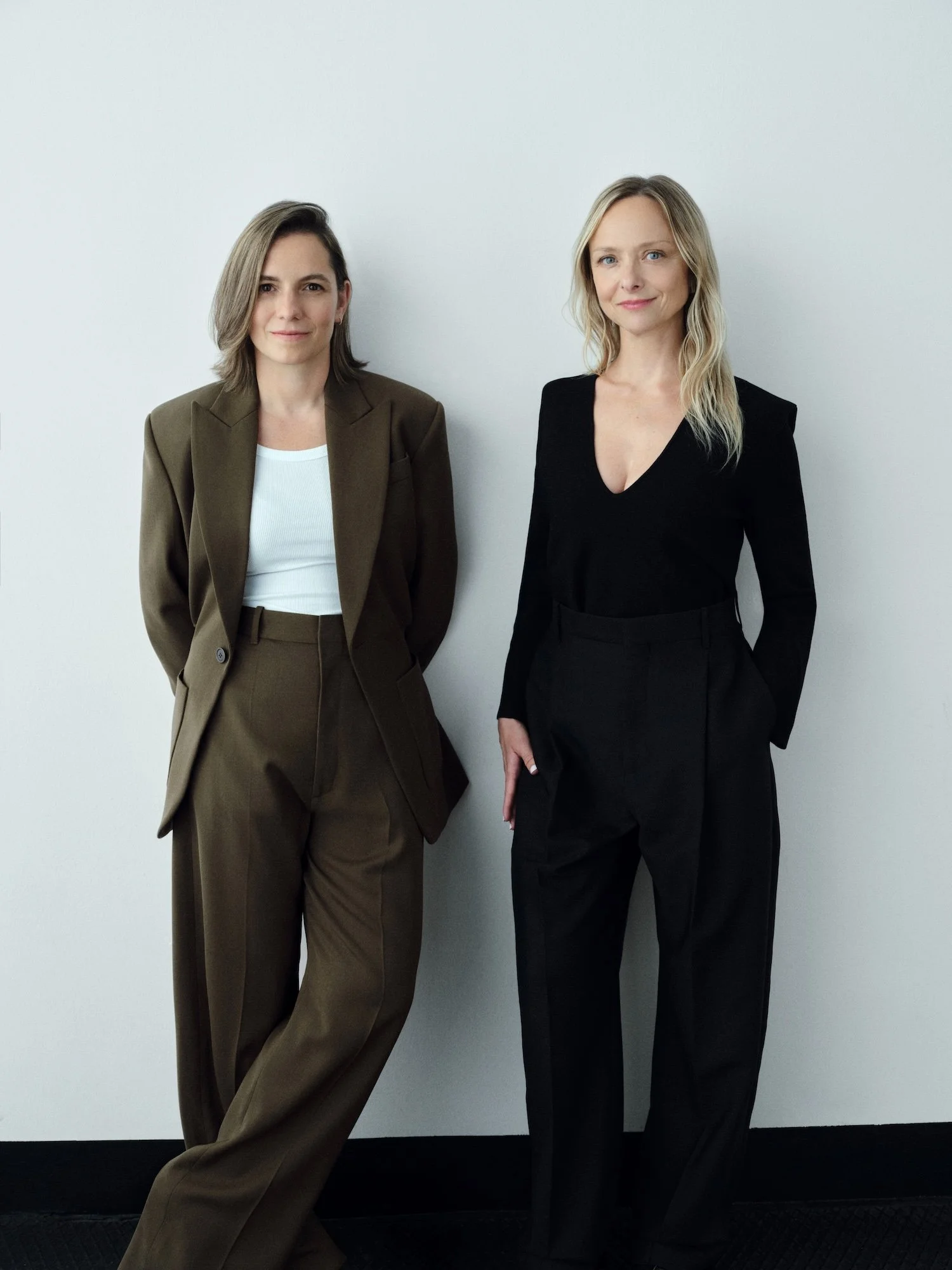
Nathalie Noël (left) and Clémence Besse (right) (image: Yan Wasiuchnik).
This kind of systems thinking, Noël suggests, is part of Eryon’s product-based approach, which sits alongside her interest in discussing ideas of functionality in relation to scent. “All of the objects in my home were very intentionally chosen, looking at the materials they were made from,” Noël explains, “and I choose very intentionally my fashion. What do I wear? What is it made from?” Within perfume, she suggests, this same approach is often lacking, with Eryon seeking to apply lessons from other design fields as a remedy to this. Noël cites the work of Swiss Alpine architect Gion A. Caminada as an inspiration for the brand, whose reconceptualisation of the American architect Louis Sullivan’s maxim that “form ever follows function” instead argued that “before there is form – there is place.” Caminada’s attentiveness to people and the places in which they live, made manifest in Eryon’s focus on Swiss landscape, is also apparent in the architecture of Peter Zumthor, Caminada’s compatriot and the designer of the 7132 Thermal Baths in which Eryon is launching. Zumthor, the 2009 Pritzker Prize laureate, has achieved widespread acclaim for his buildings’ focus on graceful integration with the sites on which they are built, with Noël admitting to an admiration for his focus on “presence” within architecture – a capacity to ground a person in present experience by offering, as Zumthor argued in a 2013 lecture at Tel Aviv University, “a gap in the flow of history, where all of [a] sudden it is not past and not future.”
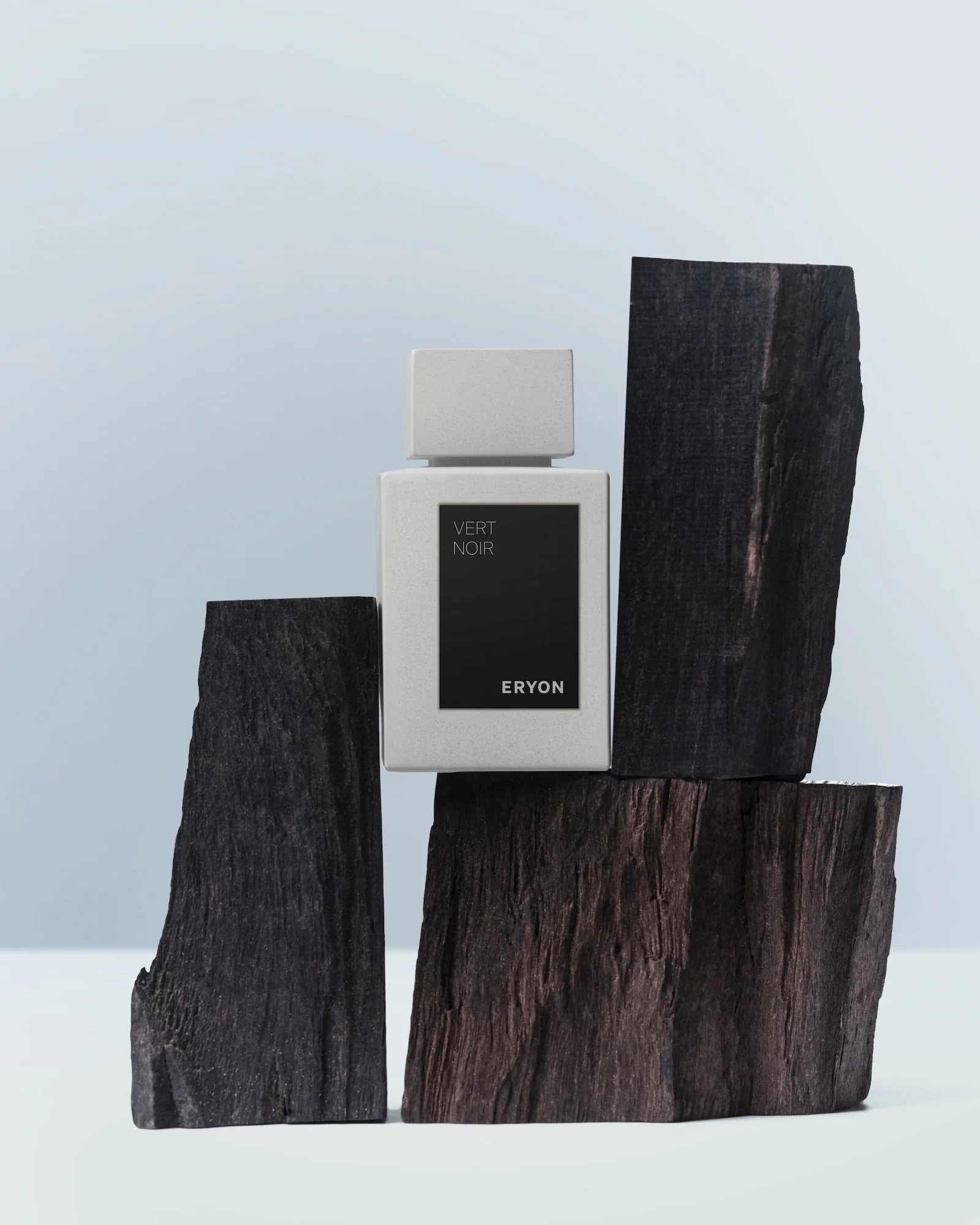
Vert Noir, one of the eight Eryon eaux de parfums (image: Nacho Alegre).
With Eryon, Noël suggests, Zumthor’s focus on presence is interpreted as providing a key functionality for scent. “What are the emotional registers that we want to touch with a scent?” she asks. “Can we bring in a moment of presence and an emotion that we want to generate?” The goal of Eryon, she explains, is to provide “an olfactory palette” that can offer different atmospheres at different times of the day, with wearers encouraged to switch and layer scents to suit their moods, as they would with different garments. The Eryon scents are intended to individually evoke different registers and emotions and experiences (Pera Fredda, for instance, is sweet and honeyed, yet has a mineral quality intended to evoke the fruit laying fresh under a thin layer of frost), but also to transition with a person’s mood throughout the day. “It’s a palette that can accompany you into different moments of presence,” Noël elaborates. “It may be that when you start your day, you wake up in the morning and everything feels possible, everybody’s asleep, there’s no noise and there’s beautiful light.” For moments such as these, she suggests, scents such as Silence Minéral offer a material reflection of the sensation of optimism wearers might experience, whereas tones like the Intense Après Lumière might better match the sense of drama and warmth of an evening event. “When we went back into the world of intentionality, we felt that what we wanted to do with the collection is create a universe where people are able to find themselves in the emotion that they either feel, want to be in, or want to project,” Noël says. “We want to help place consumers in a very specific state of mind.”
This, Noël argues, is purposefully akin to a Swiss state of mind, with Eryon seeking to draw on the country’s heritage within industrial and graphic design – from designer Max Bill’s (1908-1994) notion of “die gute Form” (the good form), a concept proposed in rejection of the styling, frippery, ego, and in-built obsolescence that Bill saw in much of the design that surrounded him, to the systems thinking of architect Fritz Haller’s (1924-2012) modular USM furniture joint. For Noël, Eryon seeks to draw lessons from this national design history and apply them to scent, as well as connecting to the country’s natural landscapes on a more emotional level. “Switzerland has an amazing design heritage, which is how we’re also trying to do things,” she explains. “And on the other side is what our scents actually smell like, which is where we’re trying to translate the beautiful, elemental power of our country.” Outside, the cold wind from the Grisons Alps continues to blow down the slopes, carrying through the curtains to pick up Eryon’s notes of angelica, pear and vanilla, and carry them throughout the room. “We are a Swiss design brand,” Noël concludes, “and with that we want to work with the land, the wind and the water.”
Words Oli Stratford