
A Place We Wish to Be
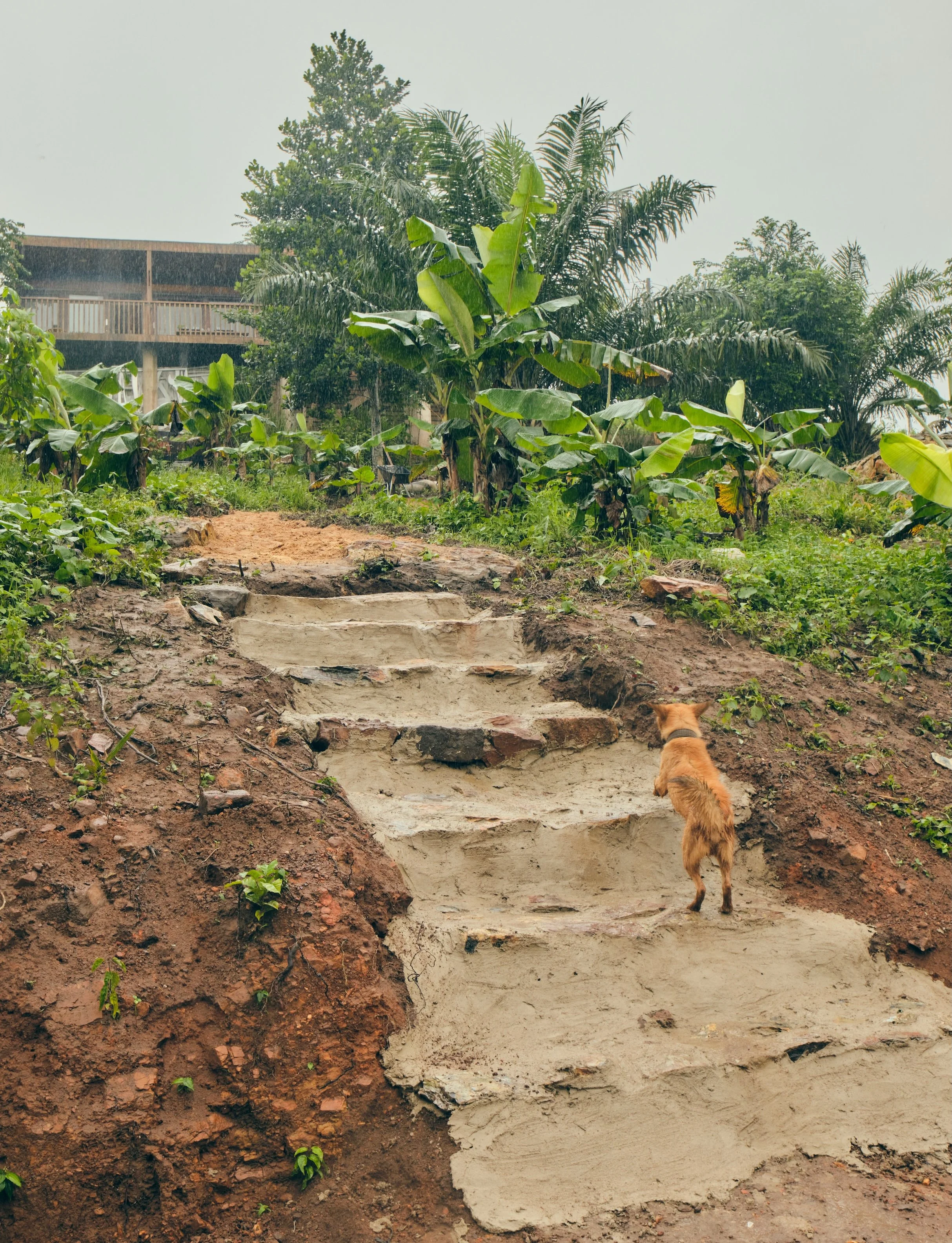
ANO’s new educational space in the Aburi Mountains, Ghana, is inspired by indigenous knowledge systems which combine art, education and ecology (image: Alfred Quartey).
“You have to provide a vision, and this is where I say your duty lies. But the point is, which kind of vision?”
There are some questions that I carry with me always. The one above is drawn from poet Kofi Awoonor, speaking about the role of artists at a 1967 conference of African writers. Another comes from geographer Ruth Wilson Gilmore. In ‘Abolition Geography and the Problem of Innocence’, she asks: how do we make the places we are into the places we wish to be?
The land we come to is in the midst of Konkonuru, a town within Ghana’s Aburi Mountains. It is the rainy season and fog touches everything almost always, but especially in the wake of downpours. On days when it clears, I see the entirety of a steep half acre dotted with patches of oil palm, pawpaw and plantain trees. The land is rocky and, walking down the slope, we make a path navigating the large stones, grasses that reach our knees, and dozens of plants whose names I don’t yet know.
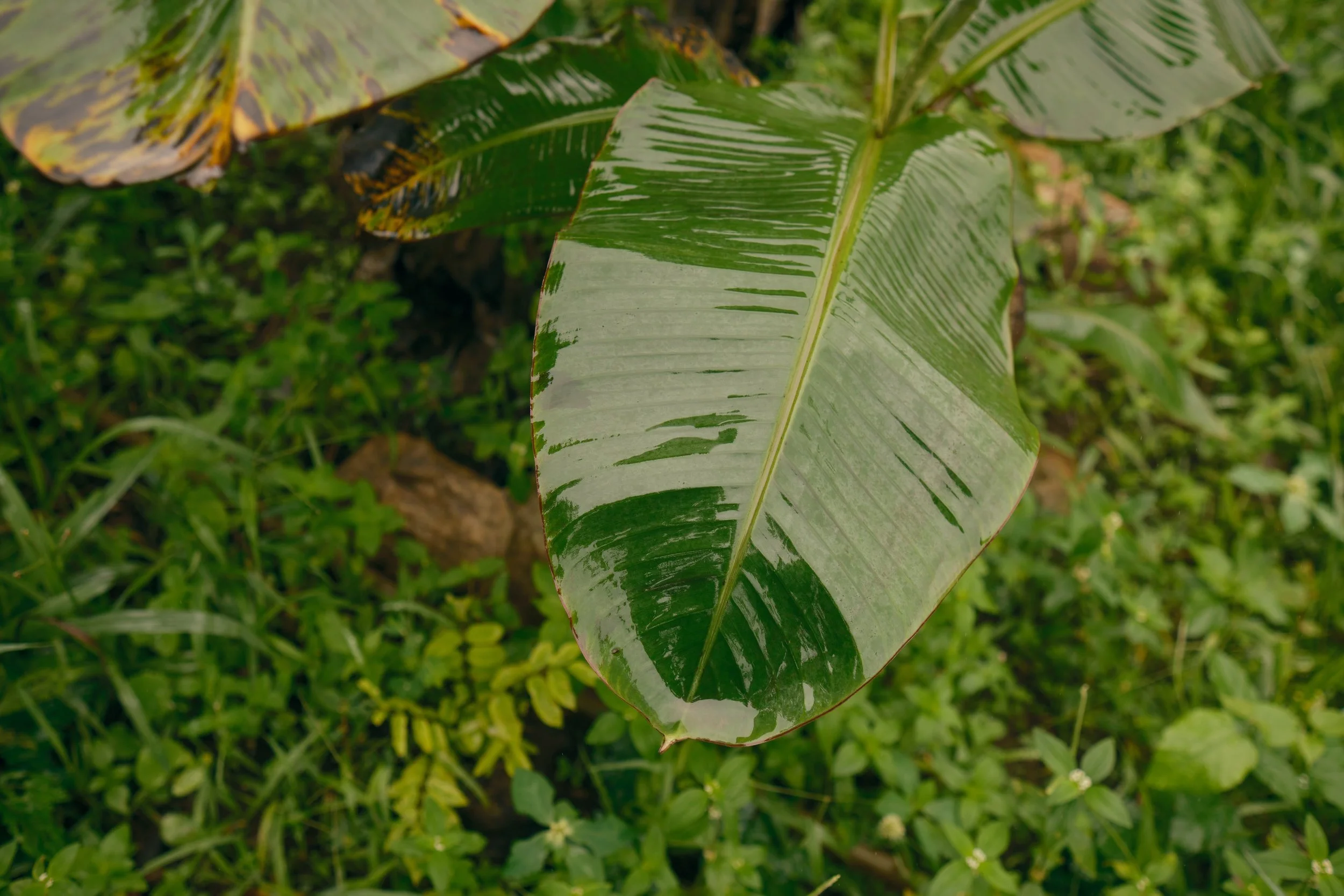
Image: Alfred Quartey.
Despite the height of the forest on the drive to the land, the treescape is relatively young. Timber extraction and fires resulting from drought in the early 1980s have transformed the ecologies of Ghana’s Eastern Region, disappearing much of the original forest around the Konkonuru area. Alongside the extraction of palm oil and cocoa, large areas of forest in Ghana were subsumed into the British government’s project of acquiring “empire timber”, or woods from various British colonies. As architect Iain Jackson details in his work with the Transnational Architecture Group, the British-owned African Timber and Plywood Company played a central role in extracting African mahoganies, walnuts and teaks that were used to construct the interior decoration, floorings and furniture of British homes, universities, post offices and libraries from the 1950s and 60s onward.
In a conservation report dating to 2002, curator William Ofosuhene-Djan describes a silk cotton tree pictured in black and white as “the sole survivor of the original forest that once covered the Aburi hills”. He writes of an abnormally thinned treescape where one can easily count trees from a distance, the scarcity of bitter kola, odum and atee-nini, combined with the total disappearance of others, even as the forest was beginning to reclaim itself. On a visit to Aburi Botanical Gardens, my guide extends this loss of trees described by Ofosuhene-Djan some 20 years ago to an associated loss of knowledge, expressing how children no longer learn the different species’ names, much less the possibilities of engaging with the beings around them.
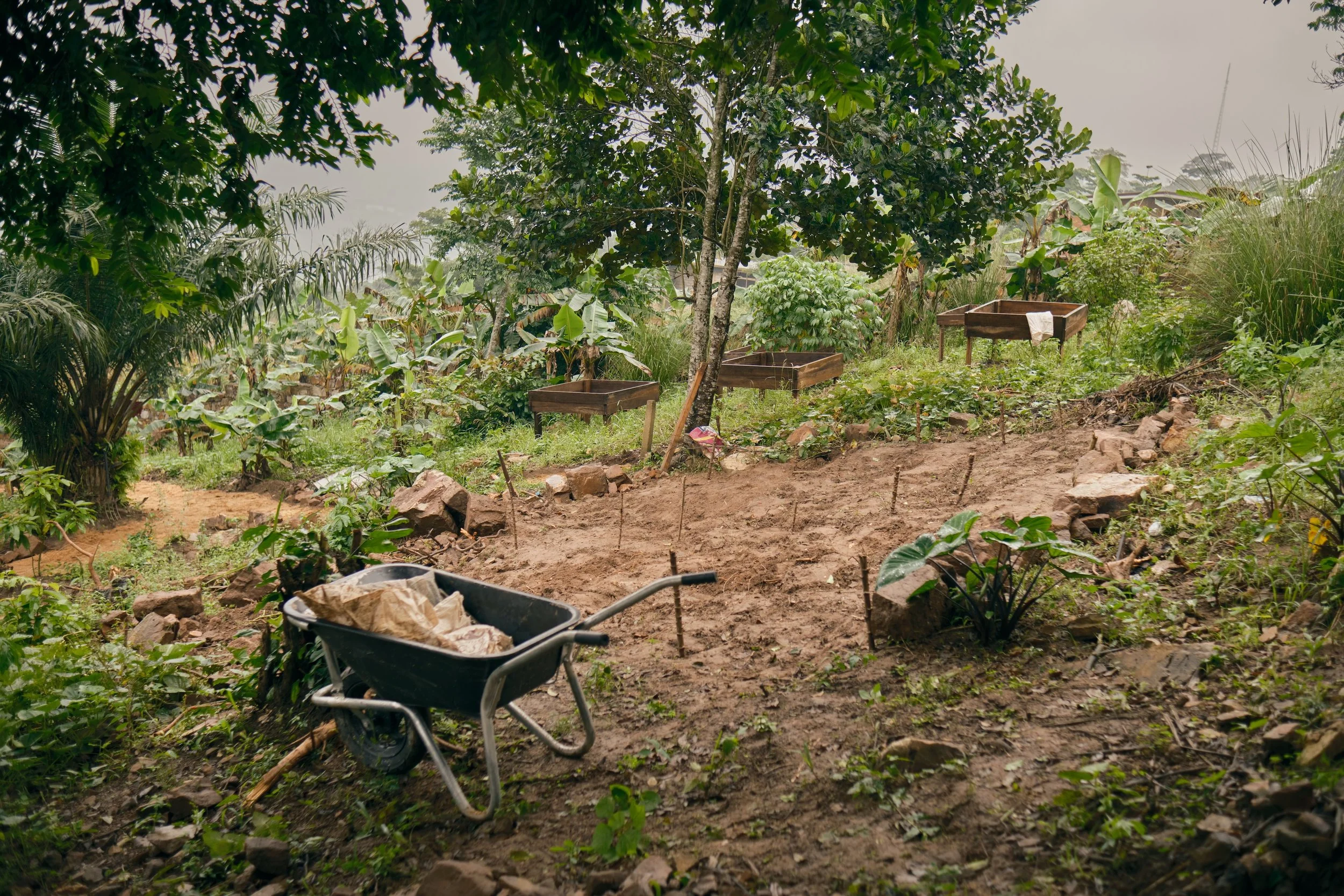
Planting underway at ANO (image: Alfred Quartey).
In this way, where I am is not unlike many other places – a landscape that has been transformed by colonial inheritances. As everywhere, it is navigating imbalances imposed by the illusion that it is possible to grow infinitely with finite material. And here, too, bodies of knowledge that have for so long sustained a balance have been overwritten with those that employ violence against land and life to acquire wealth by any means. Each day we see the story unraveling as lives and livelihoods are disordered by disrupted ecologies and racialised hierarchies of human and non-human life.
This all appears so entrenched as to be immovable – as though it has always been. But it hasn’t, and it is worth remembering that Gilmore’s question asks of where we wish to be. Centred around a transformation of how we sustain ourselves, the land that I imagine is somewhere that life’s flows are rewoven. It is a place whose stewards conceive of creativity and collective memory as being necessary to imagining a world that is different to this one. Those who come there to learn and teach reconsider what we have inherited, how we construct buildings, grow food, dye clothes and understand waste. There are jars of heirloom seeds and they serve as a library of sorts, borrowing and gifting the practice of patronage. Nonuniform rows of plants and colossal drooping banana trees compel us towards a literacy of land that extends beyond the page. The place is one where people come to learn of possibility, and where presence is healing.
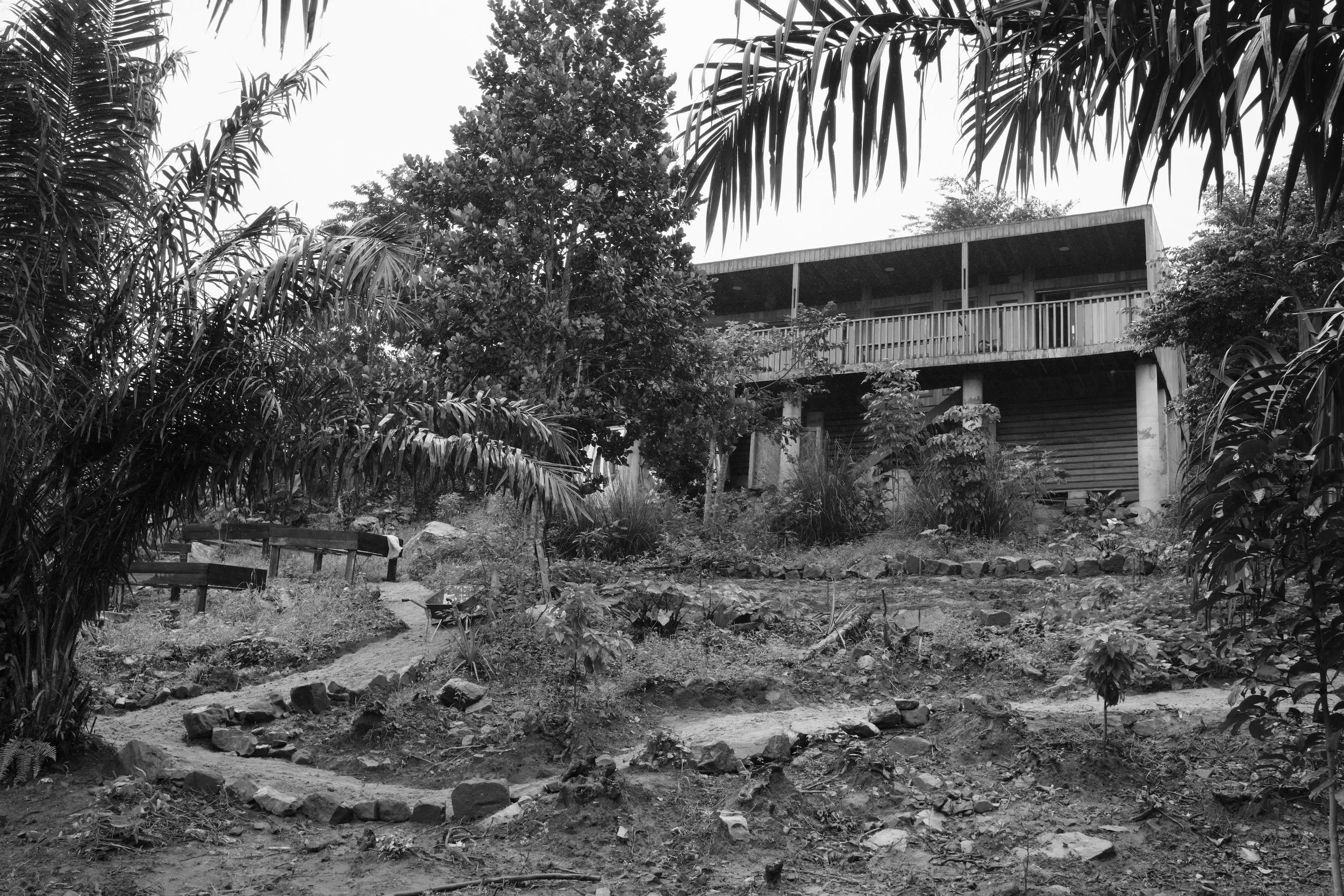
This is reminiscent of Konkonuru itself, which has long been a town of healers. Founded two centuries ago, it was originally the base of the standing army of Aburi, and residents became skilled in addressing injuries and ailments resulting from war. This ecological knowledge and distinction remained even after war left. So the place I imagine is one that, in some way, returns to itself.
I find myself there with one other person of a most carefully attentive spirit, Taeya Boi-Doku. Her presence brings light and the most brilliant questions. With our hands in the soil alongside one another, we share laughter and labour, delighting in the sweetness of shared purpose.[1] Our task of transforming the land into an educational space is something we are doing as fellows with the ANO Institute of Arts and Knowledge, or ANO, an organisation founded in 2002 by writer and art historian Nana Oforiatta-Ayim.
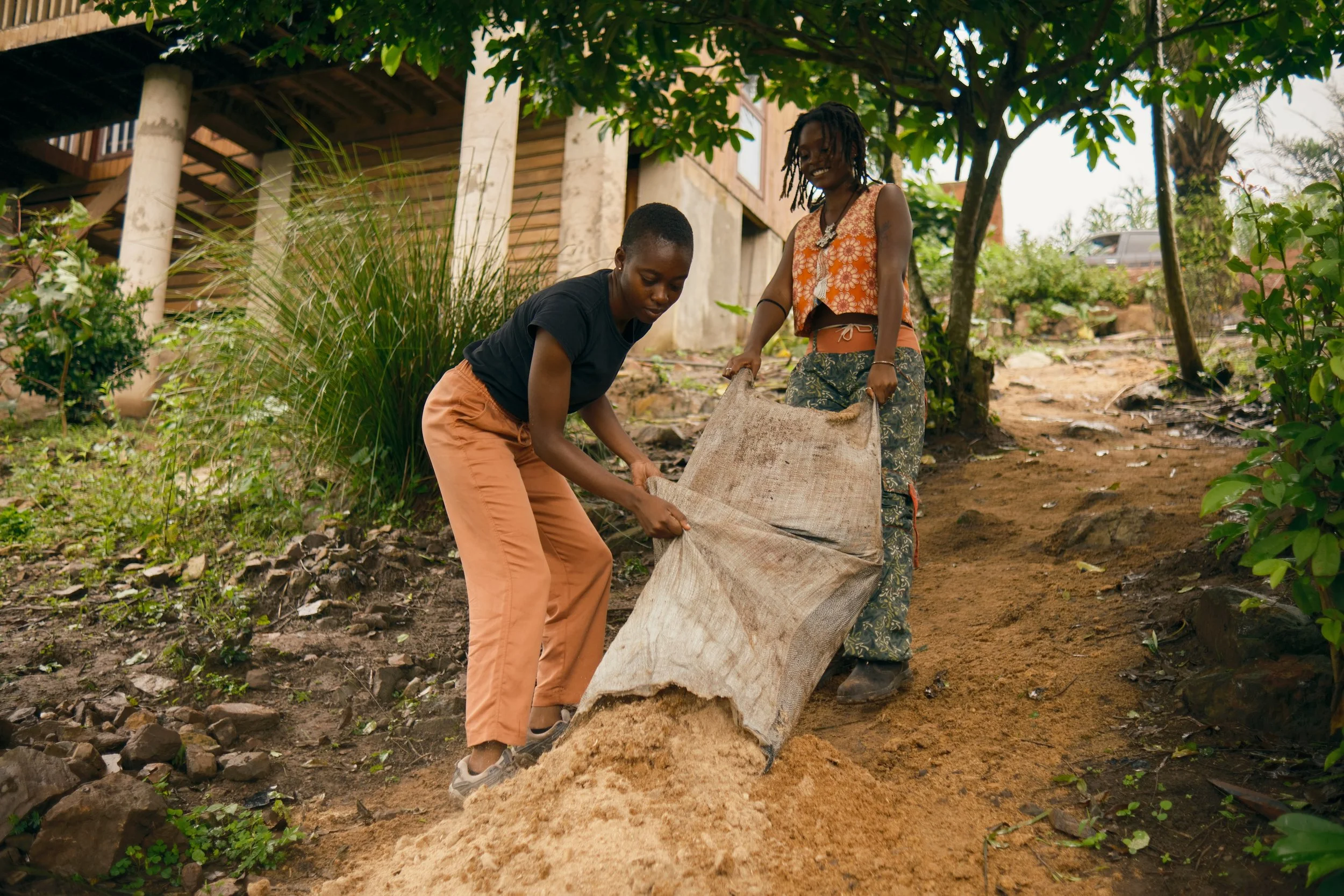
Fowota Mortoo (left) and Taeya Boi-Doku (right), working on the ANO garden (image: Alfred Quartey).
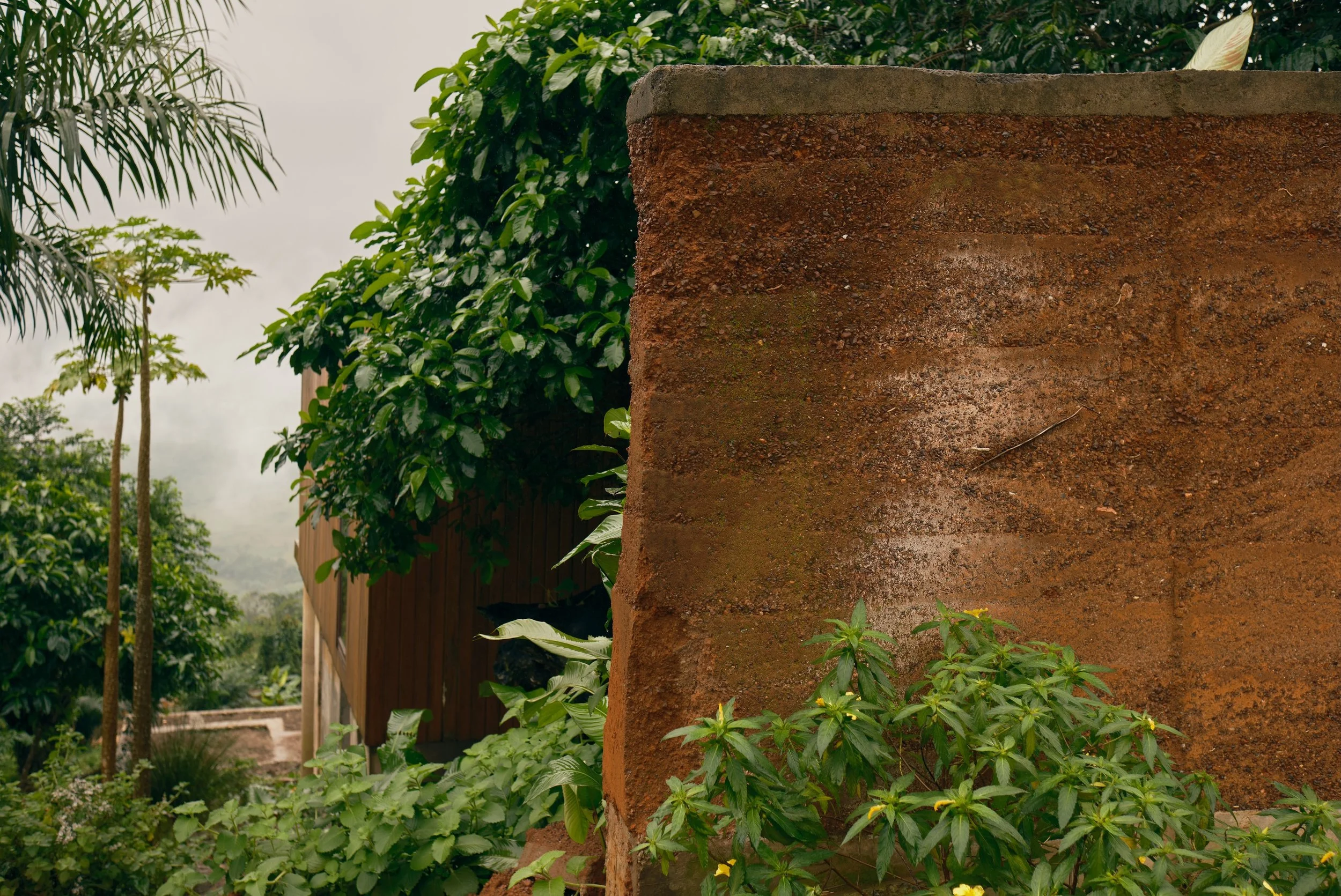
ANO’s work centres on creating new institutional forms that diverge from the existing model of Western cultural institutions on the African continent. As the organisation shifts away from an exclusively arts-centred model, there is room for work that recognises how the arts and knowledge systems are interwoven with broader philosophies of ecology and education. Alongside an educational organic farm, the new space will include a school, as well as accommodation for culinary and artist residencies. In Ayim’s words, the shift has been prompted by decades of research relating to indigenous knowledge systems where “art and culture are linked to cosmologies, education, knowledge of nature and the earth”. These structures are being designed and built in collaboration with Hive Earth, a studio based in Accra, Ghana, which specialises in rammed earth construction. The organisation is also in conversation with Worofila, an architectural practice based in Dakar, Senegal, which employs bio-climatic construction and foregrounds the use of local materials. Building on ANO’s decade-long work to produce the digital Pan-African Cultural Encyclopedia, which will launch in September 2024 and documents aspects of indigenous knowledge systems across the continent, our task is to design a physical space that translates these bodies of collective memory into spatial form.
In trying to create a place that reanimates this memory, we navigate the facts of erasure – of knowledge, lifeways and names – that make it more difficult to imagine, let alone materialise, a world different to this one. And still, as archivist Judith Opoku-Boateng told me once: “Deɛ ɛmoa no adi no, wɔnni nkɔ, deɛ aka no, yɛbɛbɔ ho ban” – “The birds may have taken their share, but we will protect that which is left”. We intend to do this, though not with humid storerooms or pillaged “collections”, but by recalling that the way to keep archives alive is by living them. And so we begin with misshapen blocks of nyame dua, odum, bamboo and palm, with the ever-present materiality of memory, and with shears in our hands that can be made useful towards this envisioning guided by our inheritances.
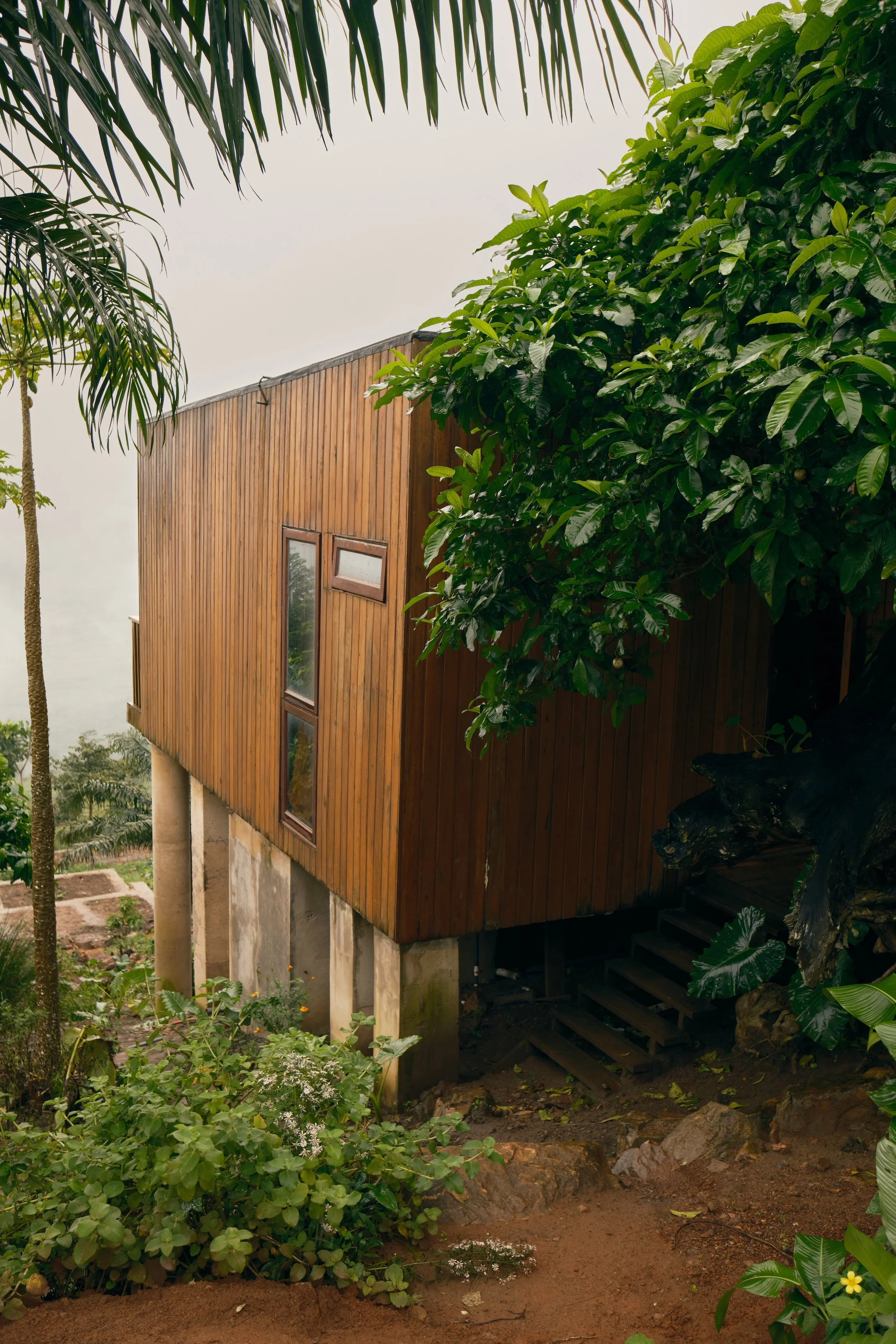
A residence in the ANO space (image: Alfred Quartey).
Our sketches for this place take form in bound notebooks that migrate to Google Drawings, in sandy soil soon covered with footprints, in the margins of pages, in the exchange of breath and ideas aloud. They depict a mosaic garden whose pieces align with the contours of the land, a small enclave of plants that can give natural dyes for artists in residence, and a long communal table that will host meals centring indigenous dishes. As we work, we encounter those who I have come to think of as the healers, despite having no such formal designation. Their knowledge is invaluable to how we shape the land, and is reminiscent of novelist Ayi Kwei Armah’s 1979 novel The Healers. The book is one of the things I bring with me to the land, and I return to it in the evenings, spellbound. Armah speaks of the healers as those whose work is the “ending of all unnatural rifts”. They must see beyond the present and tomorrow, working for “results so firm they may not be wholly visible till centuries have flowed into millennia”.
The first we encounter while we search for seeds.
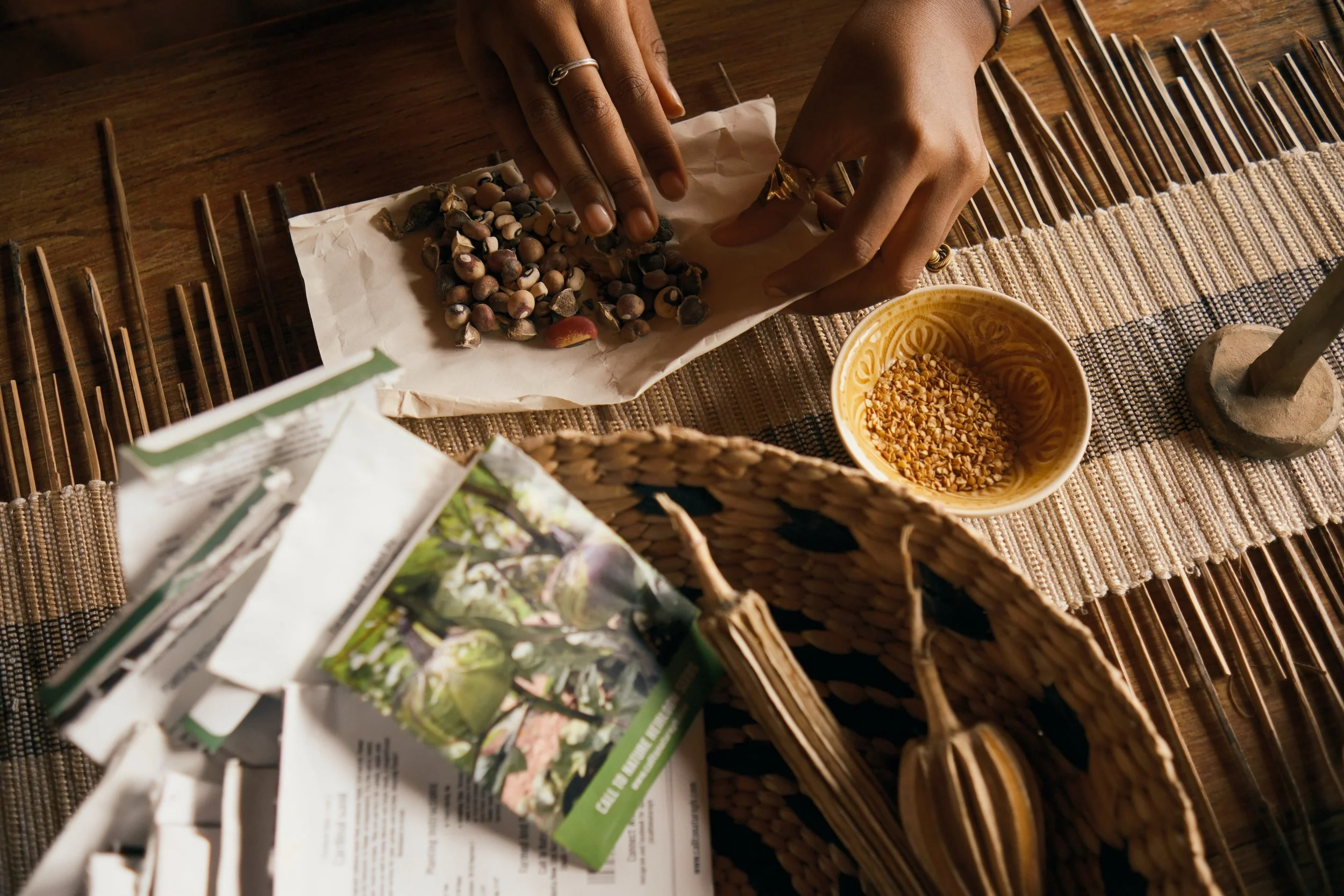
Indigenous seed varieties (image: Alfred Quartey).
Early in gathering material for the land, we travel a few hours north to Bolgatanga for an indigenous seeds fair. The event is organised by Beela and Trax Ghana, two organisations based in the Upper East Region working to maintain farmer-managed seed systems. It takes place in the town’s Jubilee Park where dozens of farmers from the country’s Upper East and North East Regions have gathered for a seed exchange. Those in attendance are seated by region under three large white tents facing a raised platform that plays host to speeches about the importance of retaining an autonomous and sovereign food system, of which the foundation is seed.
It brings together seeds that many in attendance have not seen in decades, all of which are indigenous varieties. These seeds can enable the traditionally cyclical and autonomous practices of seed-saving; they differ from hybrid seeds that are bred in order to produce higher yields, but which cannot be resown to bear fruit, undermining farmer autonomy and community-managed seed systems as growers are forced to buy new ones each season. Preserving and sharing them through gatherings like this retains seed variety, which is crucial in sustaining foods that have been passed down through generations, and securing adaptability and farmer autonomy despite yearly shifts in growing conditions.
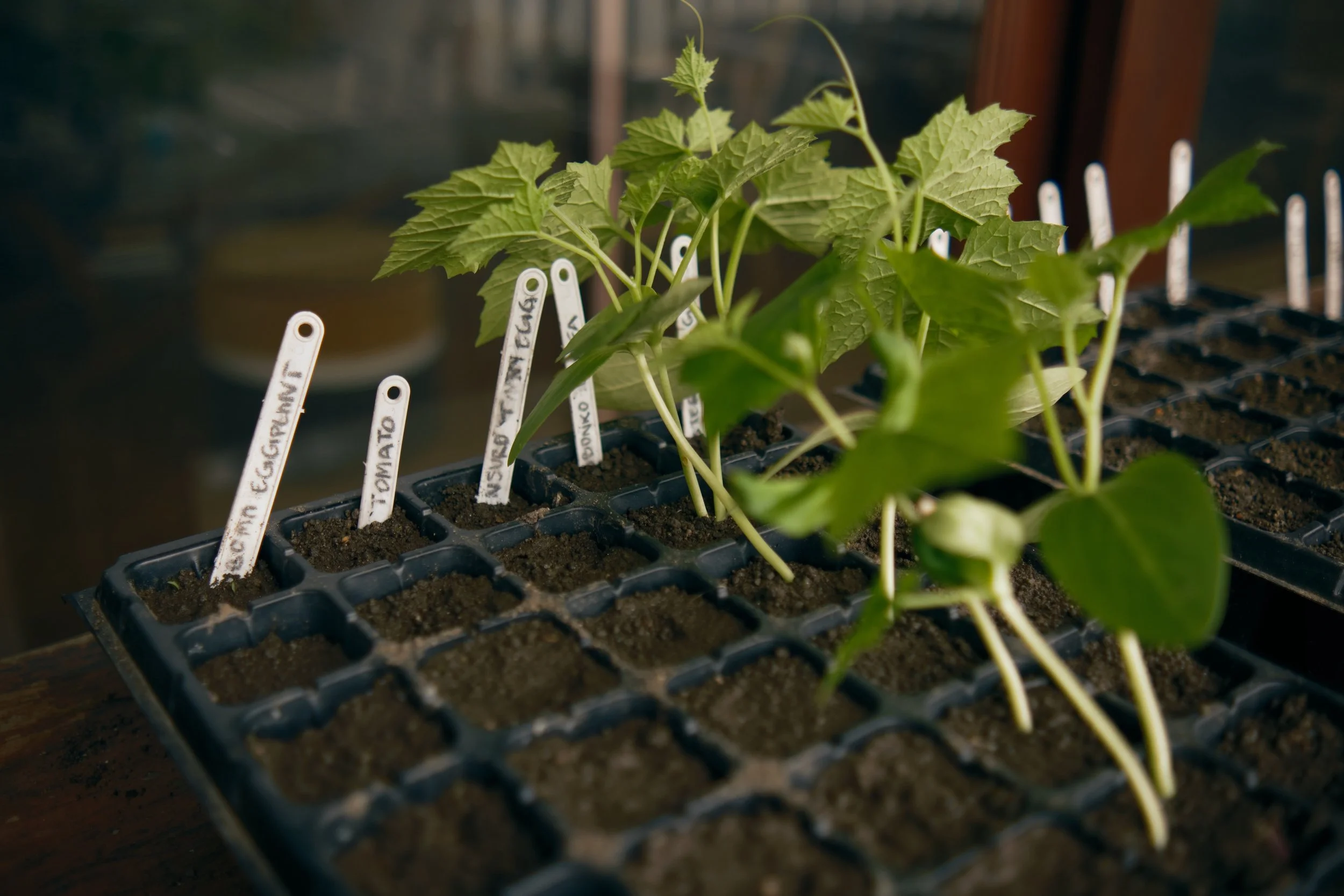
Seedlings prepared for ANO (image: Alfred Quartey).
One of the speakers, Edwin Baffour of advocacy organisation Food Sovereignty Ghana, references replacing millet with corn in making the dish tuo zaafi, especially across southern Ghana. It is a shift, he notes, that could one day lead to a loss of memory that things had ever been otherwise. He emphasises millet as a drought-resistant indigenous grain that is less acidic, higher in fibre and more nutrient-dense than corn. Though the global food system has been shaped to be dominated by select varieties of every fruit, vegetable and grain, this work of preserving diversity of seed is critical, as each seed has characteristics that make them best suited to grow in different circumstances, whether related to water, heat or soil.
The significance of this distinction in seed type is reinforced a few days later during a visit to see Solomon Amuzu, the founder of Call to Nature, the first heirloom seed company in Ghana. Through Amuzu we source a number of seeds to add to those that we’ve gathered in the north: akokomesa basil, Techiman tomato, bokoboko spinach, apatram and ase beans, and nkruma tenten, a variety of okra. Neighbouring Asenema Waterfalls, Amuzu’s farm is bordered by massive bamboo, prekese and oil palm trees and, as he points to each of the areas of land planted to give seed, he tells their story. The evivi ntor basil was gifted from a woman he met in the Volta Region, and the seeds from one of her plants have brought forth thousands. The Nsoso cherry tomatoes he encountered on a walk through the forest.
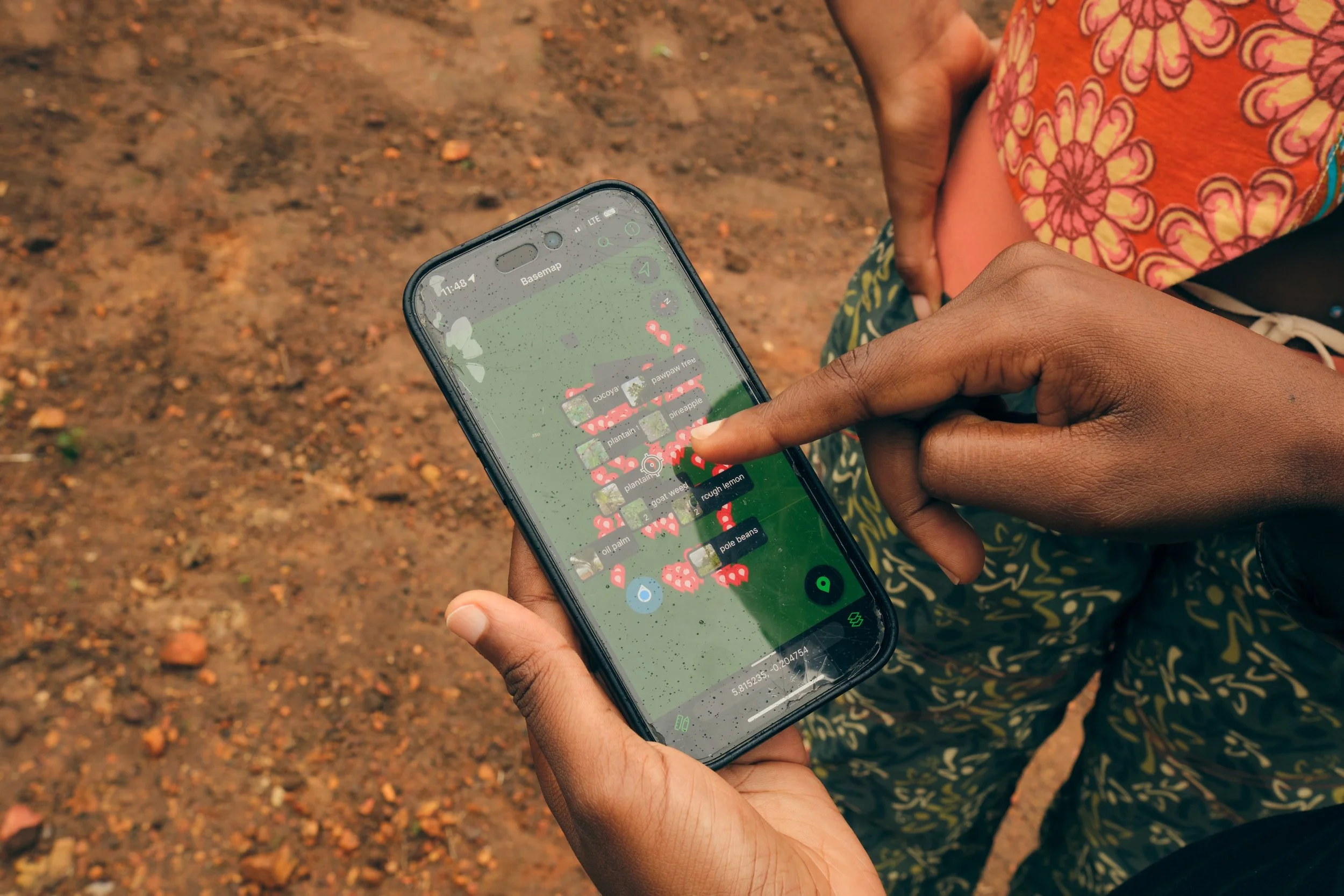
Mapping the location of different plants (image: Alfred Quartey).
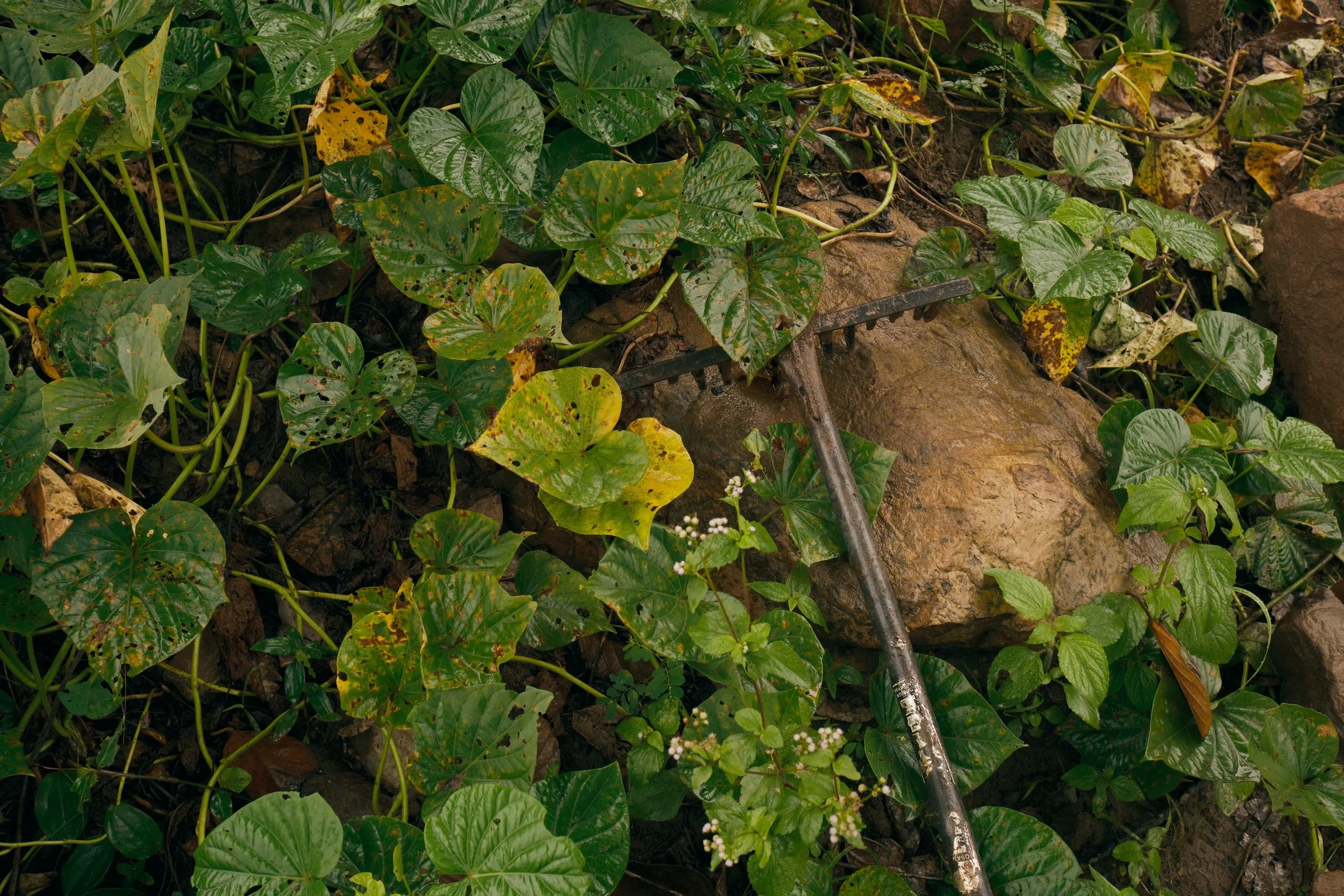
Back on the land in Konkonuru, we work slowly in crafting the rows, and shovelling and shifting rocks in order to preserve the existing plants, many of whom we learn are medicinal despite so often being characterised as weeds. Edem Assigbui, the caretaker of the land, is beside us as he is on most days. Whether sourcing pieces of wood or harvesting bamboo from a forest a short walk from the busiest part of Konkonuru, he guides, always affirming the possibility of doing whatever we’d hoped.
On one of these days, we make a short trip north to Kpong to meet Mush Kuma, the founder of Kay Seedlings and an artist. Having studied painting and sculpture, he draws out the texture, colour and shape of the miracle berry bush, the water-loving gotu kola, and the bottle palm trees that surround us in an intensely soft-spoken way, as well as the craft and creativity needed to graft trees successfully. He describes the shift in his practice simply: “I’m still practising art. But the alive one[…] I used to paint plants. Now I create them.”
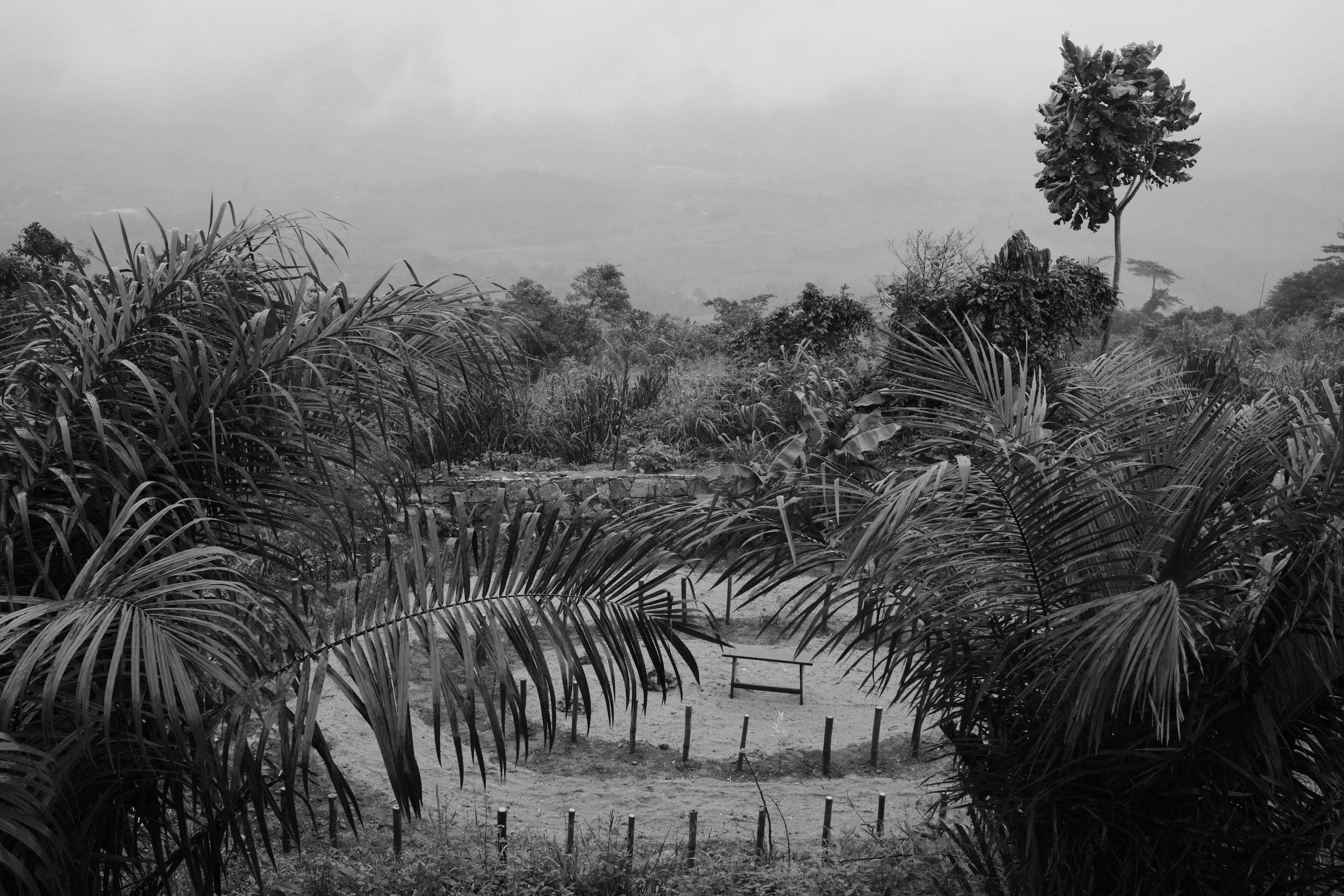
The meditation path (image: Alfred Quartey).
We leave there with a dozen knee-high tree seedlings of various mango, lemon and guava varieties that later form the edges of a meditation path on the flattened area of land towards the bottom wall. Though we can see the entirety of the spiral now, trees will eventually form a shaded canopy over the walkway with fruits that come in and out of season. Arranging the knee-high seedlings in a spiral and lining the in-between spaces with stakes of bamboo, we make a path that is wide enough for two that ends in a small circular clearing. The spiral recalls the Adinkra symbol owia kokroko, or “the greatness of the sun”. At the entrance we place miracle leaf, which is often found at the gateway of homes, meant to deter those with bad intentions. It is one of many plants whose placement signals significance, such as the aviãti, or boundary tree, and bendua, which are often planted in order to demarcate land boundaries.
These designs form the basis of what will be an educational space, abundant with children’s yells of delight and wonder. It will abound with cycles – of water reused, food scraps returning to soil, of building materials that work with the earth.
The place we are making has traces of what, in some ways, I have seen before. There is the Experimental Farm of Pessubé and the pilot schools that were built in the liberated regions of Guinea-Bissau in the 1960s to 1970s,[2] the Freedom Farm Cooperative founded by Fannie Lou Hamer in 1967 in Mississippi,[3] the Somankidi Coura collective in Mali formed in the late 1970s,[4] and more. Centred around creating new possibilities for the spaces they inhabited, each of these sites began with reimagining food and education systems. Recognising the interconnected nature of land, politics, economy and culture, their stewards crafted spaces of refuge and sanctuary amid oppressive structures through their commitment to sustaining collective memory. Spaces like these are continuing to blossom in Ghana and across the African continent, each of which reimagines the notion of the archive by centring reciprocal relationships to land and education. In the midst of intensifying environmental crises, they model a different positioning of ourselves within a web of ecologies, doing work to repair and sustain life.
There is a difficulty in giving a singular name in English to these spaces, as their work is precisely in opposition to the fragmentation of our lives into discrete areas (of school, or work, or play), or our knowledge into disciplines of study. Despite this difficulty, there are, as always, names in other languages. Among them – milpa, mahereko and maroon.[5]
As the end of my stay on the land comes closer, I am engaged in the work of mapping the land. This process has found me often in the company of Richard Amoani, a curator at the Botanical Gardens, and immersed in a new literacy and language. Seated at a large table across from each other, every plant I ask him about, he knows. Following writer Imani Perry’s articulation in her book Vexy Thing (2018) of maps as sites that draw our attention to one set of things rather than another, I am considering what to make visible, and to whom, in these maps that will help orient visitors to the ANO space.
One map will foreground the plant ecologies of the land – their locations relative to each other, their names, significance, and ways to engage with them, weaving in the different uses of plant fibres from the land. The other map will be more reflective of process and with a greater eye to temporality, incorporating old images of the Konkonuru Community Farm Project from a few decades ago, archival maps of Konkonuru, and the silk cotton trees that once covered the Aburi hills. Both are slowly coming into being, shaped by the collective memories that have created this place that we, and many others, have imagined.
[1] In his book The Healers, Ghanaian author Ayi Kwei Armah writes: “The others available were many, of course. The impression they gave of something stable, undisturbed, came from their accepting the existing world as satisfactory. But what deep-eating blindness could make any soul see its satisfaction in such warped realities? The only problems the others saw were two: to find a personal place in the given world; and having found that space, to keep it. But his need was for relationships with people for whom the existing world was not perfect, not even reasonably satisfactory. These would be people whose place in the world was something yet to be created because their real world was not yet entirely present. People to work with.”
[2] Sónia Vaz Borges and Filipa César’s work explores Amilcar Cabral’s state farm Granja de Pessubé and the pilot schools established by the PAIGC political party in the liberated regions of Guinea-Bissau during the liberation struggle against Portugal. Carlos Schwarz expands on this in his text ‘Amilcar Cabral, An Agronomist Before His Time’.
[3] Monica White writes about the Freedom Farm Cooperative founded by Fannie Lou Hamer in Freedom Farmers: Agricultural Resistance and the Black Freedom Movement (2018).
[4] Somankidi Coura was a farming collective established in Mali in the wake of severe droughts that prompted a shift towards autonomous economic and farming practices. The cooperative became a regional model and is described in a research collaboration between co-founder Bouba Touré and filmmaker Raphaël Grisey in ‘What Malian Farming Collective Somankidi Coura Tells Us About the Value of Art’, published in Art Review.
[5] In ‘Milpa Ecologies: Transgenerational Foodways in Tlaxcala, Mexico’, published in Elementa: Science of the Anthropocene, Keitlyn Alcántara describes the ancient milpa growing system of “terraced networks of both agricultural and wild plants”. Chérie Rivers Ndaliko’s forthcoming monograph Mahereko: A Womanist Lexicon of Radical Black Ecology makes reference to the Kinande word. Writer and organiser Beatriz Nascimento’s work, meanwhile, centres on understanding maroon communities, or quilombos in Brazil, as “autonomous Black spaces of liberation” and as a persisting political practice. Her 1989 film, Orí, directed by Raquel Gerber and narrated by Nascimento, explores much of her intellectual and creative body of work on the Brazilian Black Atlantic and the Black Consciousness Movement of the 1970s and 80s.
Words Fowota Mortoo
Images Alfred Quartey