
Witnesses of War
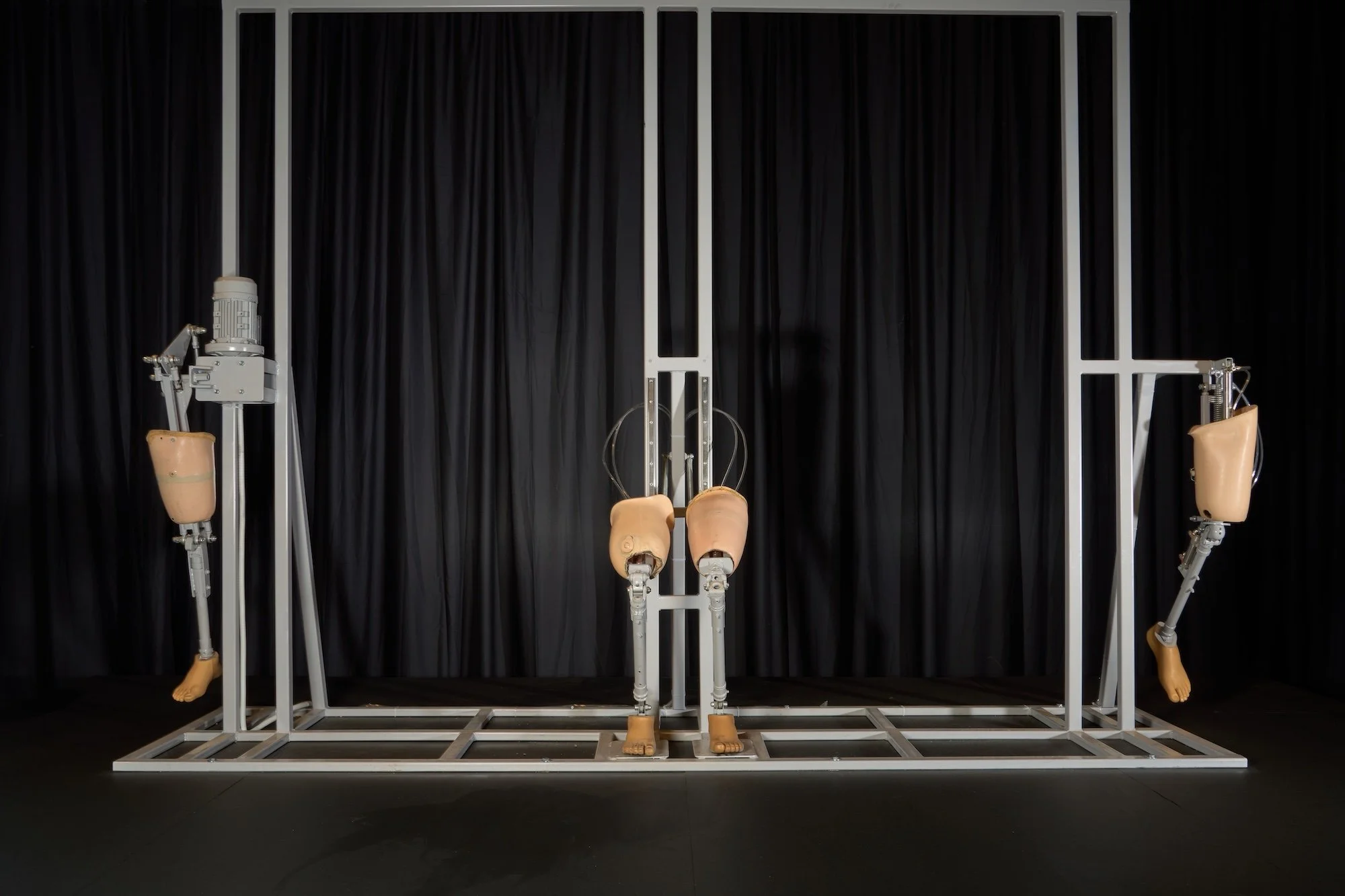
A New Integrity by Nikita Kadan at Pavilion 13 in Kyiv (image courtesy of Dmytro Prutkin and RIBBON International).
“[They] get up and go into the fire, they get up and go into the fire,” writes Nikita Kadan, a Kyiv-based artist, in a poem about Ukrainians heading to the front lines of Russia’s ongoing war against their country. “For you, for me, they go into the fire.”
The poem features in A New Integrity, Kadan’s most recent exhibition at the Pavilion 13 arts space in Kyiv, commissioned and produced by RIBBON International. Described by the artist as a “theatre of automatons”, the exhibition features a series of kinetic sculptures whose motion explores the implications of Russia’s war on Ukraine. Accompanied by oral testimonies from Ukrainian veterans, interviewed by sociologist Sofia Lavreniuk, Kadan’s exhibition combines movement and storytelling to examine the lived experiences of war.
At the centre of the exhibition, a series of prosthetic limbs move through slow, repetitive gestures: legs kicking in the air and limbs twitching through movements that seem human and familiar, yet unusual in their slowness and detachment from the body. In the context of Ukraine, prosthetics have become symbols of both bodily loss and restoration, and reminders of the human costs of war. As Kadan explains, the exhibition explores “what war means, the price of peace and war, and what individual destiny and body trauma mean in both war and post-war realities.”
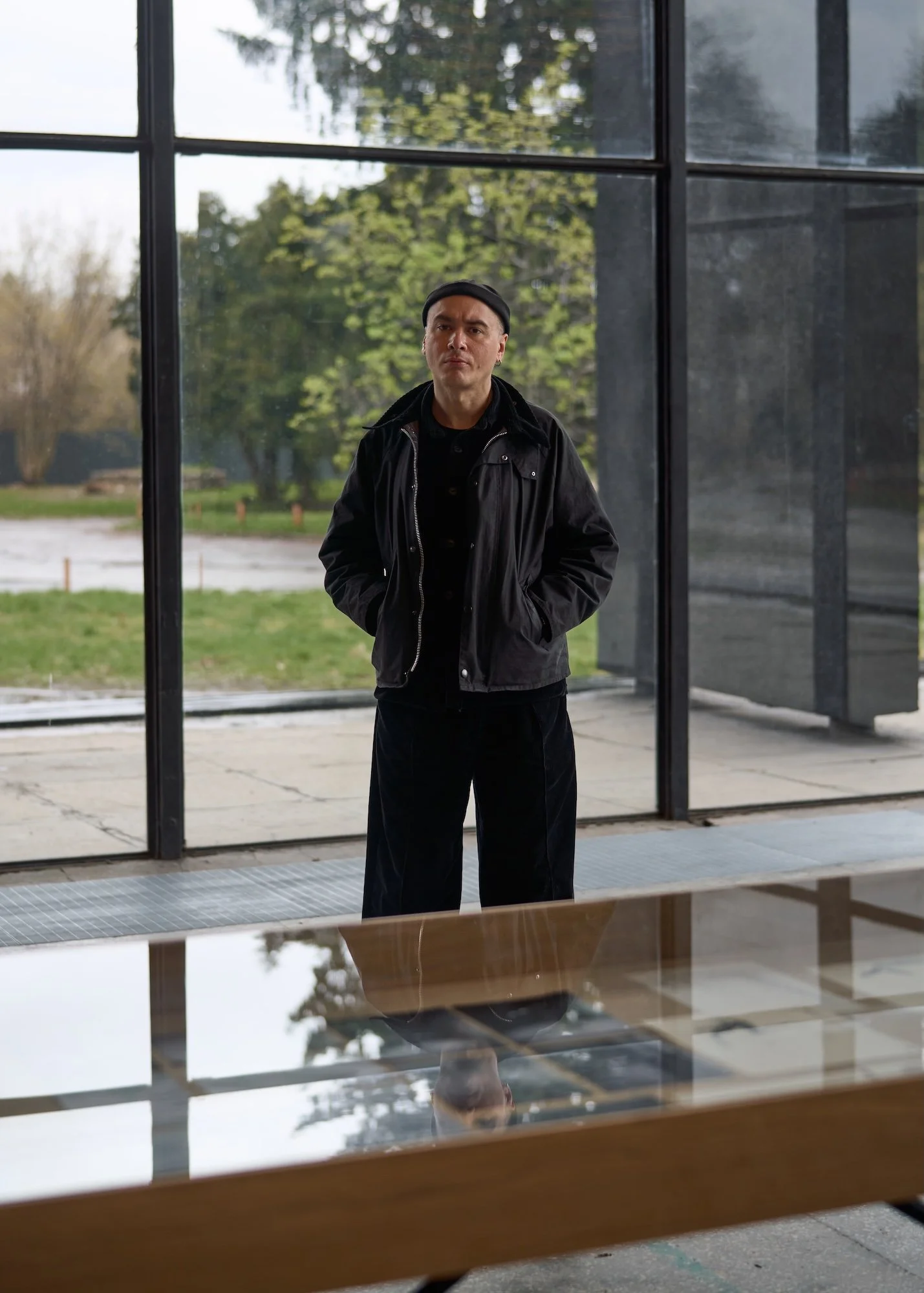
Nikita Kadan in Pavilion 13 (image: Dmytro Prutkin and RIBBON International).
The prosthetics on the stage perform three simple physical exercises, which resemble those a person recovering from physical trauma might perform during rehabilitation – their dedication to their task, even when separated from a body, seeding a feeling of uncanniness throughout the space. Their rhythmic movements have been synchronised to a soundscape by artist Clemens Poole, who blended the real sounds of prosthetics moving with a series of rhythmic, metronomic notes to generate a sense of anxiety.The prosthetics here are not presented as medical objects, but as witnesses of war, transformed through the accompanying veterans’ testimonies into objects of storytelling.
Collected from various rehabilitation centres across Ukraine, these testimonies are voiced by actor Anastasiia Seheda to provide a uniform voice across the audio. “I asked her to perform in a very neutral, almost automatic tone – like the voice announcing trains at a station,” Kadan says. By creating a certain distance between the audience and the voice, Kadan tries to reflect on how a person dealing with trauma may find it difficult to speak about their experiences.
Kadan’s wider engagement with prosthetics as part of his practice did not begin with A New Integrity. Since 2023, he has used prosthetic limbs in several works exploring the social realities of war in Ukraine, particularly the themes of trauma, collective memory, and pain management that are embodied within the objects. Their Voices (2023), for example, featured a prosthetic leg accompanied by a microphone, displayed alongside audio of a soldier’s testimony about the realities of living with war injuries. Another piece, We’ll Stay with You (2025), involved a prosthetic leg suspended in the air, kicking at irregular intervals and generating loud sounds. “It was intended as a reminder of Ukrainians who had lost limbs, who were heavily injured and often unable to access proper treatment, rehabilitation, or prosthetics,” Kadan explains.
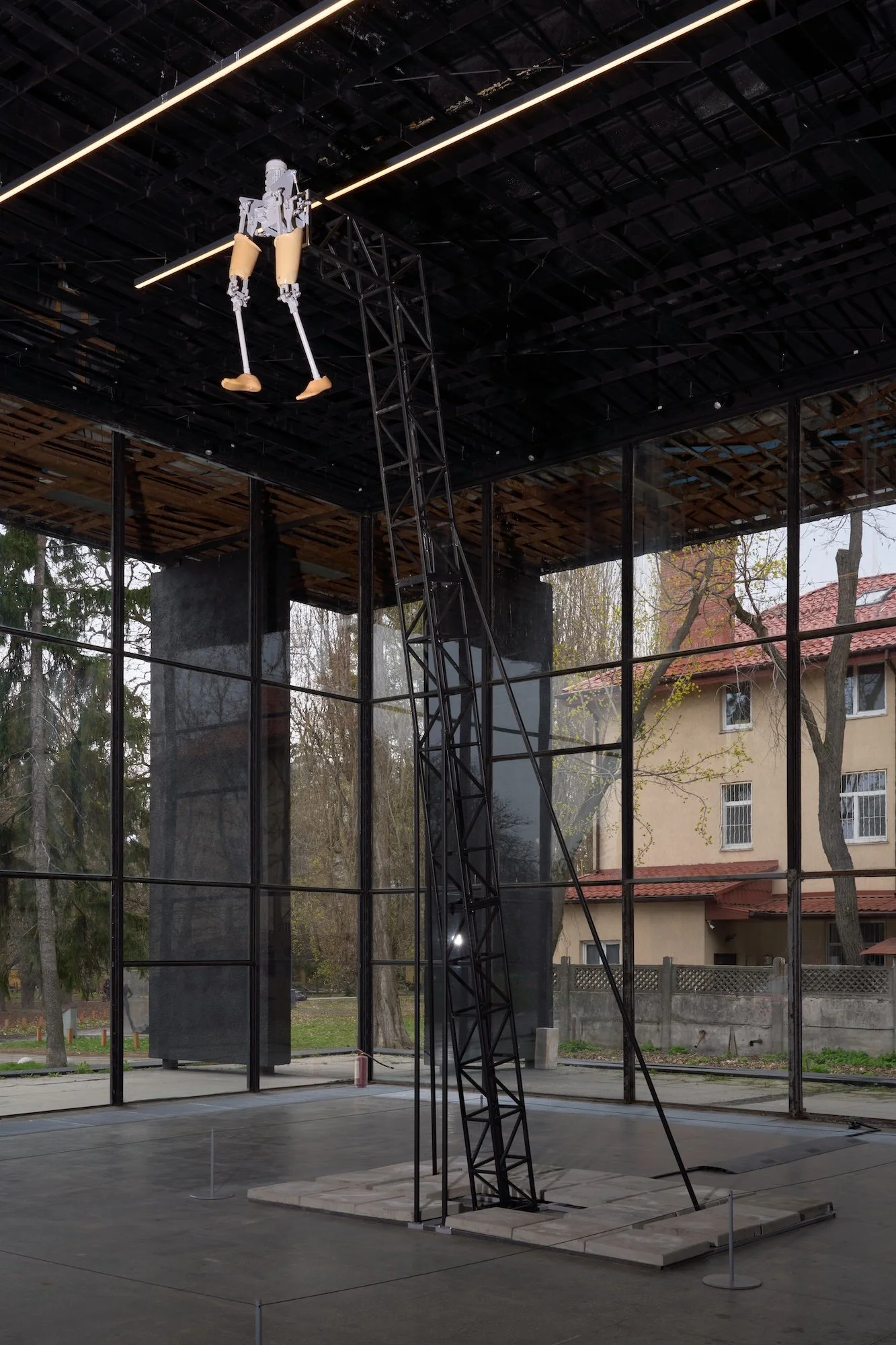
One of Kadan’s prosthetic pieces, installed within the space (image: Dmytro Prutkin and RIBBON International).
A New Integrity represents an expansion of these earlier ideas, combining movement, soundscapes, and oral testimonies together within one installation. These ideas gain further resonance through the physicality and material realities of the designed objects that Kadan works with. He purposefully uses inexpensive prosthetics, for instance, to highlight the lack of facilities and rehabilitation provided to veterans of the conflict. “We took the simplest, the cheapest ones, because not many injured veterans, or injured people in general, can afford them,” explains Kadan. “Many have really cheap ones, and many have none.”
In A New Integrity, as its title suggests, integrity is explored on both bodily and territorial levels. Kadan uses prosthetics to reflect both the fractured state of Ukraine as it pushes back against Russian encroachment on its land, as well as the bodily loss experienced by some veterans. The exhibition also explores how injury and war reshape social integrity, identity and everyday human interaction. Oleh, one of the veterans featured in the installation, describes walking with prosthetics in public: “Their gaze starts low, then slowly moves up higher, higher. I wait for the moment they finally meet my eyes. But they don’t.” Rather than presenting integrity as something that can be fully restored, the exhibition suggests it remains fragile and permanently altered after war.
This approach is furthered through Kadan’s choice to avoid directly depicting traumatised bodies directly. Instead of using photographs or paintings of injured veterans, Kadan focuses on prosthetics and oral testimonies. “In this case, I try to look at the veterans in a less pornographic way,” Kadan says. “When you have a complete body and you attend an art show and you look at an image of a traumatised body, there is something broken there, like some moral crack[…] when you look at pain from a place of safety and comfort.” The decision to centre prosthetics, he says, is a way of shifting an audience’s gaze in a different direction. “Removing the image of the body from the work makes the audience think about the body instead of simply consuming it visually,” Kadan explains. “You are not confronted with a direct visual shock, you do not simply see an amputated body and react immediately. Instead, you become aware of the absence of body parts.”
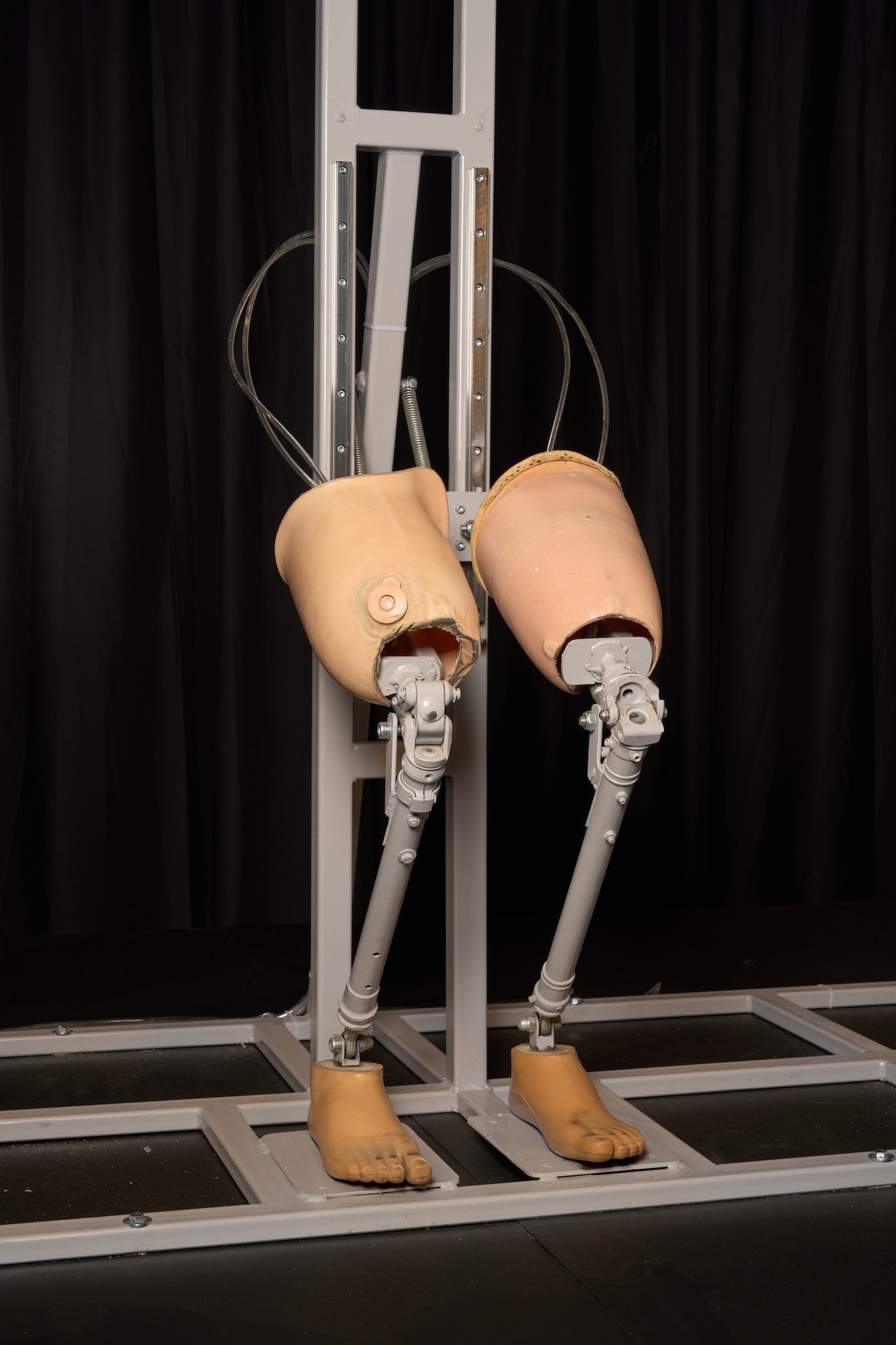
Kadan purposefully worked with the cheapest available prosthetics to highlight the lack of facilities and rehabilitation provided to veterans of the war (image: Dmytro Prutkin and RIBBON International).
Despite the war, Kadan explains, daily life in many Ukrainian cities continues alongside its ongoing violence. “Even if cities are bombed, but there are no Russian troops nearby, we consider it a rather peaceful city,” he says. “I’m in a peaceful city of Lviv, but sometimes there are drone attacks, missile attacks, but still the bars and restaurants and art galleries are open.” Within this reality, A New Integrity is interested in what happens to veterans once they return from the front lines and attempt to build lives again. “I was interested in how other people react to them, whether they feel respected or ignored, abandoned or neglected, which often happens,” Kadan says. “I also wanted to question whether the state they sacrificed their health for actually takes care of them or not.”
This sense of instability is reflected in another piece within the exhibition: a pair of prosthetic legs suspended in the air, moving in a slow running motion without ever reaching the ground. The piece was developed, Kadan says, in recollection of the Looney Tunes cartoons he watched during his childhood, where characters would continue running even after the ground beneath them had disappeared. It is an image that he explicitly compares to the present realities of Ukraine. “Maybe we are already running over the void, maybe we are really running over the cliff, but until we look down, we still can run or walk.” The suspended movement of the prosthetics reflects this uncertain state of continuation, where ordinary life persists despite the instability and trauma surrounding it.
Regardless of this wider social focus, Kadan explains that he still feels deeply connected to the realities of war in Ukraine. “As a man living in Ukraine, I do not know how long this war will last,” he continues. “I do not know what I will look like at the end of it, whether my body will remain complete, or whether my mental health will survive intact. Missile and drone attacks have happened on streets next to my studio. I do not know what will happen tomorrow, so I feel deeply connected to this reality.”
Words Smyra Arora