
Threading History
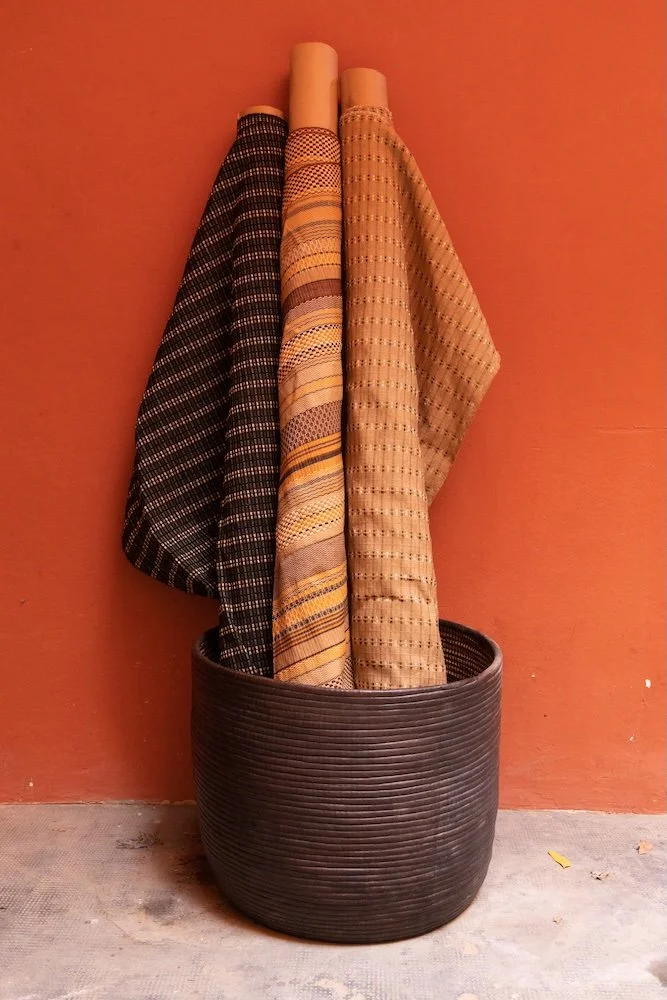
The textile work of Senegalese-French artist and designer, Aissa Dione (image: Djibril Drame).
When I first came to Dakar in November 2023, I reached out to textile designer Aissa Dione through a friend. As a ceramicist who loves crafts, art and the sea, I felt I needed to visit the city and learn about the craftspeople working there. In response, Dione welcomed me into her home. We talked about ceramics, art and history, all while having lunch in her garden: a little oasis planted with trees and vegetables in the middle of Senegal’s hectic, dusty capital city. Dione is tall and energetic; her gaze projecting a blend of joviality and experience. She carries herself like someone who has seen a lot.
This may be true. Dione is a designer who has dedicated decades to trying to preserve the heritage of Senegal’s traditional textiles, as well as working to reignite the country’s wider textile industry and repair the damage wreaked by the import of cheap fabrics and garments. Her products, which range from furniture to fashion, are aesthetically simple and thus, to me, highly elegant – a beautiful mix of tradition and contemporary design. “In Senegal we have many craftspeople so it is easy,” she tells me. “If you want to develop something, it is not as difficult as if you were in another country.”
So when I returned to Dakar in November 2024, as part of a five-month journey to participate in art residencies across Senegal and Nigeria, and gain a deeper understanding of these countries’ craft traditions, I resolved to visit one of her ateliers. During that visit, I bought a boubou robe from her collection. I remember how it felt as I first tried it on. The cotton was light and felt amazing on my skin. The quality of the textiles and the making was palpable. The design features blue, black, and green shades of fabric, all touched by a subtle pattern of horizontal lines which make the garment special while also remaining simple. I have not stopped wearing it since.
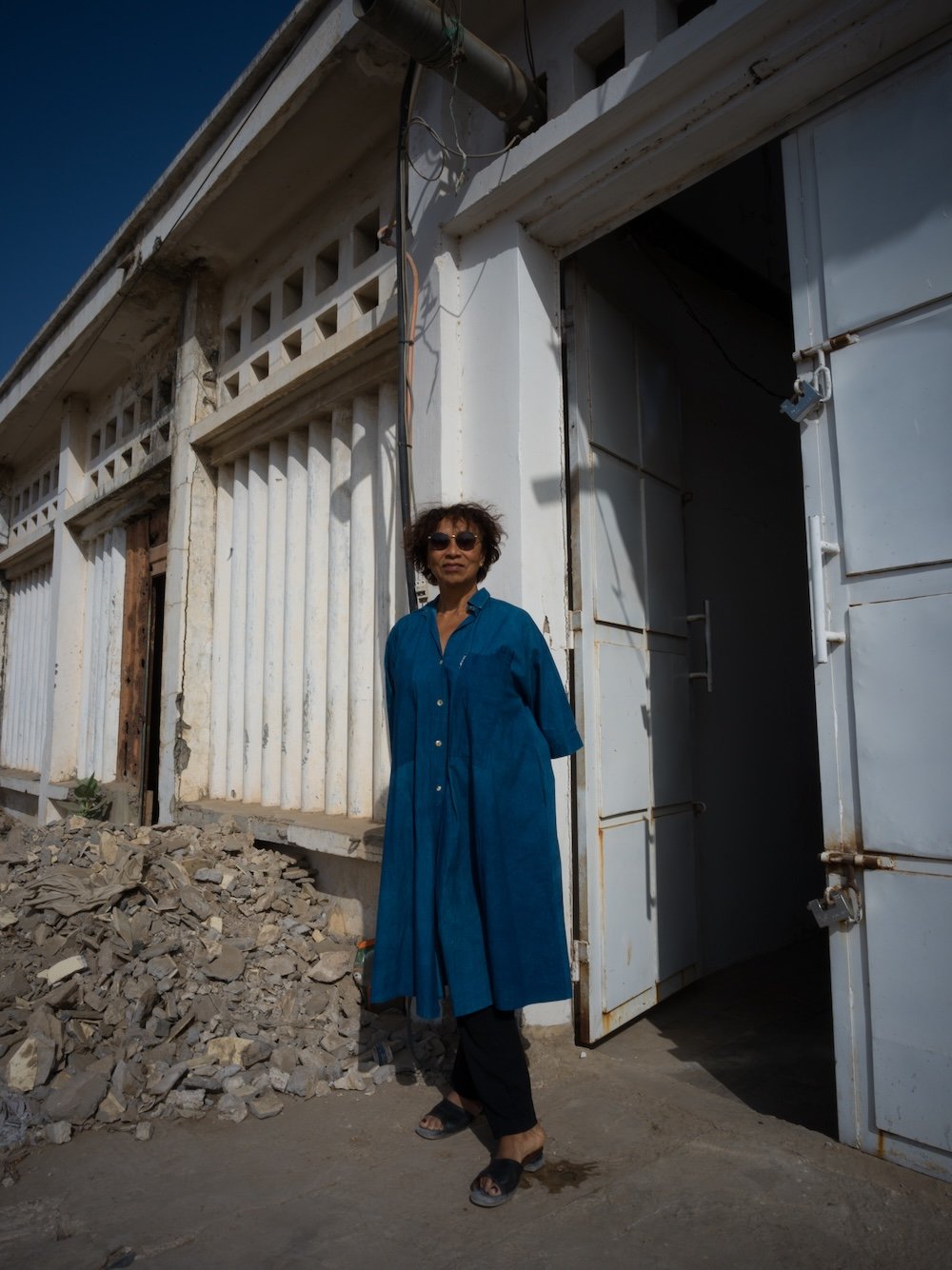
Aissa Dione outside her second space in Pikine (image: Djibril Drame).
When looking for a story about survival, Dione’s is one. She was born in France in the 1950s, but came to Senegal in the early 1970s in search of her father. Having trained in fine art, Dione initially worked in her new country as a painter, albeit one with a vision that would define her later career in textiles: a focus on local materials. “I was very angry at Europe for different reasons and even though I was a painter, I didn’t want to use painting [techniques] coming from Europe,” she tells me. As someone who has also grown up between heritages, I can understand her quest. As we try to make sense of ourselves, we search to feel like we fully belong; for home, whether it be a new one or an extended version of what we have lived so far.
Today, Dione seems to have found that home in textile design, but her path there has not been entirely straightforward. While establishing herself in Dakar, her resistance towards European art traditions saw her instead making works using batik, a traditional method of decorating fabric using hot wax and dye. She sold these works as paintings for about 10 years, visiting local companies to get new clients. During one of these visits, a company told her that it didn’t want art, but was looking to re-design all its offices. “I said OK… I can do it,” she tells me, while bursting out in laughter. Searching for local materials to use for the project, Dione turned to her grandmother, who managed weavers in Dakar for a living. These weavers made traditional Senegalese textiles, including Manjak cloth, which had originally arrived in the country with the Manjak people from Guinea-Bissau, who brought along an intricate weaving process that dates back to the 15th century. Manjak cloth features patterns woven with short lines of thread, which are repeated throughout the piece. These patterns can range from simple straight lines travelling across the fabric, through to mesmerising geometrical compositions that look like hidden messages in an ancient script.
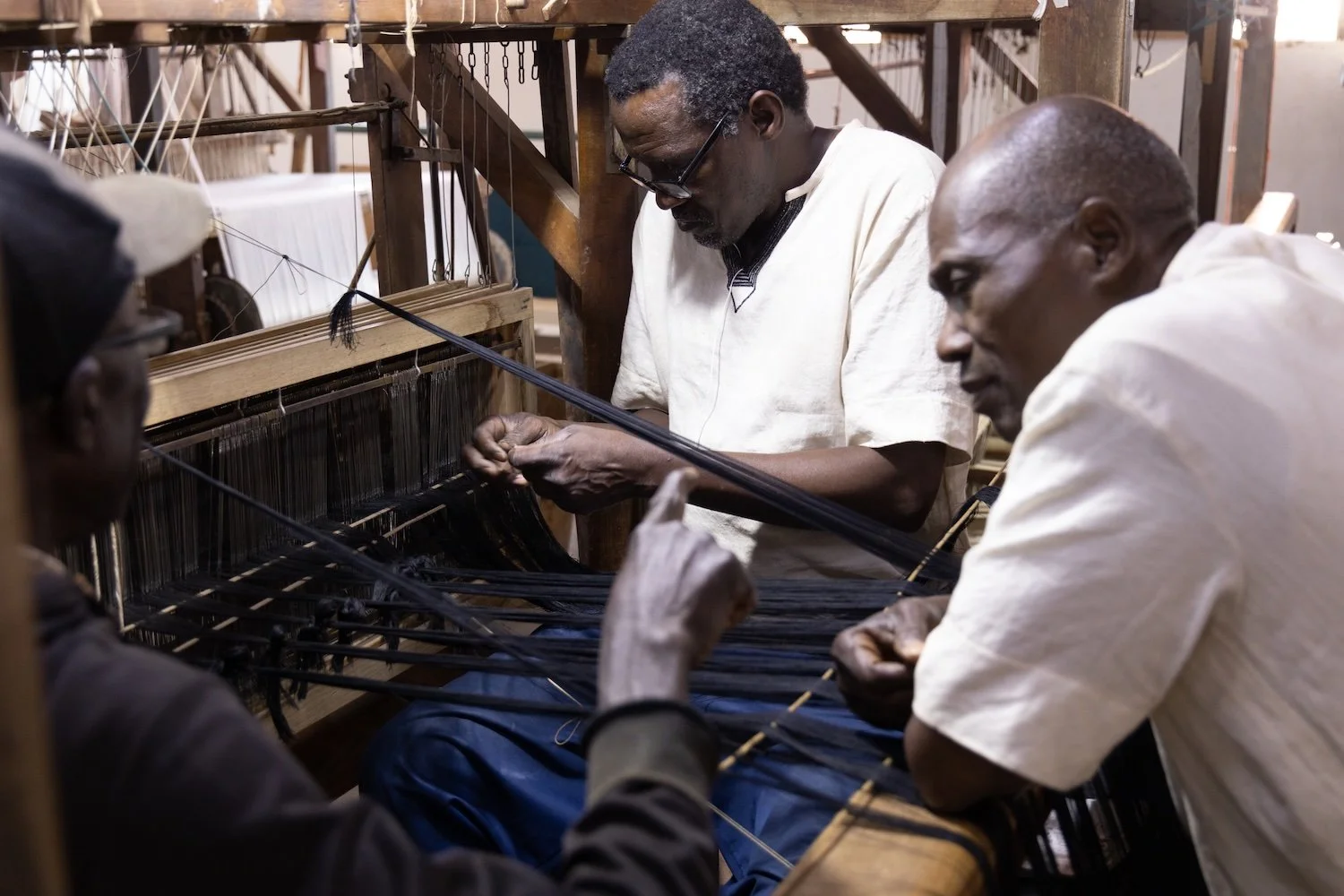
Two people need to work together to hand-weave the threads on Dione’s looms (image: Djibril Drame).
The traditional hand looms used by the weavers of Dione’s grandmother, however, were only between 15 and 20cm wide. In order to make the lampshades, sofa upholstery and wall coverings required for the project, Dione needed to widen them – something she had promised in her design proposal before knowing whether it was technically possible. The first weavers she approached refused to change the size of their looms, and only her grandmother’s colleague François Nango would accept the challenge, widening his looms to 90cm. Nango soon recruited his brother and cousin to work on the project with him, and so Dione’s company was born – with weavers who are still working with her today.
That business is now based in an atelier in the HLM area of Dakar. Once my eyes adjusted to the view in the space – a room full of looms with very defined paths to move around – and my ears got used to the deafening, yet fantastic, sound of the looms in action, the first thing I noticed were weavers working in pairs. Even though Dione’s looms are larger than conventional Senegalese looms, they are still operated in the traditional way, with two people working together to hand-weave the threads. What’s more, all of the workers are men, whereas the office is run by women. This is a central element of the craft’s survival at the hands of Dione: she has established her business in harmony with traditional West African structures of weaving. Men make and women manage them – just like how her grandmother managed weavers in her workshops.[1]
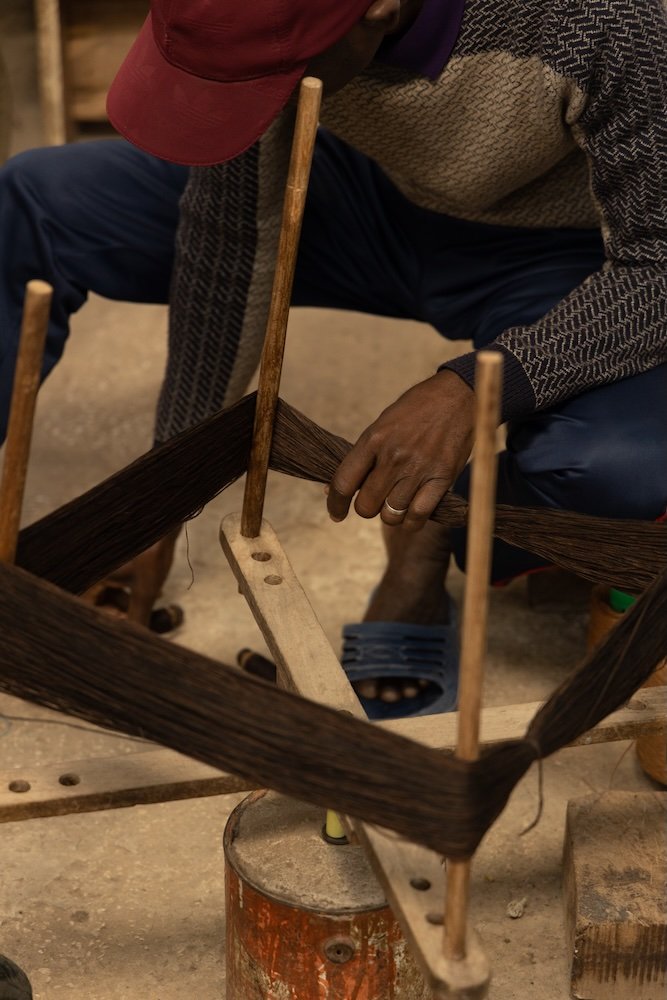
Image: Djibril Drame.
Thanks in part to the fact that Dione is following local customs in her production, the sons of the weavers she has been working with for decades are now learning and joining the business. Similarly, two of Dione’s daughters have become involved in the management side of her business. So when I ask her about the future of weaving in Dakar, there is no fear or doubt in her mind. It will continue. “It is also a question of salaries,” she tells me. “If people have a good salary, the work is not too complicated and the atmosphere is OK, people will want to stay.” Dione employs all her weavers full-time, offering a level of job security that is rare for craftspeople who typically work to commission. It is part of her strategy to keep the industry going – after all, who would want to work on something that is not stable? As the craftsmen make the textiles, she makes sure the works are sold and the orders keep coming in, and so everyone remains in business.
Dione seems to have found a balance between tradition and modernity, which applies not only to her business mindset, but also her designs. Originally, she says that she was mainly inspired by Japanese textile aesthetics, which brought a more sombre and quiet energy to her works; the textiles that Dione created for luxury French fashion brand Hermès in 1997, for example, feature dark blue, grey and camel colours overlaid with white threads to create geometric patterns. This source of inspiration eventually led to Dione’s ongoing collaboration with Okujun, a fabric supplier based in Japan. Since 2019, Dione has created three collections of silk fabrics created using hand-woven techniques in both Japan and Senegal, combining the expertise and aesthetic traditions of both countries. Over time, however, Dione’s palate and aesthetic have broadened and become bolder – her 2020 collection, for example, includes opulent dark red and gold fabrics, in addition to earth-toned ones. “I have thousands of references that we haven’t exploited yet, and every day we are forced to use new ones,” Dione says, explaining that some of her designs have been inspired by external commissions. This is a consistent thread in Dione’s story: rooted in traditional techniques, but still looking for new ways to make textiles for today.
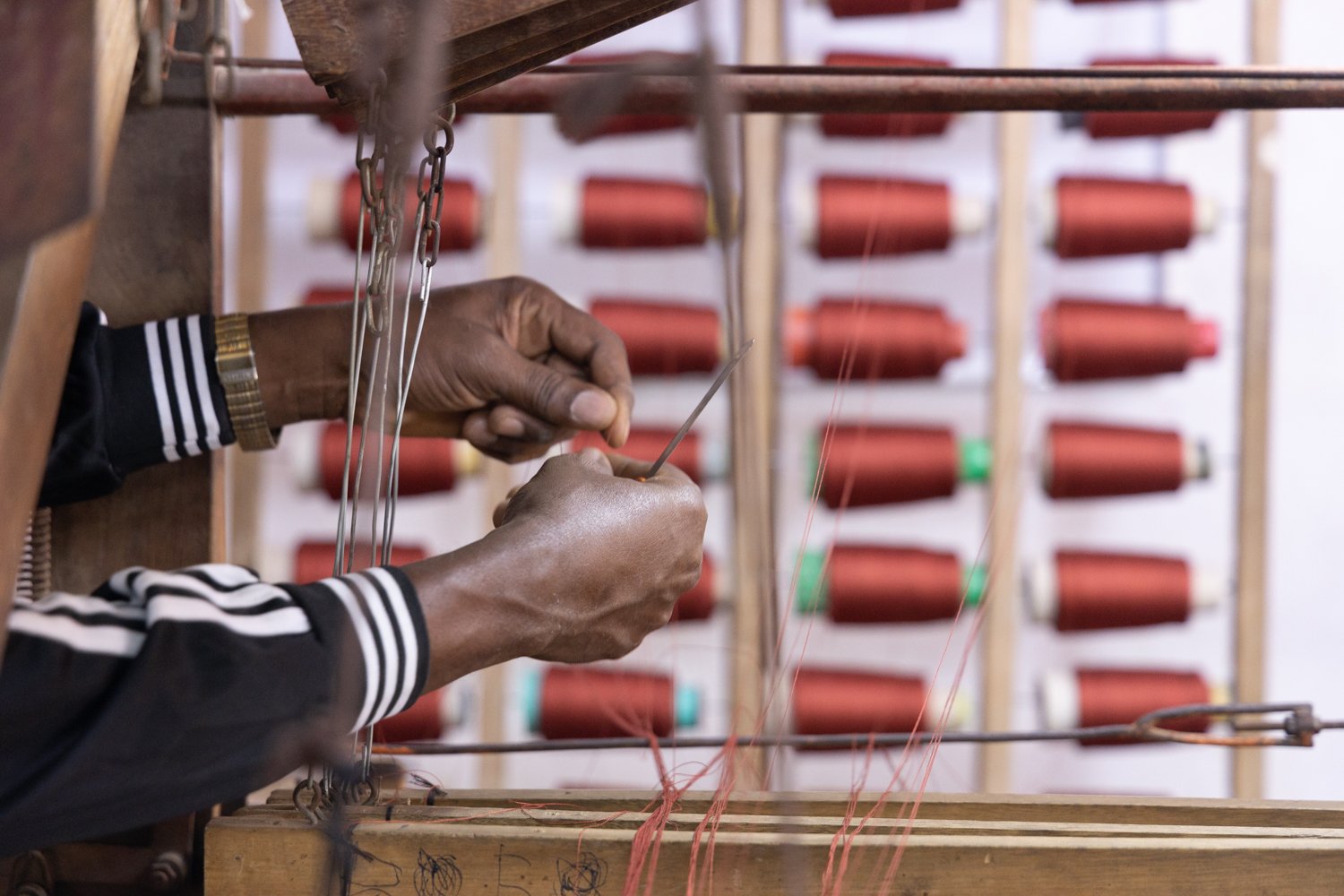
Image: Djibril Drame.
In working within Senegalese textiles, Dione has faced numerous challenges, not least the fact that their history goes hand in hand with the history of cotton. When Dione first started her business in 1992, there was a spinning industry in Senegal which provided easy access to cotton thread. “We used to get up, go next door and buy thread from Senegal, because we had the industries,” she tells me. “Same for all countries in West Africa.”
Senegal’s spinning industry had been built by the French while the country was under colonial rule, with textile manufacturers such as La Cotonnière du Cap-Vert (CCV) established in 1951. “Then the French decided to move on from spinning and sold it to the Lebanese,” Dione summarises. This situation was compounded by an influx of Chinese goods in the early 1990s. Manufacturers struggled to compete with the new flurry of imports, and soon stopped spinning their own thread in favour of importing it from China instead. “The threads began breaking very badly in the looms,” Dione tells me, “which is how we discovered [our supplier] had changed to Chinese threads.”
After Senegal’s spinning industry entered its decline, many of its factories closed and their machines were broken down and sold for parts, Dione tells me. The more I learn about the perils of the textile industry, the more I realise that it represents the perfect channel for understanding how the world works: geopolitics, global markets and capital, and the ongoing impact of all of these on the African continent. The drama of Senegal’s cotton industry is the drama of a globalised world. “You can’t imagine the cotton situation,” she tells me. “This was awful because my business had started to go and I had nearly 120 people. It was between 2000 and 2010. It was annus horribilis,” she adds, able to laugh about it now. As Senegal’s textile industry collapsed, Dione went in search of thread that would match the quality her work requires, looking at suppliers from Turkey to Egypt. In 2010, she found a small enterprise in Egypt, El Shehab Merdye, which now supplies threads to Dione and even dyes them in bespoke colours.
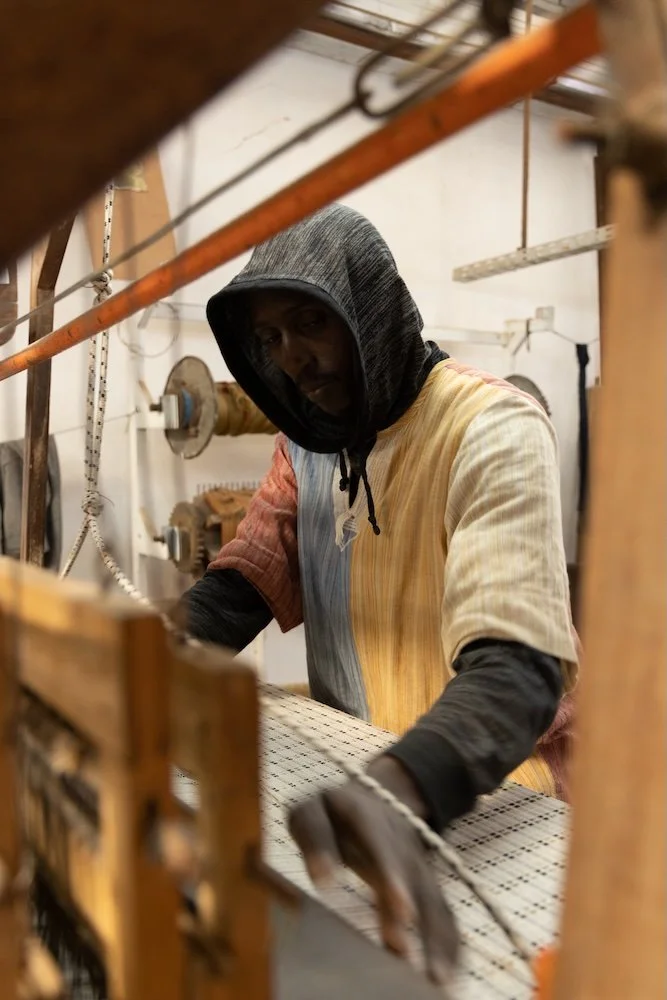
Image: Djibril Drame.
This collapse had another corollary, however: from the early 2000s, Dione started to purchase mechanical looms from the 70s and 80s, sourced chiefly from within Senegal, where the textile industry was dwindling, and from Lyon, France, where factories were switching to modern digital looms. “We are using knowledge generated from craft together with the same thread, the same colours, the same aesthetic, but with a slow industry,” she tells me. It is something I come to understand as I wear my boubou – it feels handmade and looks hand-woven, yet was produced on one of these mechanical looms, with the speed at which these operate (compared to the more languorous pace of hand-weaving) allowing for the price to drop. It is, Dione hopes, a game-changer, as “we could open a new production and make our aesthetic affordable to more people.” In this respect, the mechanical looms Dione has salvaged are enabling a homecoming for locally-produced textiles. Despite the fact that Senegal is a cotton producer, creating some 24,000 bales between 2023 and 2024, the country still imports most of its textiles. “Everyone wears polyester,” Dione tells me. “In hospitals, they have nylon sheets, when Senegal is producing cotton[…] and sheets are the easiest product one can do. Can you imagine?”
In order to bring cotton into everyday garments, Dione recently launched a new fashion line made using the old mechanical looms – the collection from which my boubou is drawn. “Thirty years ago, people here didn’t trust the making of Senegal,” she tells me. It is a trend that can be seen elsewhere too – as foreign goods arrive into a country, we embrace the new and disregard what has been traditionally and locally made. For a long time, Dione tells me, foreign clients were the only ones who were interested in her work and who could afford to buy it – given that Dione employs her workers full-time, her production costs have always been relatively high, something which has been compounded by factors such as governmental taxes for internal commerce. “In order to develop, I had to look for markets outside [the country],” she says, a quest which has led to collaborations with European fashion brands such as Christian Lacroix and Fendi. “Now [Senegalese culture] is really changing,” she says. “People are looking for makers who can offer good quality, aesthetic products that are interesting for their homes.” With her market and brand established, and the potential of the mechanical looms to help lower costs, Dione can now “go back and offer [to] the local market.”
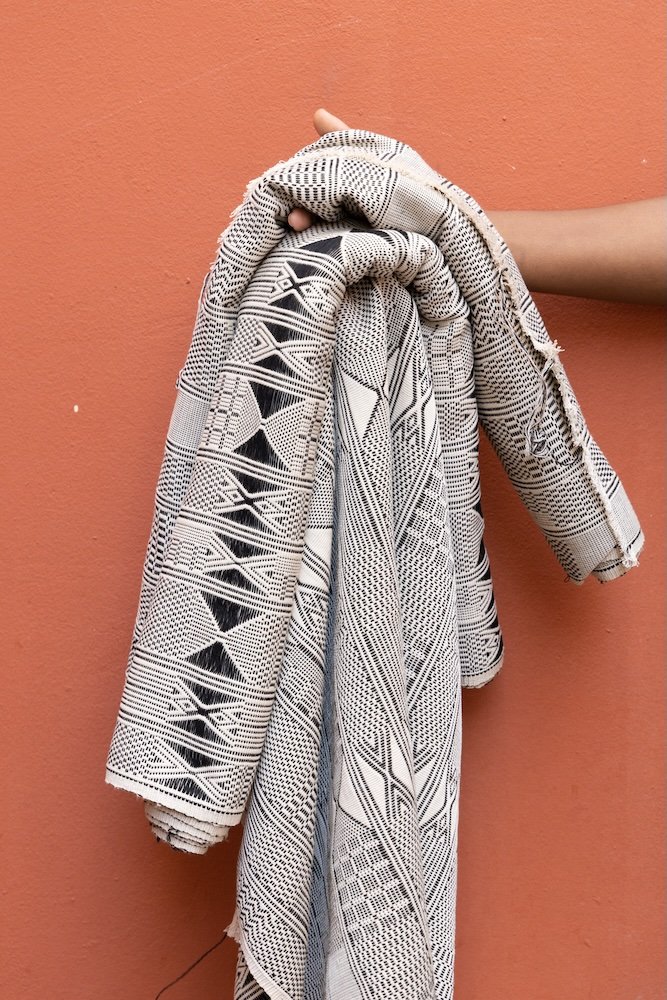
Image: Djibril Drame.
When I thought I had seen everything during my visits to her atelier in HLM, Dione suggests a trip to Pikine, a city to the east of Dakar. Here, Dione has taken over a section of what was once the largest textile factory in Senegal, which has now housed her mechanical looms and carpentry and upholstery workshops since the beginning of 2024. As I come in, my heart stops. The smell of wood – Senegalese, of course – the tools, the mix of materials and crafts and the deafening sound of the looms working – all touched by the beautiful light coming in through the ceiling windows. Dione’s spaces are part industry, part museum, which makes them all the more special. One of the new looms in Pikine is from a factory in Lyon, dating from the 1950s. The loom is currently non-functional, but Dione is now working with local engineers and mechanics to restore it to use. She tells me that levels of manufacturing skill are high in Senegal and, in order to avoid having to import spare parts for these ancient looms, local makers can make replicas instead. In so doing, more local mouths are fed, and more local workers remain in business.
Dione’s craft is not only impacted by global markets, however, but also by the remnants of Senegal’s colonial ties with France. The new Senegalese government, which was elected in spring 2024 under President Bassirou Diomaye Faye and Prime Minister Ousmane Sonko of the Patriots of Senegal for Work, Ethics and Fraternity (PASTEF) party, seems to be working to change this post-colonial relationship, however, and in December 2024, the Minister of Industry and Trade announced that the country plans to ban both the import of secondhand clothing – which amounts to 18,500 tonnes each year in Senegal – and the export of raw textile materials in order to protect and revitalise its domestic textile industry. “They are re-joining our philosophy,” Dione says.
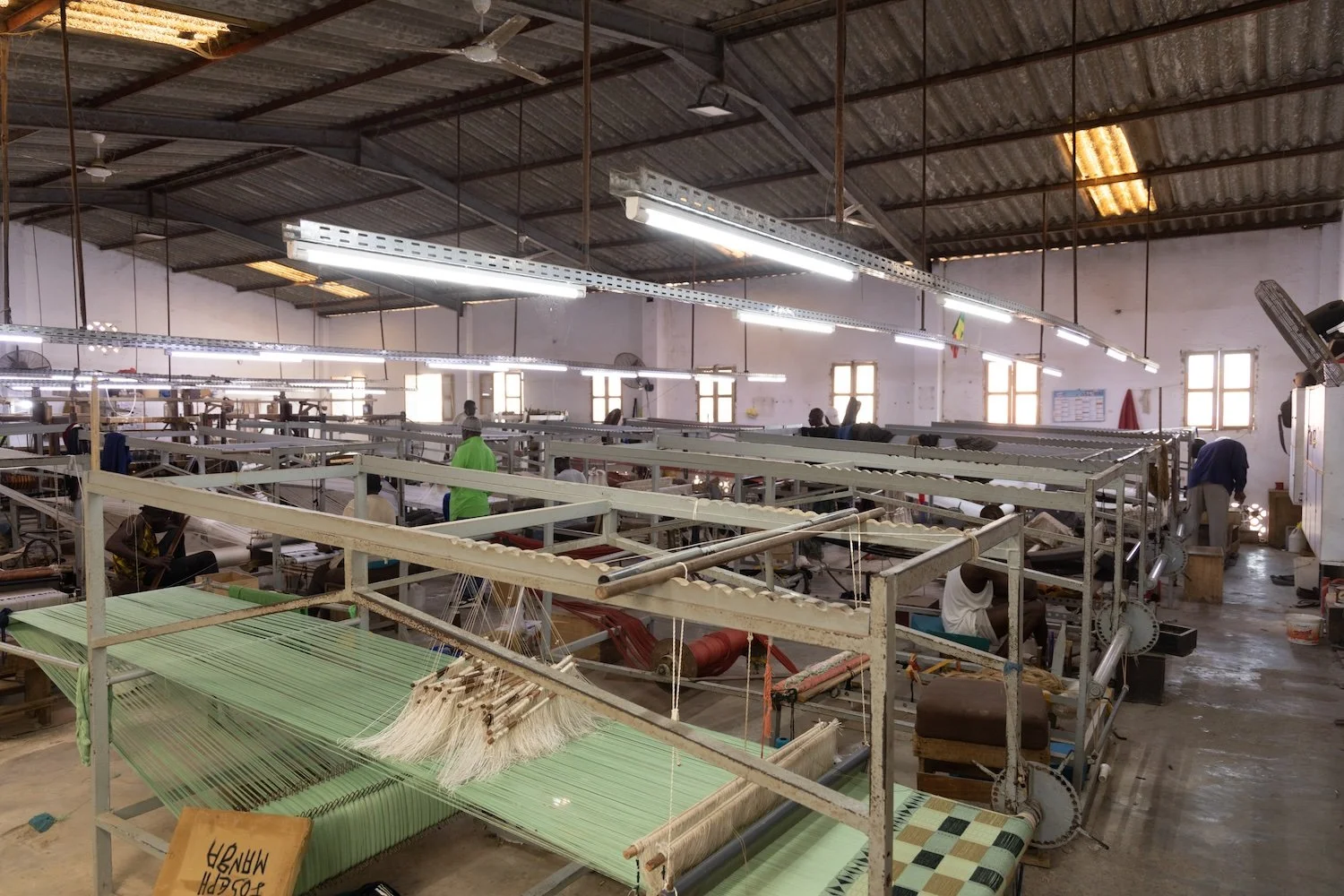
Looms in Dione’s HLM atelier (image: Djibril Drame).
The Pikine space is a huge factory, yet seemingly not big enough for Dione’s ambitions. She already needs additional space and has now embarked on another quest that she hopes can further contribute to reigniting the country’s textiles history. She is currently looking into partnering with the partly government-owned Senegalese company Domitexka. Founded in 2010, Domitexka specialises in textile production for export and, in 2018, took over a disused factory in Kahone, a town southeast of Dakar, where hundreds of looms were left behind as part of its closure. The proposed deal will be an exchange, a collaboration between industry and design: Domitexka wants Dione’s aesthetic; she wants its looms. And so the future is created and everyone can survive.
Dione’s decades of experience have given her a solid understanding of what it means to preserve a craft. “The most important thing is to not lose the technique,” she explains to me, “so the only way for any craft to be preserved is to modernise the aesthetic.” When I see how her sofas, cushions, throws, boubous and shoes marry contemporary design with traditional textiles, her vision becomes tangible. True to the essence of traditional Manjak cloth, the patterns in her collections range from simple lines to complex designs, such as a pattern which resembles a hair comb that Dione uses as her company’s logo. Yet by widening the traditional looms and experimenting with different colour palettes, she has managed to open a new world of possibilities for traditional Senegalese textiles. “In order to keep people employed, new markets need to be found and that comes through design,” Dione says. “Whether for craft or for industry, in Africa, in our context, to design is the only way.”
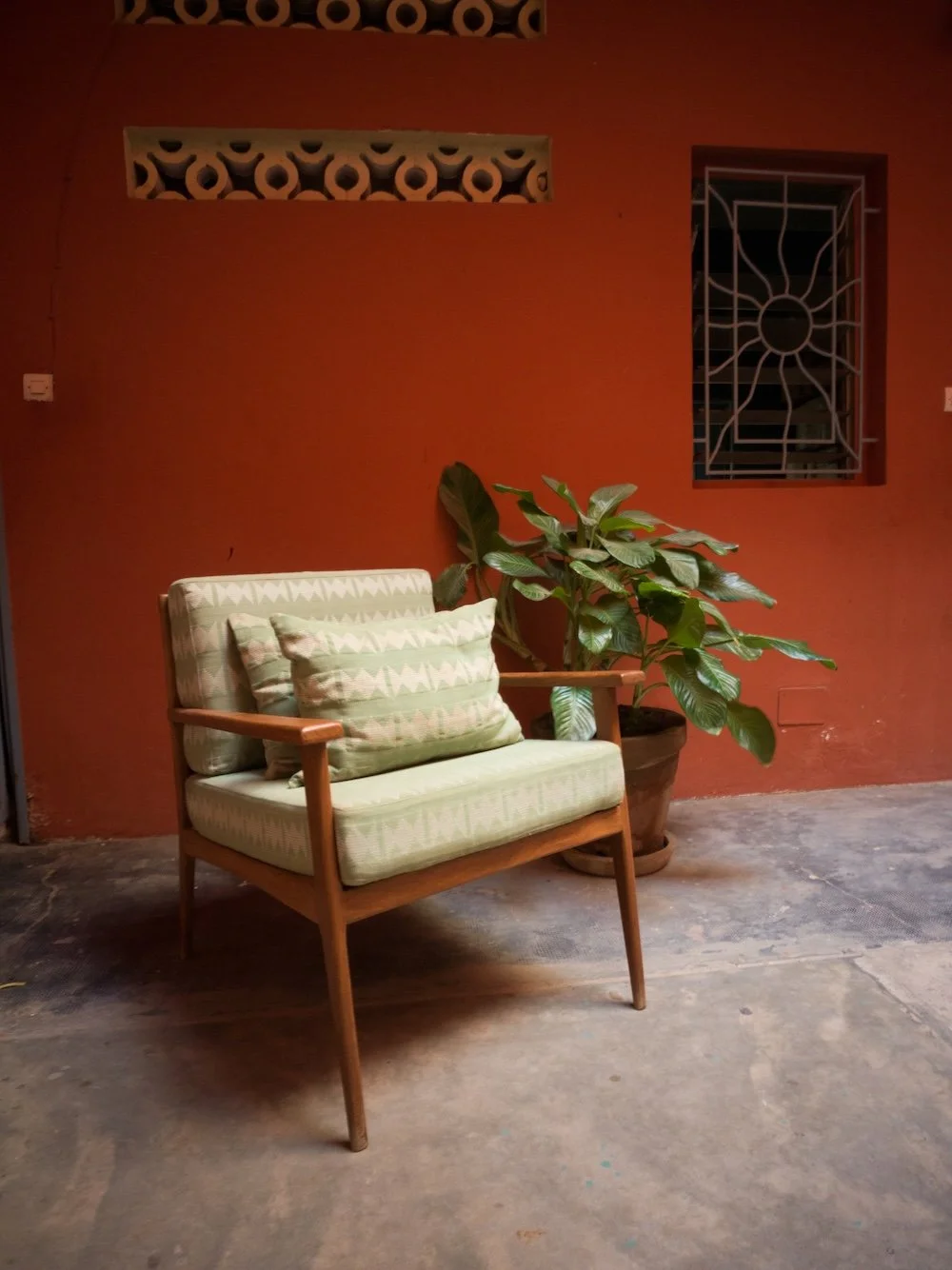
Furniture made in Aissa Dione’s workshop that is upholstered with her fabrics (image: Djibril Drame).
Before we end our time in Pikine, I ask Dione to summarise her experience. “The overall concept is political,” she replies. “Making on the spot, in Senegal, in Africa, developing know-how and being independent. That’s it. When you make your own goods that you consume, that you use everyday yourself and you don’t have to import, that is a political move.” I leave the factory elated. As a maker, it is inspiring and reassuring to see that it can be done: that we can work against the often overwhelming global currents. Dione’s story has all the ingredients for success: passion, vision, an in-depth understanding of her craft’s history and local traditions, and a relentless drive to continue threading new stories of survival.
[1] As I keep discovering during my travels in West Africa, many of the craft environments that are thriving today seem to be those which have maintained the traditional gender roles ascribed to them, from all-female pottery communities in Nigeria, to all-male weaving teams in Senegal. These divisions perhaps derive from the fact that pottery is easier to make at home alongside child-rearing and housework, while weaving requires more space. Witnessing these different communities has challenged my own views – coming from a Western upbringing, it is difficult to see women discouraged from participating in weaving and not interpret it as misogyny. However, I have loved visiting all-female pottery communities and witnessed first-hand how spaces reserved for particular communities can bring many benefits.
Words Bisila Noha
Images Djibril Drame